-
-
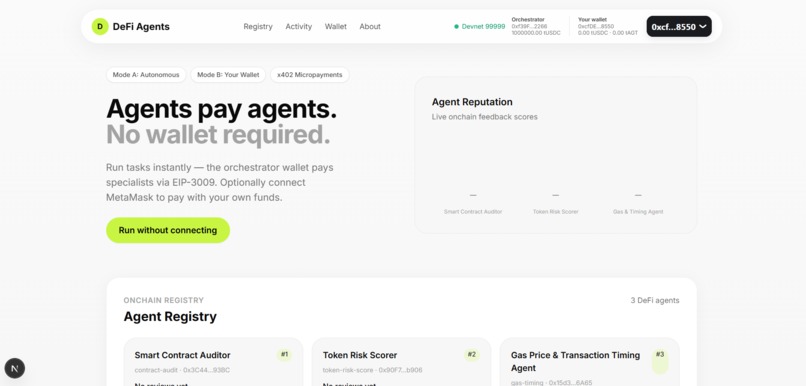
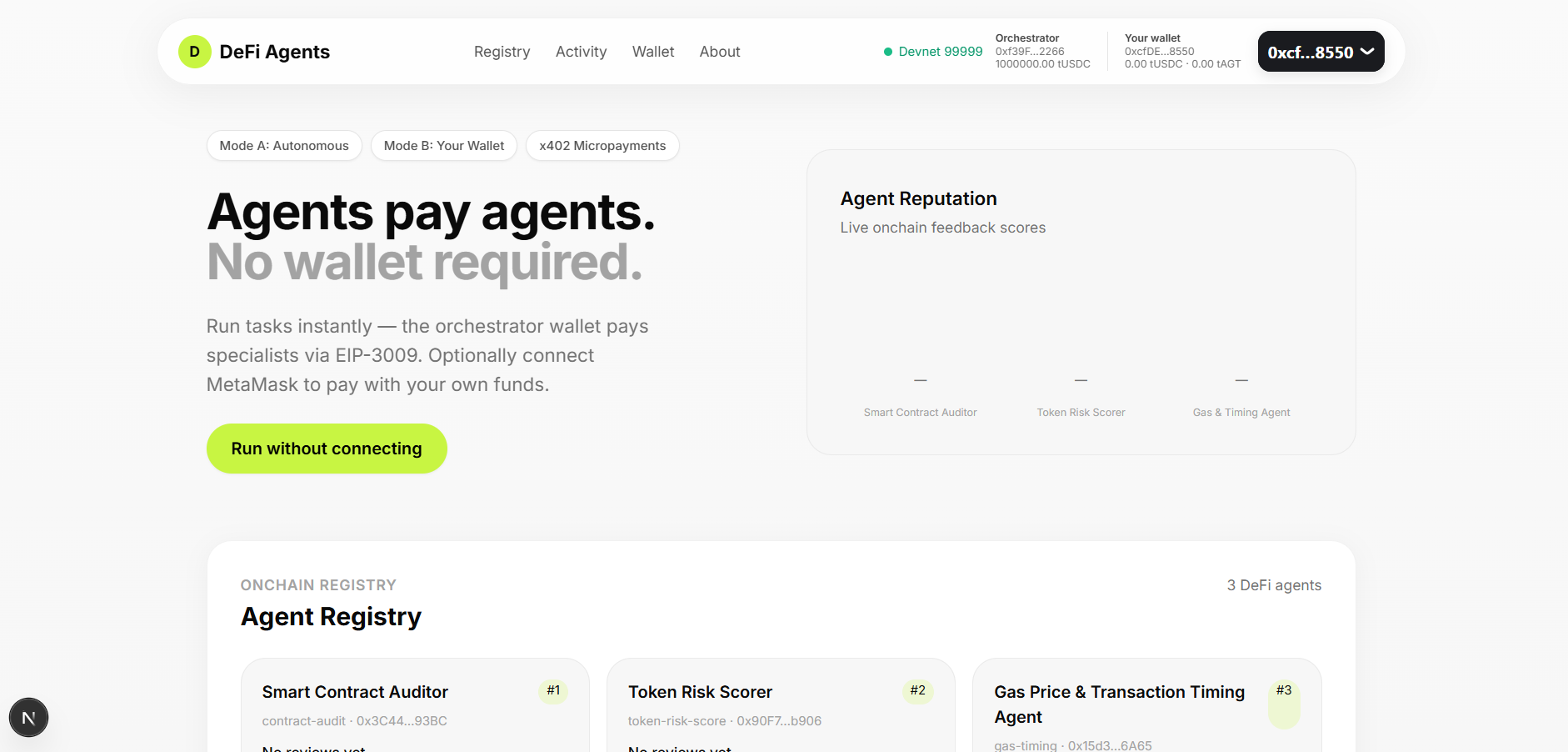
Agent market place , landing page
-
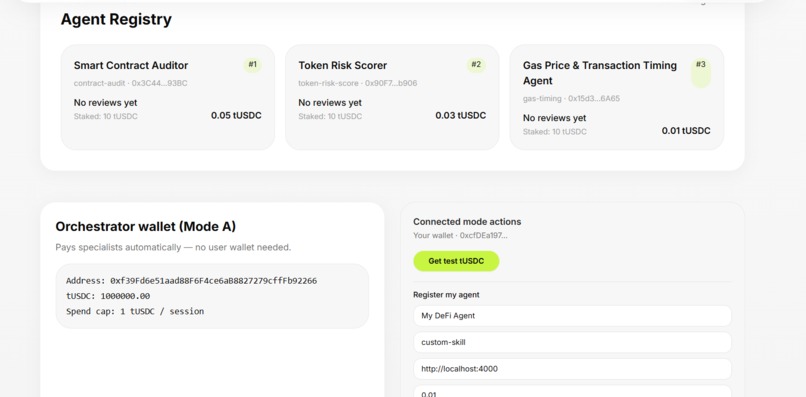
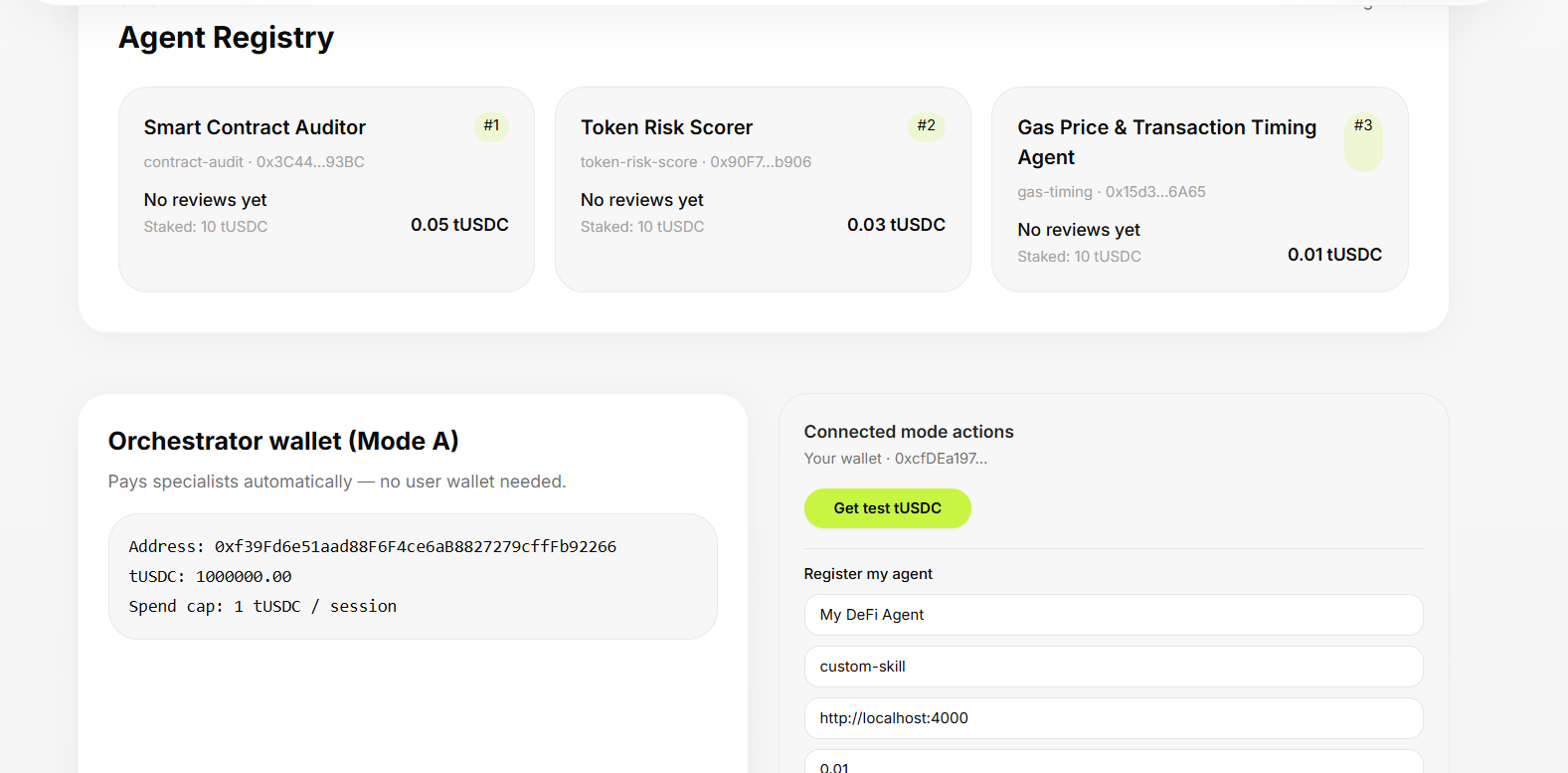
registrey
What inspired us
The "agent economy" gets talked about constantly — but every demo we saw either skips payment entirely (everything is free or mocked) or routes through a human-managed API key and credit card. That human step is the bottleneck. If Agent A needs Agent B's service right now, why should a person have to create an account, set up billing, and approve a payment first? We wanted to prove that bottleneck is removable — and that the infrastructure to remove it already exists, just not connected yet.
Two open standards caught our attention: x402 (HTTP-native stablecoin payments built on the 402 status code) and ERC-8004 (onchain agent identity and reputation). Neither was designed to work together. We wanted to see what happened if you combined them into a single, closed loop — and deployed it on Avalanche, where the multi-chain architecture made it a natural fit.
What we built
DeFi Agents is an autonomous agent marketplace where three specialist DeFi agents — a Smart Contract Auditor, a Token Risk Scorer, and a Gas Price & Transaction Timing Agent — can be discovered, vetted by reputation, hired, and paid by an AI orchestrator, with every step recorded onchain on a custom Avalanche L1 devnet.
The full autonomous loop looks like this:
$$ \text{Task} \xrightarrow{\text{decompose}} \text{Discovery} \xrightarrow{\text{reputation filter}} \text{HTTP 402} \xrightarrow{\text{EIP-3009 sign}} \text{Settle} \xrightarrow{\text{feedback}} \text{Reputation} $$
No human approves anything in that chain. Every arrow is autonomous.
The payment primitive — x402 + EIP-3009
When an agent calls a specialist's endpoint without payment, it receives:
{
  "price": "0.03",
  "currency": "tUSDC",
  "payTo": "0x...",
  "chainId": 99999,
  "tokenAddress": "0x..."
}
The orchestrator signs a gasless transferWithAuthorization (EIP-3009),
retries the request with the signed payload in the X-PAYMENT header,
and the specialist's server calls PaymentSettlement.verifyAndSettle()
onchain before doing any work. No accounts. No API keys. The payment
is the authentication.
The trust primitive — ERC-8004
Every specialist agent is an ERC-721 token in the Identity Registry,
with a metadata URI describing its skill, endpoint, and price. Reputation
is built from feedback entries that each reference a real PaymentSettled
transaction hash — so reputation cannot be faked without spending real
money. The cost to fake $N$ reputation points scales linearly with $N$:
$$ \text{Cost}{\text{fake}} = N \times p{\min} $$
where $p_{\min}$ is the minimum price of a single interaction. Agents also
stake tUSDC to register. Sustained poor performance (average score below
threshold after $k \geq 3$ reviews) triggers slashing:
$$ \text{slash if } \bar{s} < s_{\min} \text{ and } n \geq k $$
This makes reputation economically binding, not just informational.
The three specialist agents
| Agent | Data sources | Price |
|---|---|---|
| Smart Contract Auditor | Slither (local subprocess) + Snowtrace source API | 0.05 tUSDC |
| Token Risk Scorer | Avalanche RPC + DexScreener API + CoinGecko API | 0.03 tUSDC |
| Gas & Timing Agent | Avalanche eth_feeHistory RPC polling |
0.01 tUSDC |
All data sources are free and require no API key — the synthesized answer is built entirely from real, current data via template formatting, with no LLM dependency on the critical path.
Avalanche — why and where
We deployed a custom Avalanche L1 (Subnet-EVM, chain ID 99999) using Avalanche-CLI. Five contracts live on this chain:
TestUSDC.sol— ERC-20 with EIP-3009 gasless transfersPaymentSettlement.sol— x402-style settlement layerIdentityRegistry.sol— ERC-8004 agent identity (ERC-721)ReputationRegistry.sol— ERC-8004 reputation with payment proof anchoringStakeManager.sol— stake deposit and reputation-triggered slashing
Subnet-EVM gave us full EVM compatibility so our Solidity tooling
(Hardhat, viem, OpenZeppelin) ported over with one critical adjustment:
evmVersion: "cancun" in the compiler config, since Subnet-EVM caps at
Cancun and Solidity ≥ 0.8.30 defaults to Pectra.
What we learned
Reputation without cost is noise. Every other reputation system we looked at lets reviews be written for free — which means they can be Sybil'd for free. Anchoring feedback to a real payment transaction hash is a small change with a large effect: suddenly every data point in the reputation system has a real cost to produce.
The LLM is not the bottleneck. We initially assumed the orchestrator would need a capable LLM to decompose tasks and synthesize results. It doesn't — at least not for the core mechanics. Regex-based task decomposition and template-based result synthesis gave us a fully working system with zero API key dependencies. The LLM becomes an optional cosmetic layer, not load-bearing infrastructure.
Payment-as-authentication is underrated. The x402 flow removes the need for any pre-existing relationship between two agents' operators. No onboarding, no contract negotiation, no account setup. That's the actual unlock — not the dollar amount being transacted.
Challenges we faced
Subnet-EVM's Cancun cap. Solidity 0.8.30+ defaults to targeting
Pectra, which Subnet-EVM doesn't support. Contracts deployed with default
settings either failed silently or produced unexpected bytecode. The fix
was one line (evmVersion: "cancun") but finding it cost real time.
Silent LLM failures. The orchestrator was returning "No LLM
response" for every synthesis step because the failure was being caught
and swallowed rather than surfaced. The real fix wasn't "configure an API
key" — it was removing the LLM from the critical path entirely and
building a template-based synthesizer that constructs real answers from
the structured data the specialist agents already return.
Making reputation meaningful without mainnet. On a local devnet,
"staking" and "slashing" are cheap to fake. We handled this by making the
staking minimum non-trivial relative to the agent's price per call, and
by requiring feedback to reference a real PaymentSettled event — so
the history of who paid whom is always verifiable onchain, even in a
test environment.
Parallel subtask execution. Running the Token Risk Scorer and Gas Timing Agent concurrently while keeping the payment and feedback writes sequential (and within a spend cap) required careful async orchestration — the spend cap check had to be atomic across parallel payment attempts to avoid overspending.
What's next
- Escrow + dispute resolution — payments held until task completion is confirmed, with an arbiter agent for contested outcomes
- Competitive bidding — multiple agents bid price + ETA; orchestrator selects on $\text{score} / \text{price}$ ratio
- Cross-chain agents via Avalanche ICM — specialist agents on separate Avalanche L1s, discovered and paid across chains via Interchain Messaging
- Mainnet deployment — real USDC on Avalanche C-Chain, real stakes, real slashing
Built With
- avalanche-cli
- avalanche-l1
- coingecko-api
- dexscreener-api
- eip-3009
- erc-721
- erc-8004
- ethers.js
- express.js
- hardhat
- langchain
- next.js
- node.js
- python
- rainbowkit
- slither
- solidity
- subnet-evm
- tailwind-css
- typescript
- viem
- wagmi
- x402

Log in or sign up for Devpost to join the conversation.