Inspiration
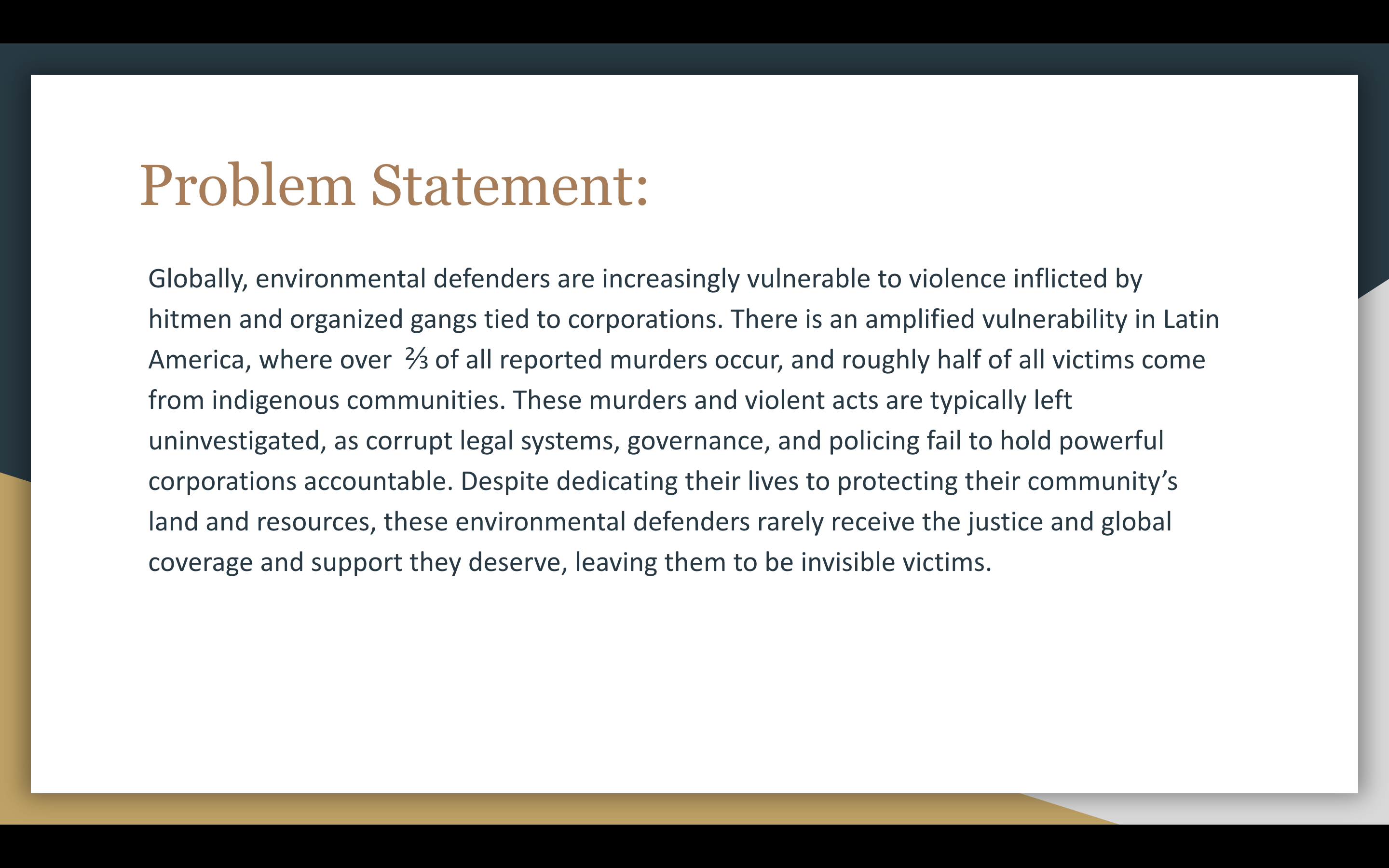
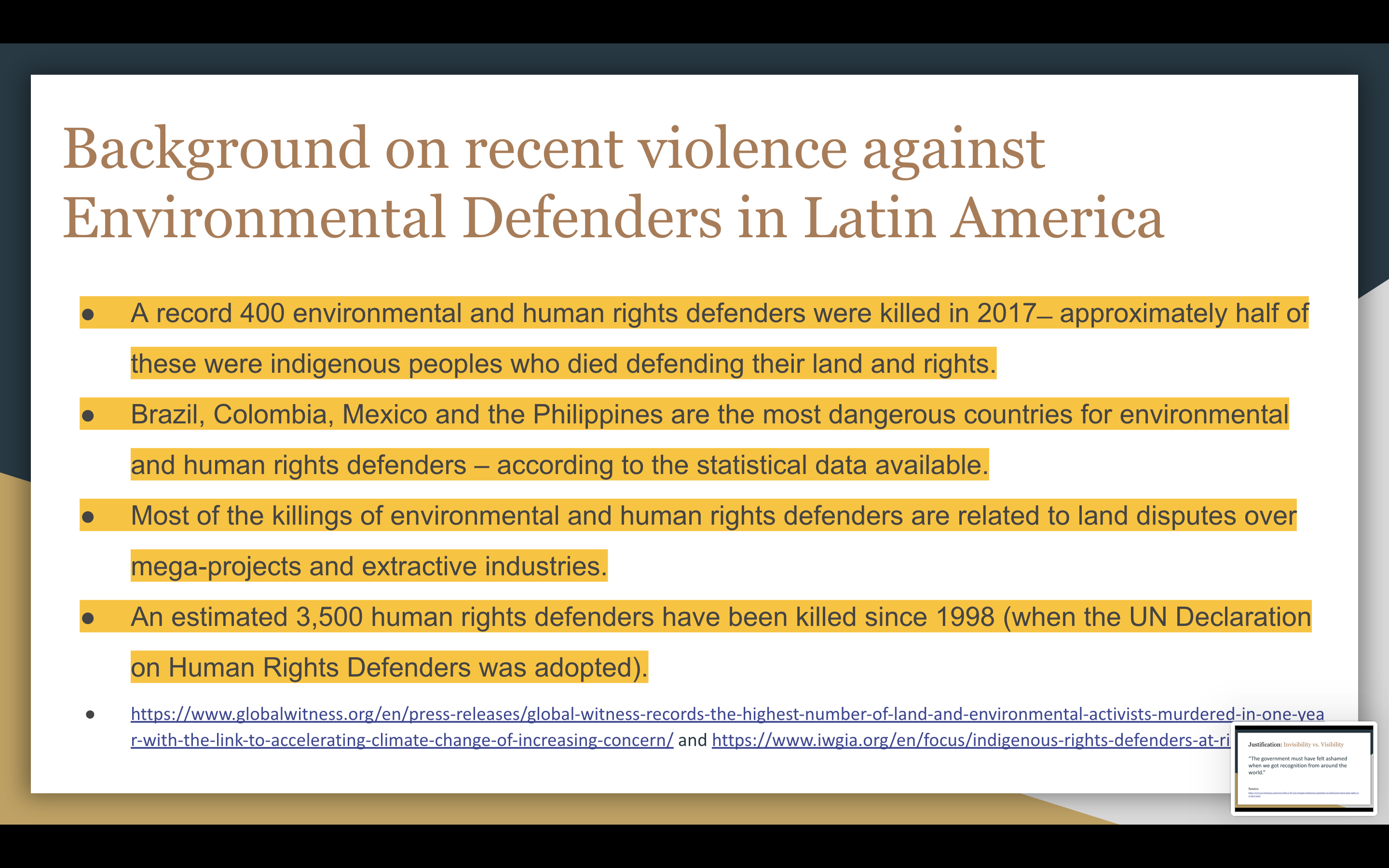
Globally, environmental defenders are increasingly vulnerable to violence inflicted by hitmen and organized gangs tied to corporations. There is an amplified vulnerability in Latin America, where over ⅔ of all reported murders occur, and roughly half of all victims come from Indigenous communities. These murders and violent acts are typically left uninvestigated, as corrupt legal systems, governance, and policing fail to hold powerful corporations accountable. Despite dedicating their lives to protecting their community’s land and resources, these environmental defenders rarely receive the justice and global coverage and support they deserve, leaving them to be invisible victims.
What it does
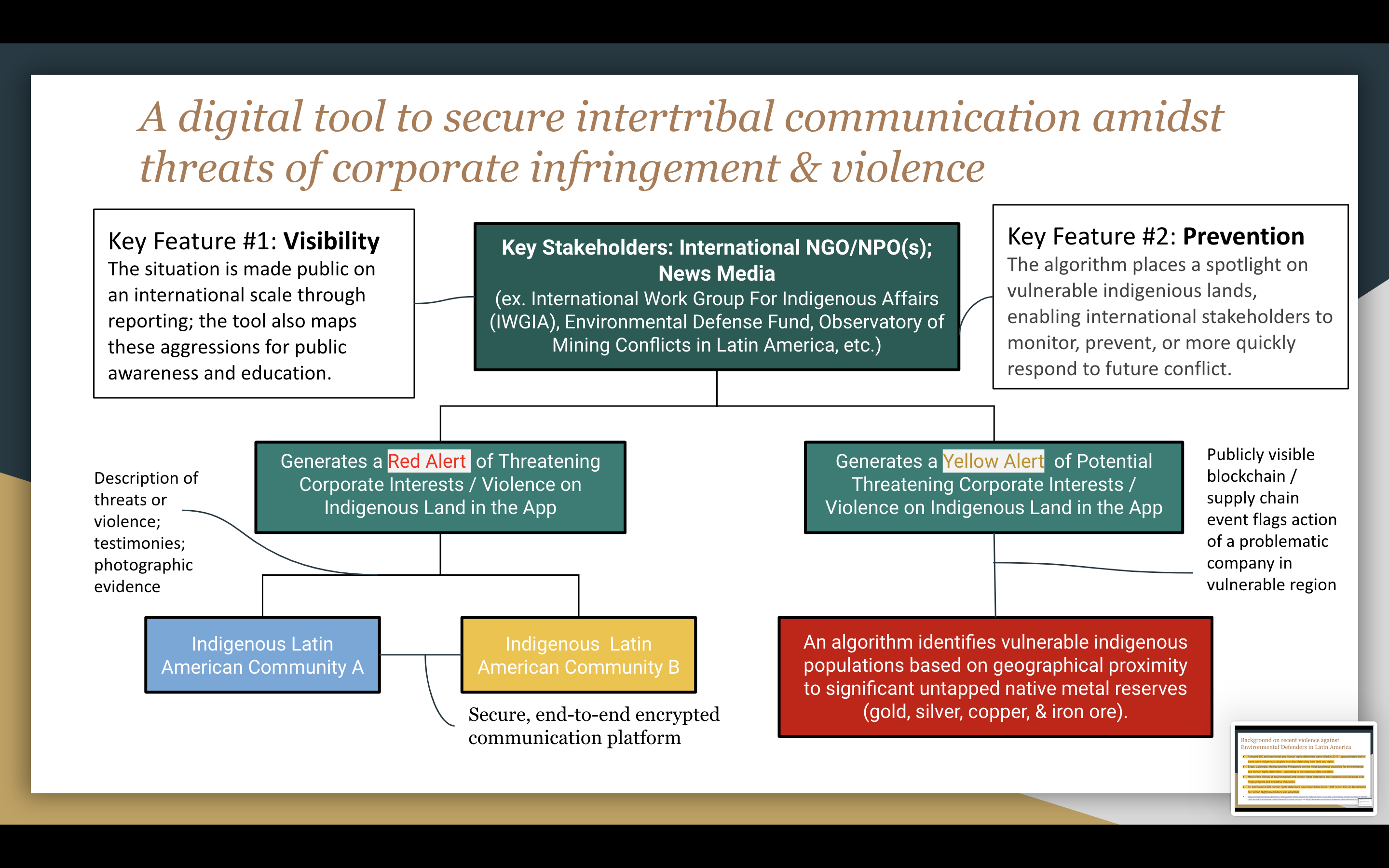
Many environmental defenders around the world use third-party messaging apps, which often market themselves as more secure than they actually are. (Robin is an environmental law student, and many activists she has worked with through the UN Environment Programme's Major Group of Children and Youth and other NGOs use WhatsApp extensively, for example.) Given data privacy concerns with WhatsApp, which forces users to share data with Facebook and potentially other third-parties, this potentially puts defenders at risk. Sharing photos without location metadata stripped out, for instance, can give poachers a map to valuable endangered species or extractive resources. Through the use of parallel private and public blockchains, our platform both enables secure communication between environmental defenders, and allows data to be shared - with defenders' consent - to track supply chains.
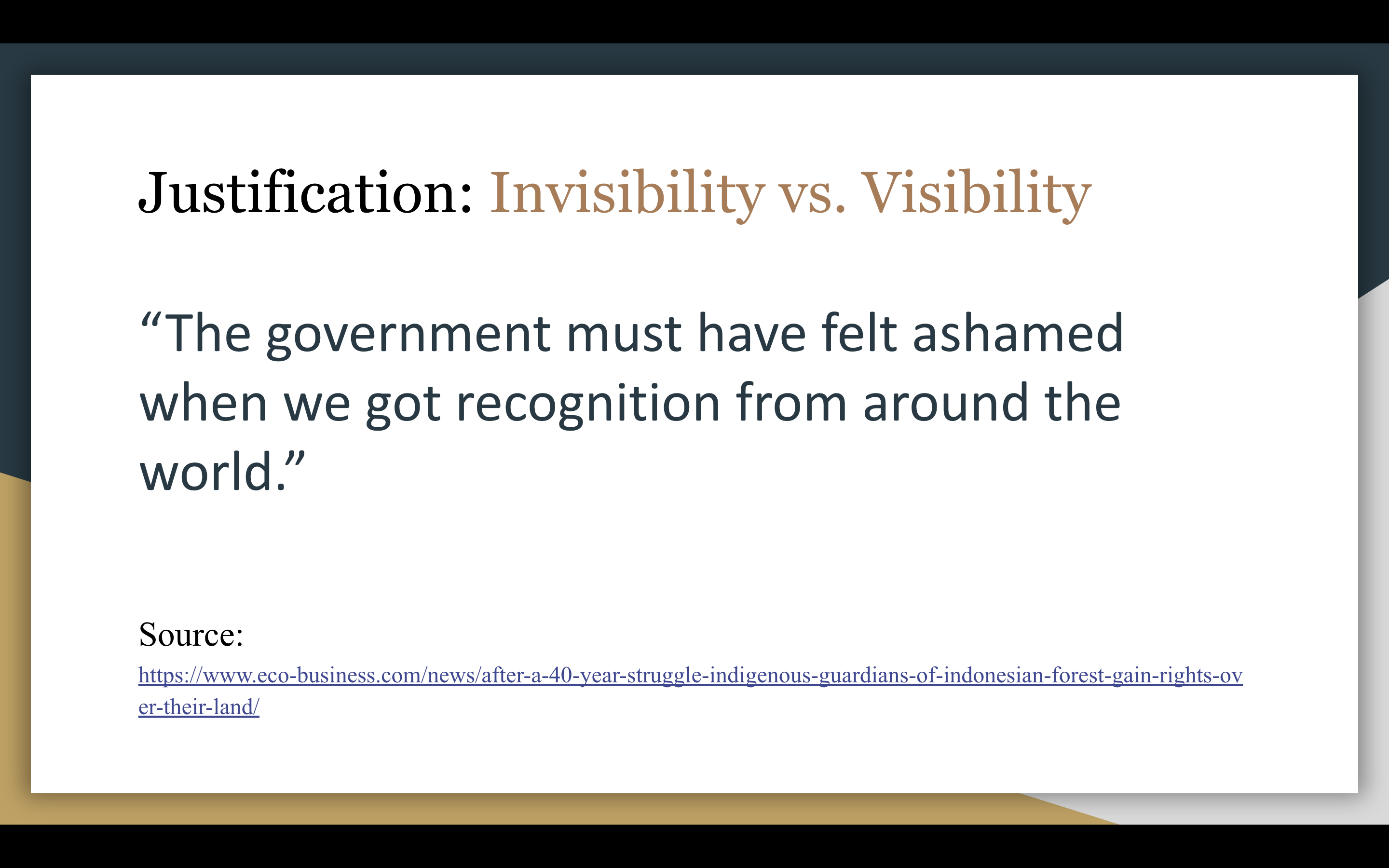
Our ultimate goal is to increase the reporting of crimes against Indigenous environmental defenders while keeping major corporations accountable for their violence. As seen in our research, especially with the data point of 1 in 28 murders being investigated in 2019 in Latin America, it is clear that Indigenous populations fighting for their land face discrimination coupled with an absence of legal protection. Right now, their stories are largely invisible to the public and world leaders. This solution would aim to make their stories more visible, while also tackling the barriers that language and reliable smartphone access present in the remote Amazon. Based on our research, this increased visibility would allow for third-party international stakeholders to place pressure on non-compliant local governments, most likely deterring future crimes and violent acts.
How we built it
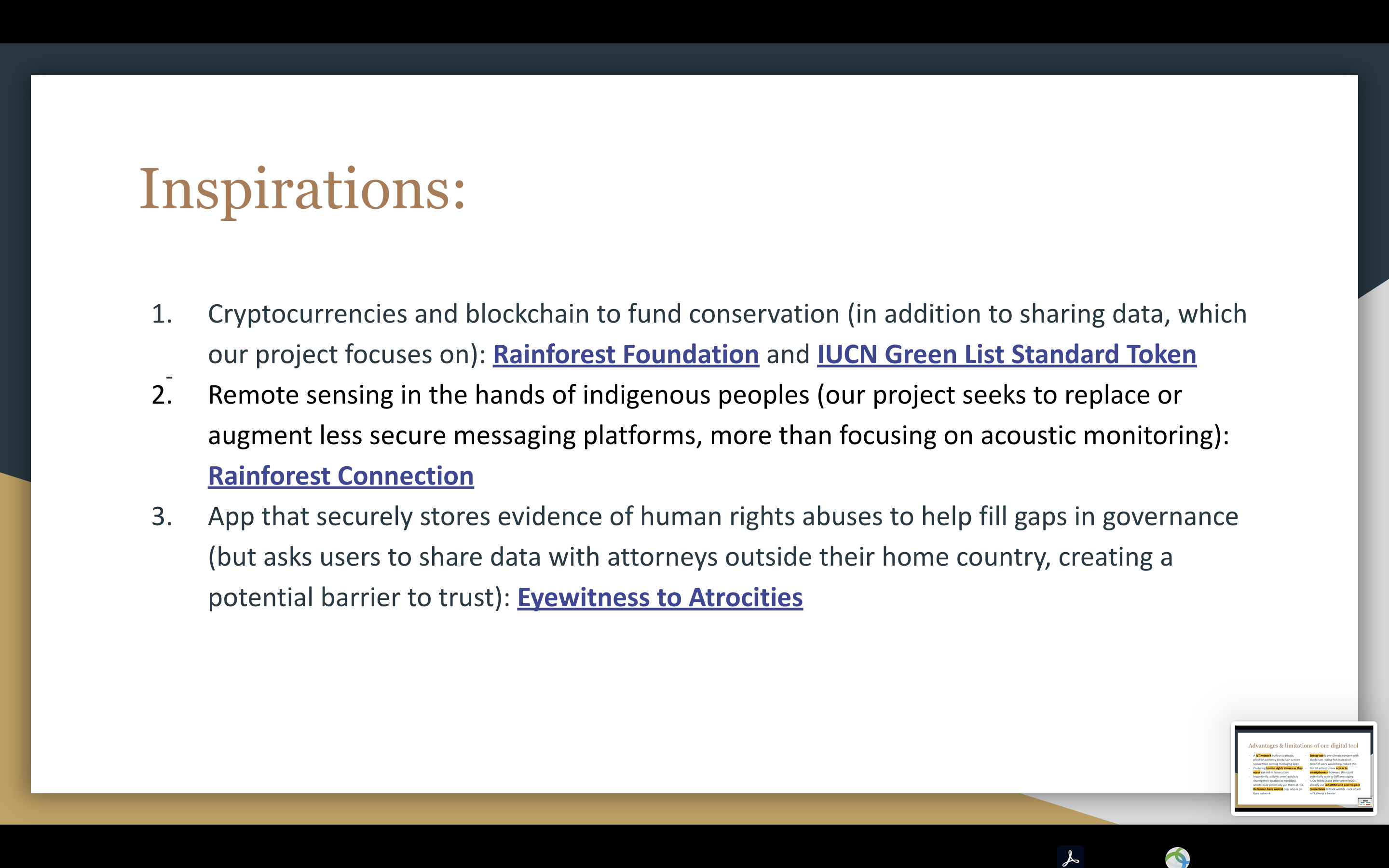
Our platform is loosely modeled on LexisNexis Eyewitness to Atrocities, which captures and securely stores eyewitness accounts of human rights abuses gathered through cell phone data. Using blockchain, the Eyewitness app is also able to authenticate that evidence has not been tampered with, providing an added layer of reliability. Evidence gathered this way has previously been used by international courts, and enables prosecution of crimes that would otherwise go unpunished. However, Eyewitness requires data - including location metadata that could potentially put defenders at risk - to be shared with lawyers outside defenders' own countries. This creates a potential barrier to trust, since many Indigenous activists are uniquely marginalized within the legal system. Our model seeks to build trust with a private, proof-of-authority based blockchain that only defenders and trusted NGO partners have access to. With defenders' consent, information may then be passed to a public blockchain used to track supply chains, and hold corporate funders of deforestation accountable. This is similar to the way Amazon Watch and other NGOs already track which corporations are complicit in Amazon destruction, and IBM and other tech companies have previously developed models to use blockchain and IoT to track supply chains.
Additionally, our platform allows NGO partners to monitor and analyze geolocation data, and issue alerts for areas that are potentially at risk of violence from extractive industries. Putting control over decision-making and access to the secure network in the hands of activists themselves is modeled on Rainforest Connection's approach to empowering Indigenous environmental defenders.
Challenges we ran into
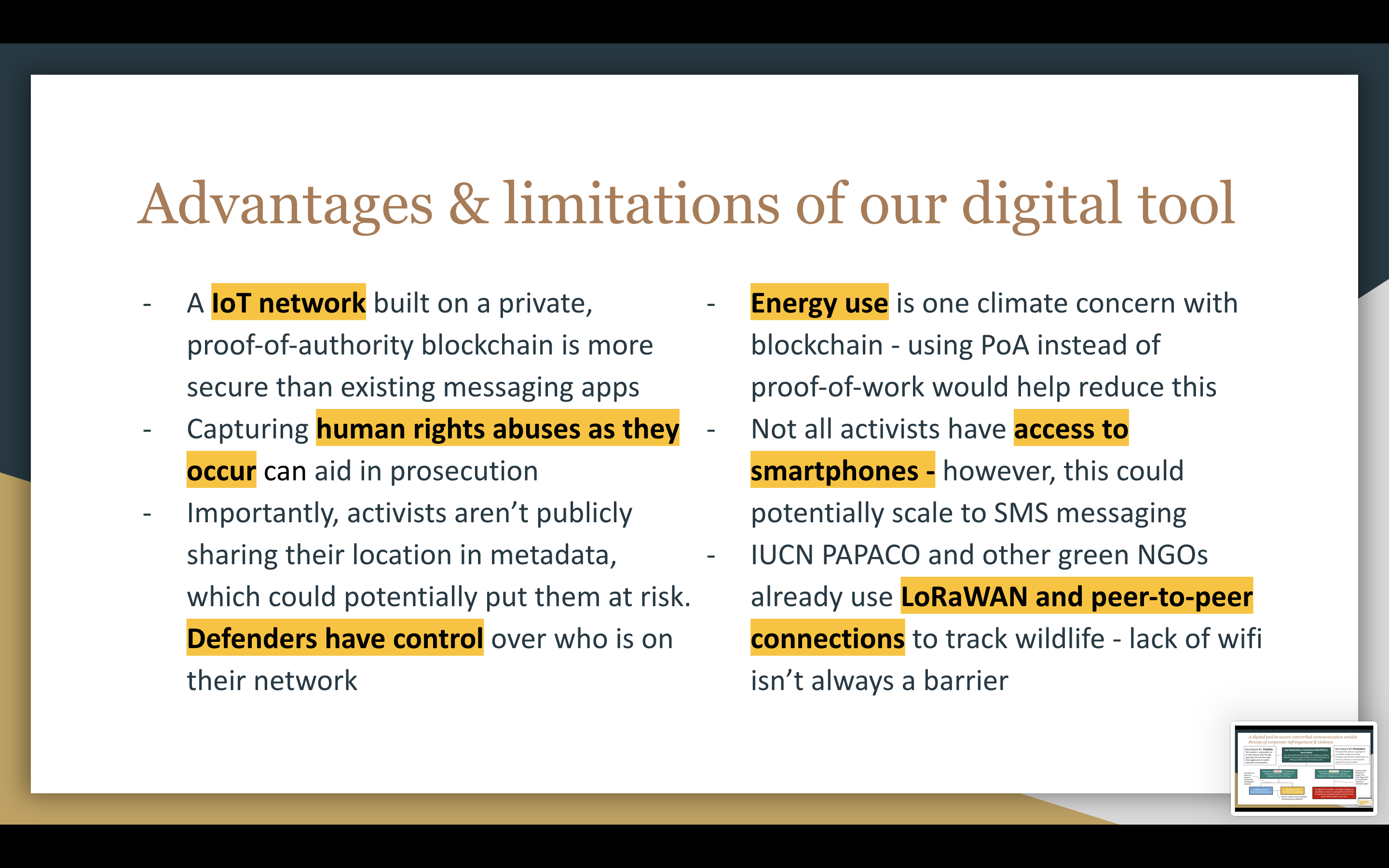
Energy use is one climate concern with blockchain - using proof-of-authority instead of proof-of-work for a private blockchain helps to reduce energy use. (The Porini Foundation, which designed a conservation cryptocurrency for the IUCN, similarly uses PoA instead of proof-of-work.) Additionally, although cell phones have become much more prevalent across the world in recent years, not all activists have access to smartphones - however, our platform could potentially scale to SMS messaging. Finally, to address lack of wifi in remote areas, we hope to incorporate LoRaWAN or other peer-to-peer networks, building on some of the work IUCN PAPACO and other green NGOs use to track wildlife.
Accomplishments that we're proud of & what we learned
During our research, we gained a deeper understanding of the challenges Indigenous environmental defenders face, and how we can help support frontline activists.
What's next for Defending Environmental Defenders
Further working through technical challenges, prototyping
Built With
- blockchain
- iot

Log in or sign up for Devpost to join the conversation.