-
-
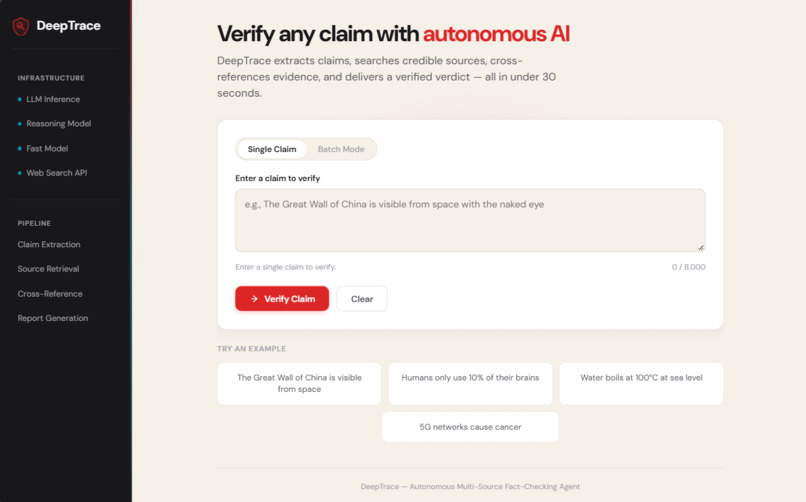
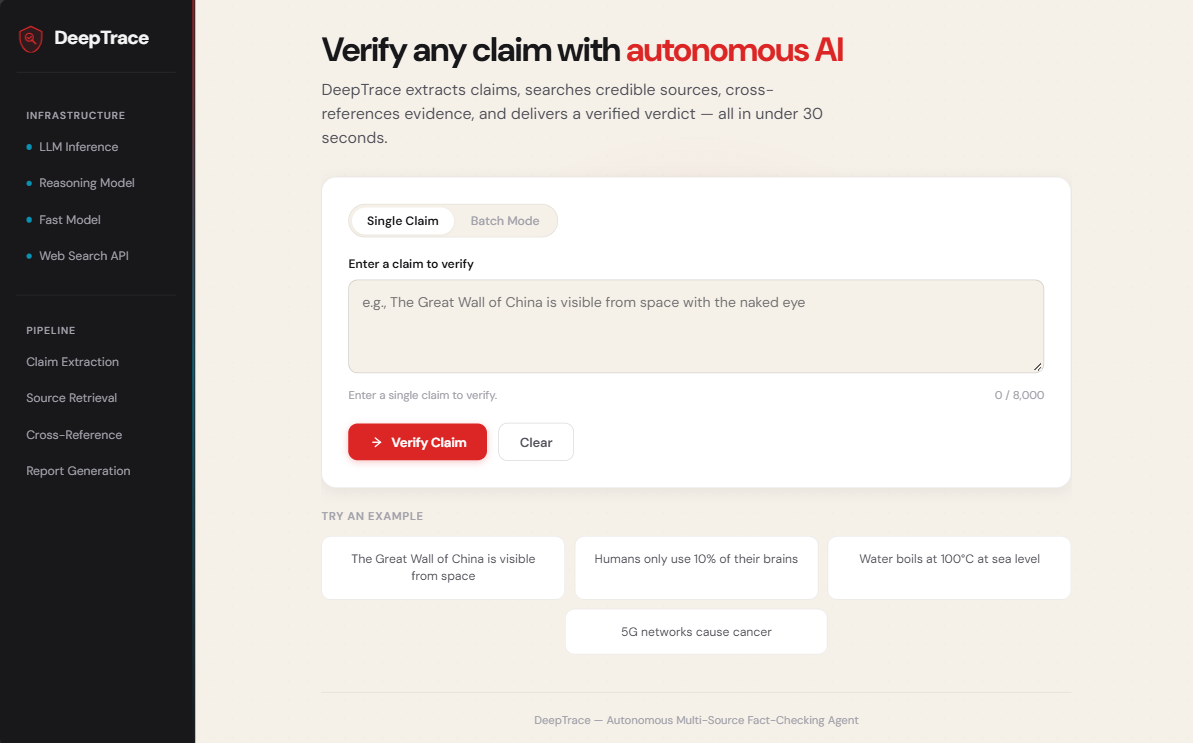
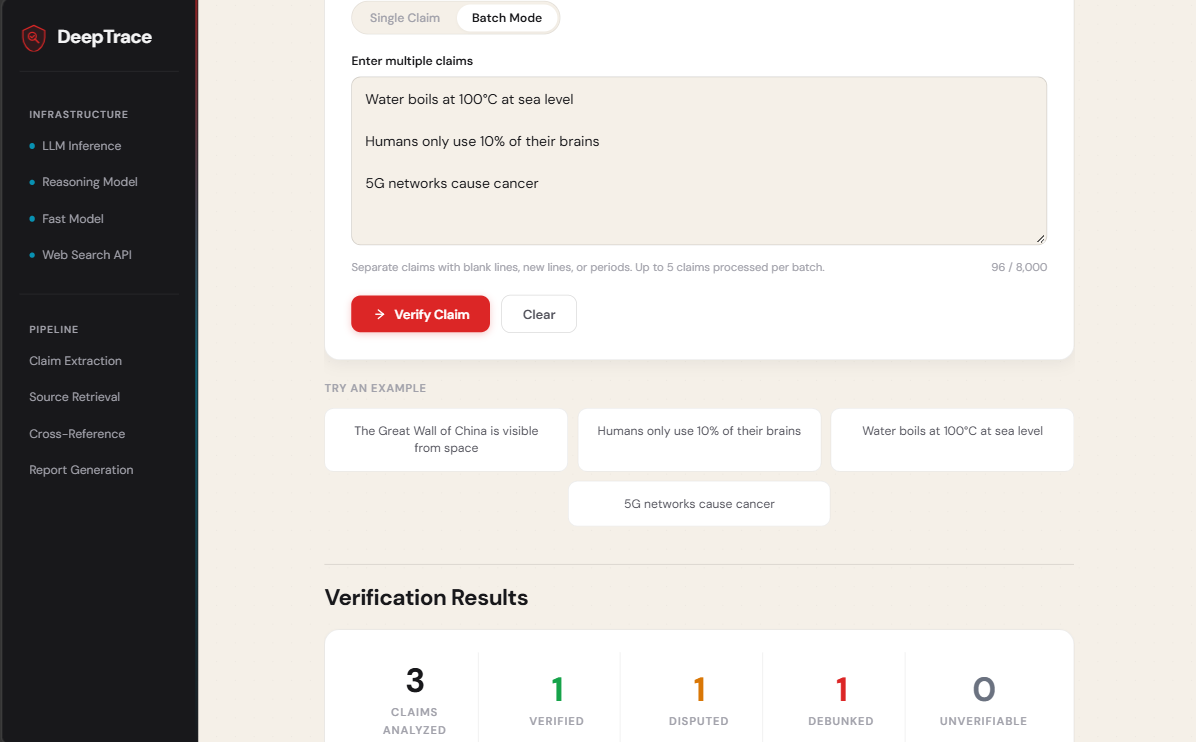
Home page: Single Claim mode with example cards, sidebar infrastructure view, and warm-authority palette
-
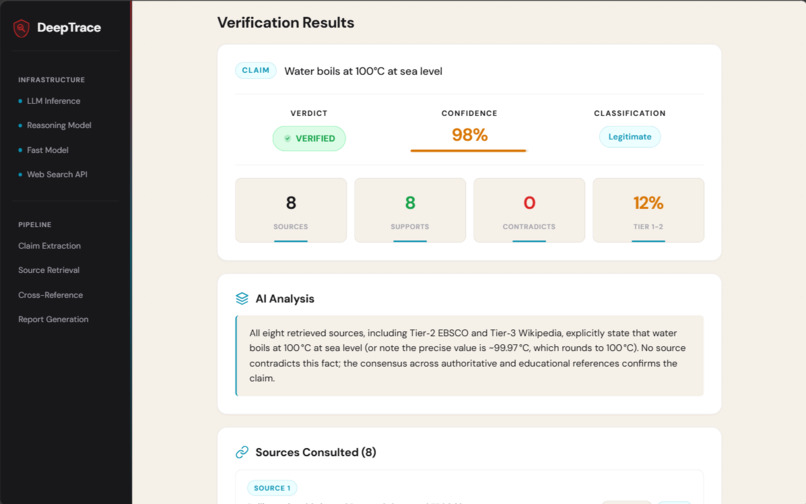
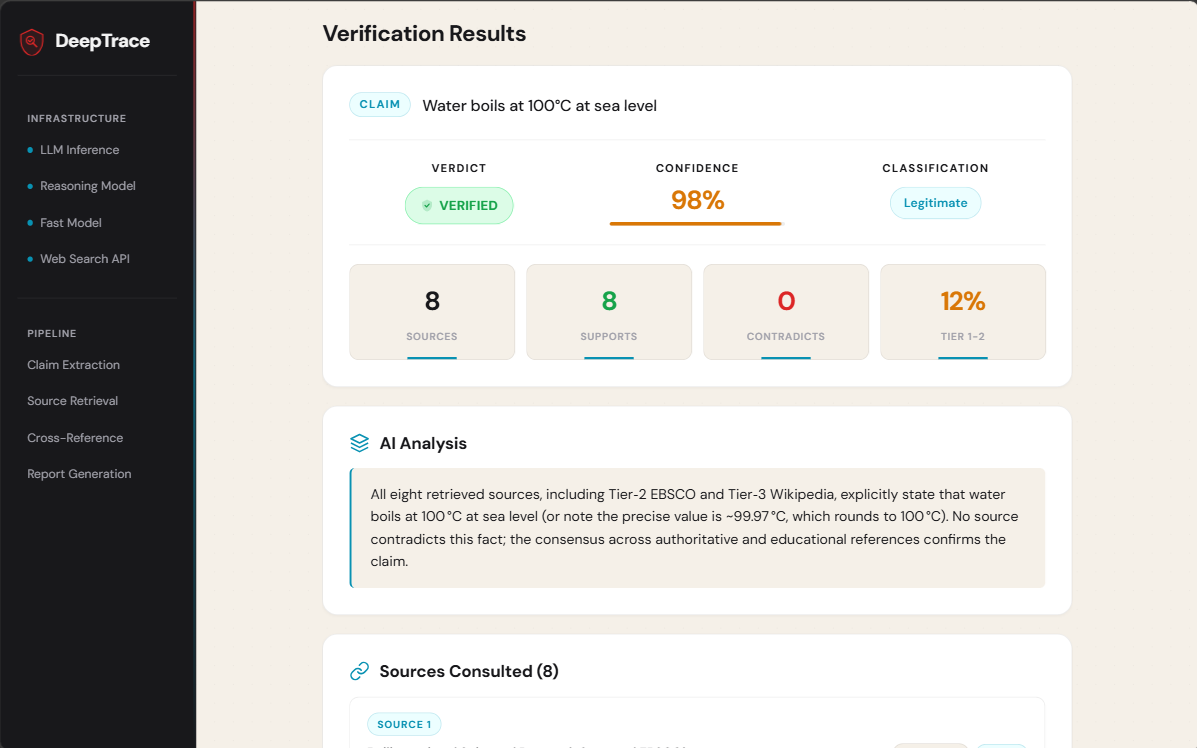
VERIFIED verdict on "Water boils at 100°C" — 98% confidence, Legitimate classification, 8/8 supporting sources, tier-ranked evidence cards
-
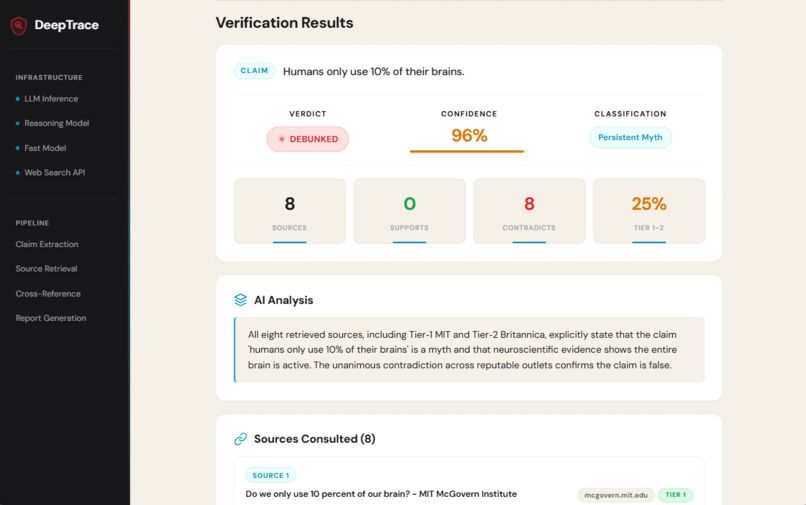
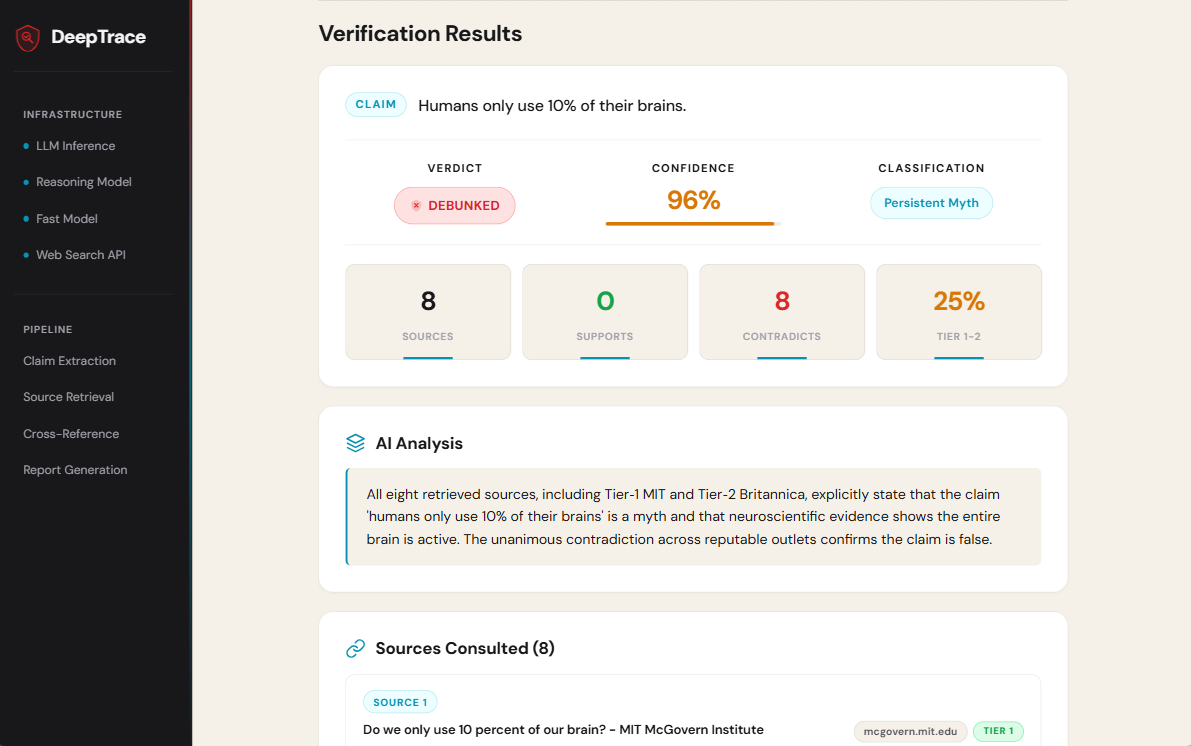
DEBUNKED verdict on "10% brain myth" — 96% confidence, Persistent Myth classification, 8/8 contradicting sources including MIT and Nature
-
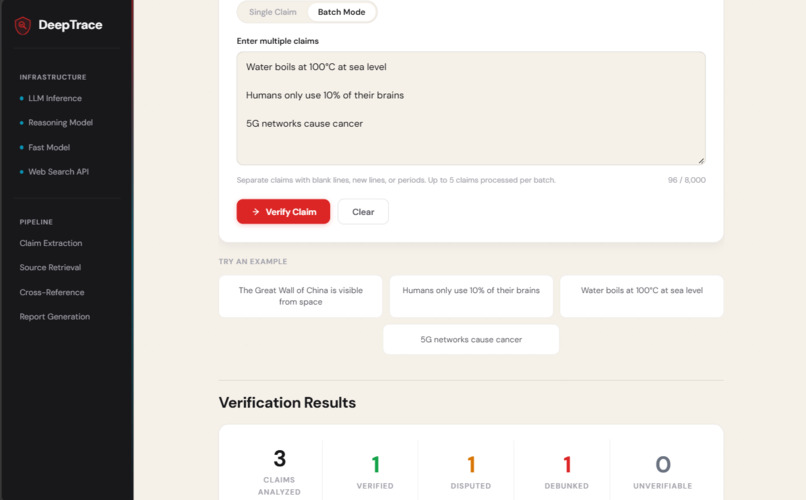
Batch mode: 3 claims analyzed simultaneously with consolidated summary dashboard showing 1 Verified / 1 Disputed / 1 Debunked
-
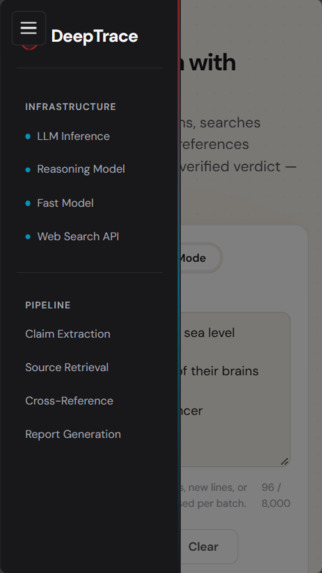
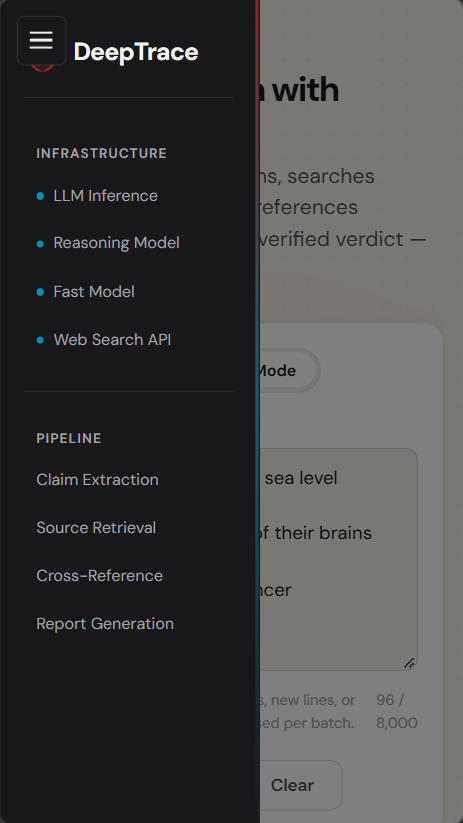
Responsive mobile layout at 390px width with hamburger menu and slide-in sidebar overlay
Inspiration
In 2026, AI-generated misinformation spreads faster than any human fact-checker can respond. A single fabricated claim reaches millions before a correction is published. Existing fact-checking tools rely on static databases that go stale within days, or they dump raw search results on the user without analysis.
I built DeepTrace to close this gap: an autonomous agent that searches, reads, cross-references, weighs contradictions, and delivers a verdict with full evidence — in under 30 seconds.
What It Does
DeepTrace runs a four-stage autonomous verification pipeline:
Stage 1: Claim Decomposition: NVIDIA Nemotron 3 Nano (30B, 3B active via MoE) extracts atomic, verifiable factual propositions from raw text.
Stage 2: Live Source Retrieval: Tavily AI Search API pulls 8 independent, live web sources per claim, tier-ranked by domain authority (Tier 1: government/academic, Tier 2: wire services, Tier 3: major news, Tier 4: blogs/social).
Stage 3: Cross-Reference & Stance Analysis: NVIDIA Nemotron 3 Super (120B, 12B active) evaluates every source's stance (Supports/Contradicts/Neutral), identifies key contradictions, and synthesizes consensus.
Stage 4: Verdict Scorecard: Transparent, color-coded verdict (Verified/Debunked/Disputed/Unverifiable) with confidence percentage, misinformation classification, and clickable source citations.
Batch mode processes up to 5 claims simultaneously with a consolidated summary dashboard.
How I Built It
- Backend: FastAPI (async Python) orchestrating a deterministic 4-stage pipeline
- Frontend: HTMX + Jinja2 for reactive server-rendered UI with zero JS framework overhead
- Inference: Nebius Token Factory hosting NVIDIA Nemotron 3 Nano (fast) and Nemotron 3 Super (reasoning) via OpenAI-compatible API
- Search: Tavily AI Search API for agentic web retrieval with domain filtering
- Deployment: Modal serverless with scale-to-zero and sub-10s cold starts
Key decisions: dual-model architecture keeps latency under 30s and cost under $0.01 per verification. Python pre-splitting for batch claims ensures deterministic separation. Four-strategy JSON repair pipeline for robust LLM output parsing.
Challenges
- LLM output truncation: Oversized Tavily snippets caused mid-JSON truncation and all-NEUTRAL verdicts. Fixed with aggressive snippet truncation, increased MAX_TOKENS, and multi-strategy JSON repair.
- Model ID discovery: Nebius catalog display names differ from API model IDs. Three 404 errors before finding the correct format via Nebius Playground.
- HTMX fragment rendering: Results template extending base.html caused double headers/footers on HTMX injection. Fixed by converting to a pure HTML fragment.
- Batch claim splitting: LLM-based splitting silently dropped claims. Replaced with deterministic Python regex sentence boundary detection.
Accomplishments
- Complete end-to-end fact-checking agent built solo in under two weeks
- Dual-model agentic pipeline on Nebius Token Factory with NVIDIA Nemotron 3
- Deep Tavily integration with tier-ranked credibility scoring across 8 live sources
- Serverless deployment on Modal with live public URL
- Responsive UI with animated stages, hover-explained classifications, and batch mode
What I Learned
- MoE models are ideal for agentic pipelines: Nano's 3B active parameters handle fast tasks cheaply while Super's 12B active handle reasoning without dense-model cost
- HTMX eliminates an entire frontend complexity layer for AI dashboards
- LLM output parsing is the hardest part of building agents; defense-in-depth parsing is non-negotiable
- Tavily's pre-extracted, relevance-ranked snippets directly improved verdict accuracy over raw web search
What's Next
- Keep Tavily as the primary evidence backbone; add optional secondary search fallback for quota resilience
- Concurrent batch processing with asyncio.gather
- Structured logging and observability
- Browser extension for one-click claim verification

Log in or sign up for Devpost to join the conversation.