-
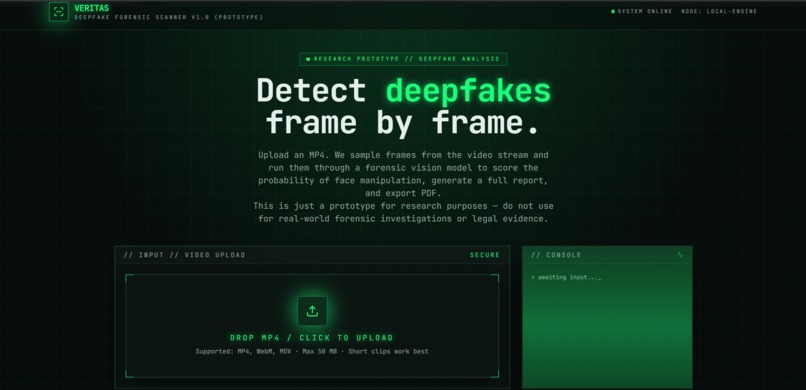
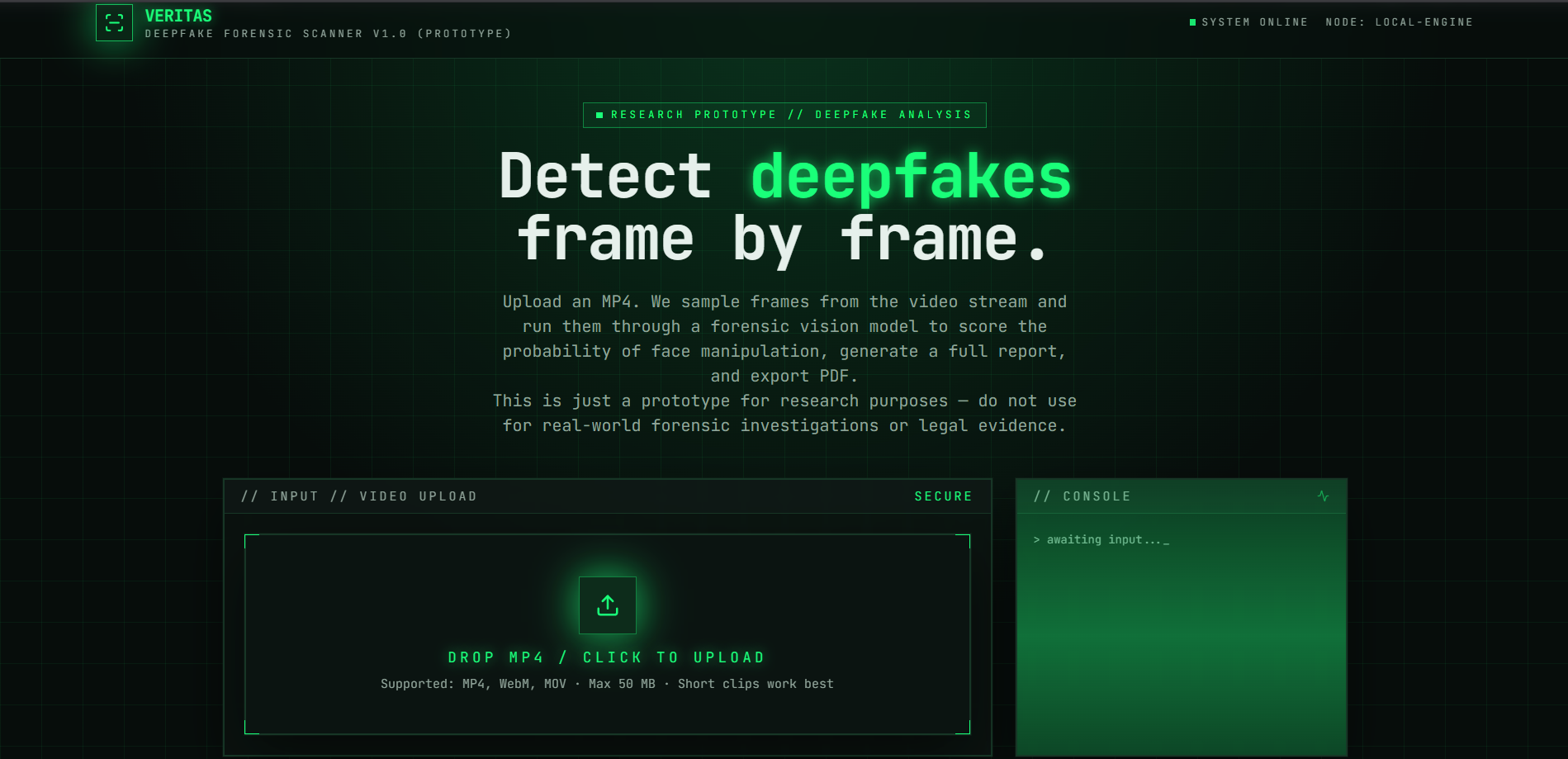
Working Landing Page
-
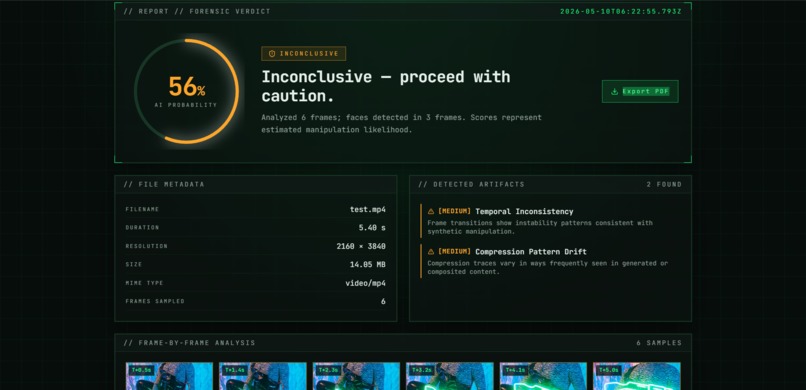
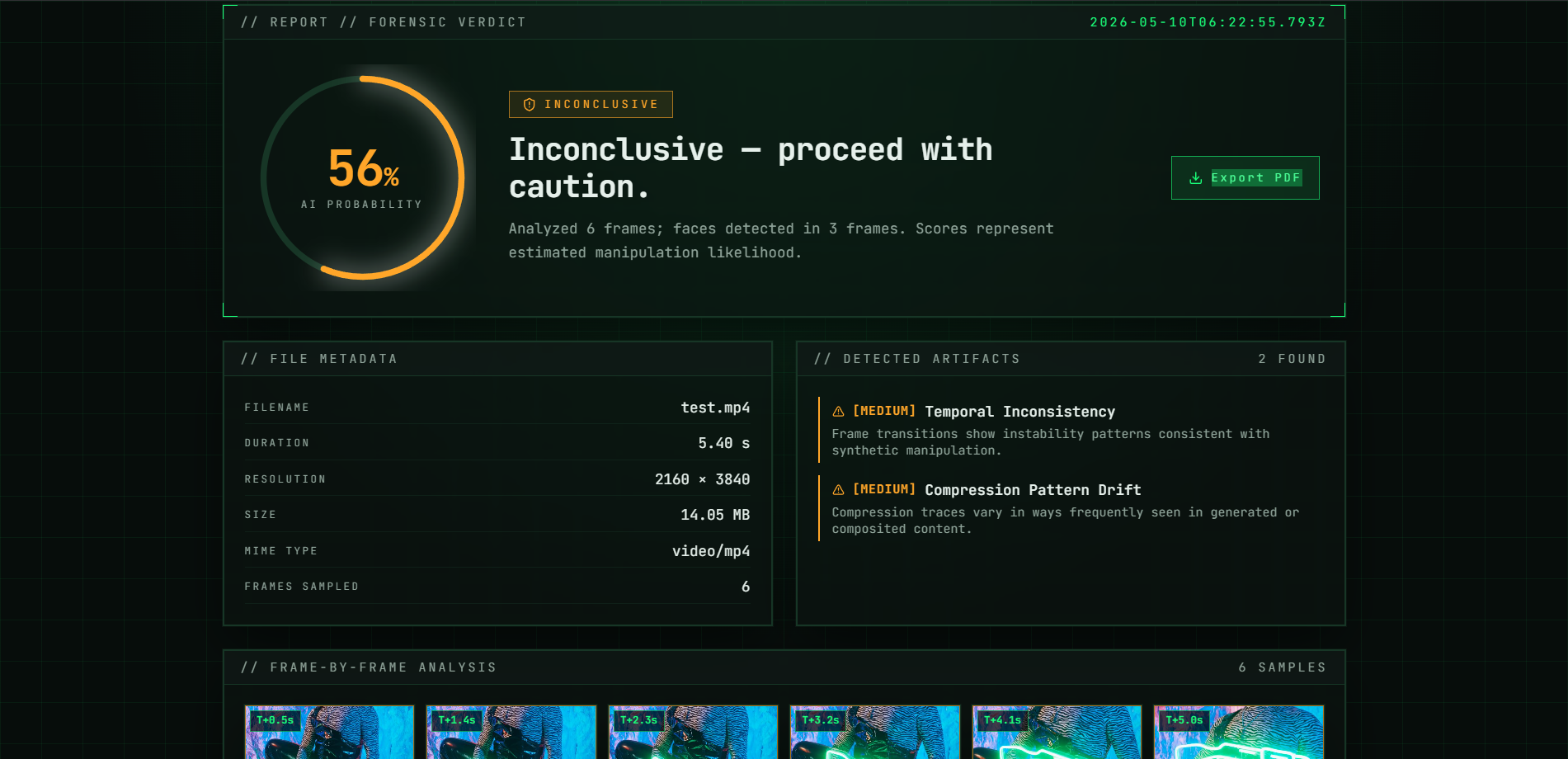
Demo Output
About the Project
Inspiration
The idea for VERITAS came from watching how AI-generated fake videos are spreading across the internet during wars, political conflicts, scams, and public crises.
What disturbed me the most was not just the technology itself — it was the human impact behind it.
There have been cases where people were falsely portrayed in manipulated videos, humiliated publicly, threatened, or emotionally destroyed before the truth could even surface. In many situations, fake media spreads faster than facts, while innocent people are left trying to prove they are real.
A single believable deepfake can create panic, misinformation, fear, reputational damage, and emotional trauma at a massive scale.
Deepfakes are not just a technical problem anymore — they are becoming a trust problem for humanity.
That realization inspired me to build VERITAS, a forensic AI-powered video screening system designed to help people analyze suspicious videos and better understand whether content may have been manipulated.
What VERITAS Does
VERITAS is a full-stack AI-powered deepfake detection web application that:
- Accepts video uploads
- Extracts representative frames directly in the browser
- Performs AI-based forensic analysis
- Detects possible manipulation artifacts
- Generates structured verdicts
- Exports downloadable forensic PDF reports
The goal was to create an accessible and understandable tool that demonstrates how AI can also be used to fight AI-generated misinformation.
How I Built It
I built VERITAS using a modern full-stack architecture.
Frontend
- React
- TypeScript
- Vite
- Tailwind CSS
- shadcn/ui
Backend
- FastAPI
- Pydantic
- Uvicorn
AI / ML Stack
- PyTorch
- Torchvision
- OpenCV
- NumPy
Detection Workflow
Video Upload
→ Frame Extraction
→ Frame Transfer
→ OpenCV Preprocessing
→ AI Model Inference
→ Score Aggregation
→ Verdict Generation
→ Forensic Dashboard
→ PDF Report Export
Frames are extracted directly inside the browser instead of uploading the full raw video, which helps reduce unnecessary data transfer and improves privacy.
The backend performs preprocessing and deepfake analysis using PyTorch and OpenCV pipelines, then returns:
- Frame-level analysis
- Manipulation indicators
- Forensic artifacts
- Confidence scores
- A final verdict
Challenges I Faced
This project was significantly more difficult than a normal web application because it combines:
- Frontend engineering
- Backend architecture
- Machine learning inference
- Deployment infrastructure
- Large AI dependencies
One of the biggest challenges was deployment.
Since the backend uses heavy ML libraries such as PyTorch and OpenCV, traditional serverless deployments were not suitable. I had to separate the architecture into:
- A Vercel frontend deployment
- A Render-hosted FastAPI backend
Another major challenge was performance.
Deepfake analysis is computationally expensive. Video processing requires:
- Frame extraction
- Image preprocessing
- Inference pipelines
- Report generation
Because this project was built entirely using free-tier infrastructure, response times can sometimes be slower, especially when the backend service wakes from sleep mode.
However, I intentionally chose to keep the system fully functional instead of replacing analysis with fake/demo outputs.
The current implementation prioritizes:
- Real processing
- Actual inference pipelines
- End-to-end functionality
What I Learned
This project taught me much more than just coding.
I learned:
- Full-stack AI deployment
- ML model integration
- API architecture
- Deployment debugging
- Production environment configuration
- CORS handling
- Inference optimization
- How difficult real-world AI systems are to build and maintain
I also learned how expensive and resource-intensive trustworthy AI systems truly are.
Building production-grade deepfake detection systems requires:
- Massive datasets
- Advanced temporal analysis models
- Continuous retraining
- High-performance GPUs
- Significant infrastructure funding
VERITAS is still a prototype, but it demonstrates how practical AI-assisted verification tools can be created and improved over time.
Future Vision
This hackathon project is only the beginning.
In the future, I want to improve VERITAS with:
- Better temporal video analysis
- Larger training datasets
- Multimodal verification
- Explainable AI visualization
- Real-time analysis
- Scalable cloud infrastructure
Most importantly, I want to continue building tools that help restore trust in digital media.
Because in a world where AI can generate fake reality, society will increasingly need systems capable of verifying truth.
Final Note
VERITAS is not intended to provide absolute proof.
It is designed as an assistive forensic analysis system that helps identify suspicious patterns and possible AI-generated manipulation.
This project represents:
- A technical experiment
- A social concern
- A step toward responsible AI security tools
Deepfakes may be the beginning of the problem.
But systems like VERITAS can become part of the solution.

Log in or sign up for Devpost to join the conversation.