-
-
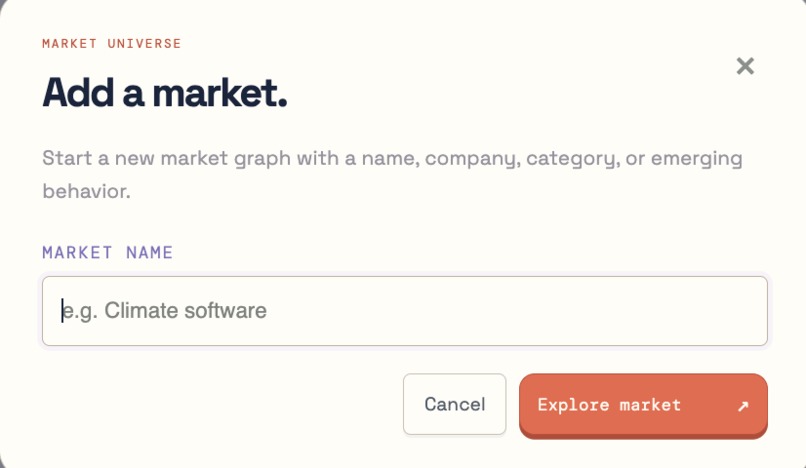
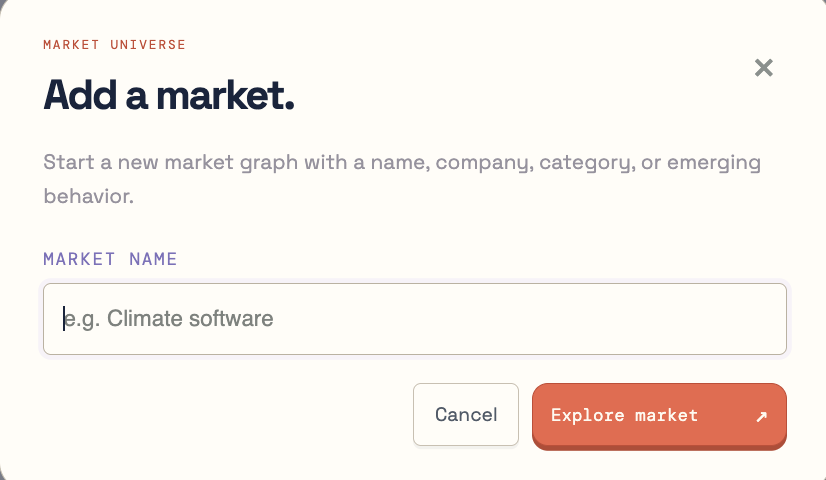
Add a market screen
-
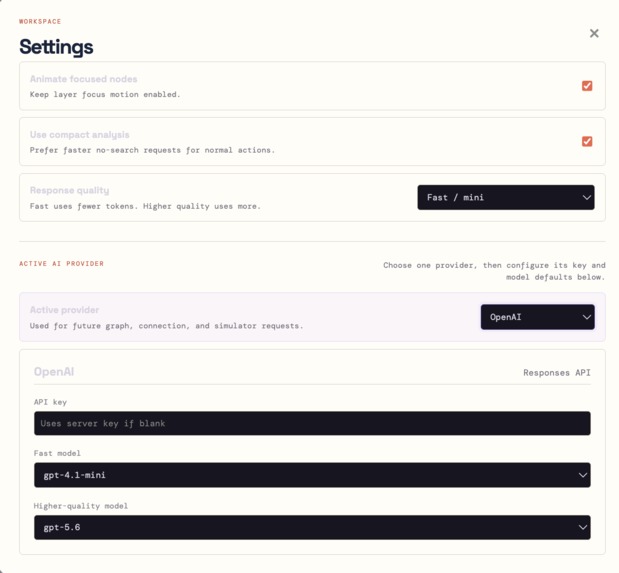
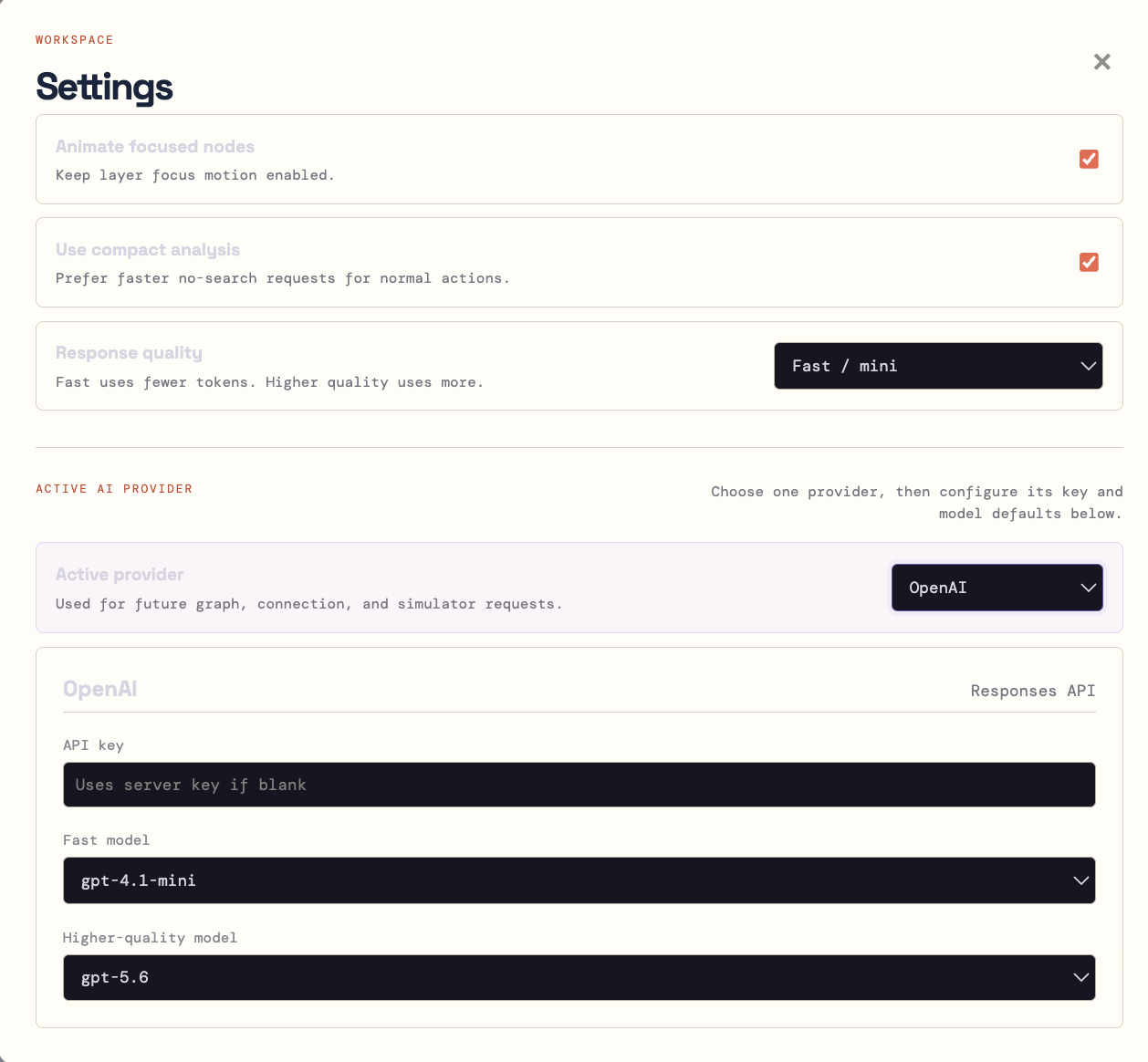
Settings screen
-
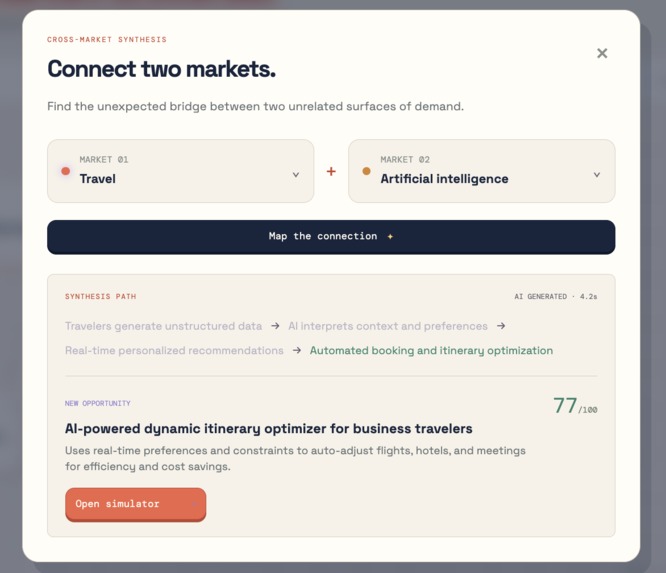
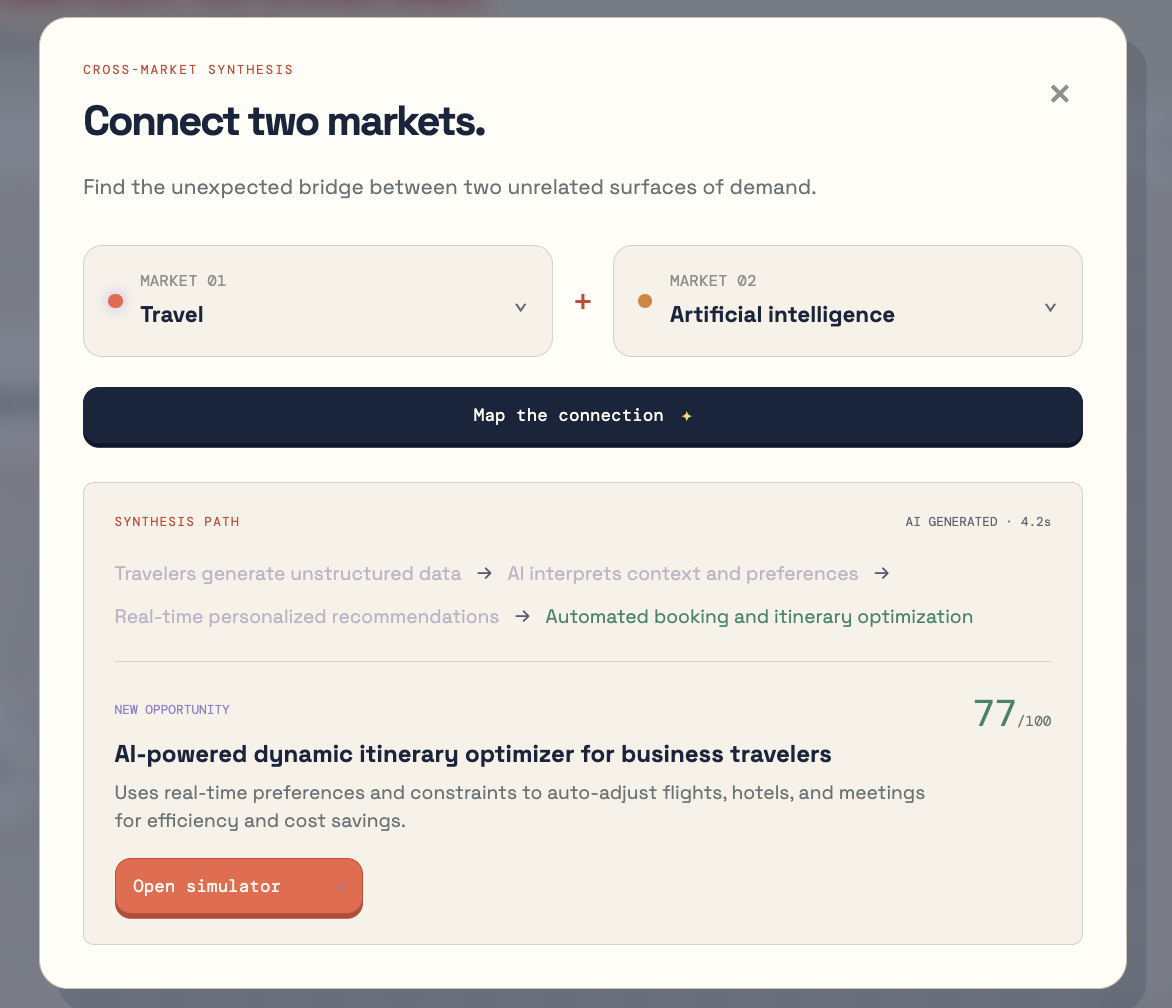
connect market screen
-
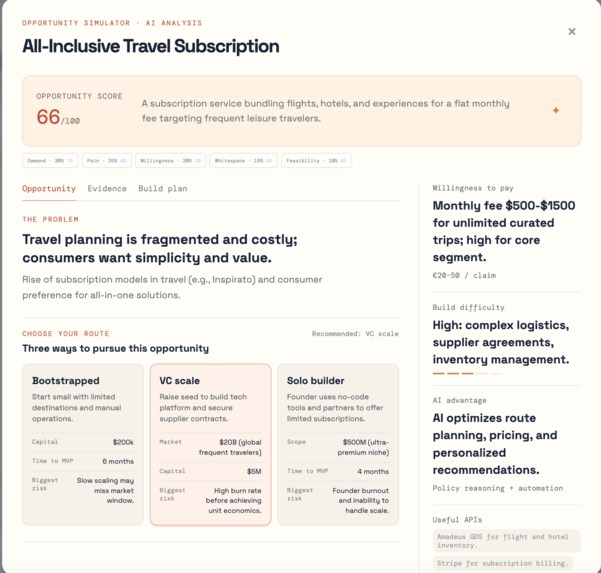
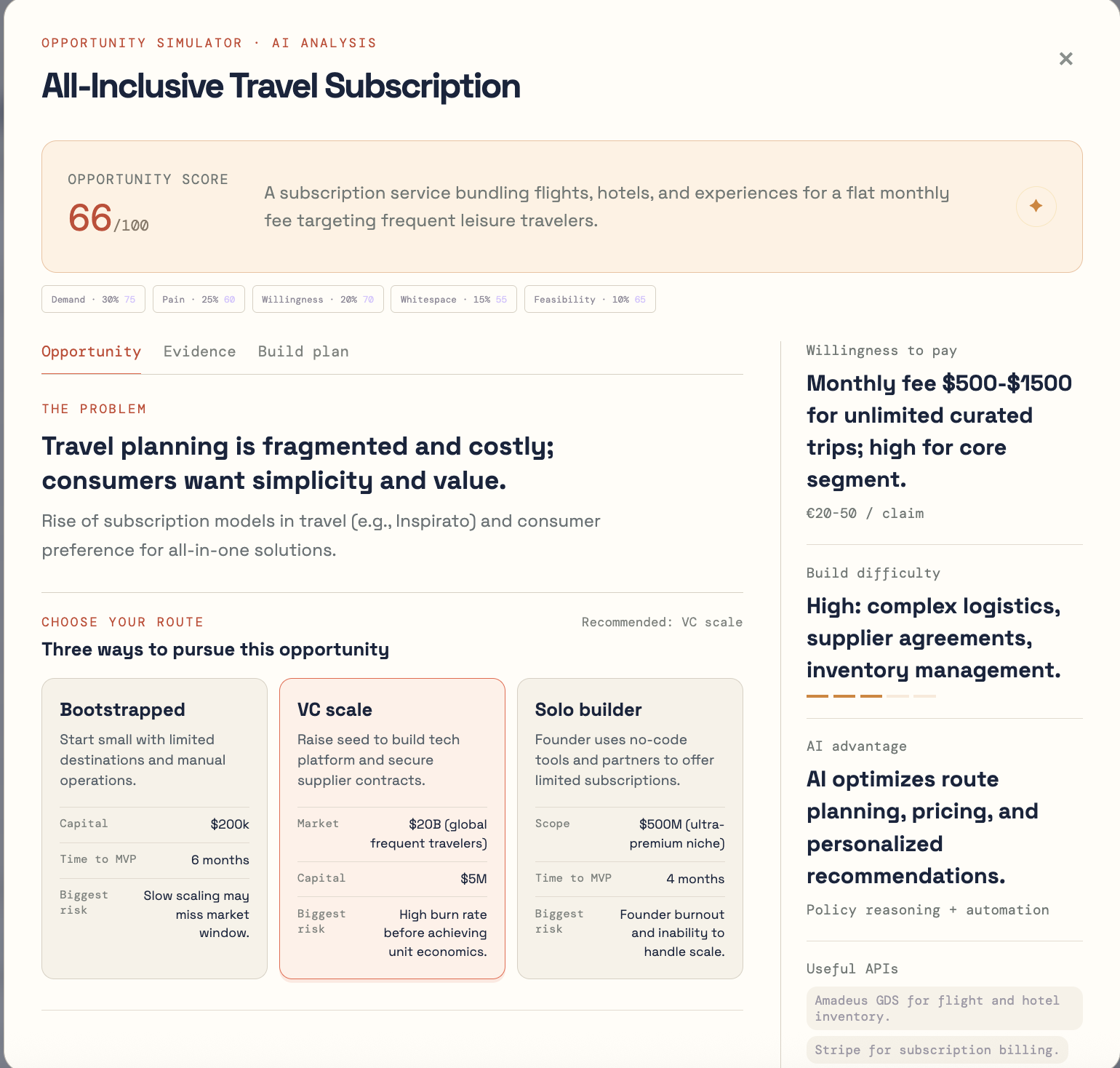
Opportunity simulator screen
-
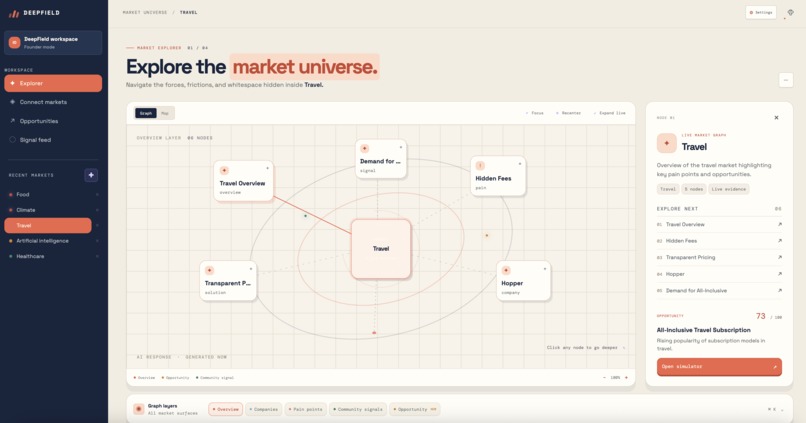
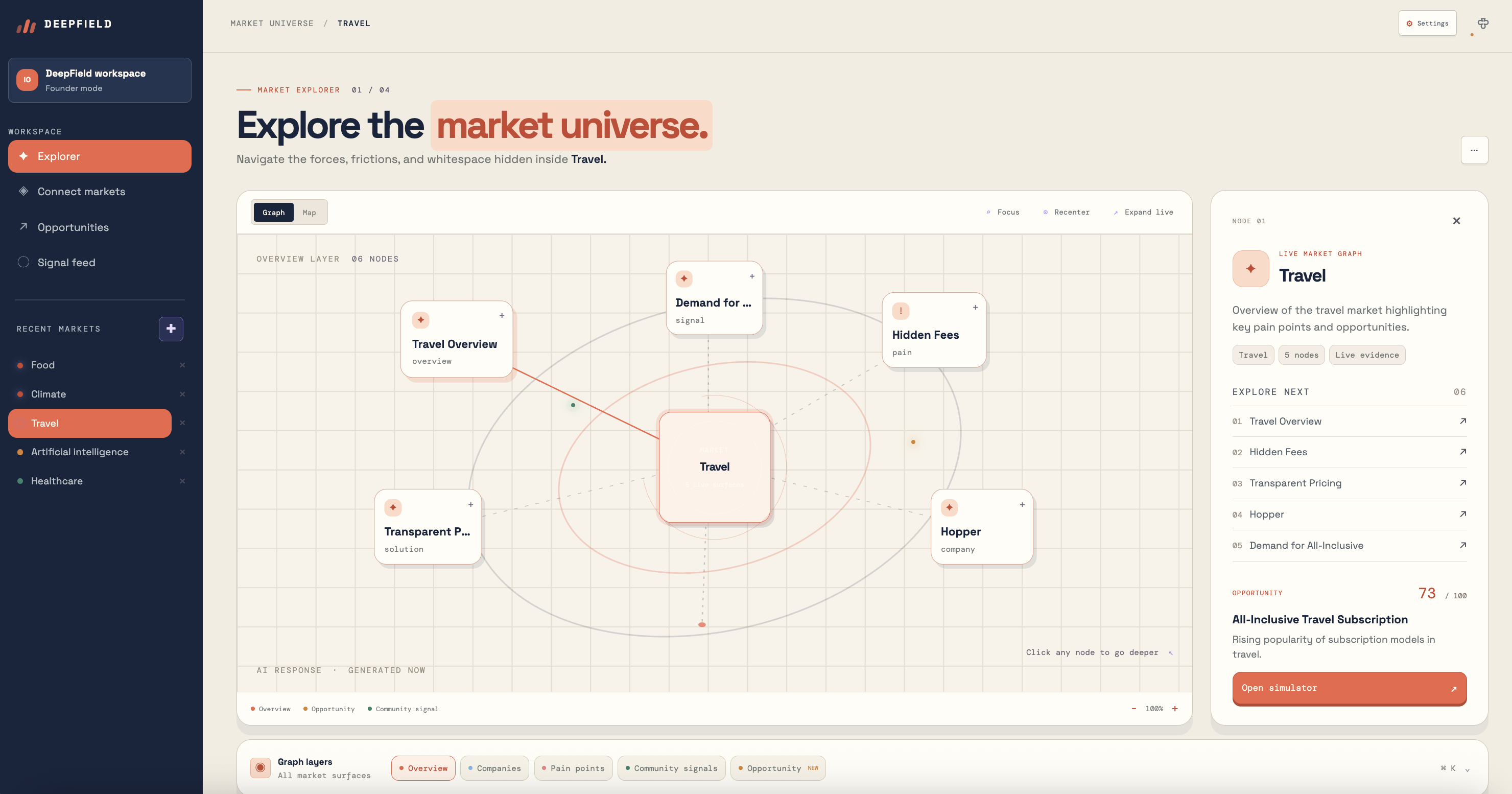
Explore the market screen
Inspiration
I saw that founders rarely struggle because they have no ideas. They struggle because they don't know where to focus. As AI can help build products fast, a founder needs to know what it needs to build in first place.
DeepField was inspired by the idea of a map for markets - a way to explore industries/markets through their users, companies, pain points, technologies, signals, and underserved opportunities. Instead of generating random startup ideas, DeepField helps founders understand a market deeply and decide what is worth building.
## What it does
DeepField is an AI operating system for market research, opportunity discovery, and product strategy.
Users can:
- Explore infinite markets such as Travel, Healthcare, or Artificial Intelligence etc
- Navigate an interactive market graph
- Expand individual nodes and explore deeper topics
- View companies, users, pain points, solutions, signals, and opportunities
- Add, remove, and switch between markets
- Connect two markets to discover intersection opportunities
- Compare Bootstrapped, VC, and Solo Builder paths
- Review risks, assumptions, pricing, go-to-market, MVP steps, and a structured build stack
- Export an opportunity plan as Markdown
- Choose different AI providers and model-quality levels
Every opportunity receives a consistent score based on demand, pain severity, willingness to pay, whitespace, and feasibility:
$$ S = 0.30D + 0.25P + 0.20W + 0.15G + 0.10F $$
## How I built it
DeepField uses a modular frontend built with native JavaScript ES modules. The code is organized into feature, service, UI, core, and data layers.
The Node.js backend:
- Orchestrates multiple AI providers
- Validates structured JSON responses
- Normalizes opportunity scores
- Handles provider fallbacks and incomplete responses
- Supports compact analysis and optional live research
- Uses caching and request cancellation
- Keeps API keys server-side for the hosted deployment
The Opportunity Simulator converts a market opportunity into a decision memo containing evidence, customers, pricing, risks, assumptions, MVP steps, founder paths, and a build stack.
GPT-5.6 was the primary reasoning and generation model throughout development. Codex acted as the repository-aware implementation partner by inspecting files, applying changes, refactoring code, running checks, debugging errors, configuring Vercel, and pushing working increments to GitHub.
## Challenges I ran into
AI providers returned structured responses differently, requiring provider-specific parsing and validation.
Rich AI responses were initially slow and expensive, so I introduced compact prompts, caching, model-quality controls, and cancellation.
Opportunity scores became inconsistent between the graph, opportunity feed, and simulator, so scoring was centralized on the server.
The simulator sometimes displayed stale data from a previous opportunity, requiring better request and active-market handling.
Vercel initially executed browser code as server code, causing a "document is not defined" crash. I fixed this by separating static assets from serverless API routes.
## Accomplishments that I am proud of
- Built an end-to-end market exploration workflow instead of a simple chatbot.
- Created an interactive graph that lets users explore markets visually.
- Built a simulator that helps users decide how to pursue an opportunity.
- Added three practical founder paths: Bootstrapped, VC Scale, and Solo Builder.
- Added a structured build stack connecting discovery to execution.
- Implemented centralized opportunity scoring.
- Added multiple AI provider options and server-side API key handling.
- Deployed a working version on Vercel.
- Iterated on the product based on real testing feedback.
## What I learned
The most valuable AI output is not always the generated answer. It is the decision structure around the answer.
Founders need to understand:
- What the opportunity is
- Who experiences the problem
- Who will pay
- What assumptions are being made
- How the score was calculated
- What the risks are
- What can realistically be built next
I also learned that perceived speed depends heavily on communication. Instant previews, visible progress, cancellation, compact responses, and clear fallback states make AI applications feel much more usable.
## What's next for DeepField
Features I am thinking of adding in future:
- Authenticated workspaces
- Persistent research history
- Source citations and evidence provenance
- Reddit, GitHub, app review, news, hiring, and funding connectors
- Government and regulatory data
- Saved opportunity comparisons
- Stronger evidence evaluation

Log in or sign up for Devpost to join the conversation.