1. About the Project
DeepFake Shield AI — Detect Truth. Defend Reality.
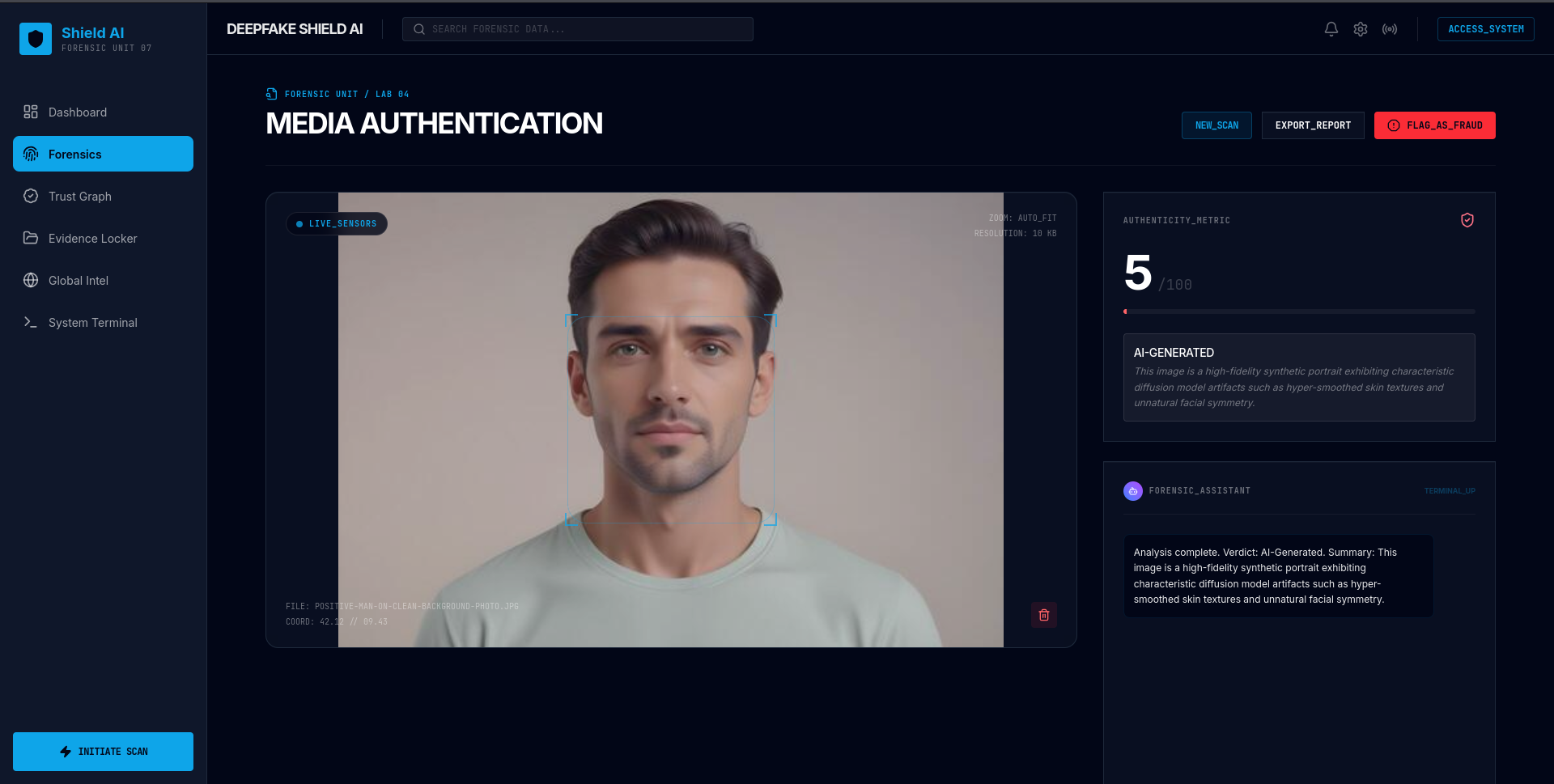
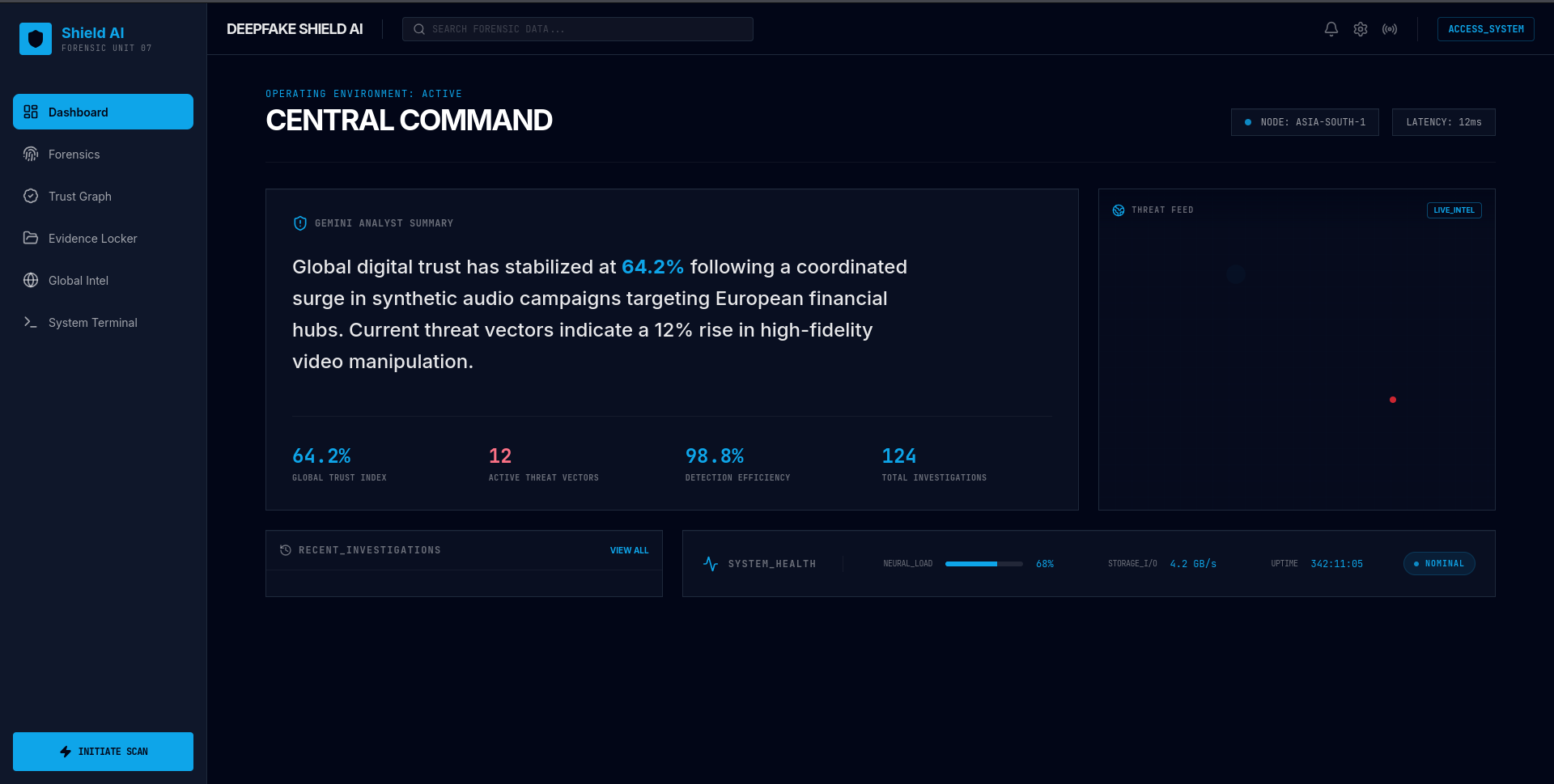
DeepFake Shield AI is an enterprise-grade cyber-forensics platform engineered to detect, analyze, and decompose synthetic media with high precision. In an era where AI-generated content can manipulate public opinion, destabilize institutions, and compromise digital trust, the platform equips journalists, investigators, and cybersecurity professionals with advanced tools to verify the authenticity of images, audio, and video.
Rather than delivering a simplistic “Fake” or “Real” verdict, Shield AI performs explainable forensic analysis by identifying suspicious artifacts, AI-generation signatures, metadata inconsistencies, and neural synthesis traces across multiple media formats.
2. The Inspiration
The inspiration behind DeepFake Shield AI emerged from the rapid escalation of CheapFakes and highly sophisticated DeepFakes appearing across social media, political campaigns, and conflict-zone misinformation operations.
We recognized a critical gap in existing detection systems: most tools provide only binary classifications without explaining why a piece of media is suspicious. For professional investigations, transparency is essential.
Our objective was to build a platform that thinks like a forensic analyst — one capable of identifying:
- GAN-generated artifacts
- Neural vocoder signatures
- Frequency-domain inconsistencies
- Pixel recurrence anomalies
- Metadata tampering
- Temporal synchronization defects in video/audio
By combining AI-driven analysis with explainable forensic evidence, Shield AI transforms synthetic media detection into an actionable investigative workflow.
3. How I Built It
The platform was designed using a secure, scalable, full-stack architecture optimized for cyber-forensics workflows.
Frontend
The interface follows a “Cinematic Dark” design language built using:
- React 19
- Vite
- Tailwind CSS 4
- Framer Motion
- D3.js
Framer Motion powers tactical HUD-style animations, while D3.js visualizes forensic relationships through an interactive Trust Topology Graph.
AI Engine
The AI analysis layer is powered by Gemini 1.5 Pro and performs multi-modal forensic reasoning across:
- Images
- Audio
- Video
The system leverages structured JSON outputs to map discovered anomalies into categorized forensic evidence. Instead of merely scanning pixels, the AI reasons about synthesis patterns, compression irregularities, and behavioral inconsistencies.
Backend Infrastructure
The backend stack consists of:
- Node.js
- Express.js
- Firebase Authentication
- Google Cloud Firestore
Secure file-stream ingestion and evidence preservation are handled through a centralized Evidence Locker, enabling persistent case tracking and forensic auditability.
Forensic Scoring Logic
The detection engine computes authenticity using a weighted consensus model across multiple neural forensic detectors.
The overall Trust Score is represented as:
$$ T = \sum_{i=1}^{n}(w_i \cdot c_i) - \lambda R $$
Where:
- (T) = Final Trust Score
- (w_i) = Weight assigned to detector (i)
- (c_i) = Confidence score of detector (i)
- (\lambda) = Risk penalty constant
- (R) = High-risk forensic indicators detected (e.g., GAN stitching, spectral mismatch, metadata forgery)
This approach enables the system to provide transparent and explainable trust evaluations rather than opaque AI classifications.
4. Challenges Faced
Multi-Modal Complexity
Supporting image, audio, and video analysis inside a unified investigative interface introduced significant architectural complexity. Maintaining a consistent user experience across different evidence types required advanced state orchestration and modular forensic pipelines.
Latency vs. Precision
Deep forensic analysis of high-resolution video is computationally intensive. To reduce perceived latency, we implemented a progressive intelligence system that streams partial “Live Intel” indicators while the full Gemini-powered forensic report is being generated.
Balancing Design and Functionality
Creating a cinematic cyber-forensics aesthetic without sacrificing usability was a major design challenge. The interface needed to feel tactical and immersive while ensuring the evidence itself remained the central focus.
We intentionally minimized unnecessary visual clutter to preserve investigative clarity.
5. What I Learned
Building DeepFake Shield AI reinforced the importance of Explainable AI (XAI) in security and investigative systems.
A black-box classification score has limited value in environments such as:
- Journalism
- Legal investigations
- Cyber threat intelligence
- Digital evidence verification
By forcing AI systems to produce verifiable forensic indicators — such as pixel recurrence coordinates, spectral frequency anomalies, and metadata inconsistencies — we transformed a simple detector into a professional investigative platform.
The project ultimately demonstrated that while AI is responsible for accelerating the deepfake problem, it is also the only technology capable of scaling the solution.
Built With
- auth
- cloud
- css
- d3.js
- express.js
- firebase
- firestore
- framer
- gemini
- genai
- javascript
- motion
- multer
- react
- tailwind
- typescript

Log in or sign up for Devpost to join the conversation.