-
-
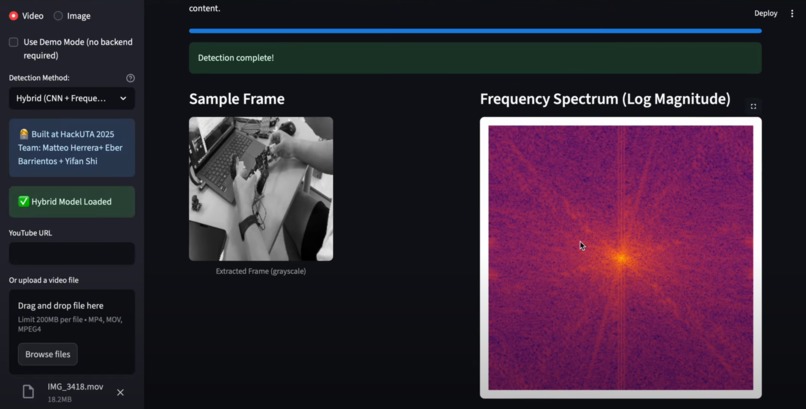
CNN + Frequency Based Analysis
-
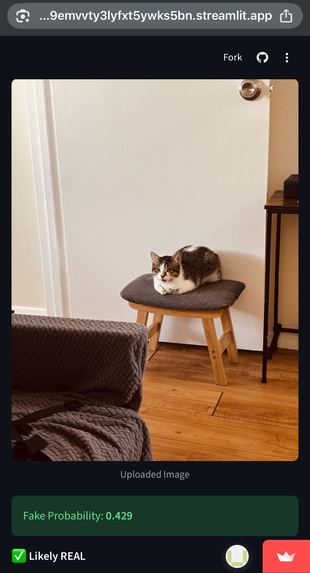
Frequency Based Only with Web Access
Inspiration
With the raising of the AI images populates around image, people some time easy to receive misleading information by the fake images. We are working on online website that is able to separate real image with the fake one. This program is special designed for the public influencer who have critical requirement on the authenticity of the information. Unlike two or three years ago, nowadays, fake image did a very good job in rendering of both the object and background. This weaken the ability for people to distinguish between two solely through visual sense.
What it does
The website will take an image from the user, download it and conduct hybrid, frequency-domain–based heuristic algorithm for AI image detection. As a result, the user will receive a fake probability to tell whether the image is fake or not.
How we built it
We implement our front-end through streamlit. Through the website design by streamlit, user is allowed to uploading image from photo library or taking from the camera. For the backend algorithm, we used opencv-python for Haar Cascade face extraction for crop relevant region. In addition to that, scipy and numpy is used to construct FFT (Fast Fourier Transform) and DCT (Discrete Cosine Transform). The energy ratio is extract through feature computation and we get the score through weighted tanh and sigmoid logistic fusion. We also implement a CNN model to compare with the FFT and DCT algorithm.
Challenges we ran into
In the beginning of the competition, we spent massive time on trying on separate deepfake video instead of picture. We soon realized that the challenge is much greater than what we expected. It not only taking significant amount of time to download, cut and process the video, but also have limited research done in this direction. We attempted in both mathematical frequency analysis and running a pre-train model but neither of two work. Therefore, we decided to switch our focus to AI image detector.
Accomplishments that we're proud of
We are able to get front-end working well with the back-end.


Log in or sign up for Devpost to join the conversation.