Inspiration
As of late, the New Jersey public school system has been plagued by incidents regarding AI-deepfakes of students being spread without the consent of said students, often targeting female students, with the Westfield incident in April 2025 and the Montgomery incident in April 2026. This has become a sad reality in today's world, as many people have to grapple with the effects
What it does
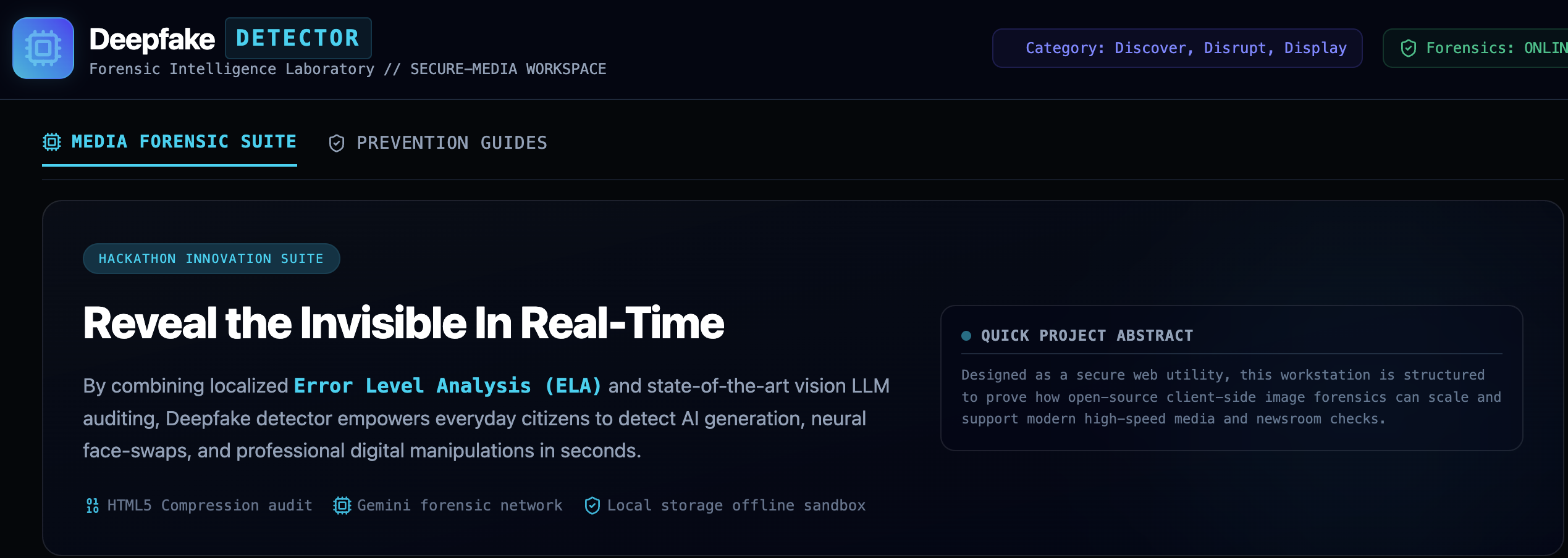
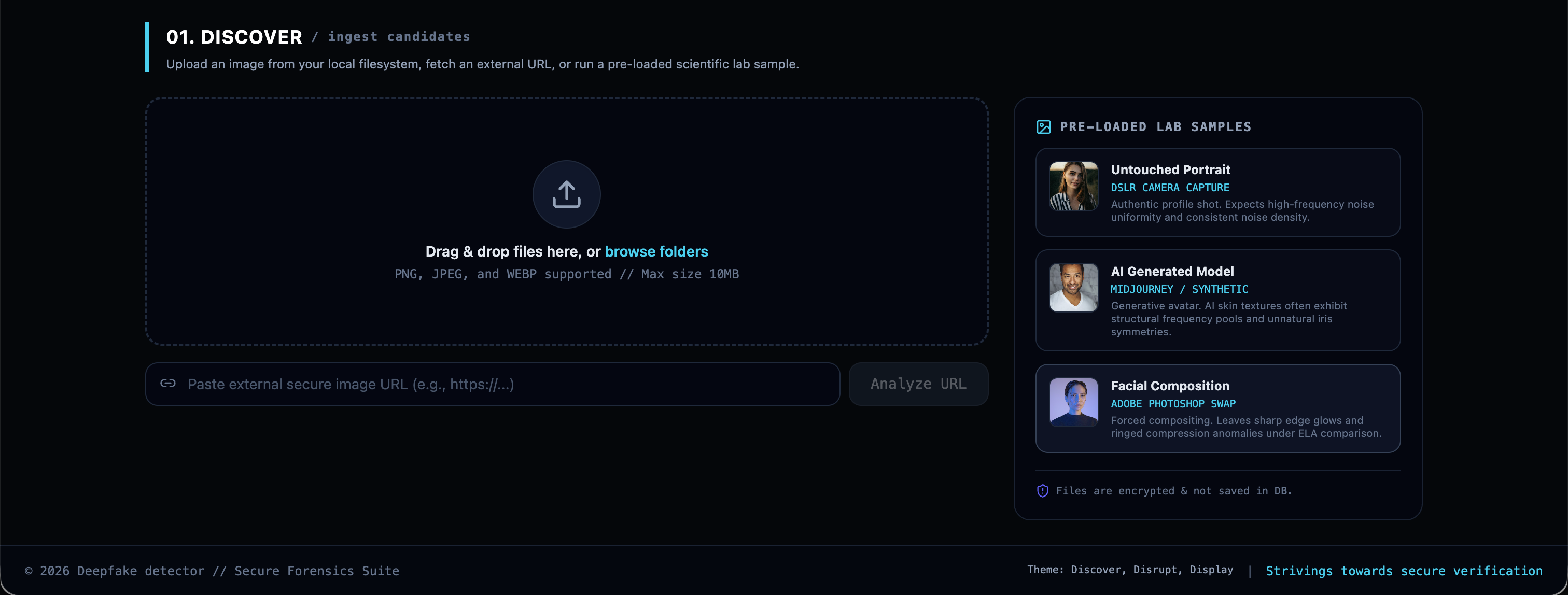
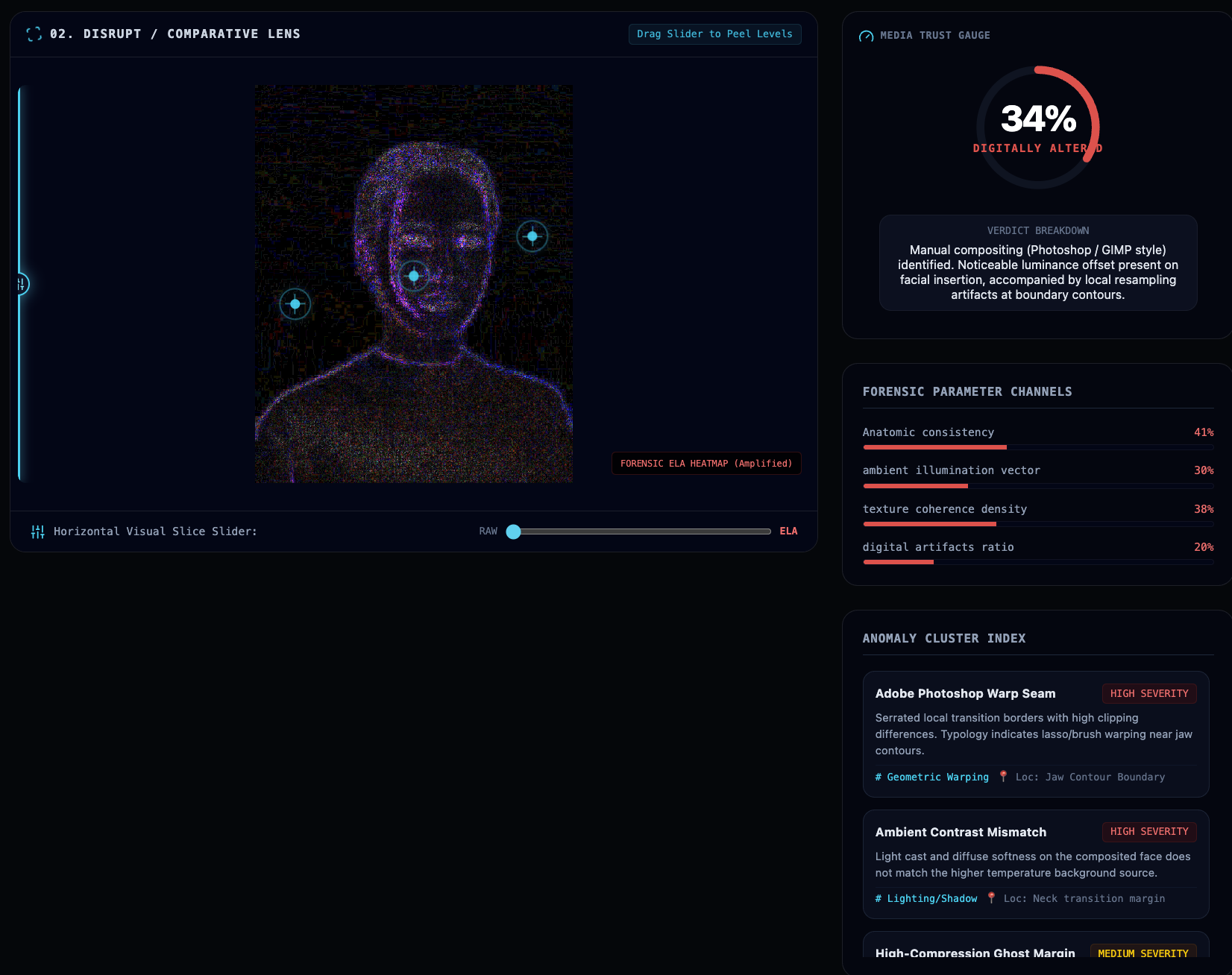
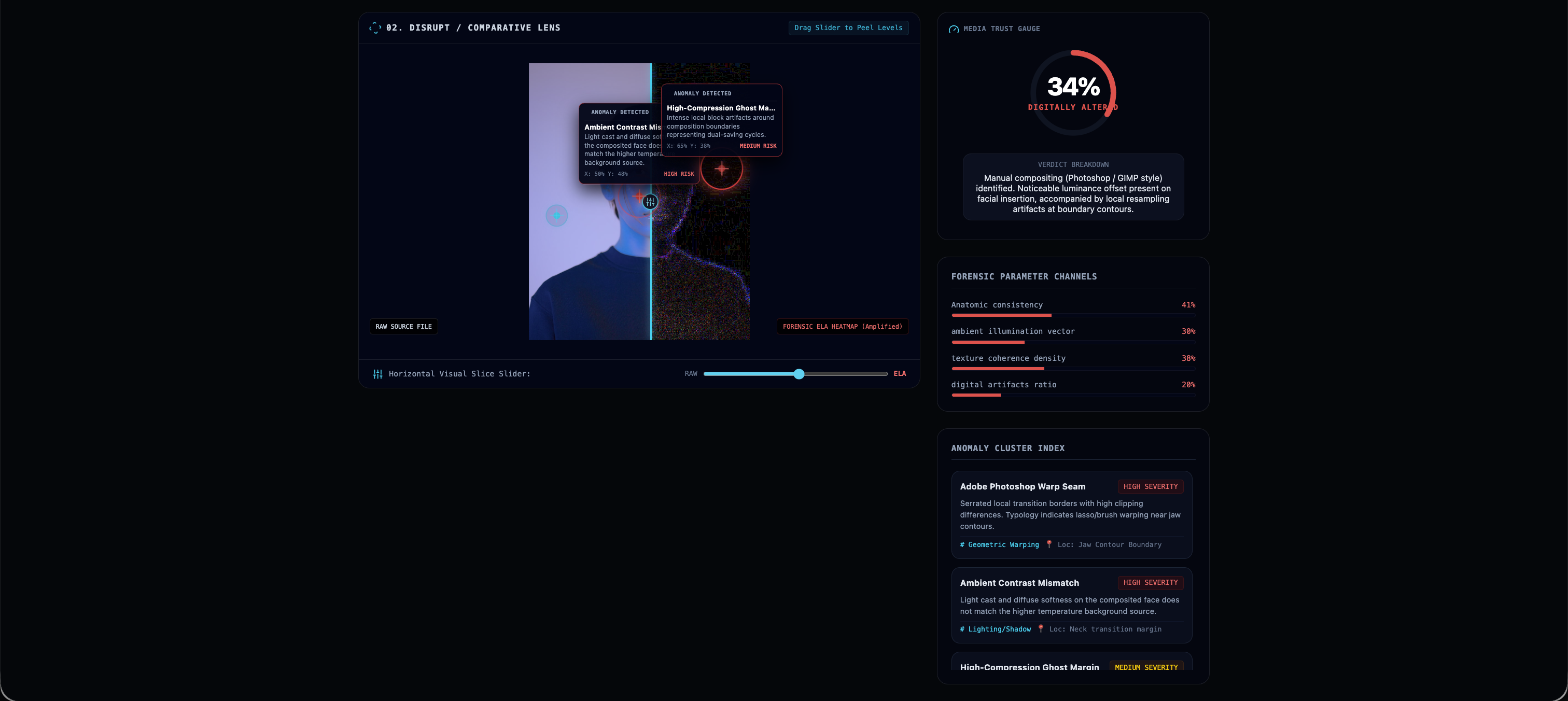
Users can drop any continuous image into our digital workspace. The app instantly performs a real-time Error Level Analysis (ELA) inside the browser, highlighting localized compression anomalies that point to pixel tampering. Simultaneously, a secure, server-side multimodal AI auditor performs a technical visual inspection—scanning biological features, lighting vectors, and metadata inconsistencies for signs of neural synthesis.
How we built it
The Web Client: Built with React, Vite, and TypeScript to create a lightning-fast single-page interface centered around high-contrast, cybersecurity-inspired telemetry themes styled entirely with Tailwind CSS. The Graphic Engine: Leveraged the native HTML5 Canvas API to handle complex pixel recalculations directly in the browser. Out-of-bounds frame blobs are compressed, re-rendered, and compared to calculate local error deltas on the fly. The Secure Server:Built a Node.js + Express backend to act as a secure proxy. This handles API request traffic securely, preventing any exposure of API coordinates or Gemini models to the browser, and returns type-safe JSON audit schemas.
Accomplishments that we're proud of
Interactive Crisis Training: Rather than writing a boring blog post about deepfake safety, we built a fully playable, branch-based voice-cloning call simulator. It successfully turns defense guidelines into a memorable, game-like experience that can actually protect a grandparent or child. In-Browser Graphic Manipulation: Getting the canvas-level pixel rendering for Error Level Analysis to calculate and draw on-screen in real-time, with smooth, adjust-on-the-fly threshold sliders, was a major math and engineering win.
What we learned
The Math Behind Splicing: We dived deep into how lossy compression structures (specifically JPEG matrices) are ruined when you insert foreign pixels. Creating our ELA module taught us how to spot microscopic differences in image grids mathematically. Game Scenarios & Human Psychology: Building the call simulator taught us how threat actors manipulate time-urgency and adrenaline. We learned that the safest response to voice spoofing is a behavioral process (hanging up and calling back independently), not a technical block. Type-Safe Full-Stack Architecture: Integrating the Google GenAI SDK with structured models on the backend taught us how to guarantee perfectly parsed, reliable JSON payloads to map results directly to UI components.
What's next for Deepfake Detector
Voice-Clip Upload Forensic Auditing: Expanding the ELA compression parser to let users drop .mp3 or .wav clips onto the interface to isolate synthetic frequency shifts, robotic stitching artifacts, and ambient room noise patterns.

Log in or sign up for Devpost to join the conversation.