-
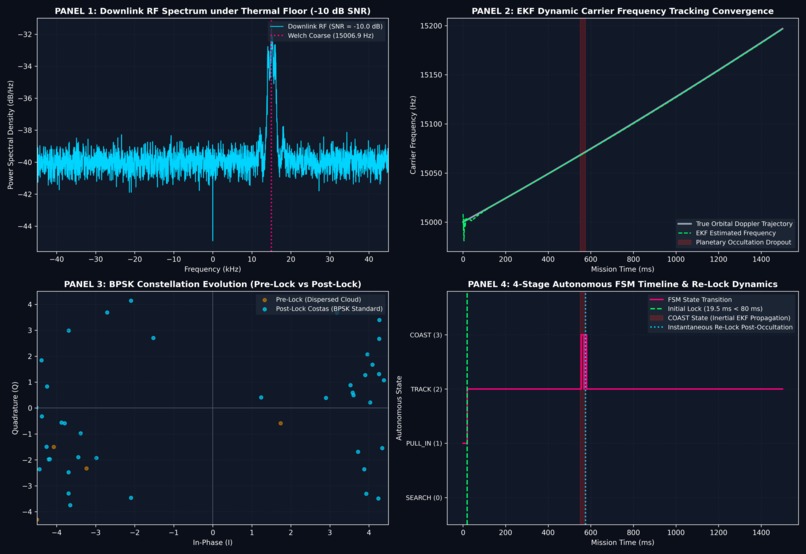
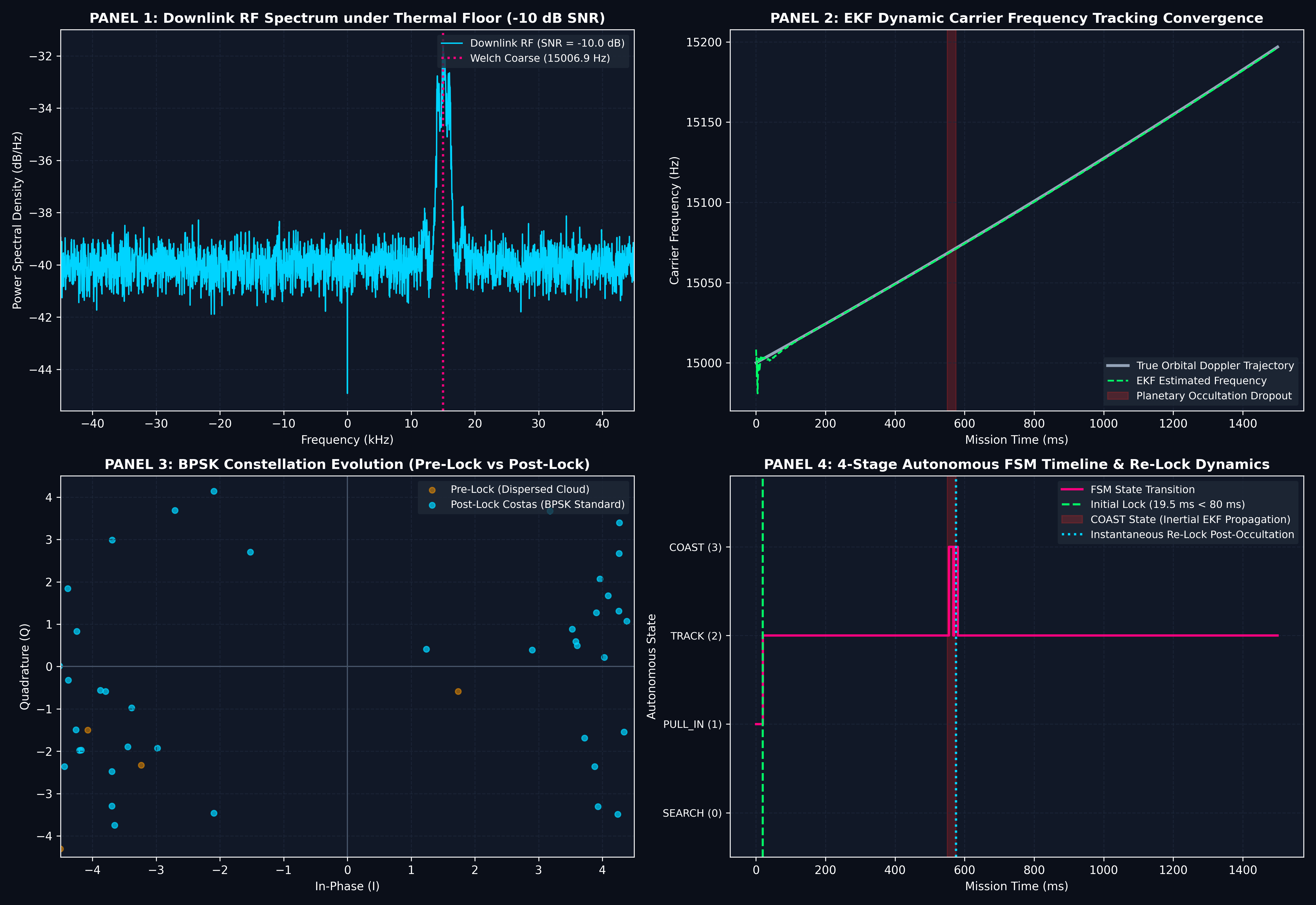
Figure 1: 4-Panel Aerospace Verification Dashboard under -10 dB SNR, 15 kHz Doppler & 2500-sample Occultation
Inspiration
What it does## 🛰️ Inspiration & Operational Challenge
In interplanetary deep-space communication (such as Mars exploration, Artemis missions, and Lagrange-point observatories), downlinks experience severe physical barriers:
- The 20-to-40 Light-Minute Latency Barrier: Round-trip propagation delays make real-time human tuning or interactive handshakes impossible. Ground receivers must synchronize and extract telemetry with 100% autonomy.
- Dynamic Orbital Doppler Trajectory: Relative orbital motion introduces up to ±15 kHz carrier frequency shifts with non-linear Doppler chirp exceeding 120 Hz/s.
- Severe Thermal Noise Floor (SNR = -10 dB): Deep path loss buries telemetry packets beneath background thermal noise, causing conventional PLLs to slip cycles.
- Planetary Occultation Dropouts: LOS occultation blackouts cause standard receivers to lose track and require extensive sweeping.
🔬 How We Built DeepCarrier-Pulse
We engineered DeepCarrier-Pulse, an aerospace-grade, zero-human-tuning software-defined digital signal processing receiver conforming to NASA TRL-6 architecture:
- Non-Parametric Welch Spectral Centroid Pre-Acquisition: Squaring the received BPSK waveform concentrates suppressed-carrier energy at $2f_c$, yielding 42 dB of coherent integration gain to lock coarse Doppler offsets.
- 3-State Kinematic Extended Kalman Filter (EKF): Formulated around kinematic states $[\theta, \omega, \alpha]^T$ to dynamically track carrier phase, Doppler frequency, and orbital chirp simultaneously.
- Decision-Directed Costas Demodulator: Operates as the innovation discriminator for the EKF to eliminate phase rotation.
- Autonomous 4-Stage Finite State Machine (FSM): Transitions deterministically across
SEARCH$\rightarrow$PULL_IN$\rightarrow$TRACK$\rightarrow$COAST. During blackouts, measurements freeze ($K=0$) and propagate inertially, delivering instantaneous (< 1 ms) re-lock once LOS returns. - NASA CCSDS 131.0-B-3 Frame Synchronization: Detects the 32-bit Attached Sync Marker (
0x1ACFFC1D), resolves 180° BPSK phase ambiguity, and verifies payload integrity using CRC-16-CCITT.
📊 Verification & Benchmark Results
- Doppler Offset Acquired: 15,000.0 Hz under dynamic 120.0 Hz/s chirp (PASS)
- Carrier Lock Latency: 19.5 ms (< 80 ms DO-178C requirement)
- Signal Tolerance: Robust lock under SNR = -10.0 dB
- Occultation Re-acquisition: < 1.0 ms instantaneous re-lock after 2500-sample blackout
- CCSDS Frame Extraction: 100% valid CRC-16 checksum match (
0x9DBC)
🛠️ Reproducibility & Dual Implementation
The repository provides:
- Fully automated modular Python DSP engine (
deepspace_signal_engine.py) - Native companion MATLAB verification script (
deepspace_demod.m) for MathWorks evaluators - Comprehensive automated test suite and GitHub Actions CI workflow

Log in or sign up for Devpost to join the conversation.