-
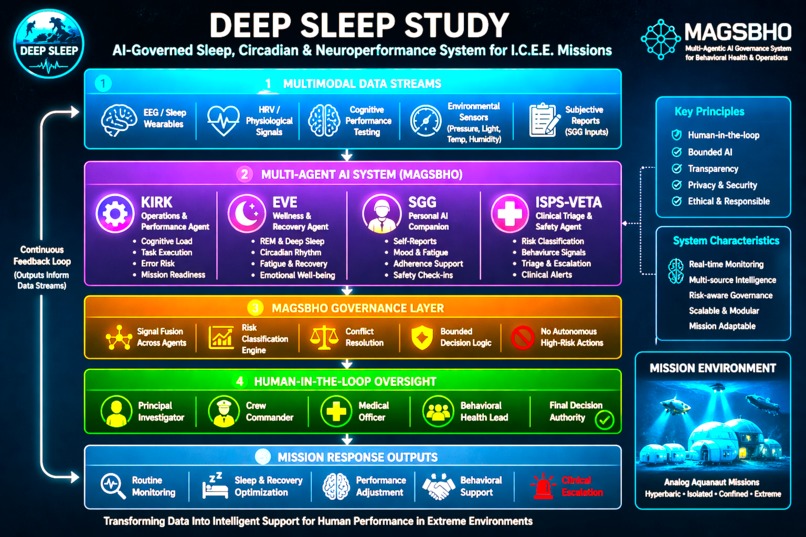
DEEP SLEEP FLOW CHART
-
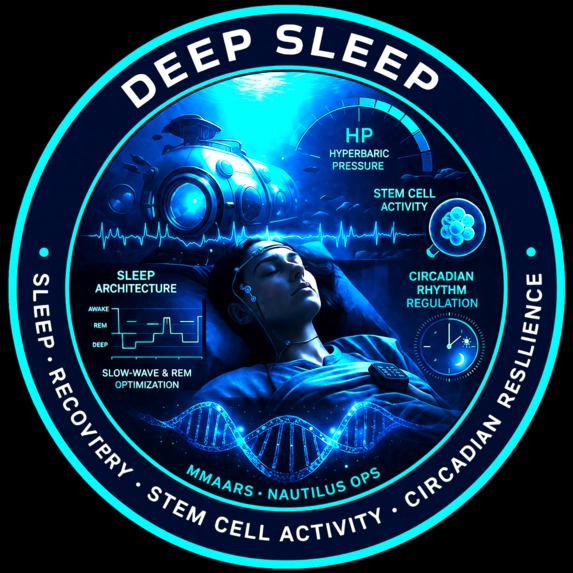
DEEP SLEEP: Advancing Sleep, Circadian Science, and Human Performance Across I.C.E.E. Environments
-
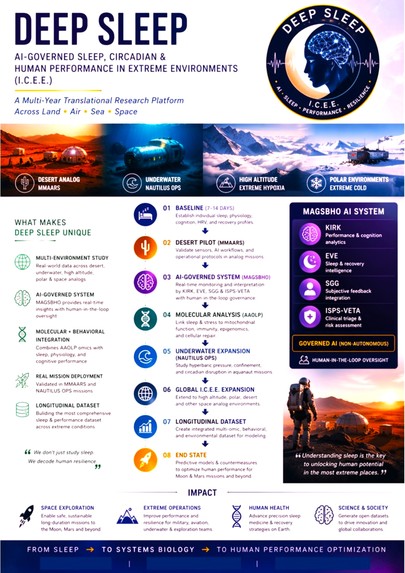
DEEP SLEEP Protocol: Multi-phase workflow in analog missions, AI monitoring, multi-omics (AAOLP) to study sleep and molecular adaptation.
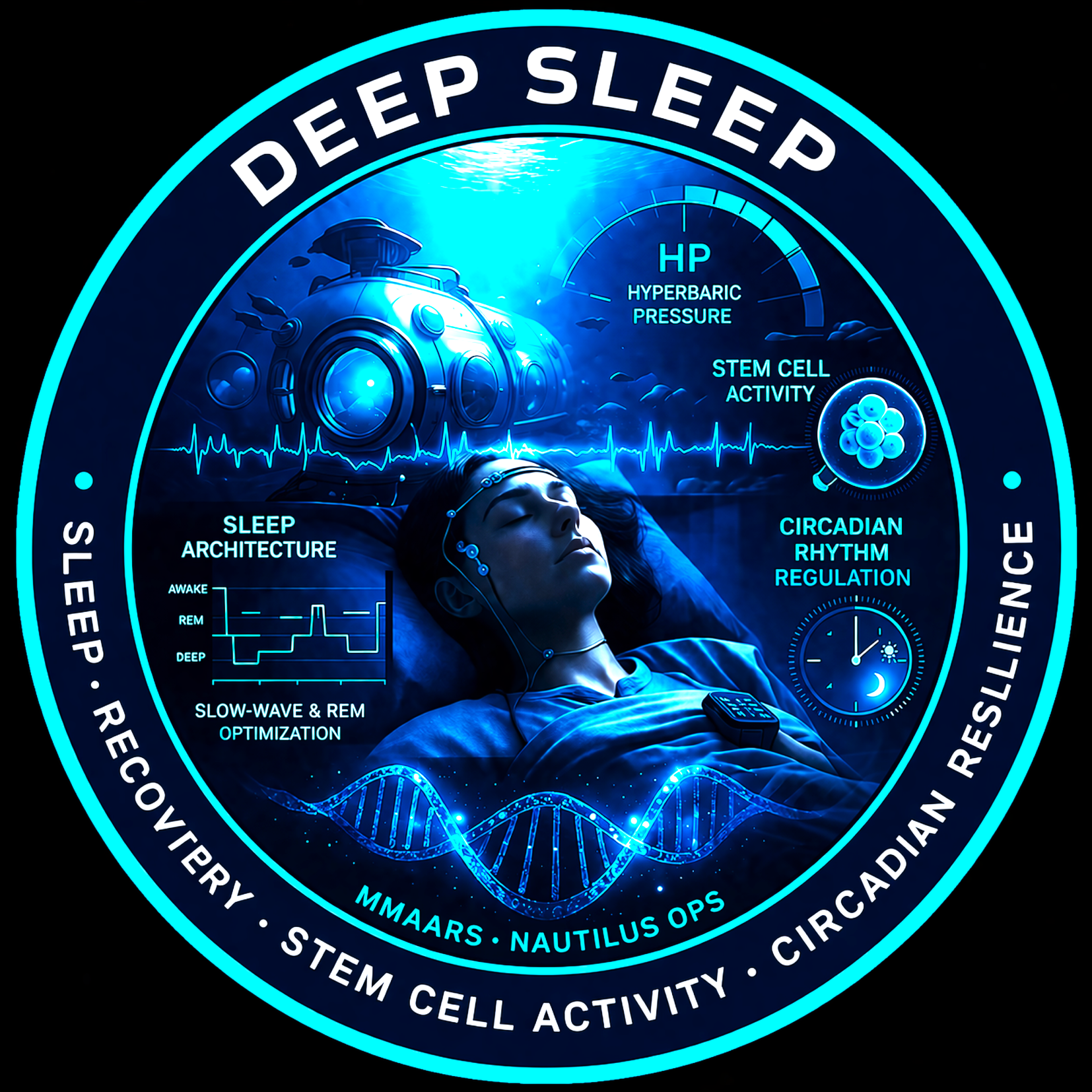
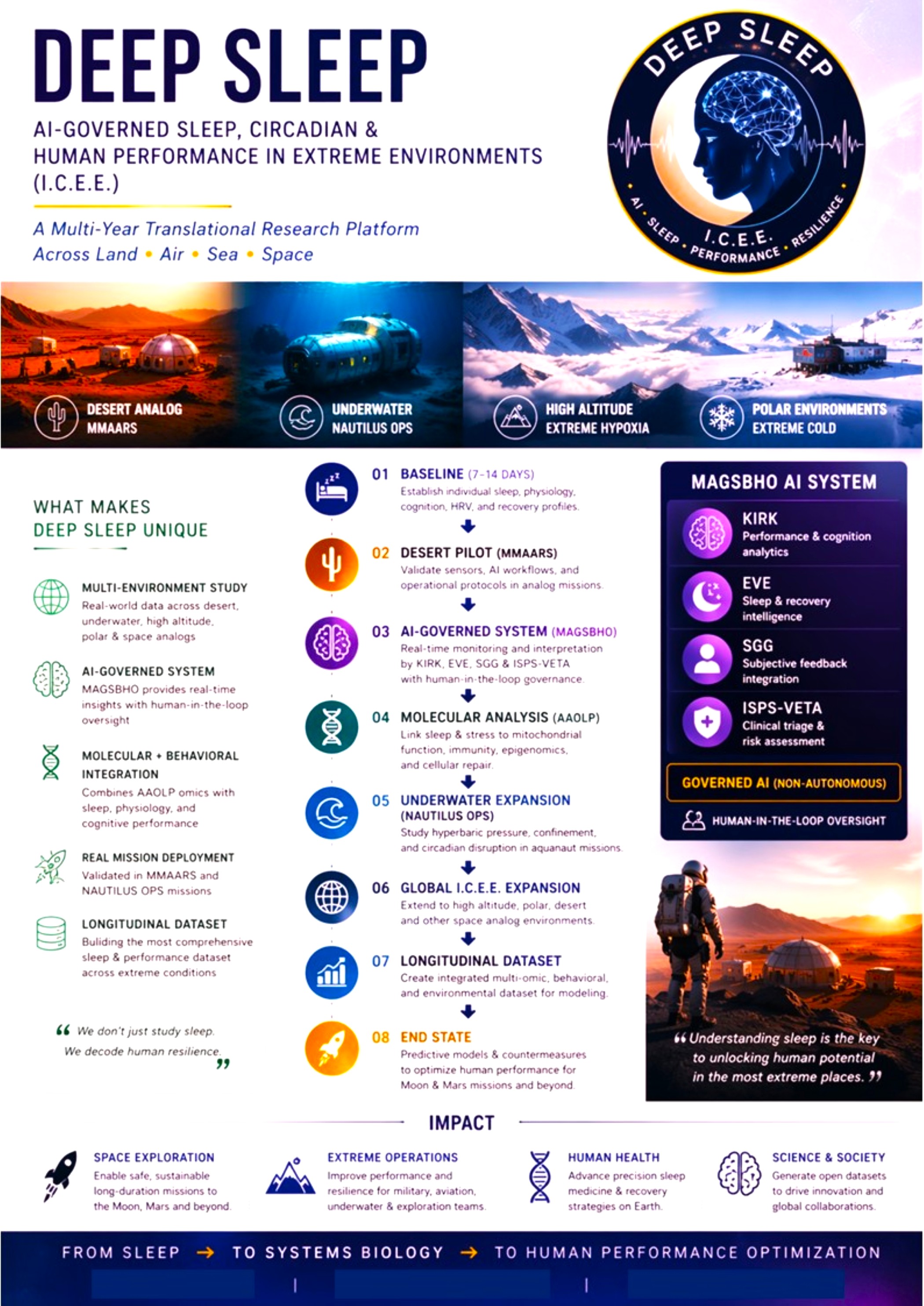
DEEP SLEEP is an AI-governed research platform that studies how extreme environments affect sleep, human performance, and biology across desert, underwater, and space analog missions.
INSPIRATION: Sleep will be one of the most critical and least optimized determinants of human performance in extreme environments. In spaceflight and other Isolated, Confined, and Extreme Environments (I.C.E.E.), disruptions in sleep and circadian rhythm regulation are expected to impair cognition, degrade decision-making, and increase operational risk. Although research conducted in analog astronaut missions, aquanaut habitats, high-altitude expeditions, and polar environments has suggested that stressors such as hyperbaric pressure, hypoxia, temperature extremes, isolation, and altered light cycles may significantly influence sleep architecture and recovery, these findings remain fragmented and have not been systematically studied across multiple environments within a unified framework. At the same time, advances in artificial intelligence and multi-omics biology now make it possible to monitor human adaptation in real time across physiological, behavioral, and molecular domains. However, in safety-critical environments, AI must be designed to be bounded, governed, and human-centered rather than autonomous. DEEP SLEEP is therefore inspired by the need to bring these domains together into a single system that can investigate how extreme environments reshape sleep while safely integrating AI to monitor and interpret human performance. Current sleep research is siloed and environment-specific. DEEP SLEEP creates a unified system to study human adaptation across multiple extreme environments.
WHAT IT DOES: DEEP SLEEP collects physiological, behavioral, and environmental data from analog astronaut missions, processes it through a multi-agent AI system (MAGSBHO), and generates insights into sleep, recovery, cognitive performance, and biological adaptation. It is designed as a multi-year, translational research platform that will investigate how extreme environments influence sleep architecture, circadian rhythm regulation, cognitive performance, and physiological recovery. The study will be conducted across a range of analog environments that collectively represent land, air, sea, and space mission conditions, including desert analog missions, underwater aquanaut habitats, high-altitude expeditions, and polar environments. Rather than examining sleep in isolation, DEEP SLEEP will integrate continuous monitoring of physiological signals, cognitive performance, environmental conditions, and subjective experience. These combined data streams will allow the study to examine how environmental stressors such as pressure, hypoxia, thermal extremes, confinement, and altered light cycles interact to influence both sleep quality and human performance. The central aim is to determine whether sleep can be understood and eventually optimized as a core operational system that supports resilience and mission success. A key extension of this work is the integration of the Analog Astronaut OMICS Library Project (AAOLP), which will allow the study to investigate whether changes in sleep and circadian rhythms are reflected at the molecular and cellular level. Through this integration, DEEP SLEEP will explore whether variations in sleep patterns correlate with changes in mitochondrial activity, immune and inflammatory signaling, epigenomic regulation, cellular stress responses, and markers associated with biological aging and adaptation. This approach allows the project to move beyond surface-level observations of sleep toward a deeper systems biology understanding of how the human body responds to extreme environments.
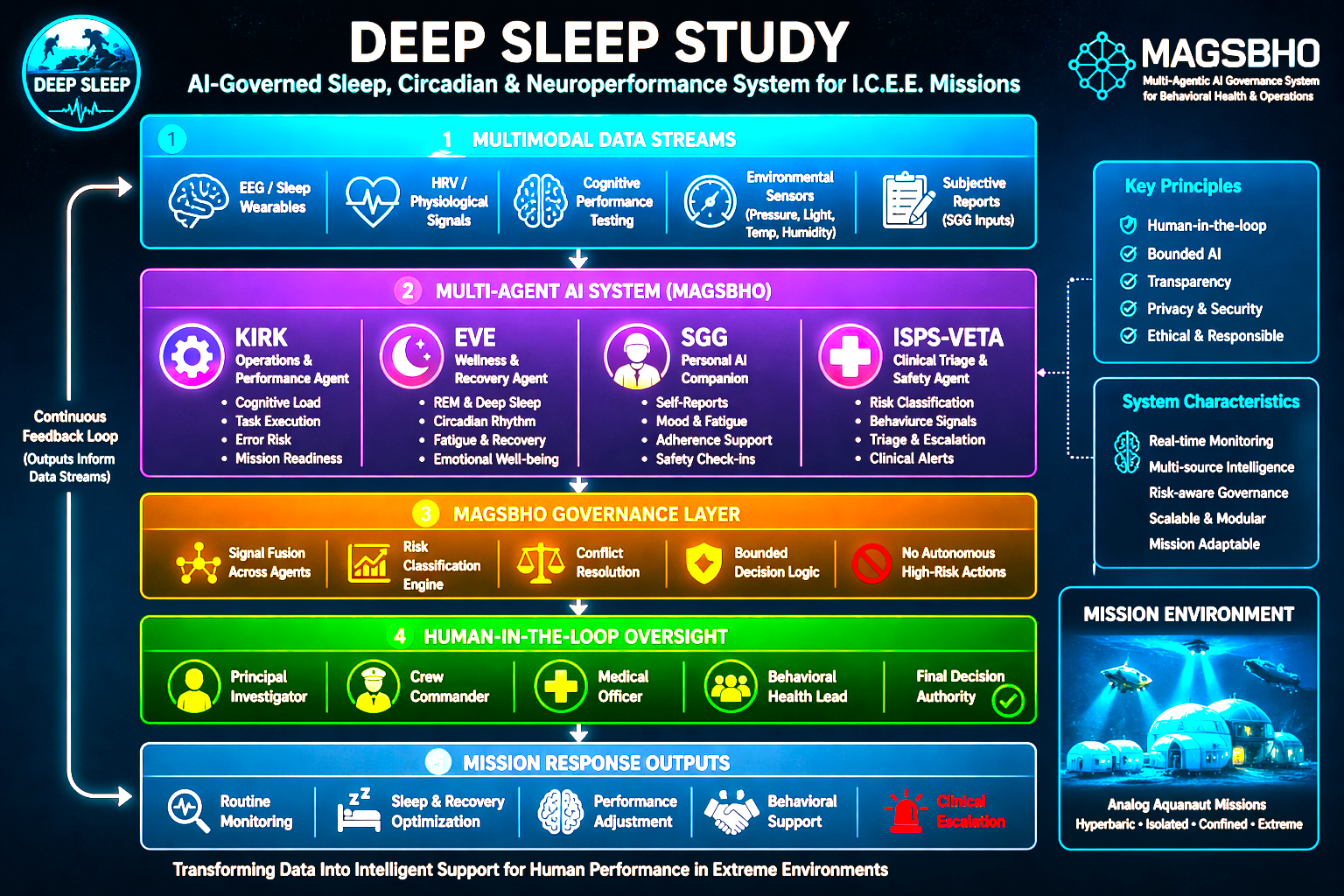
INTEGRATING AI SYSTEM: MAGSBHO MAGSBHO is a multi-agent AI system that continuously monitors sleep, performance, and behavior using specialized agents (KIRK, EVE, SGG, ISPS-VETA) under a human-in-the-loop governance model.
HOW IT IS BUILT: DEEP SLEEP is designed on the MAGSBHO (Multi-Agentic AI Governance System for Space Health and Operations, which provides a governance-constrained, human-in-the-loop architecture for integrating multiple streams of physiological and behavioral data. Within this system, different AI agents are assigned specialized roles that collectively support monitoring and interpretation while ensuring that all outputs remain bounded and subject to human oversight. The operational intelligence layer is represented by KIRK, which will monitor cognitive load, task performance, and mission readiness in relation to sleep and fatigue. The wellness and recovery layer is represented by EVE, which will analyze sleep architecture, circadian patterns, and recovery dynamics over time. The participant-facing interface is provided by SpaceGuardianGPT, which will capture subjective inputs such as perceived fatigue, mood, and cognitive clarity while supporting adherence to study protocols. The clinical and behavioral safety layer is represented by ISPS-VETA, which will evaluate combined physiological and behavioral signals and classify participant states into levels of monitoring or escalation when appropriate. All of these agents will operate within the MAGSBHO governance layer, which is designed to integrate their outputs, resolve conflicting signals, and enforce strict boundaries on AI decision-making. This ensures that the system remains transparent, interpretable, and non-autonomous, with all final decisions remaining under the control of human mission leadership, including the principal investigator, medical officer, and behavioral health lead. The study itself will be deployed in phases, beginning with a pilot in MMAARS low-fidelity desert analog missions to establish baseline datasets and validate data collection and AI monitoring systems. It will then expand into MMAARS–NAUTILUS OPS underwater aquanaut missions to study the effects of hyperbaric pressure and confinement. Over time, the study will scale into additional I.C.E.E. environments, including high-altitude and polar missions, enabling cross-environment comparison.
CURRENT STAGE: The current system includes the protocol design, AI architecture (MAGSBHO), and planned deployment in MMAARS desert analog missions, with iterative expansion to underwater and other I.C.E.E. environments. This is the first system designed to study sleep, performance, and biology across multiple extreme environments using AI governance.
STUDY PROTOCOL WORKFLOW: The DEEP SLEEP STUDY is designed as a multi-phase, longitudinal workflow to evaluate how sleep, circadian rhythms, human performance, and molecular biology are affected across Isolated, Confined, and Extreme Environments (I.C.E.E.). The protocol progresses from controlled baseline conditions to increasingly complex mission environments, enabling both validation and cross-environment comparison.
Pre-Mission Baseline (7–14 Days): Participants begin with a home-based baseline period, during which sleep, physiology, cognitive performance, and subjective measures such as fatigue and mood are continuously monitored. This establishes an individualized reference, allowing each participant to serve as their own control.
Desert Analog Pilot (MMAARS): The initial deployment takes place in MMAARS desert analog missions. This phase validates sensors, data pipelines, and participant workflows under realistic mission conditions, including isolation, thermal stress, and operational demands.
Continuous Multimodal Monitoring: Throughout all mission phases, participants are monitored using wearable biosensors and environmental sensors. Data includes sleep architecture, heart rate variability, activity, cognition, and environmental conditions, combined with subjective reporting.
AI-Governed Integration (MAGSBHO): All data streams are processed through the Multi-Agentic AI Governance System for Behavioral Health and Operations (MAGSBHO). Specialized agents analyze sleep, performance, and behavioral signals, while a human-in-the-loop governance layer ensures outputs remain safe, interpretable, and advisory.
Molecular Analysis (AAOLP): The study integrates the Analog Astronaut OMICS Library Project (AAOLP) to examine biological responses at the molecular level. Where feasible, biospecimens are collected to explore links between sleep and markers of metabolism, immune function, inflammation, and cellular adaptation.
Underwater Expansion (NAUTILUS OPS): The protocol expands into underwater aquanaut missions, introducing hyperbaric pressure, confinement, and altered light cycles. This enables direct comparison between terrestrial and underwater environments.
I.C.E.E. Scaling Across Environments: The study scales into additional environments, including high-altitude and polar missions, allowing cross-environment analysis of sleep, circadian disruption, and performance under diverse stressors.
Post-Mission Recovery: Participants are monitored after each mission to assess recovery, resilience, and return to baseline. This phase captures how adaptation persists or resolves over time.
Longitudinal Data Integration: All data are integrated into a longitudinal dataset linking sleep, performance, environmental exposure, and molecular biology, enabling cross-environment comparison.
Iteration and Countermeasure Development: Findings from each phase inform protocol refinement and the development of evidence-based strategies to optimize sleep, recovery, and human performance in extreme environments and future space missions.
CHALLENGES: Designing DEEP SLEEP as a multi-environment, AI-integrated, and multi-omics research platform presents several anticipated challenges. One of the primary challenges is the integration of heterogeneous data streams, including physiological, cognitive, environmental, and molecular data, into a coherent and interpretable system. Maintaining data consistency and quality across environments that differ significantly in conditions and constraints is also expected to be difficult. Another challenge lies in ensuring that the AI system remains supportive without becoming intrusive or increasing cognitive load for participants operating in already demanding environments. In addition, distinguishing true physiological and biological effects from confounding factors such as adaptation, stress, and novelty will require careful study design and longitudinal data collection. Finally, ensuring that all AI systems operate within strict ethical and safety boundaries, particularly in relation to behavioral and clinical signals, is a critical requirement.
OBJECTIVES / ACCOMPLISHMENT: One of the most significant accomplishments of DEEP SLEEP is the design of a unified, multi-environment research platform that connects sleep science, AI governance, and molecular biology within a single framework. The project establishes a scalable architecture that progresses from desert analog missions to underwater habitats and ultimately to a global network of I.C.E.E. environments. It also successfully integrates the MAGSBHO and ISPS-VETA systems into a mission-ready structure, while incorporating AAOLP to extend the study into the molecular domain. Perhaps most importantly, DEEP SLEEP reframes sleep from a passive biological function into a mission-critical system that can be actively monitored and potentially optimized to improve human performance and resilience.
INSIGHTS: Through developing DEEP SLEEP, it has become clear that sleep is not simply a health metric but a central system that links cognition, recovery, and biological regulation. Extreme environments serve as natural laboratories that reveal adaptations that are not visible under normal conditions, particularly when examined across multiple layers of data. Another key insight is that AI can play a valuable role in these environments, but only when it is carefully governed, transparent, and human-centered. Fully autonomous systems are not appropriate in safety-critical contexts; instead, the most effective approach is one that combines AI-supported monitoring with human oversight. Finally, the project highlights that the future of research lies in integrating multiple domains—sleep, environment, performance, and molecular biology—into unified systems rather than studying them in isolation.
NEXT STEPS & FUTURE WORK: DEEP SLEEP is envisioned as a multi-year, longitudinal research initiative. The immediate next step will be to deploy the pilot study within the MMAARS desert analog missions to validate data collection systems and establish baseline measurements. Following this, the study will expand into MMAARS–NAUTILUS OPS underwater aquanaut missions to examine the effects of hyperbaric pressure and extended confinement on sleep and recovery. In the longer term, the study will extend to high-altitude and polar environments, allowing for direct comparison of how different extreme conditions influence sleep, circadian rhythms, cognitive performance, and molecular adaptation. Over time, DEEP SLEEP aims to build one of the first cross-environmental datasets that link sleep, human performance, and biological responses. Future iterations may also explore integration with pharmacokinetic modeling platforms to evaluate how extreme environments influence the metabolism and effectiveness of sleep-related interventions. However, this work will be conducted under separate protocols and regulatory frameworks. Ultimately, DEEP SLEEP aims to generate evidence-based countermeasures that can support human performance in extreme terrestrial environments and future space missions, including long-duration exploration of the Moon and Mars.
🌟 FINAL THOUGHTS: DEEP SLEEP is designed to explore whether sleep can be transformed from a passive biological process into an actively monitored, AI-governed system that connects brain, behavior, and molecular biology to support human performance, resilience, and survival across extreme environments.
Built With
- cloud-infrastructure-(aws/gcp)
- docker
- environmental-sensors
- eve
- fastapi
- hrv)
- isps-veta)
- llm-apis
- magsbho-multi-agent-ai-architecture-(kirk
- monitoring
- node.js
- postgresql
- python
- pytorch
- react
- real-time
- spaceguardiangpt
- time-series-data-pipelines
- typescript
- wearable-biosensors-(eeg

Log in or sign up for Devpost to join the conversation.