Inspiration
For most of history, wisdom was handed down: from grandparents, from neighbours, from people who had already lived through it. Today we are more likely to ask a search engine or an AI model, and the answer comes from no one in particular. It often leaves us informed, but no less alone. Deep Rooted Guidance seeks to rebuild that bridge. It opens centuries of private letters, diaries and memoirs as a window into people's lives, and finds those who have been where you are. We were inspired by two themes: connecting things in a new way, and exploring a new world. A new world isn't always tomorrow; there is so much about yesterday that we haven't explored yet. All three members of our group are neurodivergent, so we wanted a tool that gives words to people who struggle to capture or understand what they are feeling. We wanted it to be active and easy to use: people read real thoughts and then reflect, write and process, rather than just being told an answer. The project is also a homage to The Consolations of Philosophy. Harry's dad gave him the book during a difficult breakup. Its section on Arthur Schopenhauer gave him so much comfort: someone out there had experienced what he was feeling, and had thought hard about how to move forward. Emile knows the feeling too. He reads a lot, and time and again he finds a writer describing something he recognises in himself, often with advice that applies directly to his own life. He is surprised every single time. You would think he'd have learned by now. Harry had someone to hand him the right book. Not everyone does. We wanted to build that for them: the empathy, hope and guidance of writers and thinkers who lived it, where today they might only ask an AI model.
What it does
It is the human condition to know only our own inner life, and so to believe that what we feel is ours alone. It can be a lonely thing to believe, and worse, hold us back. But everyone before us has believed the same. We aim to let you read them in their own words. We bring real voices and wisdom from the past to help people process in an increasingly isolated and AI-generated world.
Deep Rooted Guidance is a guided journal that answers you with real letters, stories and art:
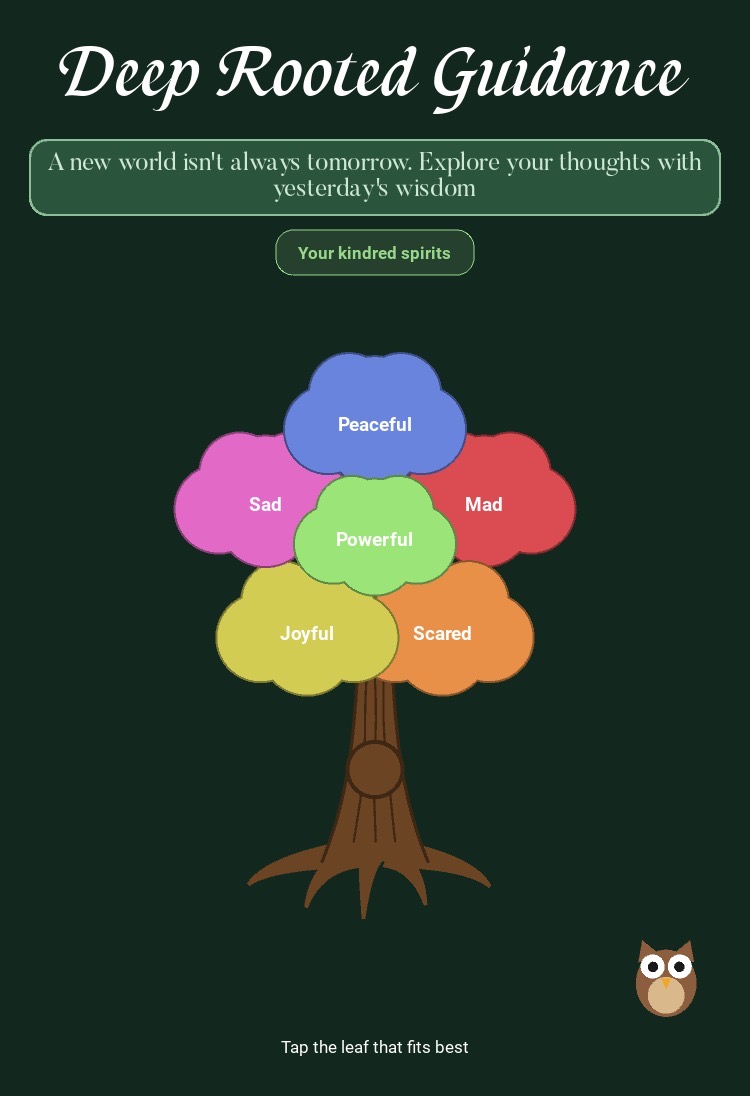
- Start at the trunk. The app opens on a tree of six core feelings: sad, scared, mad, joyful, powerful and peaceful. Pick the one closest to how you feel.
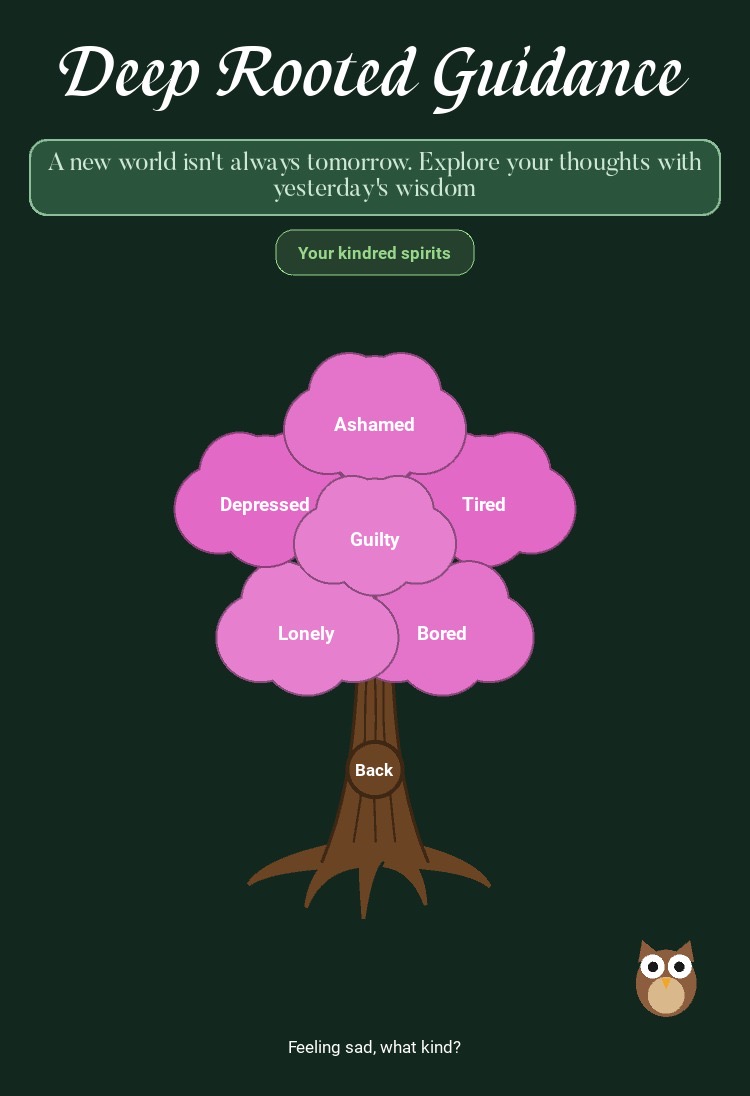
- Follow the branch. Each feeling splits into six more exact ones, 36 in all. "Sad" might become "abandoned" or "ashamed". This is where you find the word you couldn't find on your own.
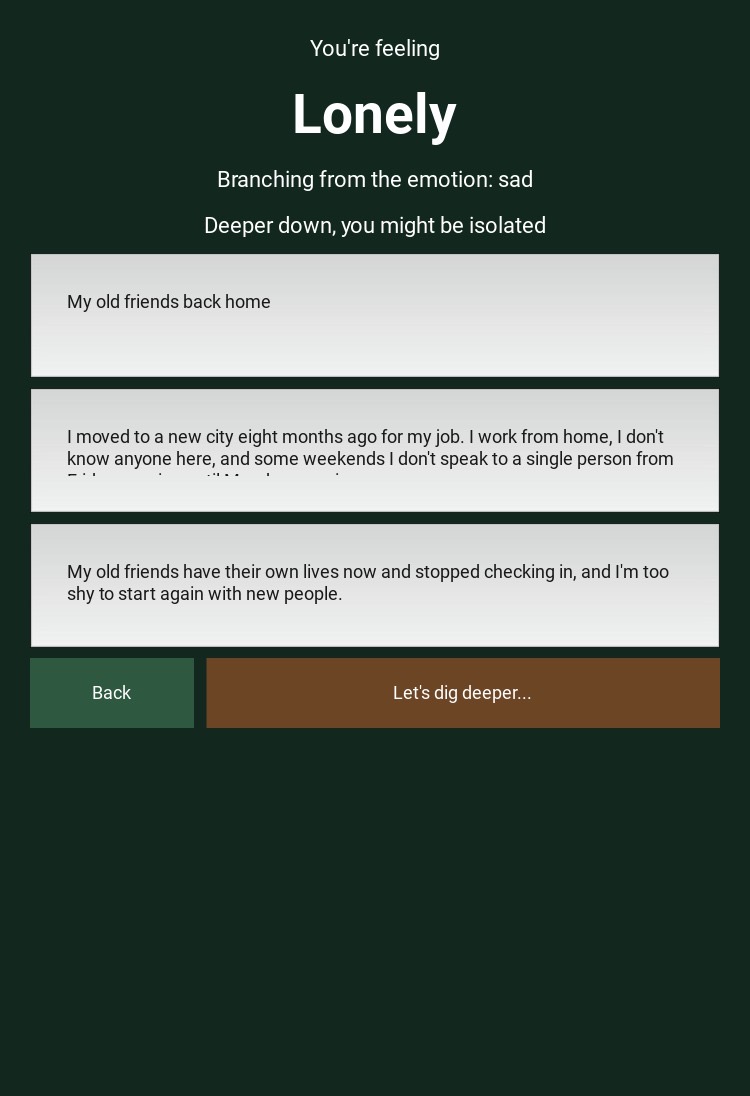
- Say what happened. Three short questions help you set it out: what happened, how it left you feeling, and what it means to you. No essay needed, a line each is enough.
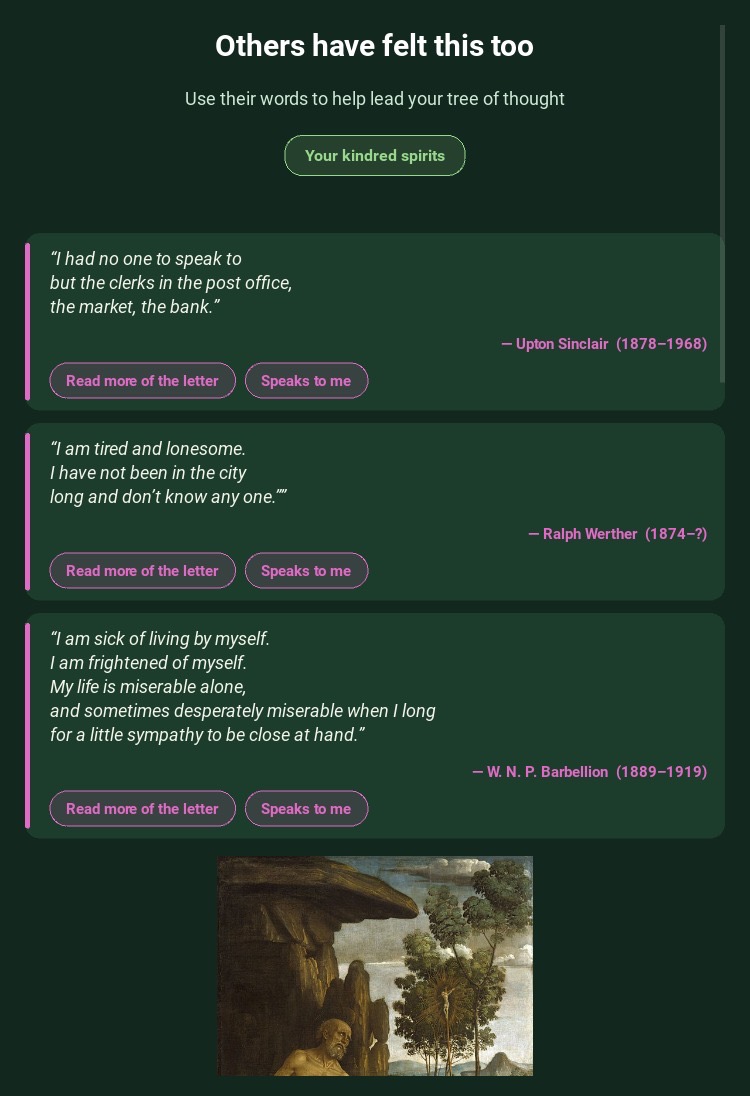
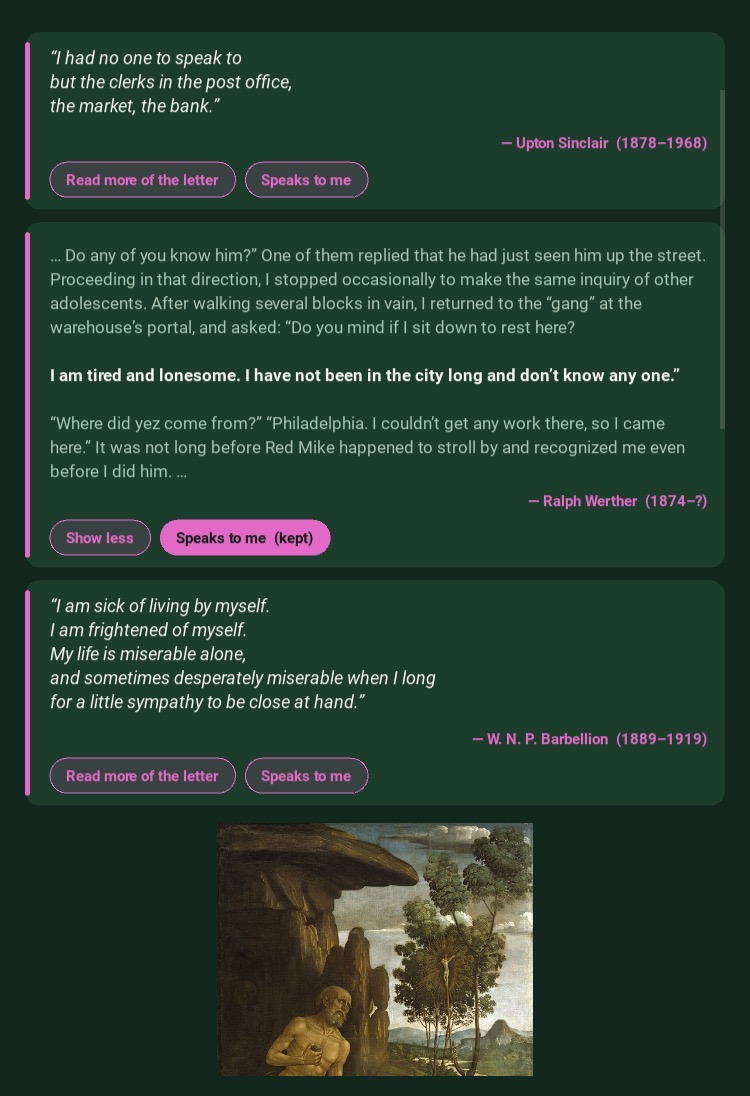
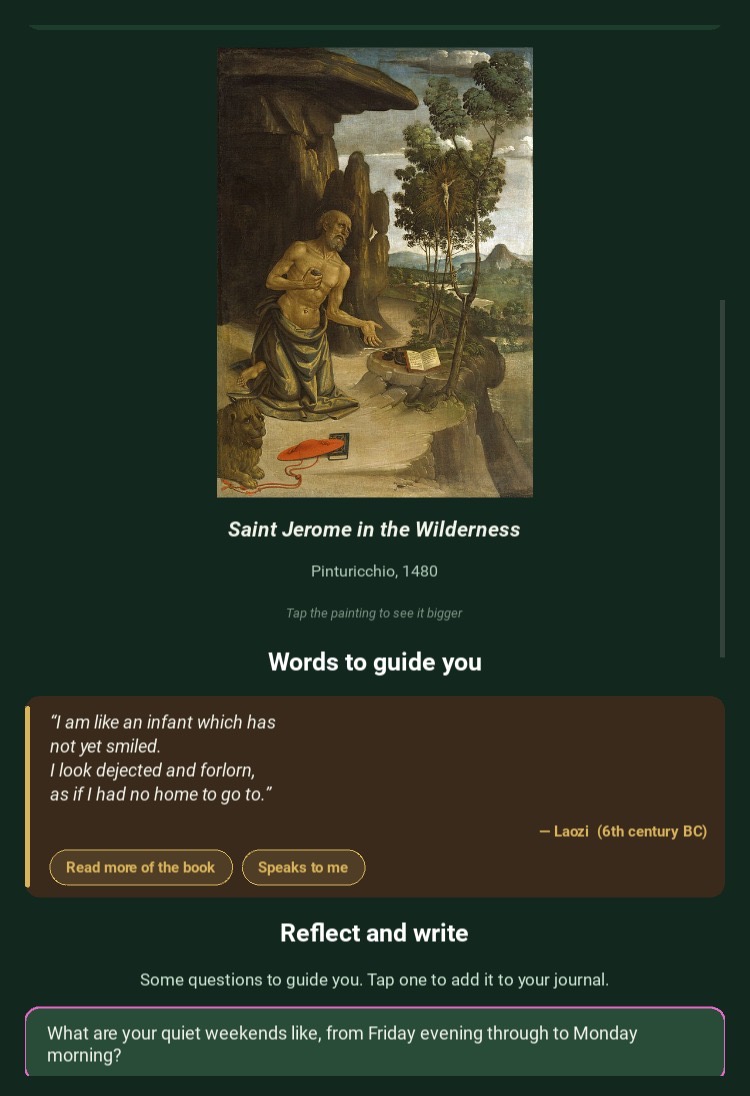
- Go down to the roots. The app currently searches 115,380 passages from real letters, diaries and memoirs, and brings back people who were in the same position, each with their name and the year they wrote.
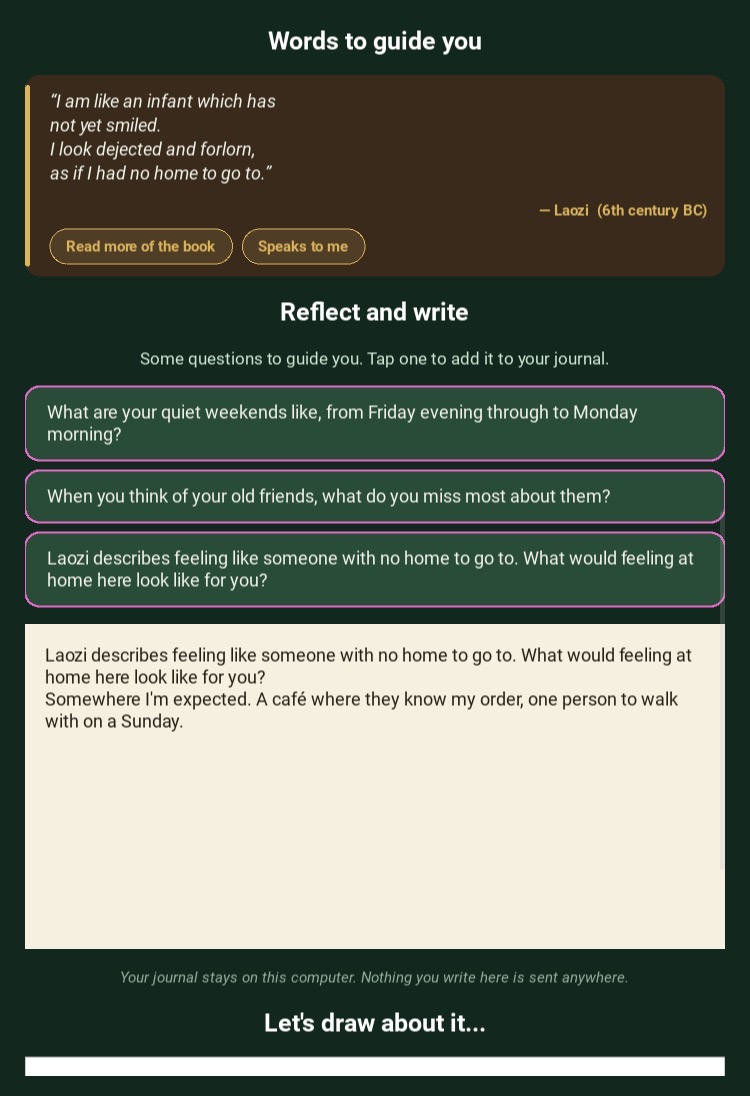
- Hear from the thinkers. Alongside them comes a passage from one of 19 works of philosophy and wisdom: someone who met the same trouble and reasoned their way through it.
- Look. A painting chosen for the feeling sits beside the words.
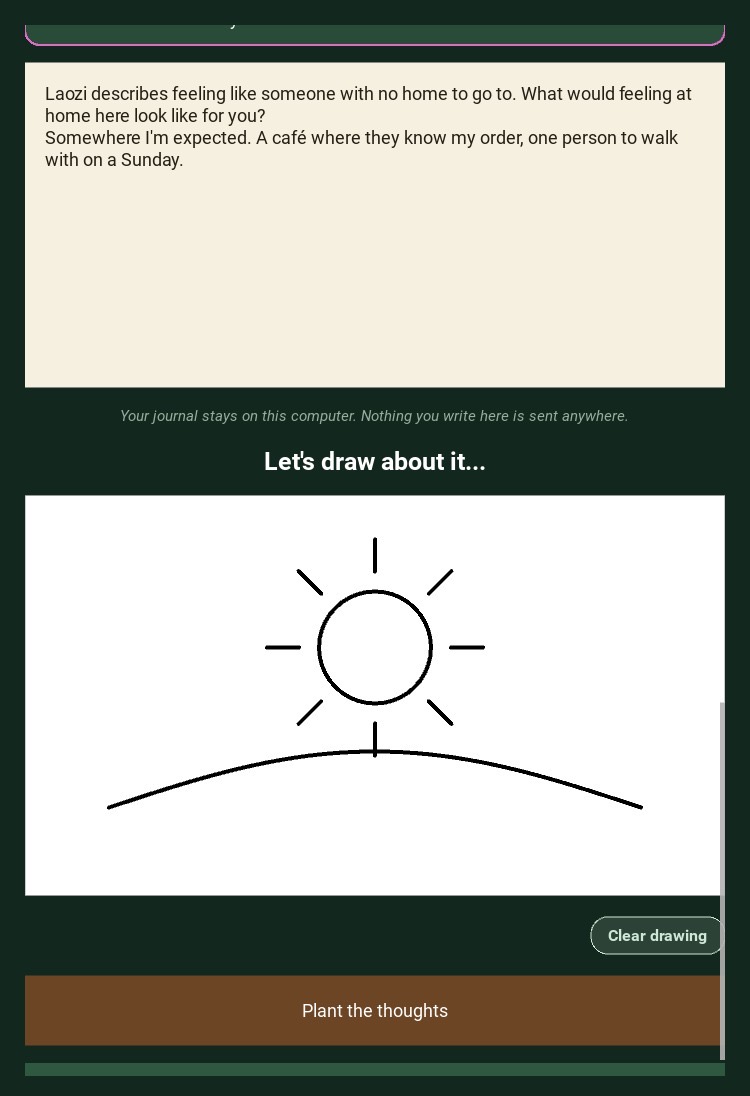
- Write your own. Three prompts and a blank page. Your entry is saved to a journal that stays on your device, so it is yours alone. It doesn't give absolute answers. It encourages active thinking, and helps to foster the feeling that you are not alone.
How we built it
Team: Erin built the frontend, Emile built the backend, and Harry handled content creation, ideation and research.
- Stack: Python, with a Kivy app, a Python backend, a Node and Express relay between them, and SQLite for the libraries. The libraries:
- Letters, diaries and memoirs: 115,380 short first-person passages by 393 writers, from public-domain books on Project Gutenberg. Each is stored with its exact position in the original. Our first build had about 4000.
- Philosophy and wisdom: 29,576 passages from 19 books.
- Paintings: 36, one for each feeling on the tree, chosen using a published dataset of how artworks make people feel (WikiArt Emotions). Curation: we chose letters, diaries and memoirs because they show people's inner lives as they were lived, written without an audience in mind. Famous writers make up 65% of the library, so we aim for at least one lesser-known writer if they pass the minimum similarity. We have also curated a wider set of writers from beyond Europe and broader in time, which is next to be added.
At a high level, the system tries to find someone who was facing the same fundamental situation as you, whatever century they lived in. To search for a feeling, a computer has to simplify it: into a word on a tree, a short sentence, a list of numbers. Every step loses something, and no framework does this perfectly. So we use the boxes only to find candidates, and what you finally read is a real person's full words, not a category. The backend is a Python service behind a Node and Express relay. One request runs a five-stage pipeline: screen, rewrite, retrieve, rerank, verify.
Matching:
- An NLP embedding model finds relations between sentences, and scores every passage against emotions we chose as fundamental anchor concerns, such as loneliness, grief and rejection.
- A large language model reframes the user's input using sensible curated questions. Think: could someone in the 1700s have written this sentence about their own life? The input is broken down into three parts: the event, the feeling and the reason. This draws on empathic similarity research (Shen et al., 2023), which describes a personal story by its central event, main emotional response and key takeaway. By capturing these, we can find writings a person is likely to empathise with.
- The embedding model scans the whole database to find similarities in both meaning and emotion, producing a shortlist of twenty.
- A more advanced LLM reads the shortlist in context and picks the passages where the writer is in the same position as you.
AI doesn’t write the wisdom. Every historical passage you read is real, and checked word for word against its source.
Under the hood:
- Scale: 115,380 passages from 639 books by 393 writers, each stored with its exact position in the original.
- Speed: the whole library is scored in 19 milliseconds, as a single matrix operation.
- Cost: shortlisting first makes a search about 5,700 times cheaper than having the model read everything: for less than a cent, not $60.
- Anisotropy correction: two random passages scored 0.20 similar just for being old prose. Subtracting the library's average vector brought that to 0.00.
- Whose voices: famous writers are 65% of the library, so half of every shortlist is reserved for lesser-known ones, as long as they are ultimately proved to be similar enough.
- Tested: across 36 searches, one for each feeling, the model found a full or partial match in more than four out of five.
Challenges we ran into
- Matching our skillsets to the tasks at hand across a mix of computer science, history and engineering.
- Such open-ended questions: we had to reduce the scope to match the hackathon time frame. It helped that we had a particular interest, although we did spend extended time ideating. Having to think of different ideas without clear metrics to organise them, while interesting, can be quite hard.
- Changing direction: earlier iterations of the prototype used sliders and shapes for a diagnosis tile design, but it relied on too many assumptions.
- Subject is not feeling: search alone kept matching the topic and missing why someone felt as they did. In our test it told causes apart in 0 of 24 cases, so we added a model that reads each shortlisted passage in context and judges whether the writer is in the same position as you.
- Putting feelings into boxes: the frameworks we used come from psychology, but they are still choices with trade-offs. A system can score well on categories it chose for itself without those categories being true or useful. Precision within a framework says nothing about the framework.
Accomplishments that we're proud of
- How diverse the voices and texts are. In our second batch of curated literature
Learning industry standards and proper engineering design methodologies.
Using a language model as a translator and reader, not an author. We prompt it the ordinary way, but nothing it writes is shown to the user. It does two jobs: it translates a modern worry into terms someone in 1750 would recognise, and it reads a shortlist of twenty real passages to judge which writer was in the same position. Translation is what this architecture was first designed for, and we think it is a better use of it here than generating advice. The bet underneath is that feelings have a shared language beneath the wording of any one century.
Using the arts to encourage active thinking and being ok with uncertainty, as the history department has always encouraged us to embrace ambiguity. Two epistemologies meet here: our system needs the empirical to find candidates by measured similarity, and the interpretive to look past the numbers and judge which one is right in a way a human understands.
What we learned
We crossed boundaries: we got to teach and create together. We taught each other history, coding, philosophy, and journaling methods.
What's next for Deep Rooted Guidance
Today it is a single journey from a feeling to a voice. We envisage it to be a companion you return to.
- More voices. Add the wider set of writers we have already curated, from beyond Europe and across more of history, then letters and diaries in other languages.
- A proper test. Have people rate the matches blind, comparing search alone with search plus the reading model, so we know how good the results are.
- Better emotion categories. Expand to a broader range of emotion classifiers.
- A matcher that learns. Use what readers mark as "speaks to me" to improve which passages are shown.
- A shared space. An anonymous sharing forum with content moderation, so people's own reflections can become comfort for others.
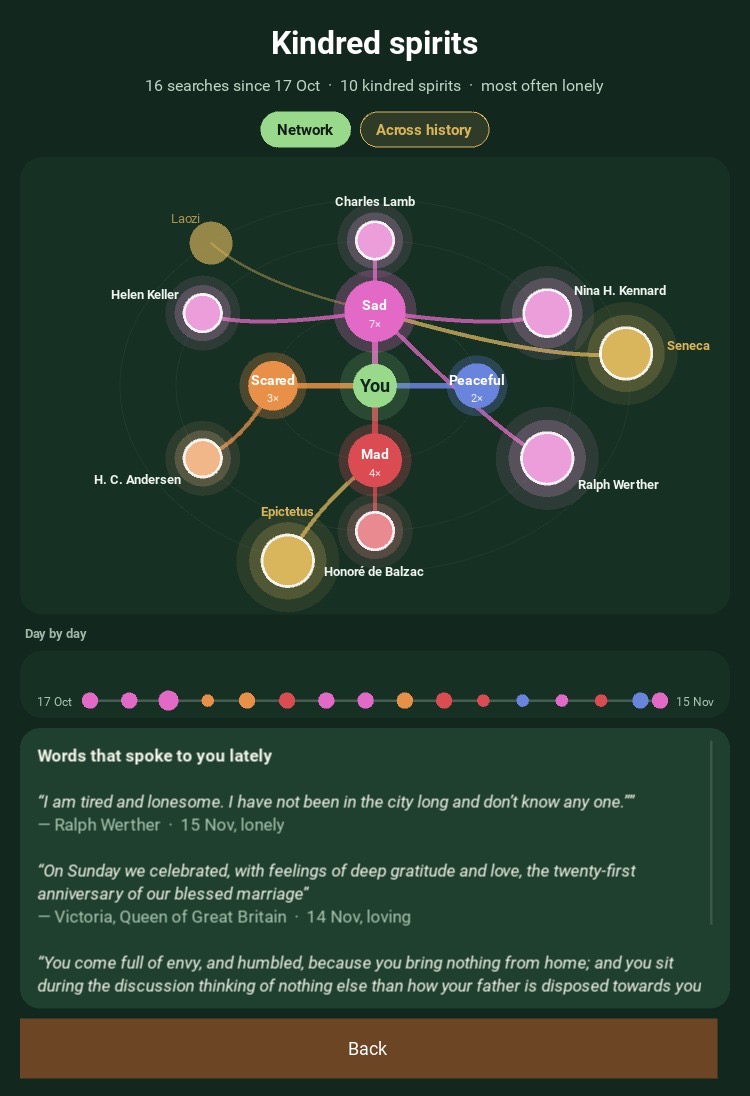
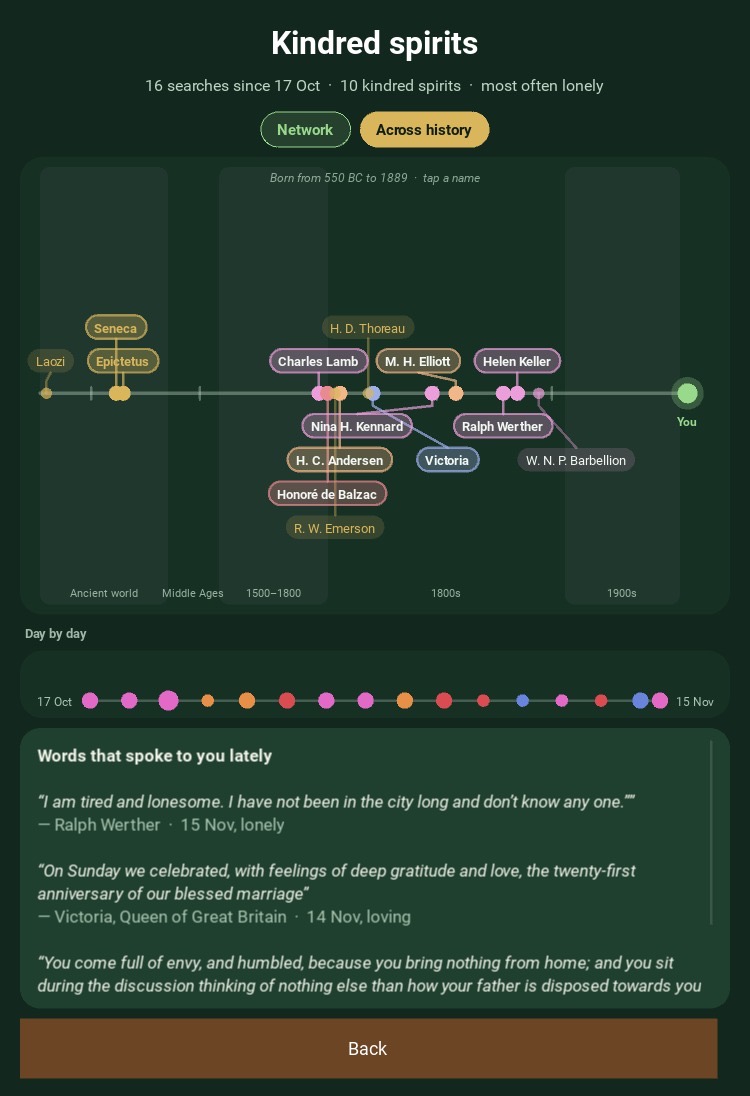
- A map of you. Build a private profile from your past entries and the passages you marked as speaking to you, so recommendations reflect who you are and what has helped before, not just today's answer. It would stay on your device.
- On your phone. The app is built in Kivy so it can ship to iOS and Android, with a short daily check-in instead of a full session.
Built With
- api
- art
- dataset
- emotion
- history
- javascript
- journalling
- json
- kivy
- node.js
- painting
- python
- server-client
- visual-studio
