Inspiration
Collectively our team is interested in medical applications of programming for the greater good of society.
In underdeveloped countries, medical misdiagnosis and lack of access to medical specialists can be a real problem.
Our goal was to create a website that would aid doctors and patients in interpreting X-rays for the purpose of disease detection in these countries.
What it does
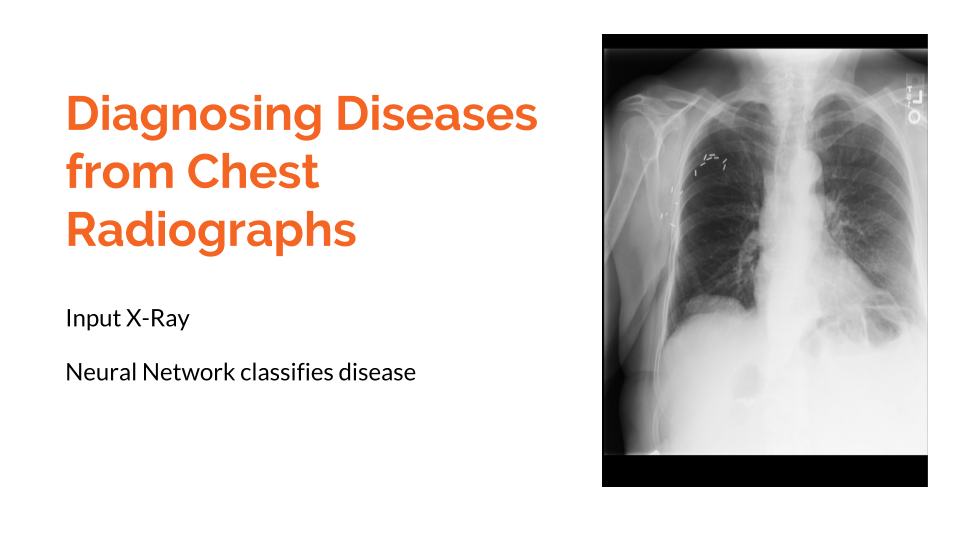
X-ray images uploaded to our website are run through our deep convolutional neural network which outputs the probability that the patient has certain disease.
How we built it
We built our deep learning convolutional neural network using Keras, TensorFlow, and Python.
Challenges we ran into
Because of the specificity of our neural net, improving accuracy of the classification was difficult.
There were no quick fixes that we could google. Any issues we encountered had to be met with improving our understanding of the behavior of the layers of the neural net to then infer the solution.
Accomplishments that we're proud of
We are proud to have been able to complete this project while navigating uncharted territory and learning and applying new skills.
What we learned
It was a challenge, but we were able to persevere on a deadline, by collectively making compromises and managing our team’s workflow and timeline.
What's next for Deep Residual Learning for Classification of X-Rays
We look forward to improving samples, distribution, normalization techniques, and accuracy in medical diagnosis.
Built With
- keras
- python
- tensorflow


Log in or sign up for Devpost to join the conversation.