-
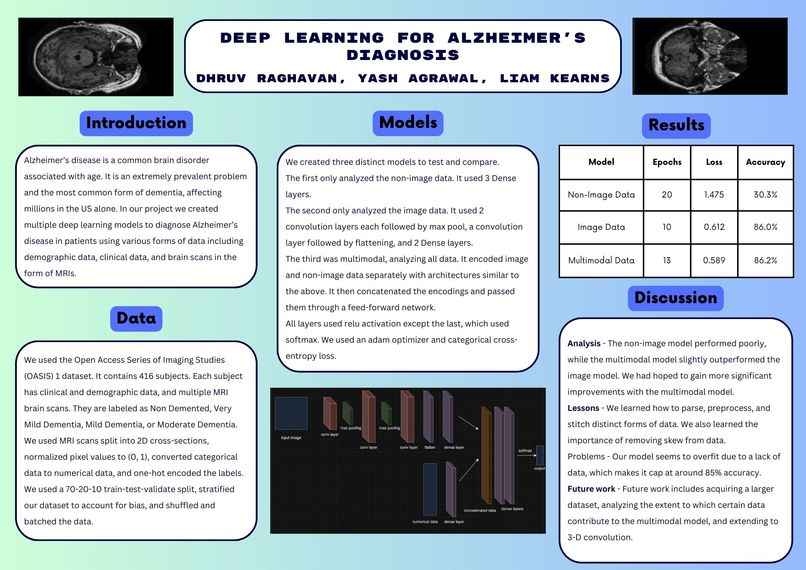
This is our group's poster
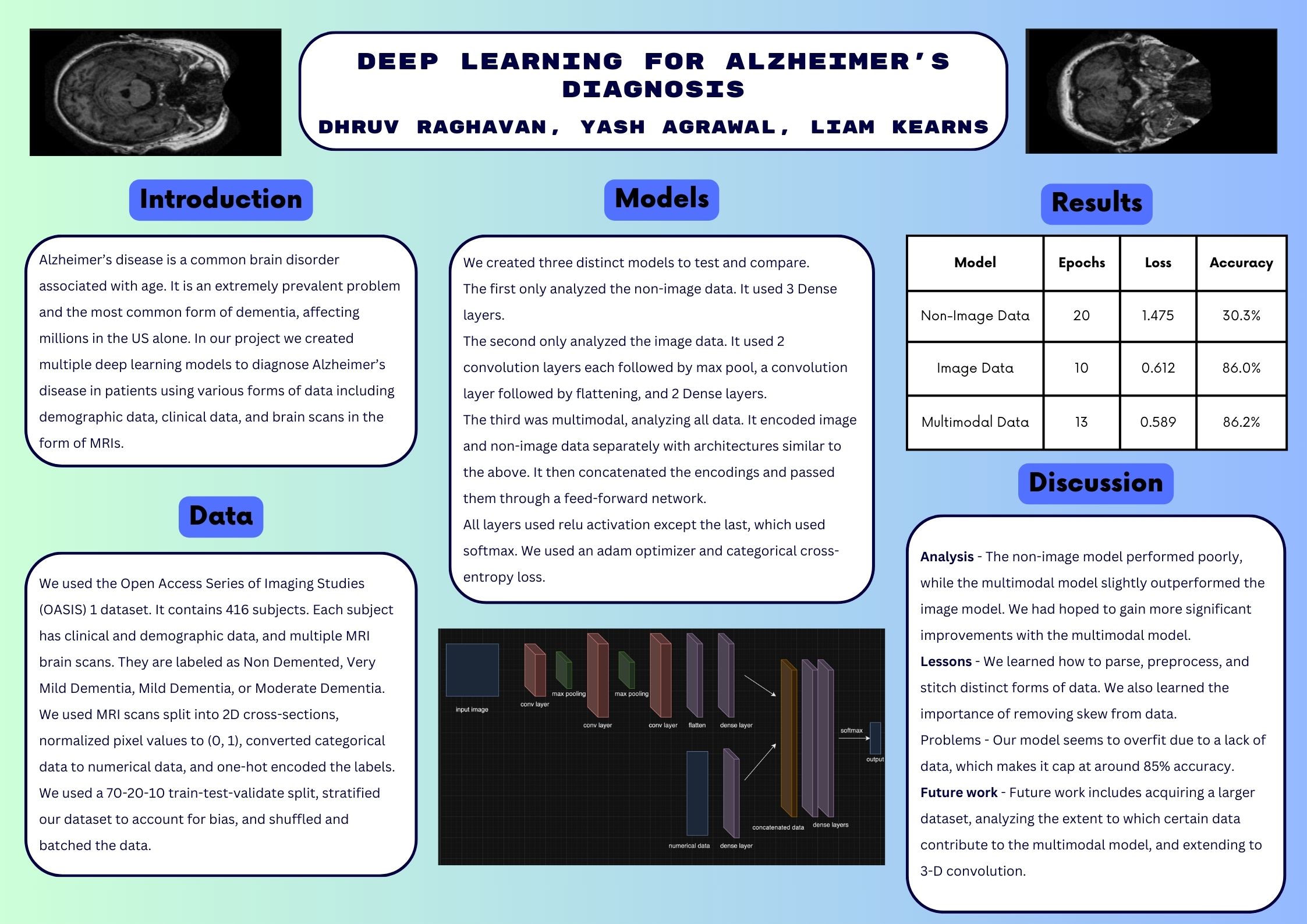
Deep Learning for Alzheimer's Diagnosis
Team Members
- Liam Kearns (lrkearns)
- Yash Agrawal (yagrawa1)
- Dhruv Raghavan (drraghav)
Introduction
We aimed to address a challenging, unsolved problem within the medical field that has a history of utilizing deep learning. Initially considering diabetes diagnoses, we pivoted to Alzheimer’s research due to the complexity and impact of the problem. Alzheimer's diagnosis is a critical classification task that may be approached as either binary or multi-class classification.
Related Work
We are not replicating any specific study but are inspired by various deep learning and machine learning approaches to Alzheimer's diagnosis. The following paper reivews recent implementations of many such models, including support vector machines, RNNs, vanilla feed-forward neural networks, CNNs, Random Forests, and logistic regression. (https://www.ncbi.nlm.nih.gov/pmc/articles/PMC10349019/)
A pivotal paper influencing our approach described unique CNN architectures for diagnosing different forms of Alzheimer’s, achieving around 95% accuracy through the use of concatenated outputs from various CNN architectures on the same inputs. We plan to build upon this by integrating multi-modal analysis. (https://www.nature.com/articles/s41598-024-53733-6)
Data
We utilize the OASIS (Open Access Series of Imaging Studies) dataset, which is commonly used for Alzheimer's prediction. This dataset includes MRI brain imaging and clinical data, with each sub-dataset containing between 400 to 2800 patients.
Our preprocessing includes one-hot encoding of demographic data like handedness and gender, as well as standardizing MRI scans to create a uniform input for our models.
(https://www.oasis-brains.org/)
Methodology
Our model architecture is designed to analyze multi-modal data, including both 3-D MRI scans and clinical data:
- MRI Data: Analyzed using a CNN with 3-D convolutional layers, with ongoing experimentation to refine the architecture.
- Clinical Data: Analyzed using a feed-forward network, with the architecture to be determined through experimentation.
- Data Integration: Outputs from MRI and clinical data analyses will be concatenated; we may also explore other methods for fusing these outputs.
- Final Classification: The fused outputs are fed into another feed-forward network with a softmax activation layer to produce output probabilities, which are then compared against the labels.
Metrics
Our success metrics include:
- Accuracy: The percentage of correct classifications by the network on a designated untrained test dataset.
- Receiver Operating Characteristic Curve: Used as an evaluation metric for certain tasks. Our accuracy goals are:
- Base Goal: 70% accuracy.
- Target Goal: 85% accuracy.
- Stretch Goal: 95% accuracy.
Ethics
Deep learning provides a robust approach for analyzing high-dimensional imaging data and capturing specific visual features and spatial relationships within the brain. It can significantly aid healthcare workers by serving as a heuristic tool, though not replacing medical expertise.
Key stakeholders include Alzheimer's patients, who may benefit from earlier and more accurate diagnoses, and healthcare workers, who might use this technology to enhance their diagnostic capabilities. Proper usage is crucial to mitigate risks of misuse. It is important that we use the model as a heuristic rather than a replacement for professional healthcare.
Division of Labor
We have decided to collaboratively work on all aspects of the project instead of a divide-and-conquer approach to maximize learning and effectiveness, maintaining accountability through regular meetings and deadlines.
Built With
- keras
- python
- tensorflow


Log in or sign up for Devpost to join the conversation.