-
-
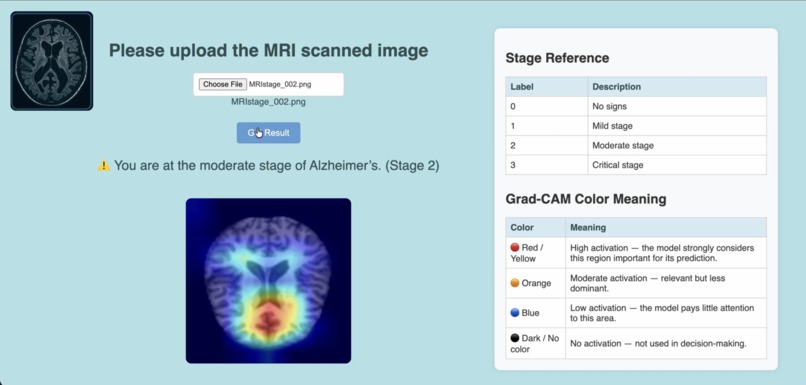
User Interface
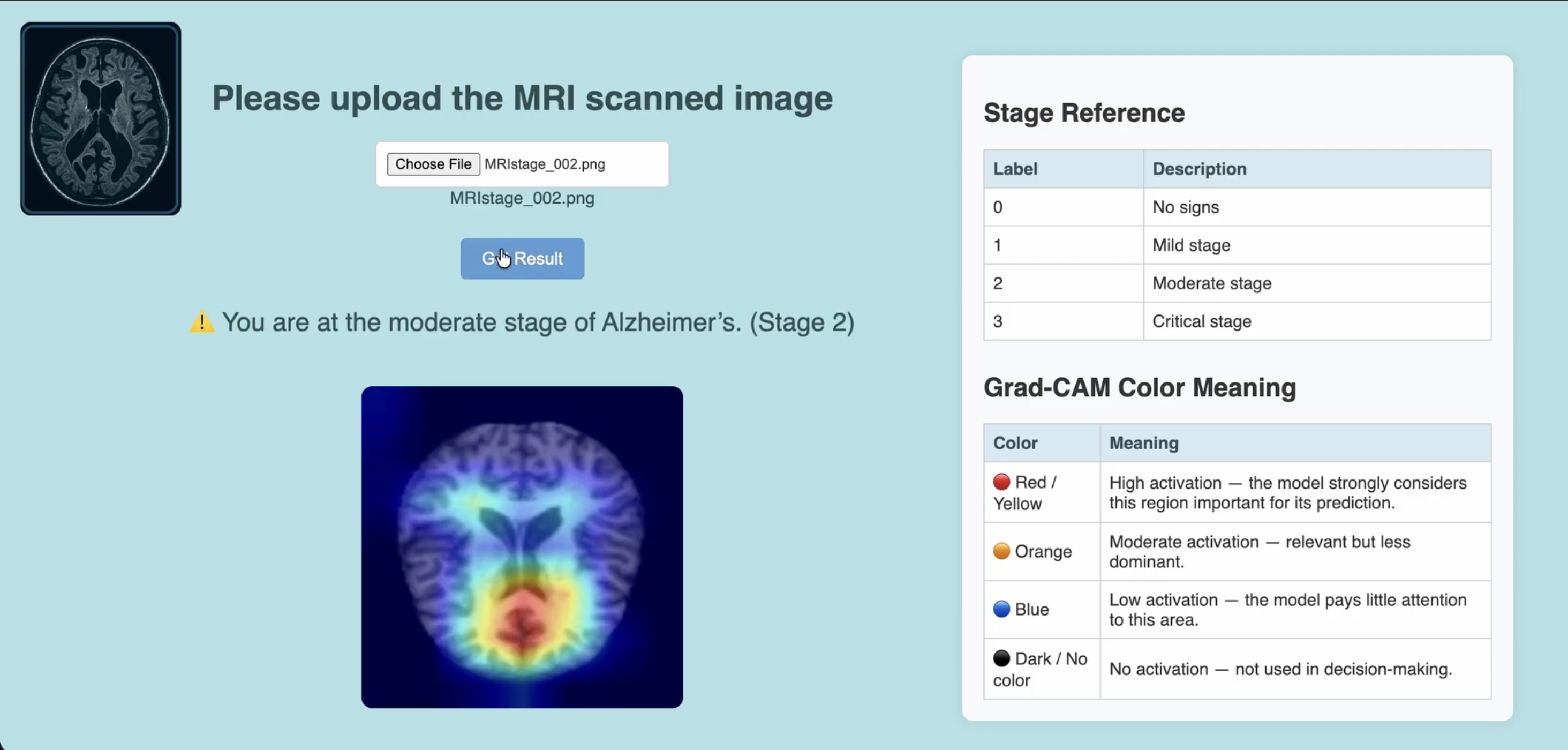
🧠 AI-Powered Early Detection of Alzheimer’s
🌟 Inspiration
Alzheimer’s disease is one of the most devastating neurodegenerative conditions, often diagnosed too late for meaningful intervention. I was inspired by the need for accessible, interpretable AI tools that could support early diagnosis—especially in underserved communities with limited access to radiologists. This project reflects my commitment to ethical AI, clinical transparency, and public health impact.
⚙️ What it does
This tool classifies Alzheimer’s stages (0–3) from MRI brain scans using a deep learning model built with EfficientNet. It provides:
- Stage predictions with high accuracy
- Grad-CAM overlays to highlight brain regions influencing decisions
- SHAP visualizations for voxel-level feature attribution
- Confidence scores and entropy plots to assess prediction certainty
- Confusion matrix to evaluate classification performance
All outputs are designed to be clinically interpretable, supporting human-in-the-loop workflows.
🏗️ How we built it
- Data: Public Kaggle Alzheimer’s MRI datasets, structured into labeled DataFrames
- Model: EfficientNet with dynamic flattening for multi-label classification
- Training: Mixup augmentation, class weighting, early stopping, and adaptive learning rate scheduling
- Evaluation: Accuracy tracking, entropy-based uncertainty, and batch-level visualizations
- Interpretability: SHAP, Grad-CAM, confidence scores, and confusion matrix heatmaps
🚧 Challenges we ran into
- Class imbalance across Alzheimer’s stages required careful weighting and sampling
- Integrating interpretability tools like SHAP and Grad-CAM into EfficientNet architecture
- Deployment stability on Render with FastAPI backend
- Designing visual outputs that are both informative and intuitive for clinicians
🏆 Accomplishments that we're proud of
- Achieved 96.95% test accuracy on multi-stage classification
- Built a fully interpretable pipeline with SHAP, Grad-CAM, and entropy visualizations
- Created a reproducible, modular framework for medical imaging AI
- Designed visual dashboards that support clinical decision-making
- Positioned the project for *real-world deployment *
📚 What we learned
- How to balance performance with interpretability in medical AI
- Techniques for handling imbalanced data and optimizing training stability
- The importance of visual transparency in building clinician trust
- How to integrate SHAP and Grad-CAM into non-standard architectures
- Best practices for ethical deployment and open-source reproducibility
🚀 What's next for AI-Powered Early Detection of Alzheimer’s
- Expand to multimodal inputs: PET scans, cognitive scores, and genetic markers
- Integrate with mobile apps and EMR systems for real-time clinical use
- Launch pilot studies in rural clinics and public health networks
- Publish validation results in peer-reviewed journals
- Extend the pipeline to other neurodegenerative diseases (e.g., Parkinson’s, stroke)
- Build an open-source interpretability toolkit for medical AI transparency

Log in or sign up for Devpost to join the conversation.