Inspiration
The inspiration behind this project was the potential of artificial intelligence to support healthcare by improving medical image analysis and assisting researchers in identifying brain tumor patterns more efficiently.
What it does
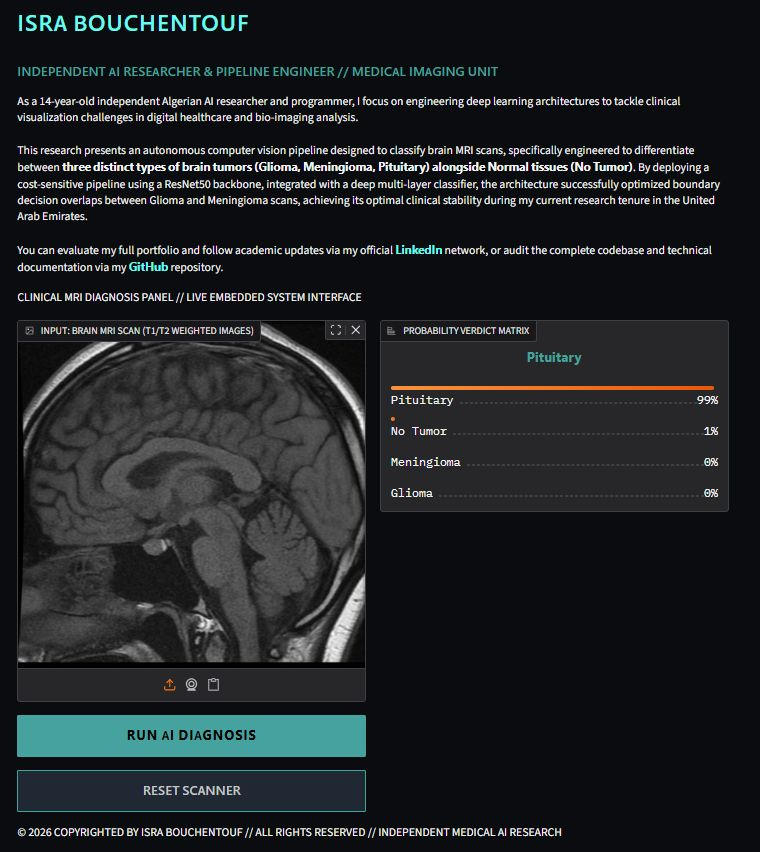
The project uses deep learning to classify brain MRI scans into four categories: Glioma, Meningioma, Pituitary Tumor, and No Tumor, exploring AI applications in biomedical image analysis.
How we built it
The framework was developed using Python and PyTorch, applying transfer learning with a ResNet50-based model, along with data preprocessing and model evaluation techniques.
Challenges we ran into
The main challenges included preparing medical image data, optimizing model performance, handling the complexity of medical AI, and considering responsible AI principles such as reliability and fairness.
Accomplishments that we're proud of
We developed an AI-based framework for brain MRI classification and explored how deep learning can contribute to biomedical research and medical image analysis.
What we learned
This project strengthened our understanding of deep learning, medical AI, and the importance of responsible AI principles, including transparency, fairness, and reliability.
What's next for Deep Learning-Based Brain MRI Classification Framework
Future improvements include expanding datasets, enhancing model robustness, exploring explainable AI methods, and further developing the framework for research applications.
Built With
- adamw-optimizer
- cnns
- computer-vision
- data-preprocessing
- deep-learning
- git/github
- machine-learning
- medical-image-analysis
- model-evaluation
- python
- pytorch
- resnet50
- transfer-learning
- weighted-crossentropy-loss

Log in or sign up for Devpost to join the conversation.