-
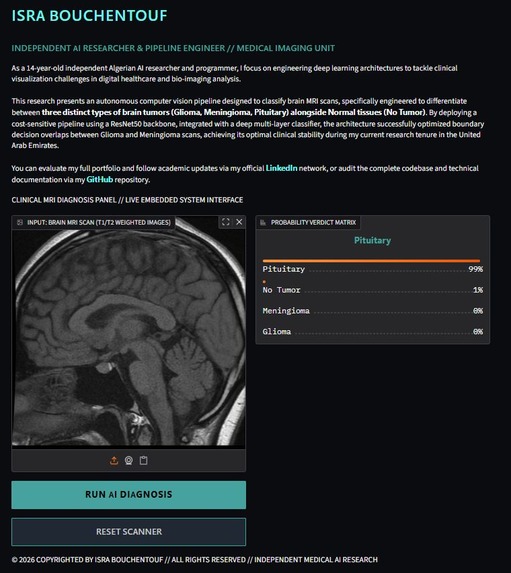
photo from the program
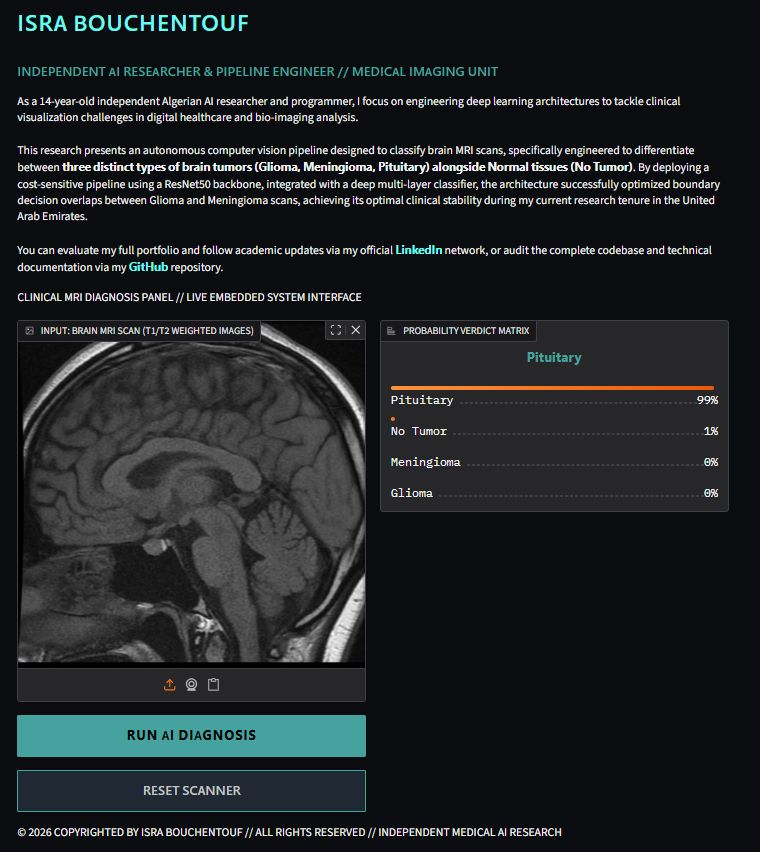
Inspiration
The inspiration behind this project came from the growing potential of artificial intelligence in healthcare, particularly in medical imaging. Brain tumors require accurate and timely analysis, and this project explores how deep learning can assist in extracting meaningful patterns from MRI scans and supporting biomedical research.
What it does
This project presents a deep learning-based framework for automated brain MRI classification. The model analyzes MRI images and classifies them into four categories: Glioma, Meningioma, Pituitary Tumor, and No Tumor. It aims to explore the effectiveness of AI techniques in biomedical image computing and medical image analysis.
How we built it
The framework was developed using Python and PyTorch. A ResNet50 convolutional neural network was utilized through transfer learning to leverage existing visual feature representations. The pipeline includes image preprocessing, model training, optimization using AdamW, weighted CrossEntropy Loss for handling class imbalance, and evaluation on unseen MRI images to assess performance.
Challenges we ran into
One of the main challenges was adapting deep learning techniques to medical imaging, where accuracy, reliability, and responsible AI considerations are critical. Additional challenges included preparing and organizing image data, optimizing model performance, evaluating generalization on unseen data, and considering potential limitations such as dataset bias.
Accomplishments that we're proud of
We developed a complete AI-based framework capable of performing multi-class brain MRI image classification. The project allowed us to apply advanced deep learning concepts to a real-world biomedical problem and explore the role of AI in supporting future healthcare technologies.
What we learned
Through this project, we gained deeper experience in deep learning workflows, computer vision, medical image analysis, and model evaluation. We also learned that successful AI systems require more than performance metrics, including transparency, fairness, responsible development, and careful consideration of their real-world impact.
What's next for Deep Learning-Based Brain MRI Classification Framework
Future improvements include expanding and diversifying datasets, improving model robustness, integrating explainable AI techniques to better understand model decisions, and exploring how the framework can be further developed for biomedical research applications.
Built With
- adamw-optimizer
- cnns
- computer-vision
- data-preprocessing
- deep-learning
- git/github
- machine-learning
- medical-image-analysis
- model-evaluation
- python
- pytorch
- resnet50
- transfer-learning
- weighed-crossentropy-loss

Log in or sign up for Devpost to join the conversation.