-
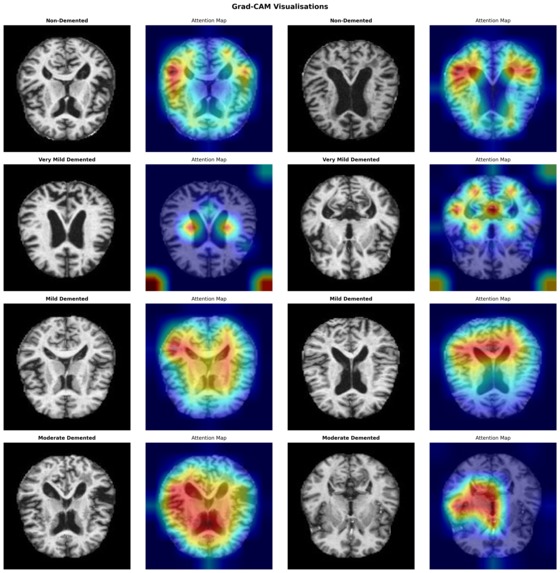
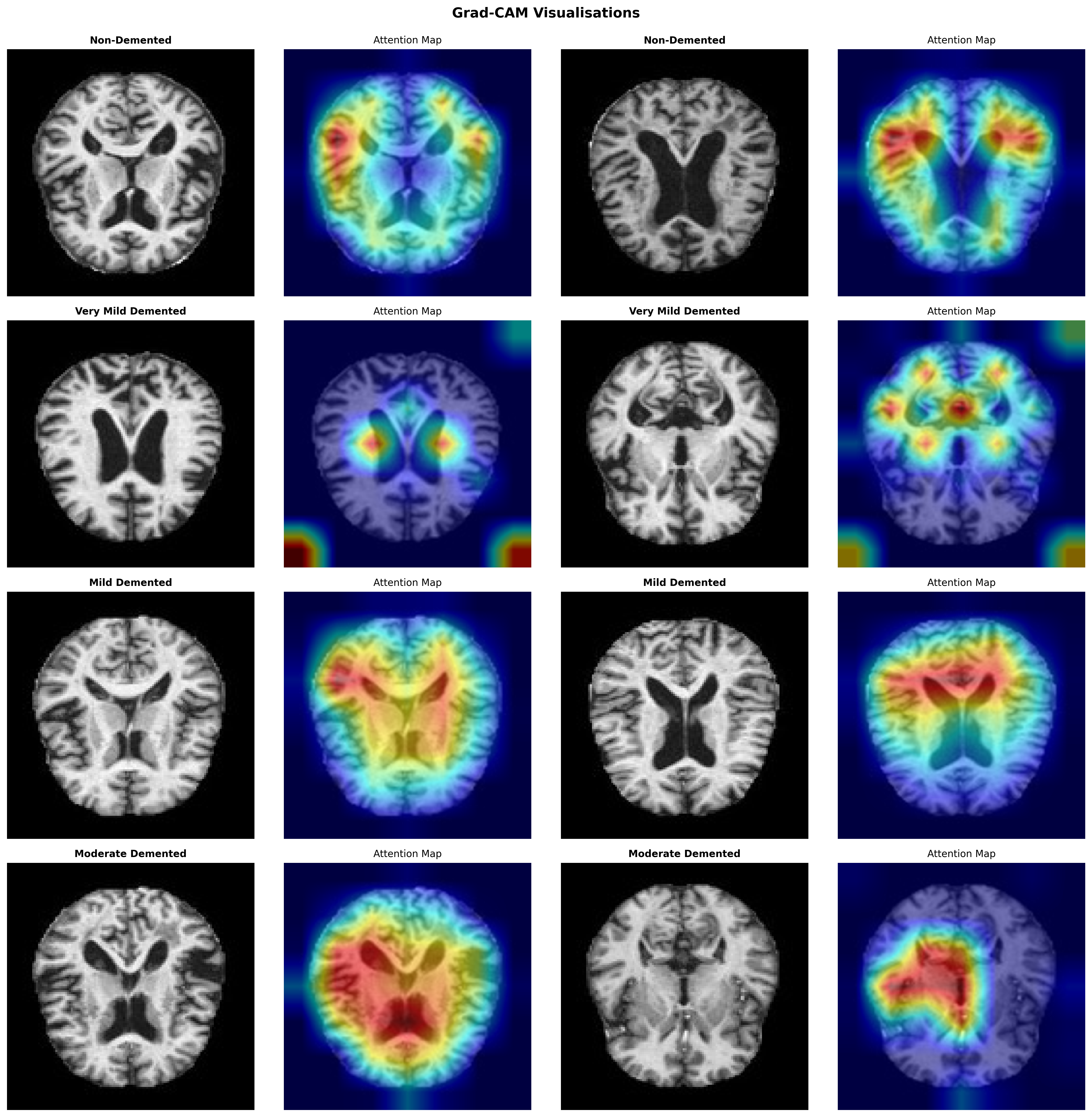
Gradcam Visualisation
Inspiration
Alzheimer’s disease has a long preclinical phase where biological changes occur years before clear symptoms appear. During my research into neurodegenerative diseases, I was struck by how early MRI changes are usually subtle and difficult to detect consistently through visual inspection alone. This motivated me to explore whether deep learning AI methods could support earlier and more reliable detection, while remaining reliable and trustworthy for clinical use.
What it does
This project is an explainable deep learning system that classifies Alzheimer’s disease severity from structural brain MRI scans into four stages. The goal is to support earlier identification of at-risk patients by detecting subtle structural patterns that are difficult to recognise visually, while providing calibrated confidence scores and interpretable outputs suitable for clinical decision support.
How I built it
I built an explainable deep learning pipeline based on EfficientNet-B4 transfer learning. The training combines heavy data augmentation, targeted external augmentation using the OASIS-3 dataset, and multiple techniques that I researched on to address extreme class imbalance in early-stage disease. Models are trained using stratified three-fold cross-validation and ensembled at inference to improve reliability.
A key focus was ensuring the system produces meaningful probability estimates rather than overconfident predictions. Post-hoc temperature scaling was applied to improve probabilistic calibration, and Grad-CAM visualisations were used to verify that the model attends to anatomically plausible brain regions associated with Alzheimer’s pathology.
I then trained the models in Google Colab using the T4 GPU.
Challenges I ran into
The biggest challenges were the severe scarcity of “Very Mild Demented” samples and the risk of overfitting or misleading confidence estimates. Early-stage cases are both the most clinically important and the most underrepresented, which required careful data curation, imbalance handling, and evaluation to avoid inflated performance.
Accomplishments that I'm proud of
I am particularly proud of building a pipeline that prioritises reliability and interpretability alongside strong performance. The model achieved high accuracy while maintaining improved probabilistic calibration, and the use of explainable visualisations provided useful sanity checks rather than black-box predictions. Addressing the extreme class imbalance was also one of my key accomplishments.
What I learned
Through this project, I gained experience in medical imaging pipelines, transfer learning for limited data, model calibration, explainable AI techniques, and the ethical considerations required when using AI for clinical decision support. I also learned the importance of designing eval pipelines that reflect real-world clinical constraints rather than optimising for accuracy alone.
What's next for Deep Learning AI for Early MRI-Based Alzheimer’s Detection
I am planning to extend the system to 3D volumetric MRI analysis, incorporating multimodal data such as cognitive scores like MMSE scores (where I'm planning to train models to detect MMSE scores from speech using the ADReSSo dataset) to improve early detection. Ultimately, the aim is to move towards decision-support tools that help flag at-risk patients earlier
Built With
- deep-learning
- efficientnet-b4
- explainable-ai
- google-colab
- grad-cam
- kaggle
- numpy
- oasis-3
- pandas
- python
- pytorch
- scikit-learn
- timm
- torchvision


Log in or sign up for Devpost to join the conversation.