-
-
Pitch_Phamplet
Inspiration
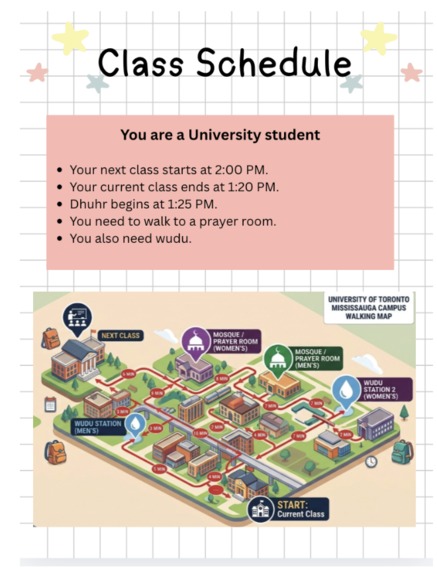
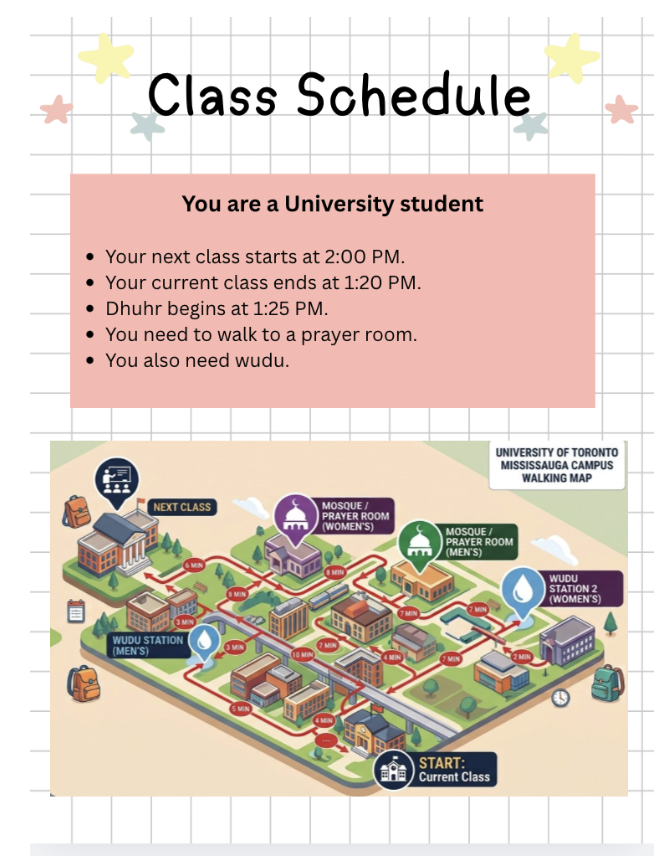
Most people think calendar conflicts are just two events happening at the exact same time. But as Muslim university students, the real problem is much deeper: it’s the constant, invisible mental tax of planning every single hour of the day. This is the reality of living in an academic system built entirely around a Gregorian calendar. Without public athans or family reminders on campus, sacred prayer windows easily fade into the noise of daily assignments and classes. Existing solutions force students to constantly check local mosque websites or download prayer apps that disrupt productivity and qushu. Many of these apps are infested with ads, send delayed notifications that fail in low battery modes, calculate inaccurate local times, or fail to account for different calculation methods and Islamic sects—isolating students trying to stay on top of their spiritual journey. When you combine that with rigid university timetables, students are left running a complex mental matrix across five different apps just to get through the day. A 15-minute gap between classes isn't a break. it’s a stress-filled math problem to figure out if you can do wudu and pray before your next lab. We built Ilmify to protect student flow state, eliminate that daily friction, and help students align their academic ambition with their faith.
What it does
Ilmify is an ad-free, university-aware schedule planner built to put your daily prayers first: Campus Selection & Onboarding: Select your specific university campus so all prayer room locations, indoor multi-faith spaces, wudu facilities, and walking routes are tailored to your actual surroundings. Smart Schedule Ingestion: Drop in a screenshot, PDF, or text export of your class timetable. Ilmify uses AI vision to extract course codes, section times, and room locations. Faith Overlay & Clashes: Overlays accurate, location-based prayer windows, Friday Jumu'ah slots, and Ramadan fasting hours directly alongside your classes across all your devices. The "Can I Make It?" Feasibility Engine: Calculates real-world physical travel feasibility using a spatial travel formula: Available Gap > = Walk Time + Wudu Time + Prayer Time Proactive Conflict Alerts: Flags hard overlaps (like evening exams during Iftar or lectures during Jumu'ah) and soft friction (like back-to-back classes spanning an entire prayer window) before they happen. Automated Accommodation Emails: Generates polite, pre-formatted email drafts for professors that reference official university religious accommodation policies.
How we built it
Our team divided tasks according to our technical strengths: Mobile App & Frontend: Built with React Native, React, and TypeScript to create a fast, clean, and accessible mobile UI designed for quick navigation while walking between classes. Backend Architecture: Powered by Node.js and Express to run schedule parsing algorithms, spatial micro-routing logic, and dynamic time-block comparisons. AI & Document Parsing: Configured OpenAI Vision and Claude API prompt pipelines to reliably convert messy timetable screenshots into structured JSON arrays without errors or hallucinations. Data & APIs: Integrated the Aladhan API for precise, customizable location-based prayer calculations alongside custom campus spatial datasets.
Challenges we ran into
Shifting Prayer Windows: Unlike static course schedules, prayer times shift by a minute or two every day. Writing flexible time comparison logic that catches dynamic future conflicts—like an evening lab overlapping with Iftar three weeks into Ramadan—was tricky. Micro-Routing on Campus: Standard mapping apps treat an entire university campus as a single address. They don't know where indoor multi-faith rooms, floor levels, or wudu stations are located. Building accurate, campus-specific spatial nodes was a major technical hurdle. Unstructured Timetables: Course schedule portals look completely different across every university. Training our AI prompts to parse varied image formats and text layouts reliably took significant testing.
Accomplishments that we're proud of
Validating a Genuine Community Need: Surveying and speaking with fellow Muslim students on campus during the hackathon proved how deeply people resonated with the "Can I Make It?" feature. Protecting Qushu & Flow State: We turned an abstract mental burden into an automated mathematical formula, removing the need to constantly check phone apps or mosque websites during study blocks. Clean & Inclusive UI: Crafting an ad-free, modern interface that respects different calculation methods and Islamic sects, ensuring every student feels included.
What we learned
Actionable Answers over Raw Data: Students don't need another app that just lists prayer times. They need an operational tool that helps them make instant decisions on the go. Tech for Self-Advocacy: Software can empower students to stand up for their rights. Providing policy-backed email drafts makes reaching out to professors for accommodations far less intimidating. Designing for High-Stress Moments: Building for a student with only 8 minutes between classes forced us to trim away bloat and prioritize speed, simplicity, and clear visual feedback.
What's next for Ilmify
Direct School Portal Integration: Partner with student portals (like ACORN, Canvas, and Quercus) to pull live schedules and assignment deadlines automatically. Mosque & Campus Event Outreach: Allow local masjids and campus Muslim Students' Associations (MSAs) to log upcoming events, guest lectures, and temporary Jumu'ah locations into our database so students never miss community updates. Smart Course Registration: Help students plan upcoming semester schedules before enrolling by calculating which course section combinations clash the least with prayer times.
Built With
- ai-vision
- campus-mapping
- claude
- claude-api
- css3
- express.js
- figma
- html5
- javascript
- json
- mobile-app
- node.js
- openai-api
- react
- react-native
- tailwind-css
- typescript
- ui-ux

Log in or sign up for Devpost to join the conversation.