Decrypto: Real-Time Crypto AML Intelligence
Inspiration
Financial systems rely on trust. Decentralised systems remove intermediaries, but they do not remove the need to understand risk.
Blockchain makes every transaction visible. It also fragments that information across wallets, intermediaries, and time. Illicit flows exploit this structure by appearing as ordinary activity distributed across many addresses.
- $158B estimated illicit volume
- $93B linked to sanctioned infrastructure
- ~1.2% of total flow, dispersed across networks
The constraint is not visibility. It is reconstruction.
If decentralised finance is to scale safely, risk must be interpretable in real time.
What It Does
Decrypto converts a wallet address into an investigation.
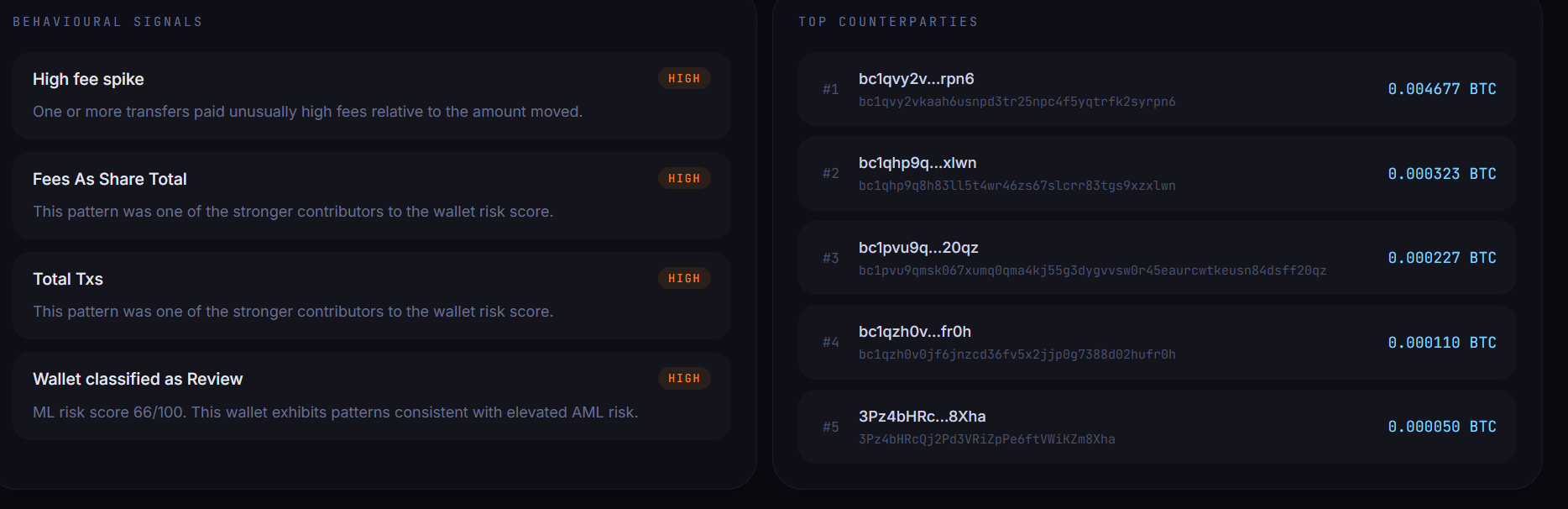
- probabilistic risk score
- behavioural explanation
- ranked fund flows
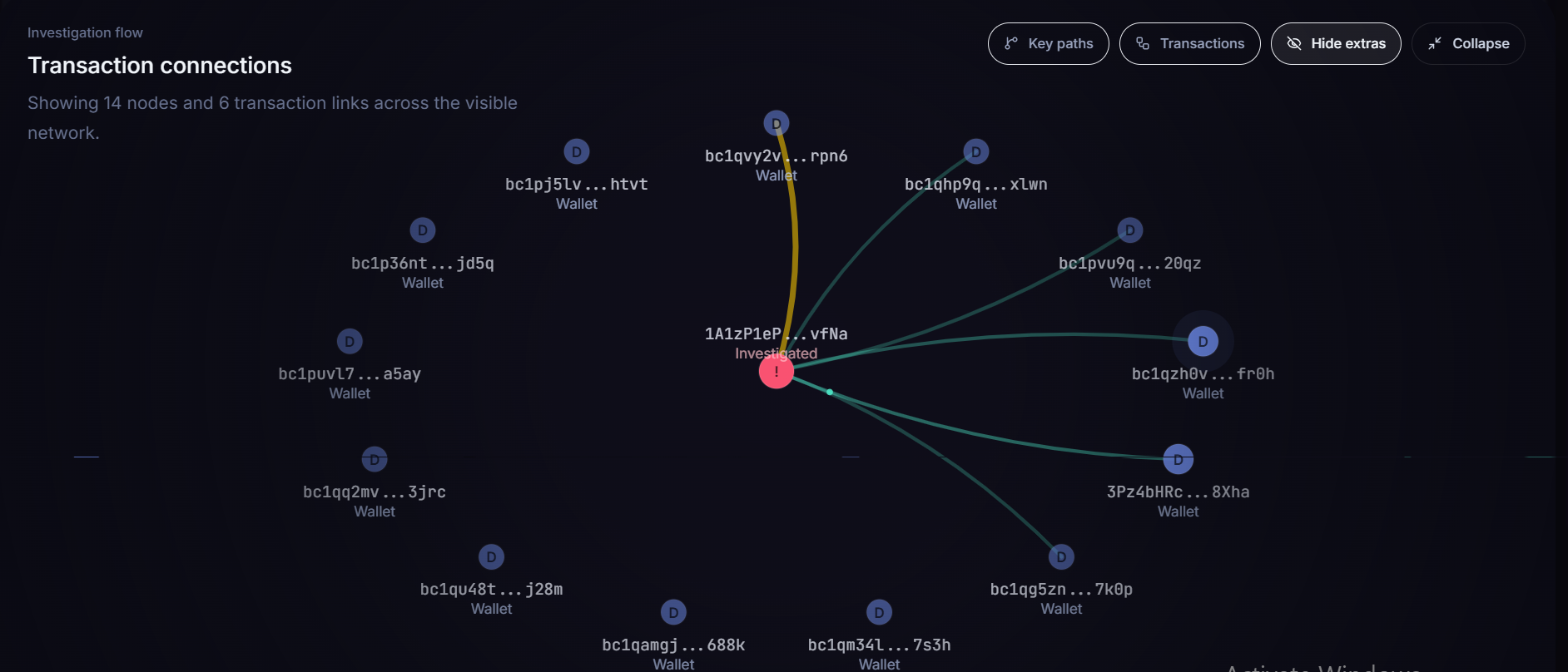
- interactive graph
- exportable report
The system does not show the network. It extracts the part of the network that matters.
Core System
Decrypto aligns three layers:
- behavioural inference
- network reconstruction
- decision-focused visualisation
Each layer feeds the next.
Pipeline
01 — Feature Construction
A wallet is encoded as a behavioural vector:
$$ X = {x_1, x_2, ..., x_n} $$
capturing:
- transaction velocity and volume
- inflow vs outflow asymmetry
- counterparty exposure
- interaction with flagged entities
- temporal structure
Unknown wallets trigger real-time feature construction. Known wallets retrieve stored representations.
02 — AI Risk Engine
A Random Forest model estimates:
$$ P(\text{illicit} \mid X) $$
Outputs:
- risk score (0–100)
- classification
- feature-level attribution
The model detects behavioural anomalies that are not observable at the transaction level.
This output feeds directly into graph scoring.
03 — Graph Construction Under Constraint
The backend exposes only one-hop relationships with directional flow:
- value sent
- value received
There is no explicit multi-hop topology.
Decrypto reconstructs investigation structure from this incomplete view.
04 — Path Extraction and Scoring
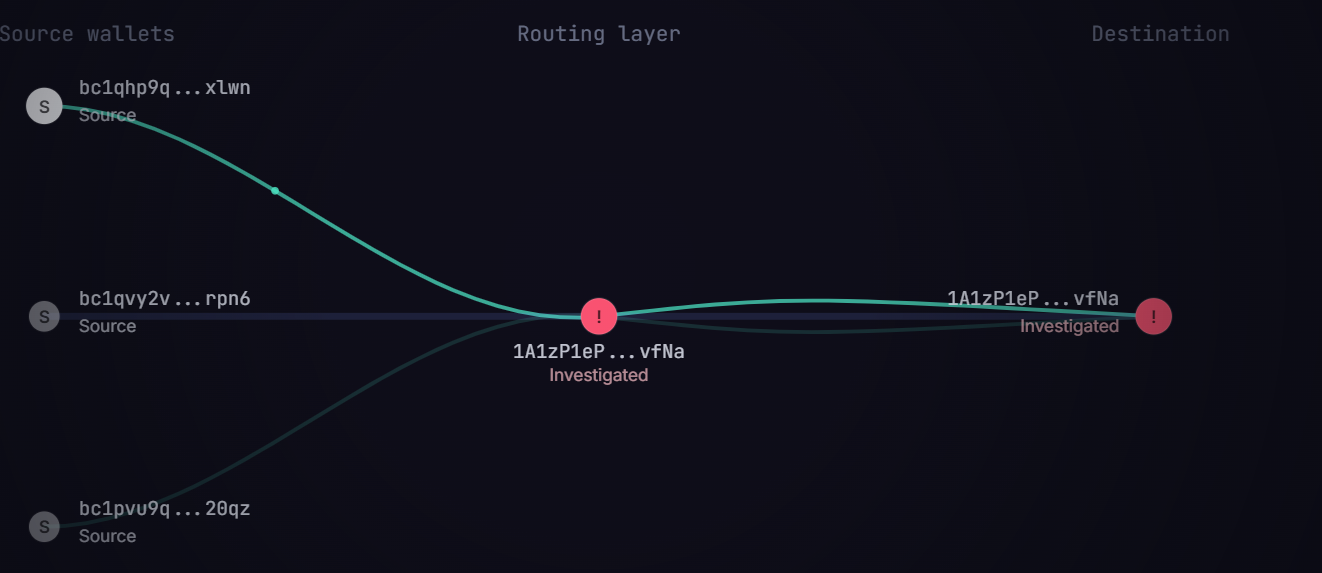
The system derives candidate paths and ranks them:
$$ \text{PathScore} = 1.1 \cdot w(r_1) + 1.25 \cdot w(r_2) + \text{destinationBoost} + \text{routingBoost} + \text{centerBoost} + \text{nodeRiskScore} + \log_{10}(V + 1) $$
Where:
- ( w(r) ) maps categorical risk into weights
- ( V ) captures transaction magnitude
- boost terms prioritise:
- sanctioned endpoints
- structurally important intermediaries
- proximity to the investigated wallet
- sanctioned endpoints
This combines:
- model-derived risk
- inferred network structure
- capital flow
One dominant path is selected.
05 — Graph Rendering
The graph is rendered as a constrained flow:
- source
- routing layer
- destination
Low-signal nodes are suppressed.
High-signal paths are isolated.
Interaction model:
- hover isolates a path
- click reveals node-level detail
- background structure fades
The graph behaves as a decision engine.
06 — Investigation Interface
The system presents:
- dominant flow
- risk summary
- exposure metrics
- sanctions matches
with supporting tabs:
- transactions
- counterparties
- activity
- alerts
Controls are minimal to preserve focus.
07 — Output
The result is a structured investigation:
- risk classification
- flagged paths
- quantified exposure
- exportable report
Technical Depth
The backend does not provide a full transaction graph.
Decrypto reconstructs ranked investigation paths from:
- partial topology
- directional flow data
- probabilistic risk signals
and aligns them into a single coherent interface.
This requires:
- inferring structure where none is explicit
- combining ML outputs with graph reasoning
- suppressing combinatorial explosion in paths
- preserving interpretability under constraint
Impact
Decrypto enables:
- AML and compliance workflows
- rapid investigation of suspicious wallets
- risk monitoring in digital asset systems
As capital becomes borderless, trust shifts into infrastructure.
Systems that make financial flows interpretable enable safe participation at scale.
Growth
- multi-hop reconstruction and clustering
- graph-based learning for coordinated behaviour detection
- cross-chain tracing
- real-time alerting
- institutional integration
One Line
Crypto transactions are complex and hard to interpret. Decrypto detects money laundering in real time using graph analytics and machine learning, turning activity into clear, actionable risk insights for faster, smarter decisions.
Built With
- docker
- fastapi
- framer-motion
- geminiapi
- mempool.space-api
- numpy
- pandas
- railway
- react
- scikit-learn
- tailwind
- uvicorn
- vercel
- vite

Log in or sign up for Devpost to join the conversation.