-
-
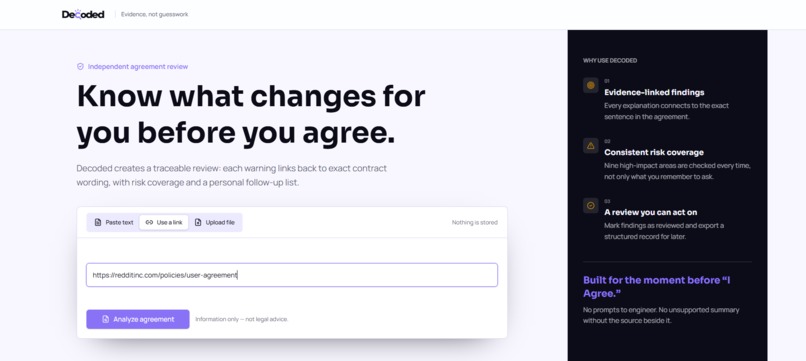
Link page
-
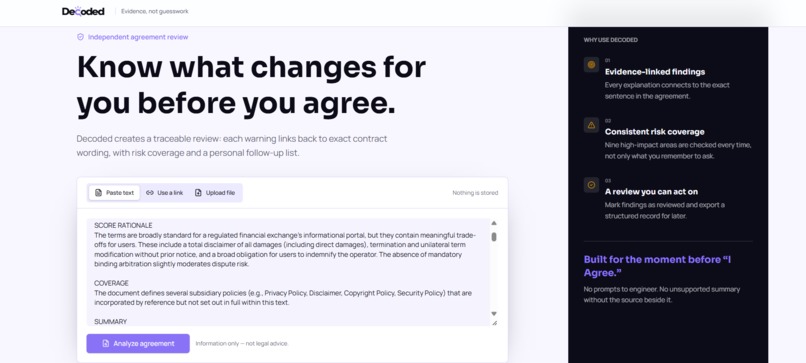
Home Page
-
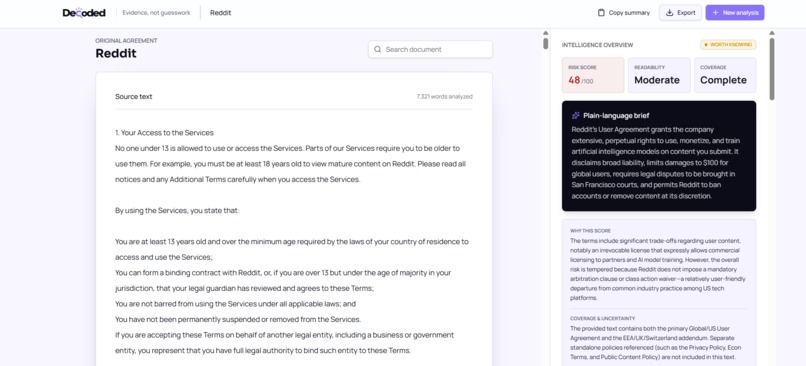
Reddit Terms & Condition
-
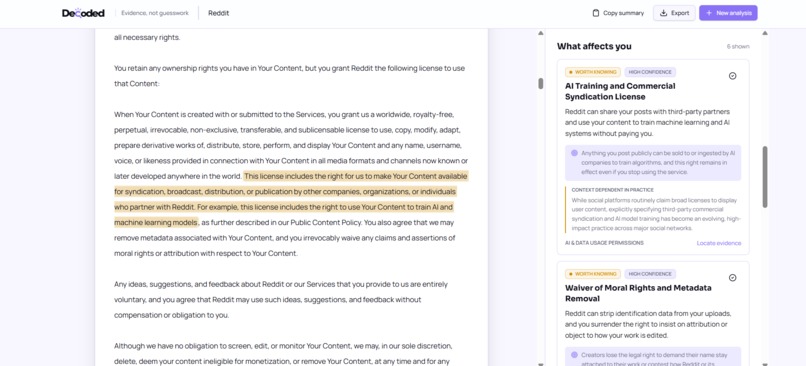
Evidence
Decoded
Inspiration
Most of us have clicked “I Agree” without reading the Terms & Conditions. Not because we don't care about our privacy or rights, but because legal documents are often long, complicated, and filled with language that is difficult for the average person to understand.
That led us to a simple question:
What if people could understand what they were agreeing to without having to read dozens of pages of legal jargon?
That idea became Decoded.
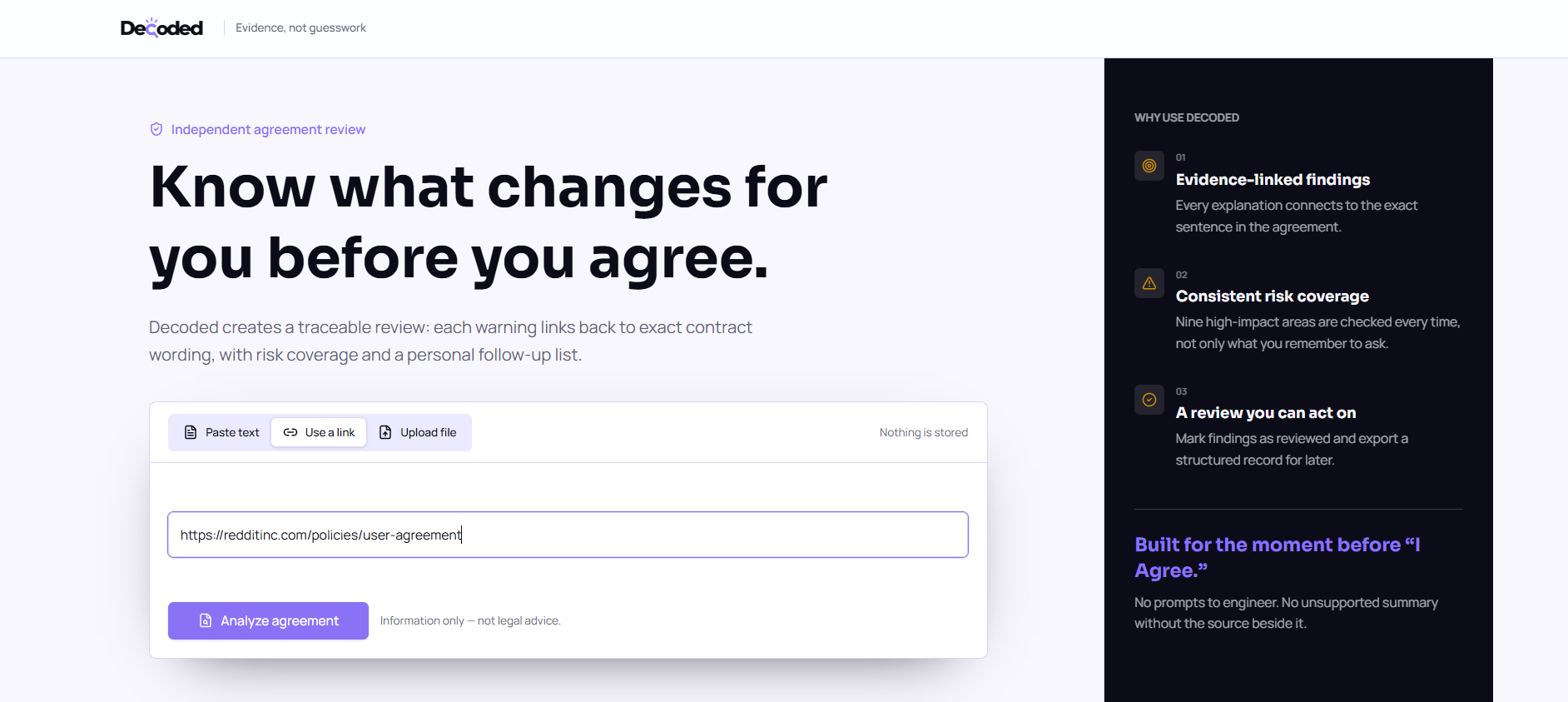
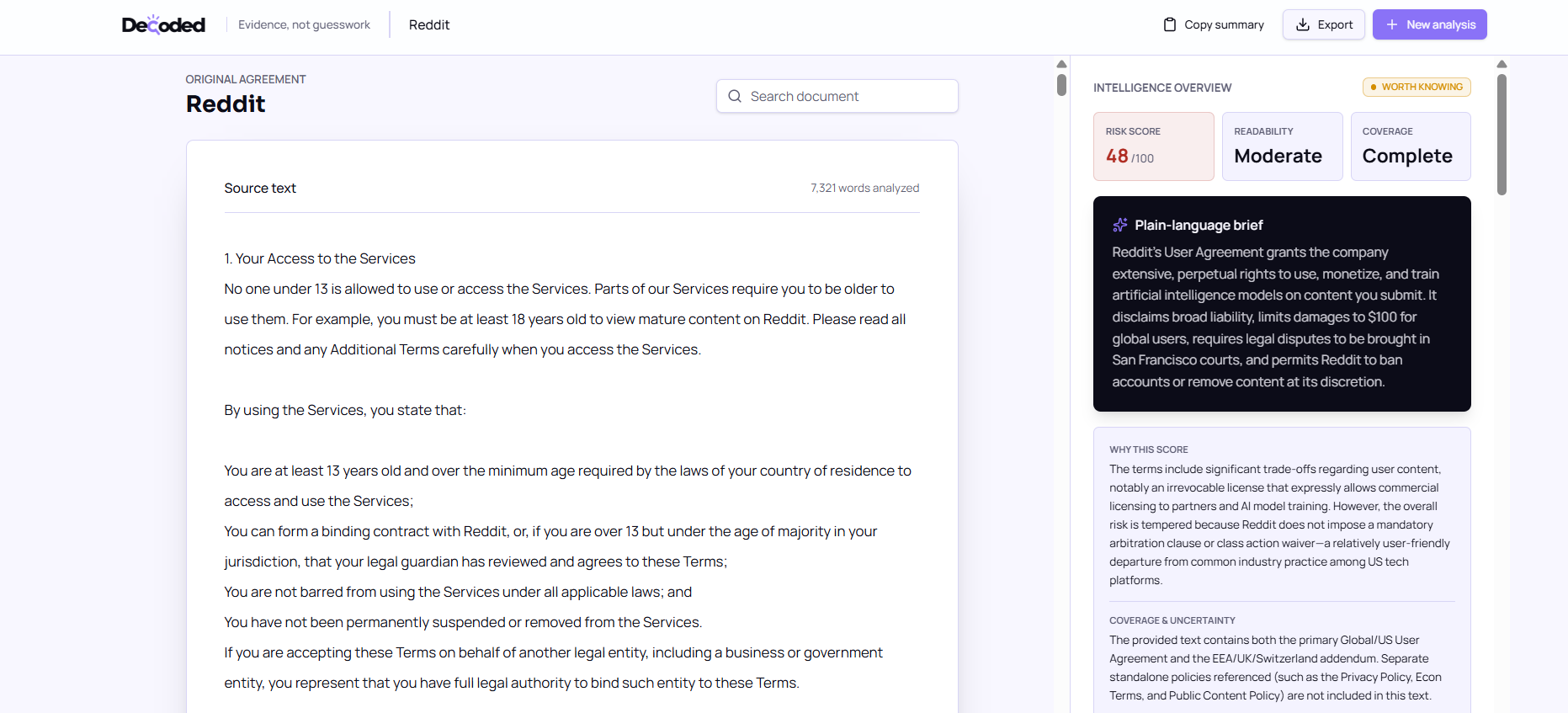
Decoded is an AI-powered tool that helps users understand Terms & Conditions by analyzing important clauses, explaining them in plain English, and allowing users to ask questions directly about the document.
What We Built
Decoded turns lengthy Terms & Conditions into something users can actually understand and interact with.
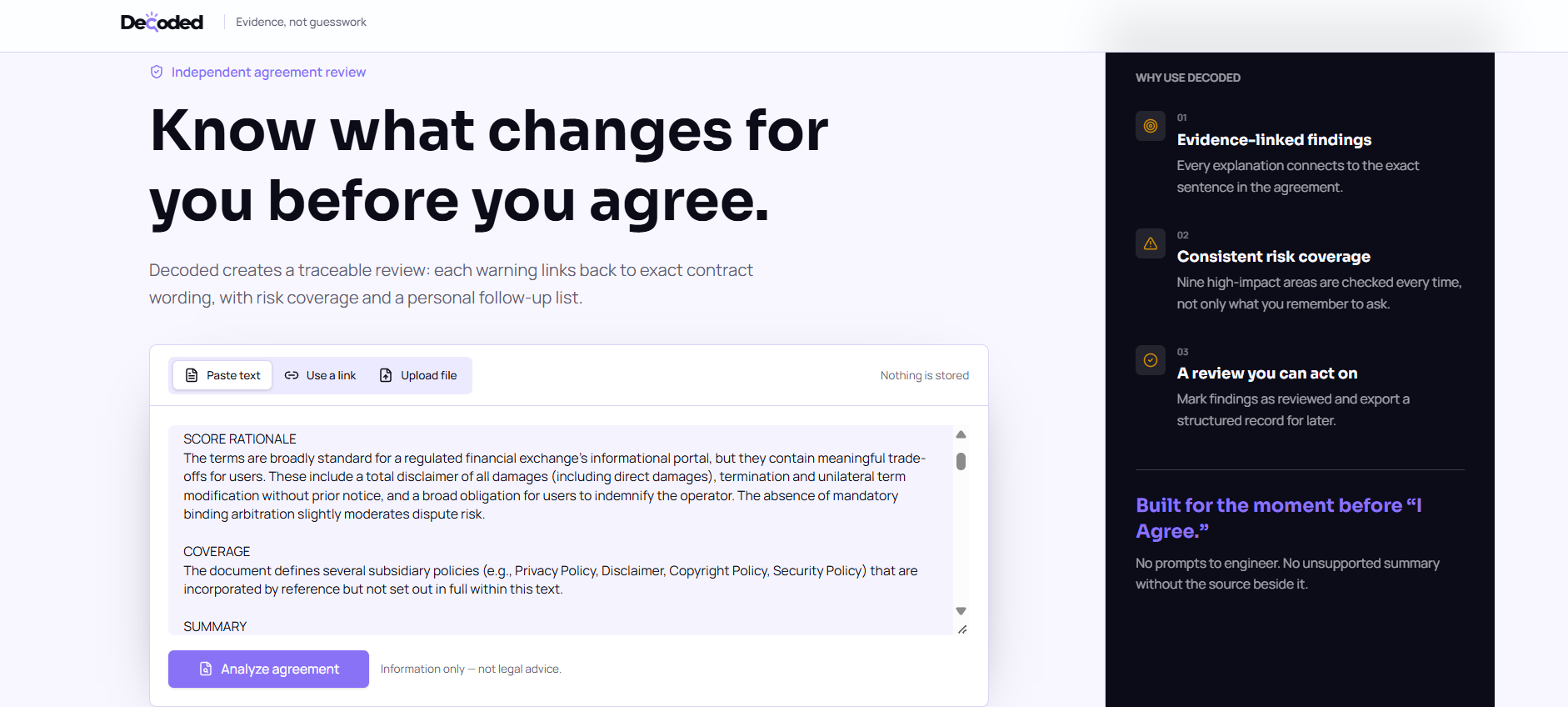
Users can provide a Terms & Conditions document and receive an AI-generated analysis of important clauses.
The system focuses on areas such as:
- Data collection and sharing
- User content and licensing rights
- Account termination
- Payments and subscriptions
- Liability limitations
- Arbitration and dispute resolution
- Changes to Terms
- Other clauses that may significantly affect users
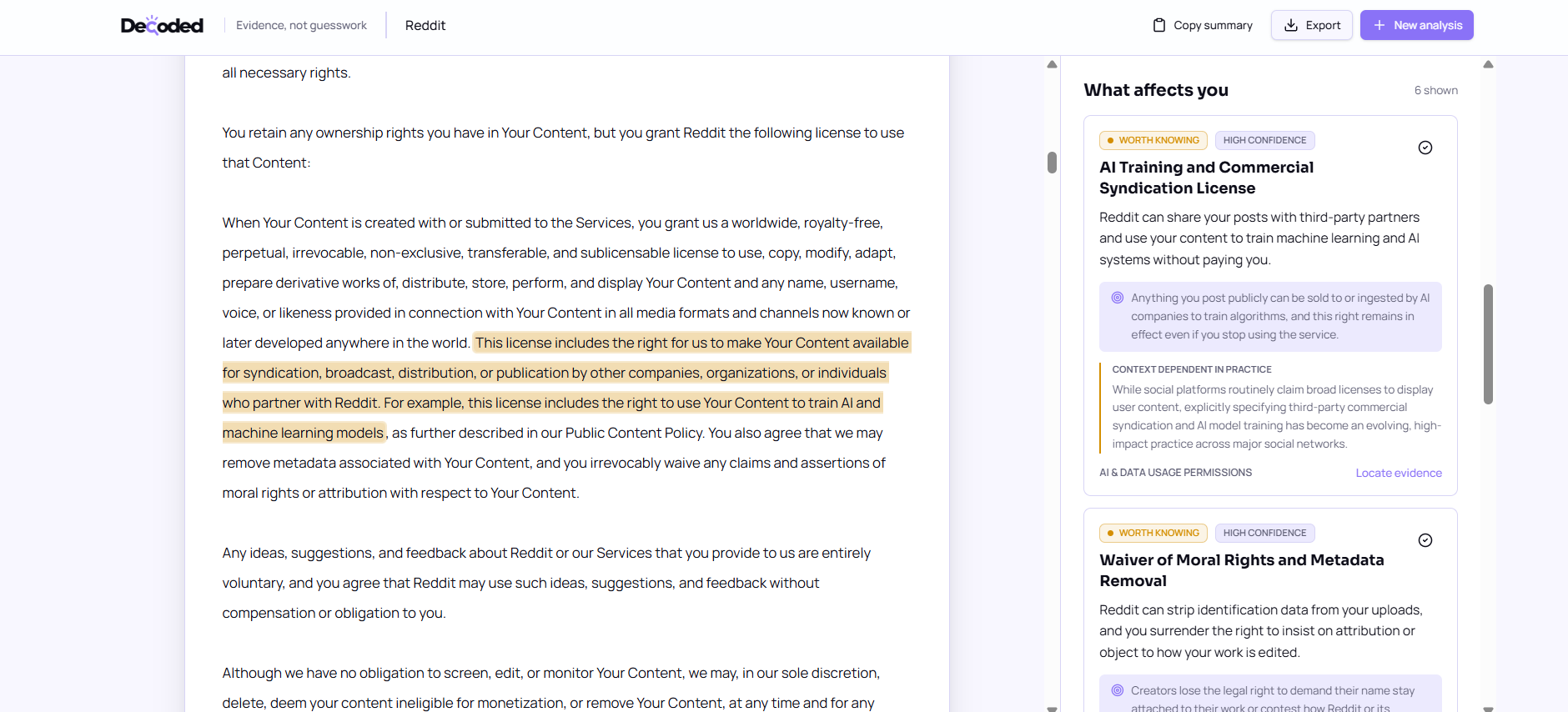
Instead of simply highlighting legal words, Decoded provides context by showing the original clause, explaining it in simpler language, and indicating why it may matter.
Ask the Document
One of Decoded's key features is its document-aware AI chatbot.
After uploading a document, users can ask questions such as:
“Can they sell my data?”
“What happens if I delete my account?”
“Can they use the content I upload?”
“Can my subscription renew automatically?”
“What happens if there is a dispute?”
The chatbot answers questions based on the contents of the uploaded Terms & Conditions, allowing users to explore the document conversationally instead of searching through pages of legal text.
This turns Decoded from a simple analyzer into an interactive way of understanding an agreement.
What We Learned
One of our biggest lessons was that not every complicated or strict clause is necessarily a bad clause.
During development, we tested the analyzer against real Terms & Conditions and noticed that a simple risk-scoring system could easily become misleading. Common clauses found across many platforms could be repeatedly flagged as highly suspicious even when they were fairly standard.
That changed how we approached the project.
Instead of treating every legal clause as a red flag, we focused more on context, explanation, and significance.
The question became less:
“Does this clause look scary?”
and more:
“What does this clause actually mean, and why should a user care?”
We also learned that allowing users to ask their own questions can be more useful than trying to predict every question they might have. The chatbot gives users the freedom to explore the agreement according to their own concerns.
How We Built It
Decoded was built as a web application with an AI-powered document analysis and question-answering workflow.
The general process is:
- The user provides a Terms & Conditions document.
- The document is processed and made available to the AI system.
- The document is analyzed for important clauses and categories.
- Relevant clauses are identified and explained in plain language.
- Users can interact with the document through the AI chatbot.
- Questions are answered using information from the provided document.
- Users can explore specific concerns without manually searching through the entire agreement.
We designed the interface around readability because the entire purpose of the project would be defeated if the results themselves looked like another legal document.
Challenges We Faced
1. Avoiding False Positives
One of our biggest challenges was preventing the AI from treating every potentially concerning phrase as a serious risk.
For example, clauses about changing Terms, collecting data, or limiting liability are extremely common in online services. Their presence alone does not necessarily mean that a service is acting unusually or unfairly.
We therefore had to refine the way the system interprets and presents these clauses.
2. Making Legal Language Understandable
Simply shortening a legal sentence is not enough.
The explanation needs to preserve the meaning of the original clause while making it understandable to someone without a legal background. Finding the balance between simplicity and accuracy was an important part of the development process.
3. Building a Document-Aware Chatbot
Making a chatbot answer questions about a specific document introduced another challenge.
The chatbot should not simply generate a plausible answer from its general knowledge. It needs to stay grounded in the Terms & Conditions provided by the user.
This meant designing the interaction so users could ask natural questions while keeping the answers tied to the actual document.
4. Handling Long Documents
Terms & Conditions can be extremely long, creating another challenge for an AI-based system. The application needs to process large amounts of text while still producing results that are organized and useful rather than overwhelming the user.
5. Making Risk Information Meaningful
We initially explored representing the analysis through an overall risk score. However, we realized that a single number can create a false sense of precision.
A document receiving a “90/100 risk score” sounds authoritative, even when the underlying reasoning may be much more nuanced.
This pushed us toward providing explanations, categorized findings, and document-based answers rather than relying entirely on one number.
Why Decoded Matters
Terms & Conditions are technically agreements between users and companies, but in practice, most people accept them without understanding them.
Decoded is our attempt to make that process more transparent and interactive.
Instead of forcing users to read dozens of pages or blindly trust a single risk score, Decoded gives them multiple ways to understand an agreement:
Analyze it. Understand it. Ask questions about it.
The goal isn't to tell users what decision to make. It is to give them understandable information so they can make that decision themselves.
Read less. Understand more.
Built With
- javascript
- openai
- openrouter
- react
- tailwind
- typescript
- vite

Log in or sign up for Devpost to join the conversation.