-
-
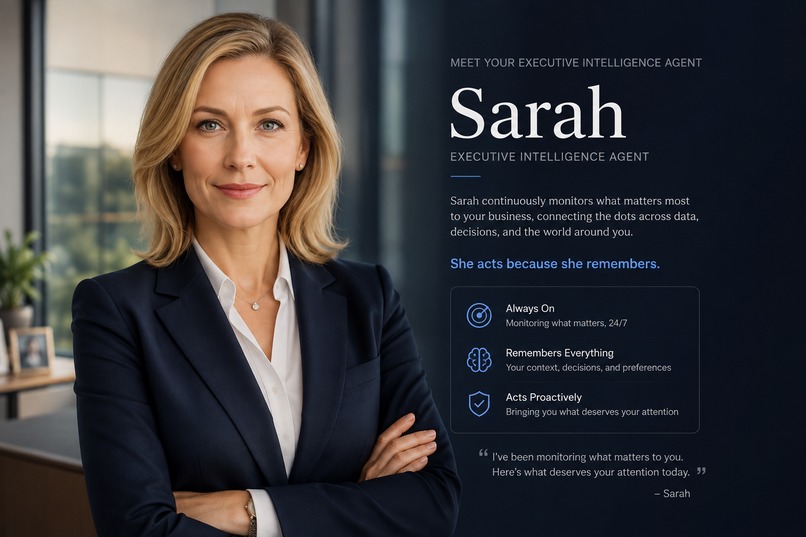
Sarah, my Top Management Assistant
-
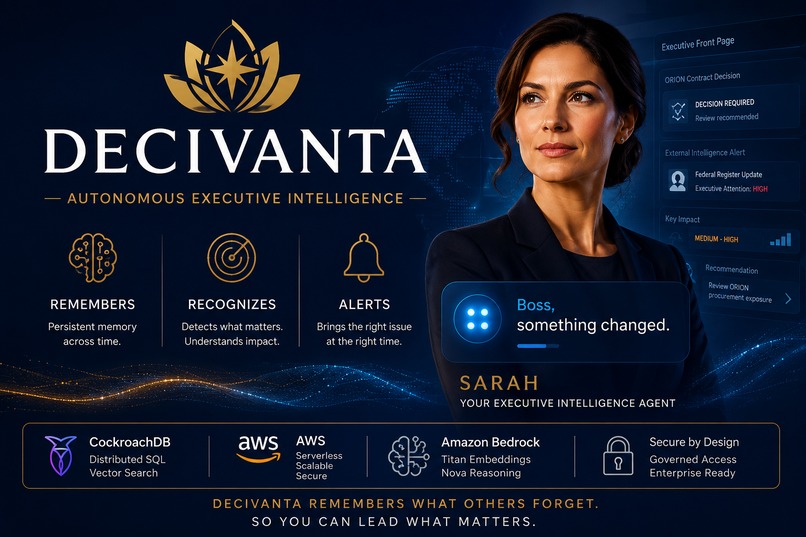
DECIVANTA - Sarah. Top Management Intelligence
-
DECIVANTA - Sarah. She works while you sleep.
Inspiration
Executives rarely suffer from a lack of information. They suffer from fragmentation, lost context, and forgotten follow-through.
A financial review happens on Monday. A business case changes on Wednesday. New external intelligence appears on Friday. Decisions are made, follow-ups are assigned, and deadlines are established—but the context connecting those events is often scattered across meetings, reports, dashboards, and individual memory.
We asked a different question:
What if an executive intelligence agent could remember what mattered—not just what was said—and use that memory to determine what deserves attention next?
That question became DECIVANTA.
DECIVANTA is built around a simple principle:
Memory should not be an archive. Memory should change what the agent does next.
What it does
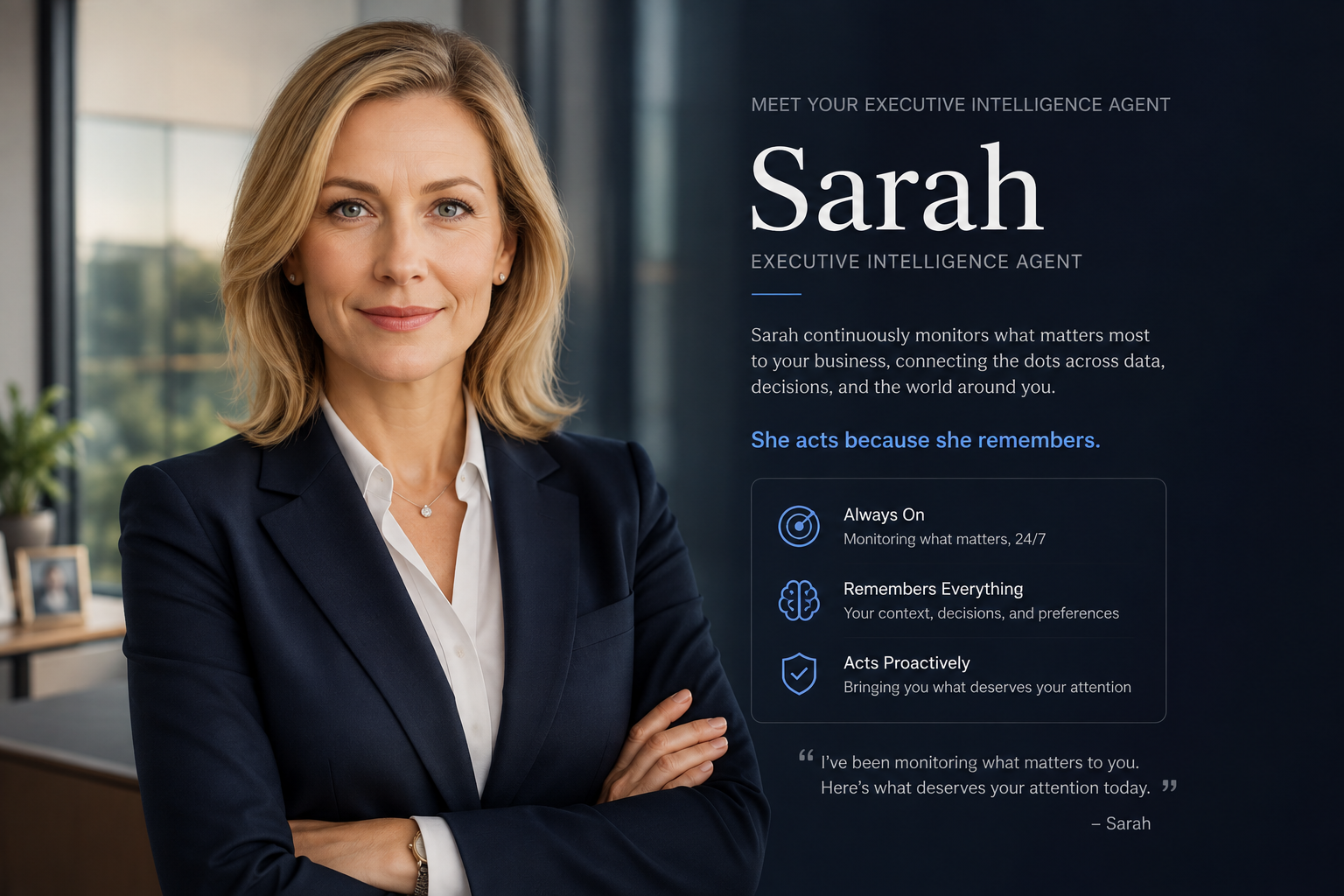
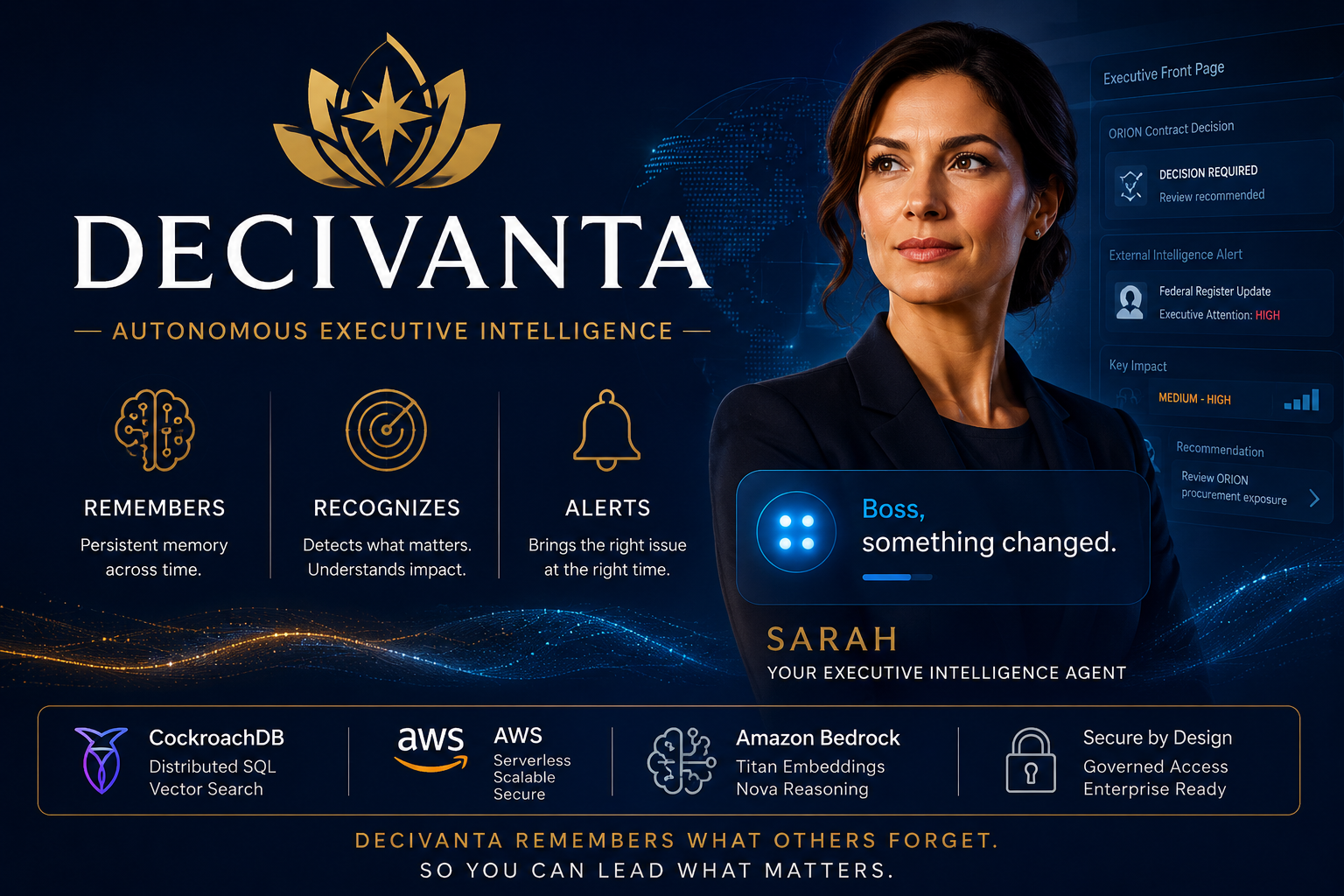
DECIVANTA introduces Sarah, an Executive Intelligence Agent designed to maintain longitudinal organizational context across different management concerns.
Instead of presenting executives with another dashboard full of information, Sarah brings forward the issues that deserve attention and explains why they matter in the context of what the organization already knows.
The current demonstration includes three executive missions:
- Financial Oversight — monitors financial conditions against established thresholds and prior executive decisions.
- Business Case Watch — keeps strategic initiatives connected to their assumptions, evidence, decisions, and follow-up.
- External Intelligence — evaluates new developments in the context of existing organizational priorities and memory.
Across those missions, Sarah follows a recurring executive cycle:
remember → connect → assess → recommend → record the executive decision → follow up
This is what makes DECIVANTA different from a conventional AI assistant. The interaction does not end when an answer is generated. Decisions and follow-up become persistent organizational memory that can influence subsequent reviews.
Human authority remains explicit: Sarah provides evidence, context, and recommendations, but consequential executive decisions remain with the executive.
How we built it
DECIVANTA was designed with CockroachDB as its persistent memory layer, rather than treating memory as an add-on to an LLM workflow.
We integrated two core CockroachDB capabilities:
CockroachDB Cloud Managed MCP Server provides governed access to structured organizational information. The agent uses controlled queries to retrieve relevant operational context while keeping database interaction bounded and auditable.
CockroachDB Distributed Vector Indexing supports semantic retrieval across persistent memory. Executive decisions, follow-up items, and contextual memory can be represented as embeddings and retrieved by meaning—not merely by exact identifiers or keywords.
On AWS, Amazon Bedrock provides the AI reasoning and embedding capabilities. Amazon Titan Text Embeddings V2 generates normalized 1024-dimensional embeddings used for semantic memory retrieval, while Amazon Nova Lite produces bounded executive guidance from the retrieved evidence and context.
AWS Lambda executes the serverless backend workflows, with Amazon API Gateway exposing the application API. The judge-facing web experience is deployed using AWS Amplify.
The result is an architecture in which operational state, semantic memory, AI reasoning, and executive actions form one continuous loop.
Challenges we ran into
The hardest problem was not generating an intelligent answer. It was deciding what an executive agent should remember and how that memory should affect future behavior.
We had to distinguish between evidence, recommendations, executive decisions, and follow-up state rather than collapsing everything into conversation history.
We also wanted semantic memory without creating a separate vector database that could drift away from transactional state. CockroachDB's distributed vector capabilities allowed operational and semantic memory to remain within the same persistent data platform.
Another important challenge was governance. DECIVANTA handles executive decision support, so AI guidance cannot silently become executive authority. We designed explicit boundaries between what Sarah can assess and recommend and what requires human decision.
Finally, repeatability and traceability mattered. Executive follow-up must survive individual interactions and return at the appropriate review point instead of disappearing when a session ends.
Accomplishments that we're proud of
We are particularly proud that memory in DECIVANTA is operational, not decorative.
The system can persist executive decisions and follow-up state, retrieve semantically relevant prior context, combine that memory with current evidence, and use the resulting context to shape subsequent guidance.
We also demonstrated the sponsor-critical architecture using live services:
- CockroachDB Cloud Managed MCP Server
- CockroachDB Distributed Vector Indexing
- Amazon Bedrock
- AWS Lambda
- Amazon API Gateway
- AWS Amplify
Our vector retrieval runs against CockroachDB's distributed vector index, and the same environment maintains the structured state required for executive continuity.
Most importantly, we created one shared executive-memory concept across three very different management missions. Financial oversight, business cases, and external intelligence are not isolated AI demos; they are different views of the same longitudinal organizational memory.
What we learned
Our biggest learning was that agent memory is not valuable simply because an agent can retrieve the past.
Memory becomes valuable when it changes the future.
A useful executive agent needs to know which previous decision matters now, which unresolved commitment should return for review, which evidence changes an earlier assumption, and what should be preserved after the executive acts.
We also learned that combining transactional state and semantic retrieval in CockroachDB greatly simplifies this model. The agent does not need one system for operational truth and another disconnected system for long-term semantic memory.
And we learned that production-oriented agent design requires restraint. A trustworthy executive agent must know not only how to reason, but also where its authority ends.
What's next for DECIVANTA
DECIVANTA was designed as the foundation for a broader executive intelligence environment.
Next steps include expanding the range of executive missions, integrating additional enterprise information sources, strengthening organizational governance and permissions, and extending the memory model across longer decision cycles and larger organizations.
The core principle will remain unchanged:
Sarah remembers what matters, connects what changes, and brings critical issues back at the right time—so organizational memory becomes an active participant in better executive decisions.## Inspiration
Built With
- amazon-api-gateway
- amazon-bedrock
- amazon-nova-lite
- amazon-titan-text-embeddings-v2
- aws-amplify
- aws-lambda
- cockroachdb
- cockroachdb-cloud-managed-mcp-server
- cockroachdb-distributed-vector-indexing
- next.js
- node.js
- typescript

Log in or sign up for Devpost to join the conversation.