Inspiration
I started building DECISPEC because I realized something that felt kind of weird. AI has gotten really good at giving answers, but it's still surprisingly hard to know if those answers are actually correct. A response can look convincing, include citations, and even show calculations, but most people aren't going to manually verify every number or source.
I wanted to build something that doesn't just generate another AI response. Instead, it actually checks if the recommendation is supported by the evidence. That idea eventually became DECISPEC.
What it does
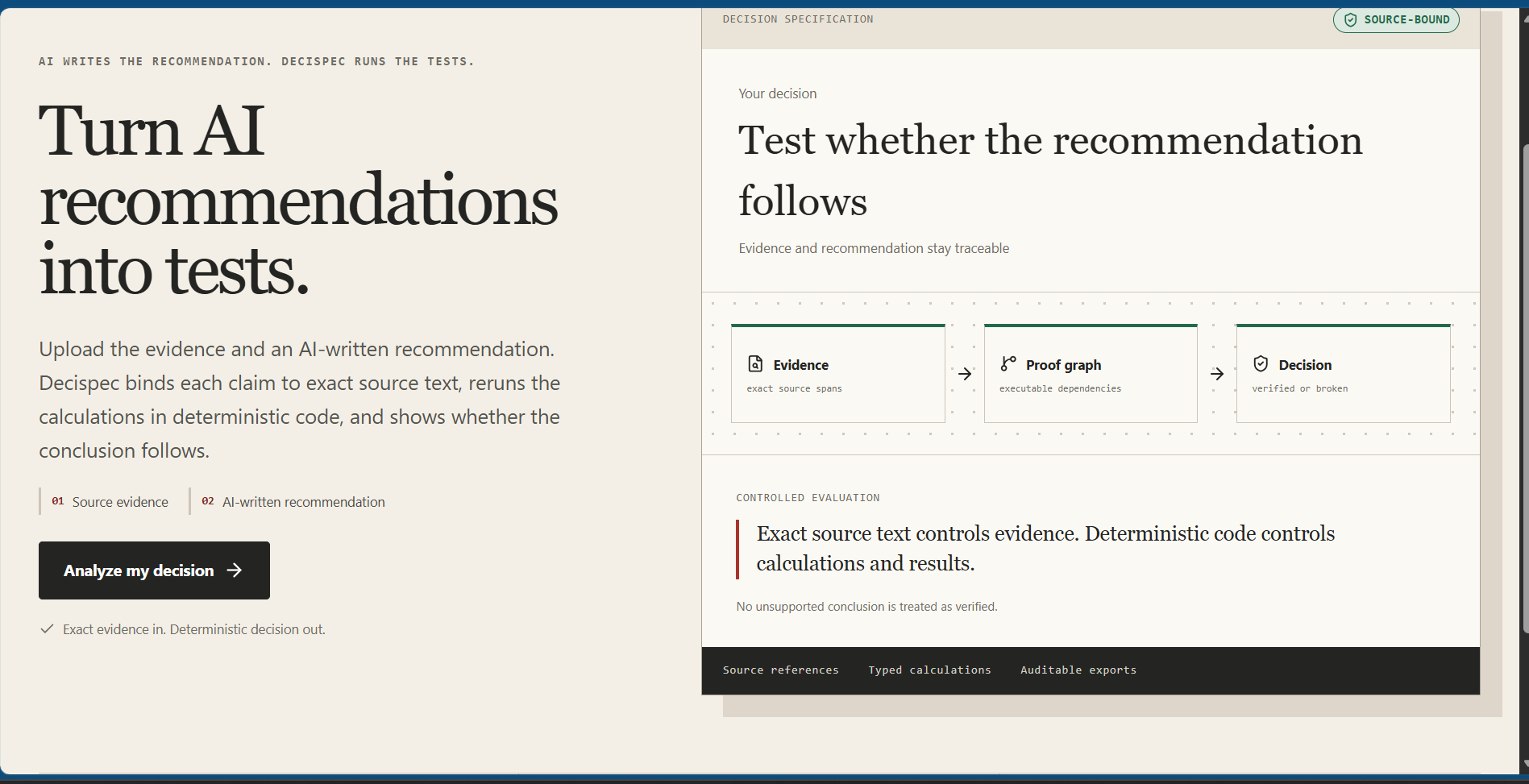
DECISPEC verifies AI-generated recommendations instead of creating new ones.
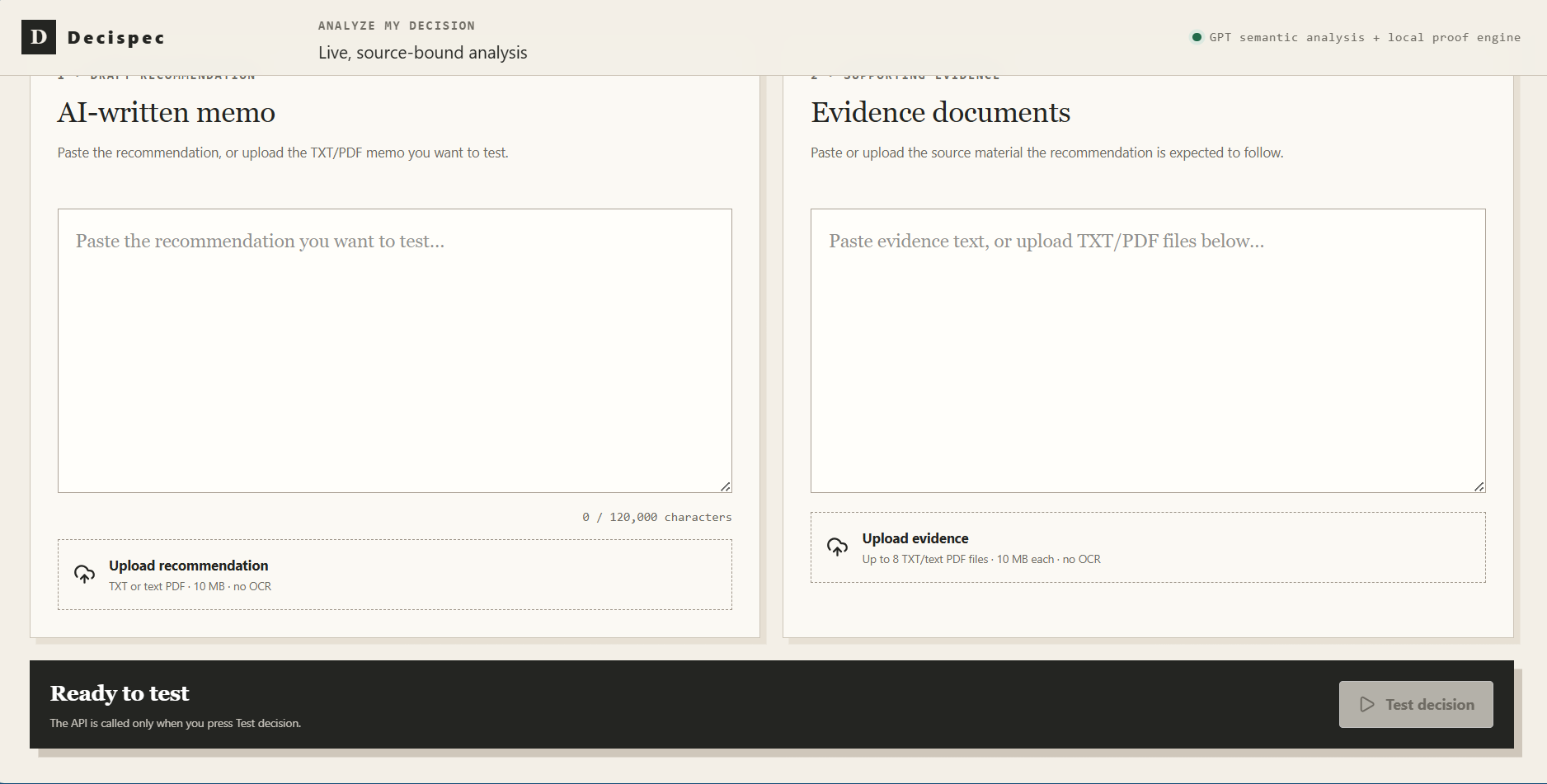
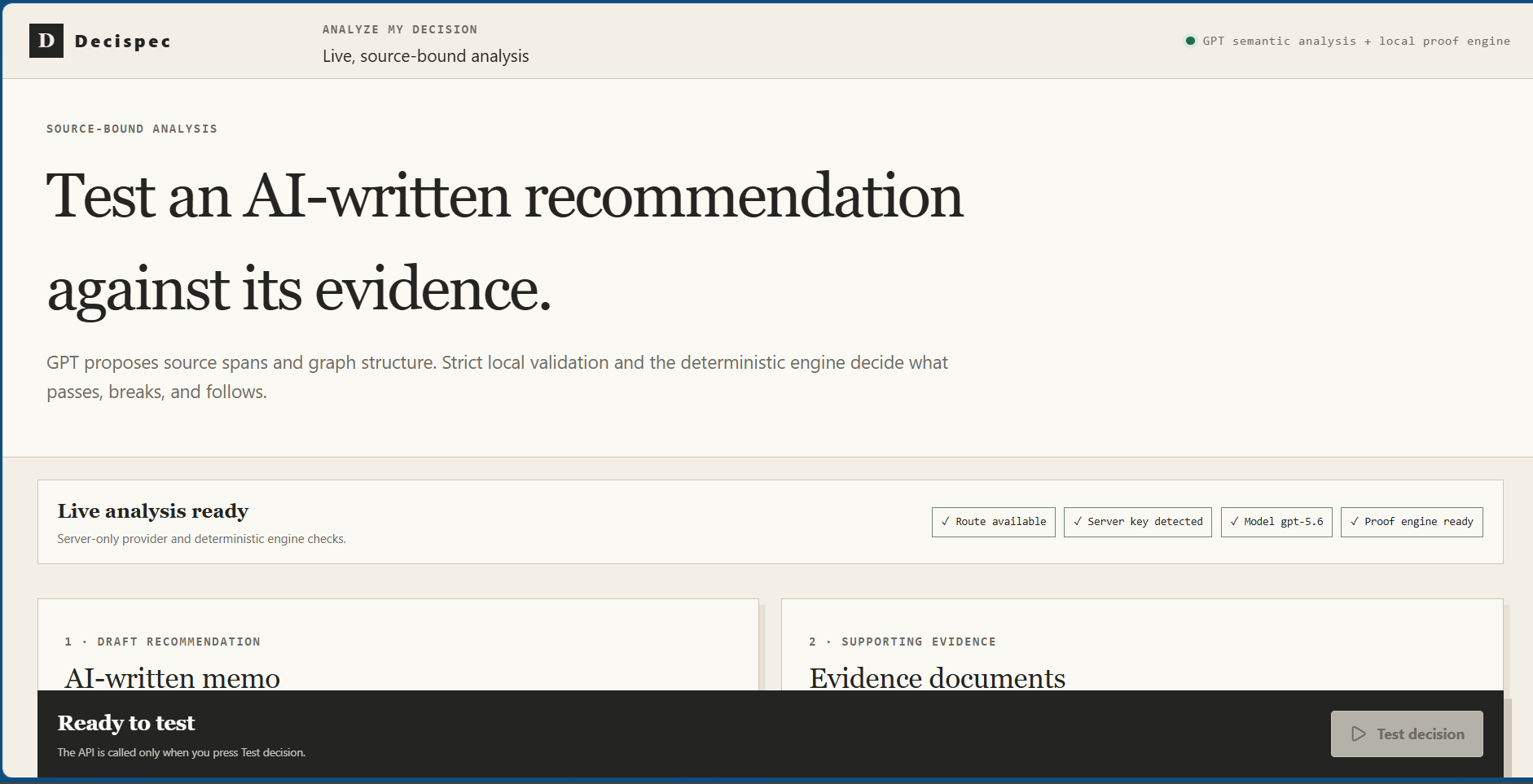
You upload source documents (or just paste the text), then provide the AI recommendation you want to verify. DECISPEC traces claims back to their evidence, validates calculations, checks quoted information, and builds a dependency graph showing how the final conclusion was reached.
If it finds an error, it doesn't just point it out. It recalculates every affected value, updates the recommendation, and generates a transparent report explaining exactly what changed and why.
How we built it
The project was built with React, Next.js, TypeScript, Codex, and the GPT-5.6 API.
Codex honestly sped up almost every part of development. I used it to help implement features, refactor code, debug problems, write tests, and iterate much faster than I could have by myself.
Inside the app, GPT-5.6 has a pretty focused job. It converts unstructured documents into structured data. After that, the verification is handled almost entirely by deterministic code that validates calculations, traces evidence, checks dependencies, and propagates corrections through the graph.
I designed it this way because I wanted the final result to be repeatable instead of depending on another AI opinion. It also keeps API costs really low.
Challenges we ran into
Probably the hardest part was getting correction propagation right.
Finding a wrong number is one thing, but making sure every calculation that depends on that number updates correctly without breaking everything else was much harder than I expected.
Another challenge was balancing AI with deterministic code. It was tempting to let the model do more work, but I wanted the system to actually verify decisions instead of just asking another AI if something looked correct.
Accomplishments that we're proud of
I'm probably most proud that DECISPEC actually explains why something is wrong instead of just saying it is.
Seeing a recommendation change because of a single corrected assumption was honestly one of those moments where the whole project finally clicked.
I'm also really happy with how transparent everything ended up being. You can actually follow the reasoning instead of just trusting a black box.
What we learned
The biggest lesson was that AI doesn't always need to do everything.
Sometimes using AI for one focused task and then letting deterministic software handle the rest leads to something that's more reliable, easier to debug, and much cheaper to run.
Building DECISPEC also taught me a lot about designing systems where every conclusion can be traced back to actual evidence instead of just trusting confidence scores.
What's next for DECISPEC
Right now DECISPEC works well for verifying reports and recommendations, but I think it could be useful anywhere important decisions are being made.
I'd like to support more document formats, improve the verification engine, handle much larger document sets, and make the reports even easier for non-technical users to understand.
Long term, I want DECISPEC to become a tool that helps people trust AI because its conclusions can actually be verified.
What it does
How we built it
Challenges we ran into
Accomplishments that we're proud of
What we learned
What's next for DECISPEC
Built With
- codex
- gpt-5.6
- next.js
- openai
- react
- tailwindcss
- typescript

Log in or sign up for Devpost to join the conversation.