Project Story
Inspiration
Decisive Grounds was born from a desire to create a roguelike experience that thrives on community engagement and competition. The core inspiration came from understanding what makes roguelikes compelling—the permadeath mechanic, procedural generation, and the rush of pushing "just one more run"—but reimagined for a social, asynchronous multiplayer setting. The project was built specifically for the Reddit and Kiro Community Games Challenge, which offered the perfect platform to blend individual player progression with shared leaderboard experiences. The idea of letting players race through procedurally-generated zones while sharing their runs with a broader community transformed a solo roguelike into something more: a competitive playground where every player's journey matters.
Development Process
Technology Stack: The project was developed using Phaser.js, a lightweight, developer-friendly framework ideal for 2D web games. Phaser's flexible architecture and WebGL rendering capabilities made it suitable for handling physics, animations, and responsive design across devices.
Core Systems Implemented:
- Procedural Map Generation: Dynamic, legal map generation ensures every zone feels fresh while remaining completable, giving the game infinite replayability.
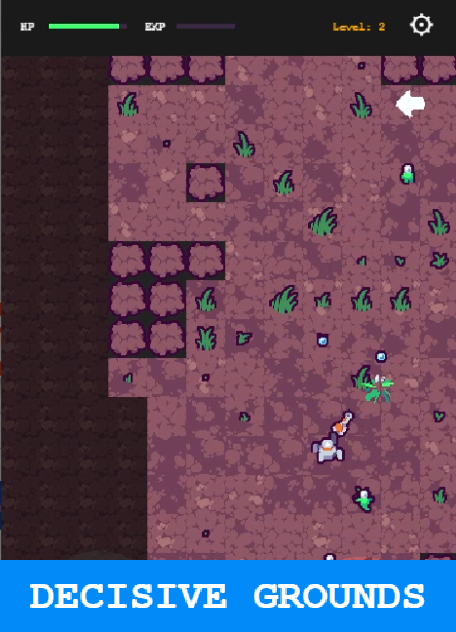
- Player Progression System: An experience-based leveling system where defeating monsters rewards experience points, allowing players to grow stronger as they advance through zones.
- Enemy AI with Cooperative Movement: Enemies employ flocking behaviors and coordinated movement patterns, creating dynamic encounters that scale with difficulty.
- UI Polish: The project extensively used the rex plugin for robust UI management, implementing main menus, save/continue functionality, tutorial flows, HP/EXP bars, and professional leaderboards displaying real player usernames.
- Responsive Design: Mobile-first optimization ensures the game works seamlessly across devices, addressing the challenge of delivering consistent experiences on phones, tablets, and desktop.
- Leaderboard & Community Features: Authentication integration extracted real usernames rather than generic IDs, creating a personalized competitive atmosphere where players share their best runs anonymously (focusing on performance metrics rather than personal data).
Challenges Faced
Mobile Responsiveness: One significant hurdle was eliminating large blank/black spaces that appeared above and below the game on mobile devices. Solving this required careful viewport configuration and responsive canvas scaling—a critical issue for a game intended for Reddit's diverse audience.
Procedural Generation Balance: Creating procedurally-generated zones that are both challenging and completable presented a unique problem. The solution involved seeding generation with developer-defined rules to ensure solvability while maintaining aesthetic variety, preventing players from encountering impossible layouts.
UI Complexity at Scale: Implementing a feature-rich UI (menus, leveling systems, leaderboards, save states) while keeping performance optimal across all devices demanded careful state management and the strategic use of the rex plugin to handle layered UI elements efficiently.
Community Data Architecture: Designing a system to store run data for the leaderboard while respecting privacy required a thoughtful approach—prioritizing anonymous run records and performance metrics over personal user information, using Redis-like structures for efficient retrieval.
Key Learnings
Throughout development, several critical insights emerged: Phaser.js excels at rapid prototyping of 2D games with its intuitive API and extensive plugin ecosystem, but requires careful optimization for mobile deployment. Procedural generation is both art and science—balancing randomness with playability shapes the entire player experience. Community-driven game design (sharing runs, leaderboards, friendly competition) transforms a solo experience into something players return to repeatedly. Finally, polish matters enormously—responsive design, professional UI, and thoughtful animations separate a finished game from a prototype, especially in a competition setting.
Decisive Grounds represents the convergence of roguelike design philosophy with modern web technologies and community-centric features, creating an experience that challenges players individually while connecting them through shared competition.

Log in or sign up for Devpost to join the conversation.