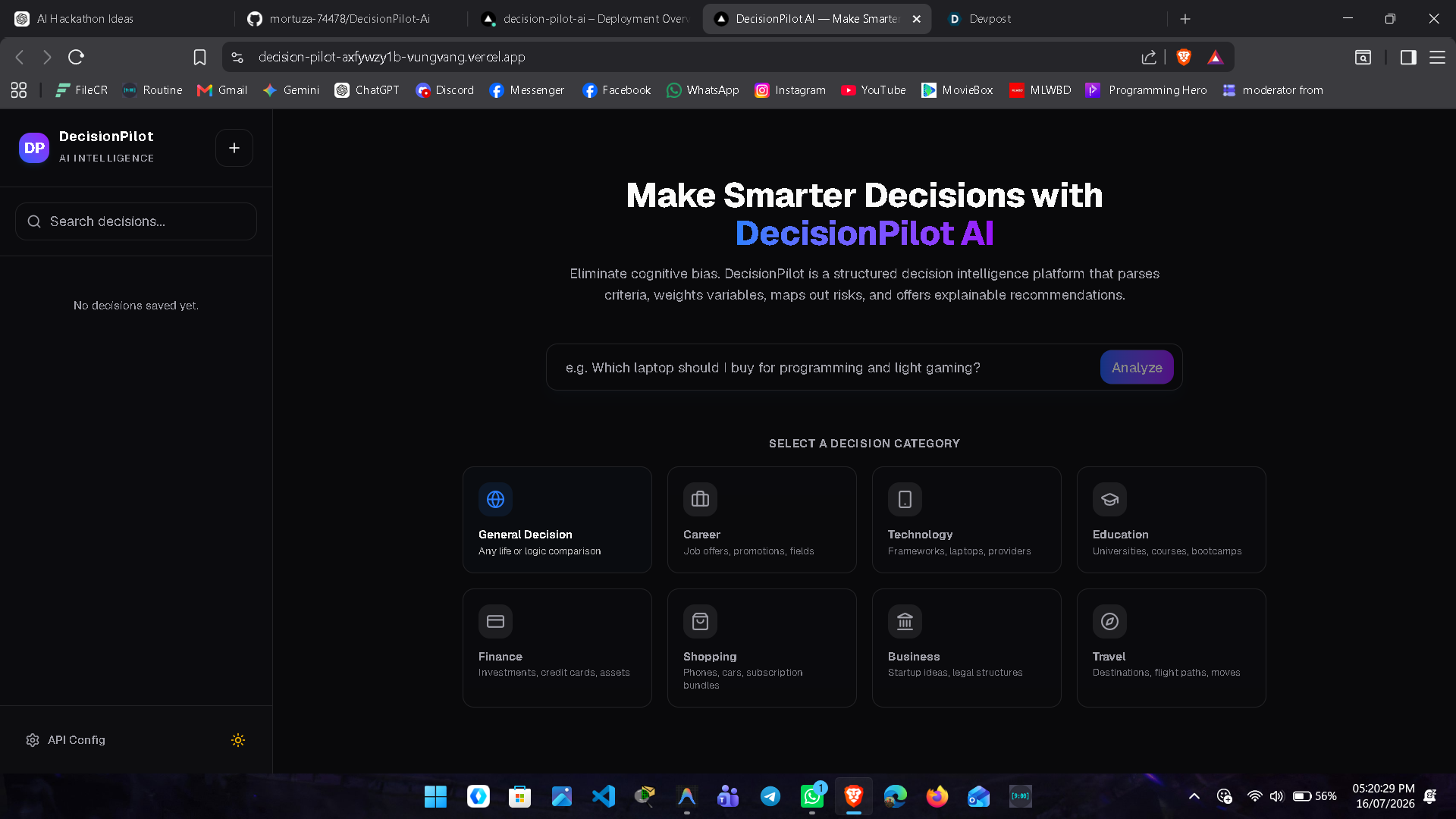
DecisionPilot AI
Inspiration
Every day, people make decisions that can significantly impact their lives, such as choosing a university, accepting a job offer, buying a laptop, selecting an insurance plan, or deciding which online course to take. While AI chatbots can provide answers, they often jump directly to recommendations without fully understanding the user's situation or explaining the reasoning behind their advice.
We wanted to build something different.
Instead of creating another chatbot, we built DecisionPilot AI, an AI-powered decision intelligence platform that guides users through a structured decision-making process. Rather than giving quick answers, it asks the right questions, analyzes multiple factors, evaluates trade-offs, and provides transparent recommendations with clear reasoning.
Our goal was simple: help people make informed decisions with confidence instead of relying on guesswork.
What it does
DecisionPilot AI acts as an intelligent decision copilot.
A user starts by describing a decision they need to make, such as:
- Which laptop should I buy?
- Which job offer is better?
- Which university should I choose?
- Should I learn React or Flutter?
- Which subscription is worth paying for?
Instead of immediately generating an answer, the AI first gathers context by asking relevant follow-up questions. Once it understands the user's priorities, it performs a structured analysis and generates:
- A personalized recommendation
- A confidence level
- Pros and cons for each option
- Trade-off analysis
- Risk assessment
- Alternative recommendations
- A clear explanation of how the conclusion was reached
This makes the decision process transparent, understandable, and easier to trust.
How we built it
We designed the application as a modern AI-powered web platform with scalability in mind.
Our stack includes:
- Next.js for the frontend and server-side capabilities
- TypeScript for type safety
- Tailwind CSS and shadcn/ui for a clean and responsive user interface
- Framer Motion for smooth interactions
- Supabase for authentication and data storage
- OpenAI/Gemini as the reasoning engine
The AI workflow follows a structured pipeline:
- Understand the user's goal.
- Extract the important decision variables.
- Identify missing information.
- Ask contextual follow-up questions.
- Build a decision model.
- Compare available options.
- Evaluate trade-offs.
- Generate a recommendation.
- Explain the reasoning.
- Suggest alternative choices when appropriate.
This approach allows the AI to reason step by step instead of producing immediate, unexplained answers.
Challenges we faced
The biggest challenge was preventing the AI from acting overconfidently.
Large language models often generate recommendations even when important information is missing. To address this, we designed the system to recognize uncertainty and request additional context before reaching a conclusion.
Another challenge was balancing intelligence with simplicity. We wanted users to experience a powerful reasoning engine without overwhelming them with technical complexity. This required careful UX design, intuitive conversation flows, and concise explanations.
Finally, we focused on making recommendations transparent. Rather than presenting a single answer, DecisionPilot AI clearly distinguishes between verified information, assumptions, trade-offs, and recommendations, helping users understand why a particular option was suggested.
What we learned
This project taught us that building AI products is about much more than integrating an LLM.
We learned the importance of:
- Designing structured reasoning workflows
- Building trustworthy AI experiences
- Asking better questions before giving answers
- Communicating uncertainty honestly
- Creating intuitive user experiences around complex AI systems
Most importantly, we realized that the best AI doesn't replace human decision-making. It empowers people with better information, clearer reasoning, and greater confidence.
Future plans
We envision DecisionPilot AI evolving into a comprehensive decision intelligence platform.
Future features include:
- Document-based decision support
- Real-time web data integration
- Multi-agent reasoning
- Calendar and email integration
- Team collaboration
- Personalized decision history
- Voice conversations
- Mobile applications
- Industry-specific decision templates for education, healthcare, finance, and business
Our long-term vision is to make DecisionPilot AI the trusted AI companion people rely on whenever they face an important decision.
Why DecisionPilot AI?
Most AI assistants answer questions.
DecisionPilot AI helps people make better decisions.
That difference is what inspired us to build this project.

Log in or sign up for Devpost to join the conversation.