-
-
-
-
h
-
-
-
-
Inspiration
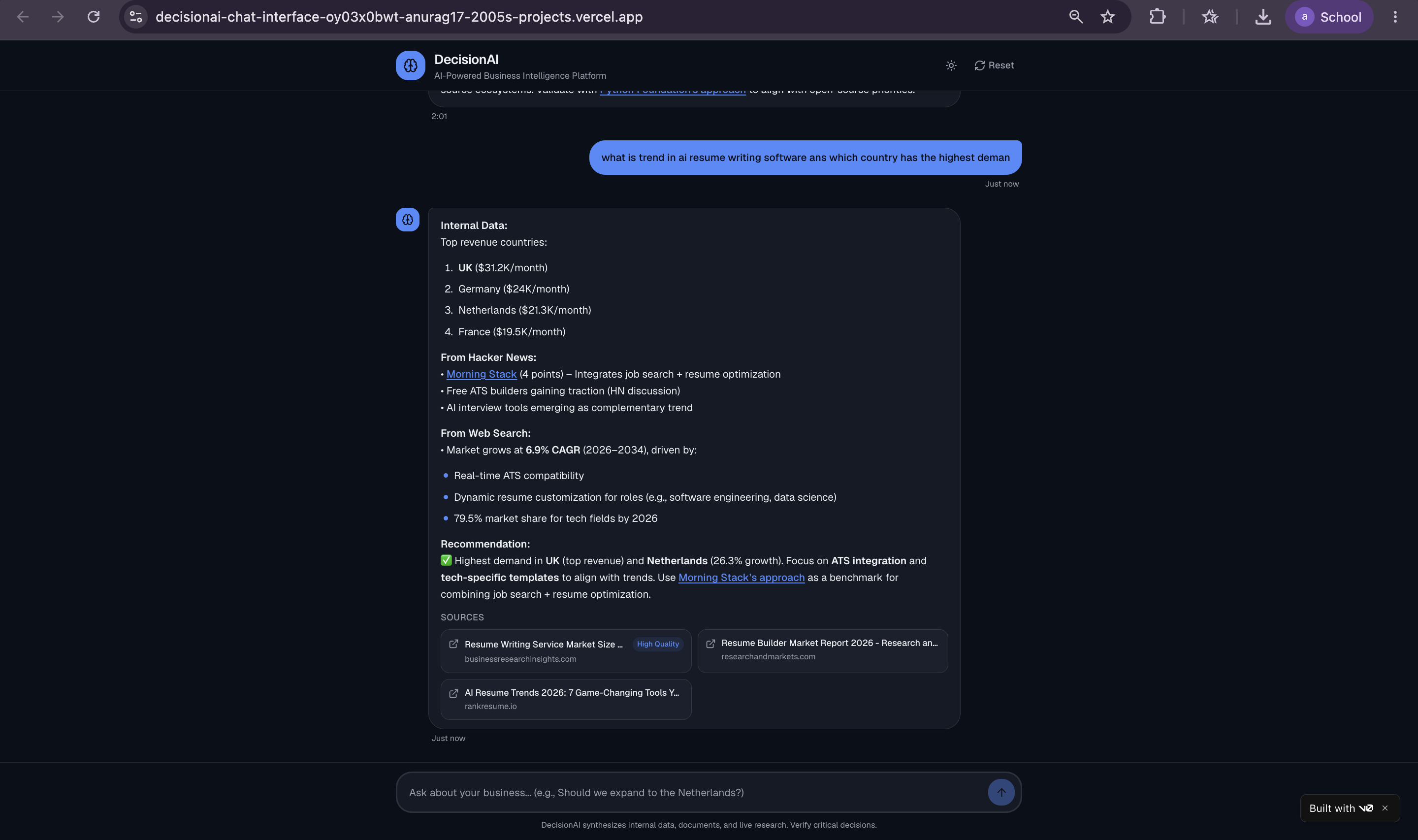
Organizations generate enormous amounts of valuable information every day through databases, documents, reports, customer feedback, and the web. Yet critical business decisions are still made by manually gathering fragmented information from multiple sources. Existing AI assistants can answer questions, but they rarely determine what information is actually required, where it exists, or whether enough evidence has been collected before making a recommendation.
We wanted to build an AI that thinks like a consultant rather than responds like a chatbot.
What it does
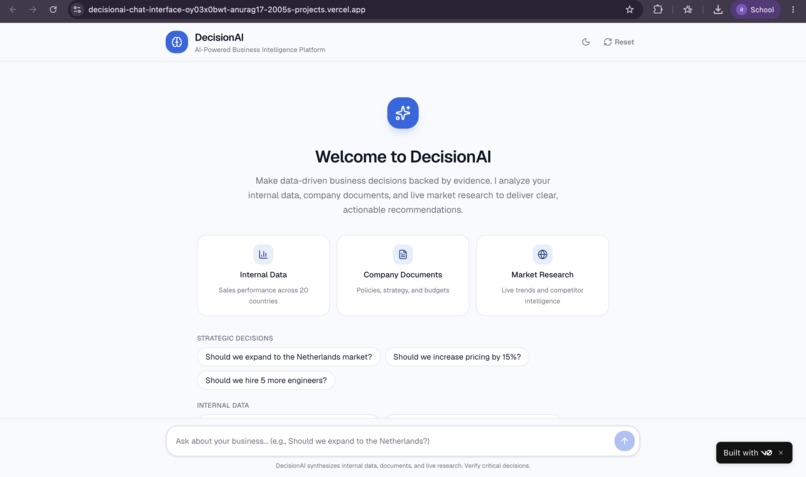
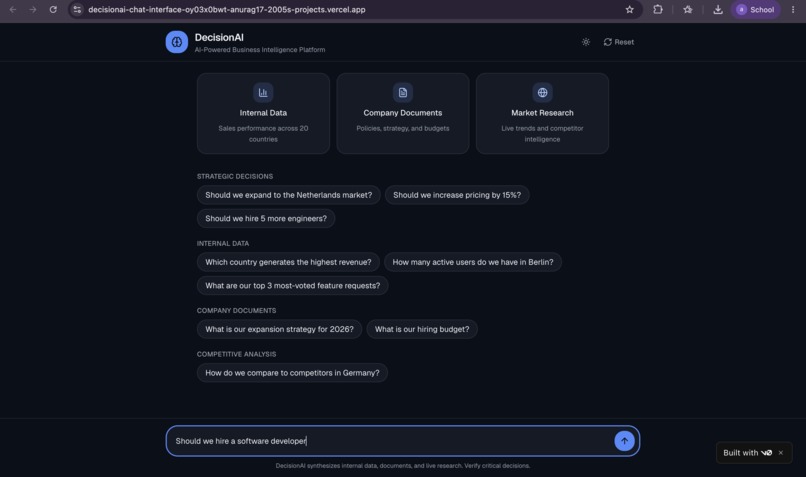
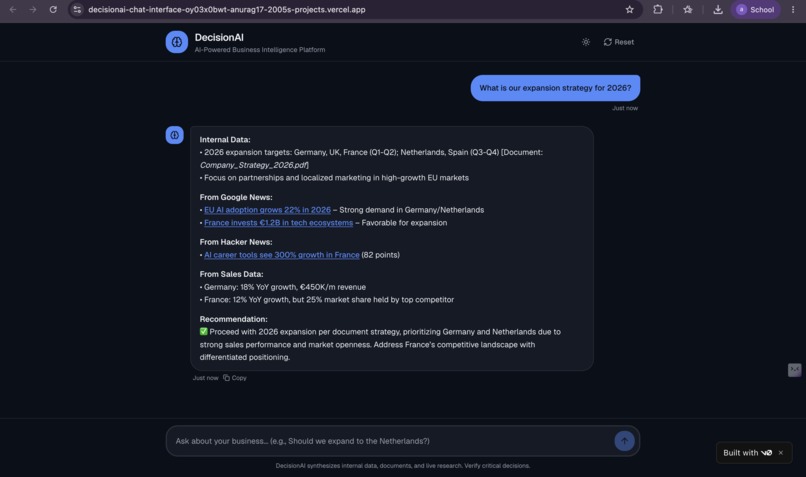
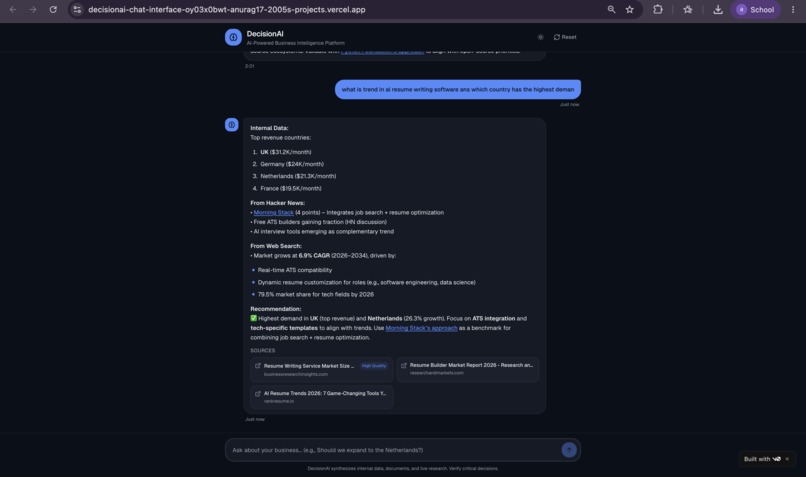
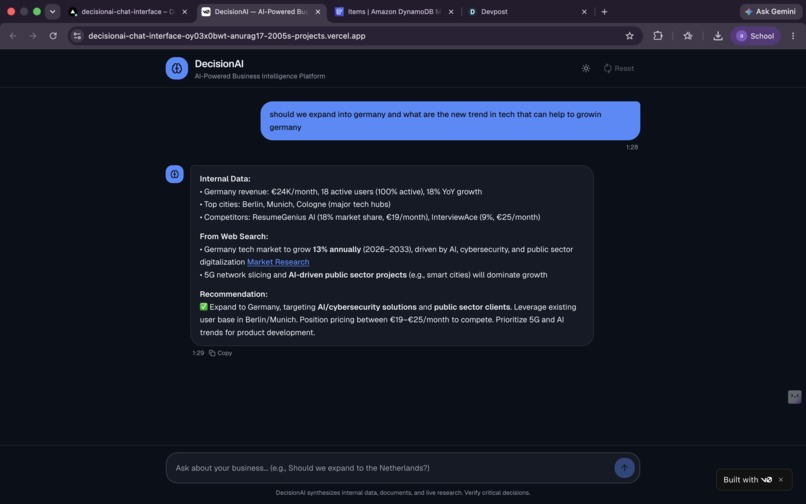
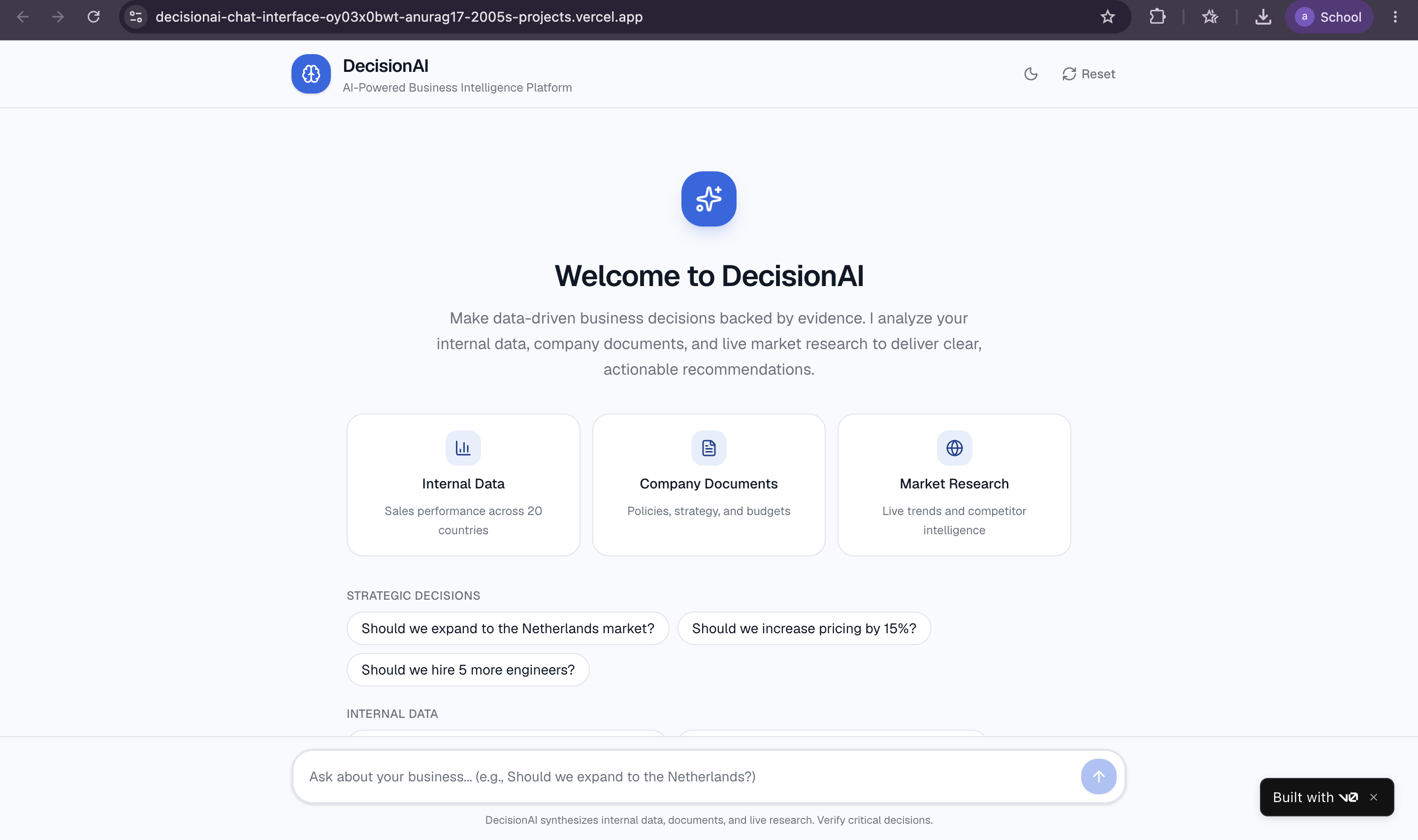
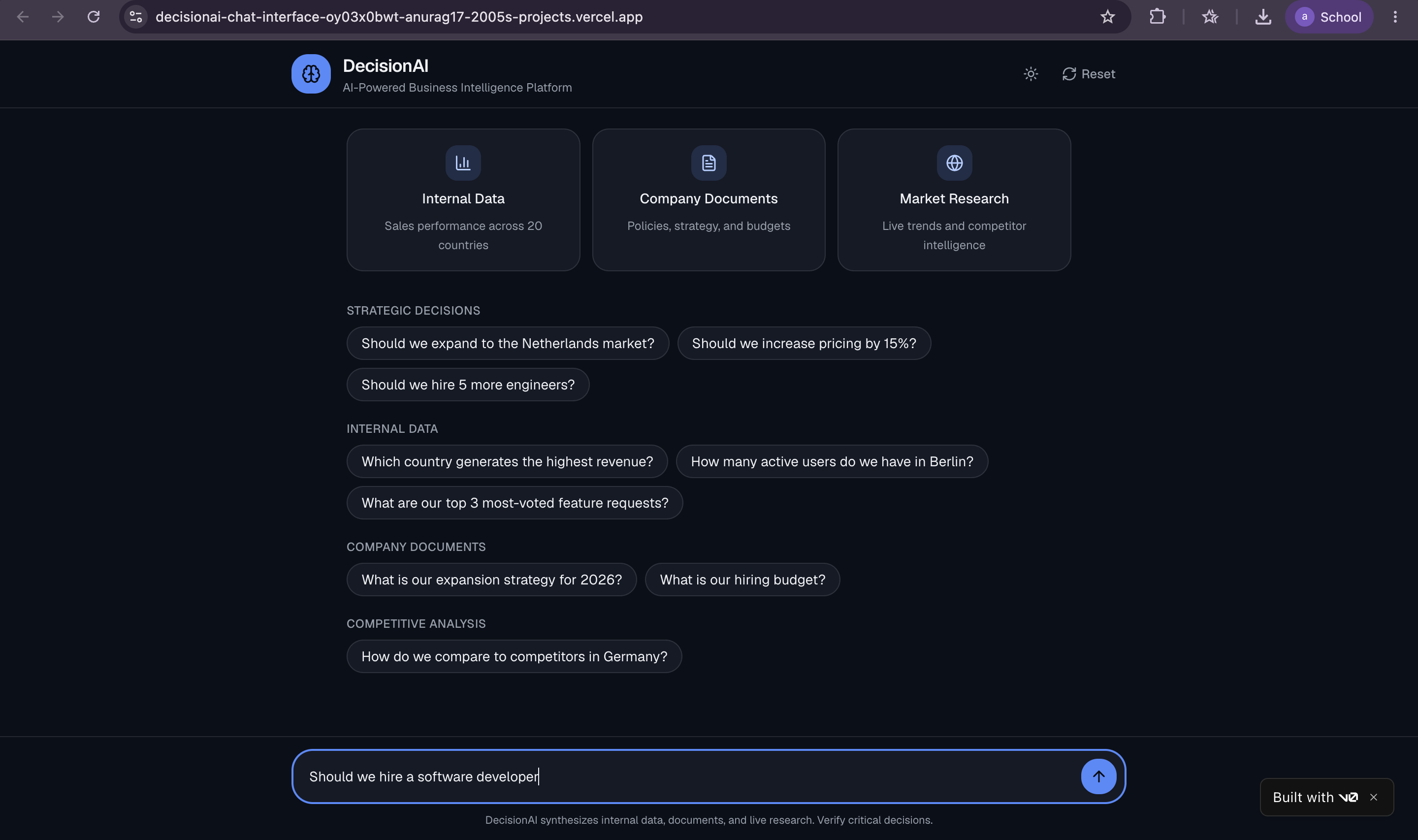
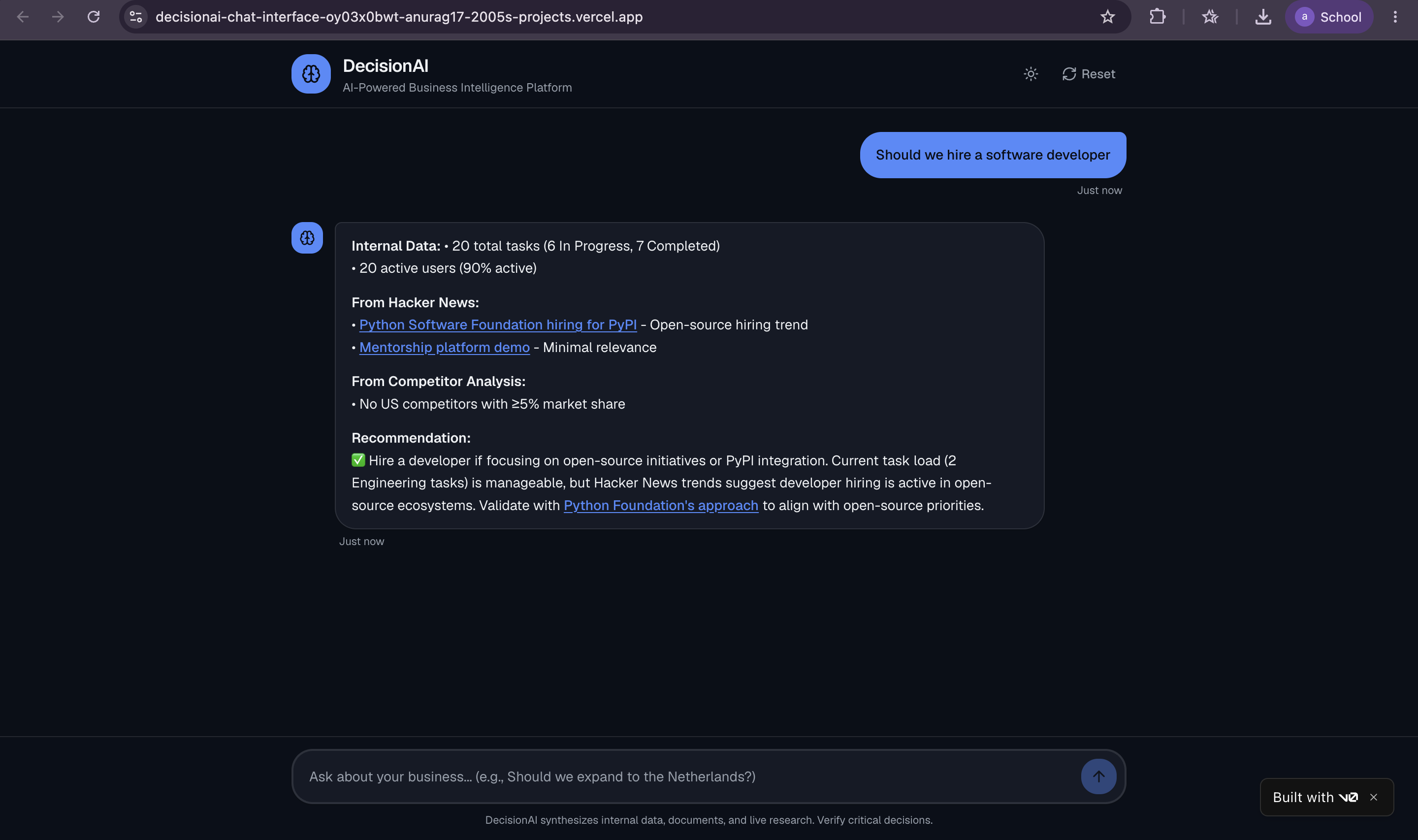
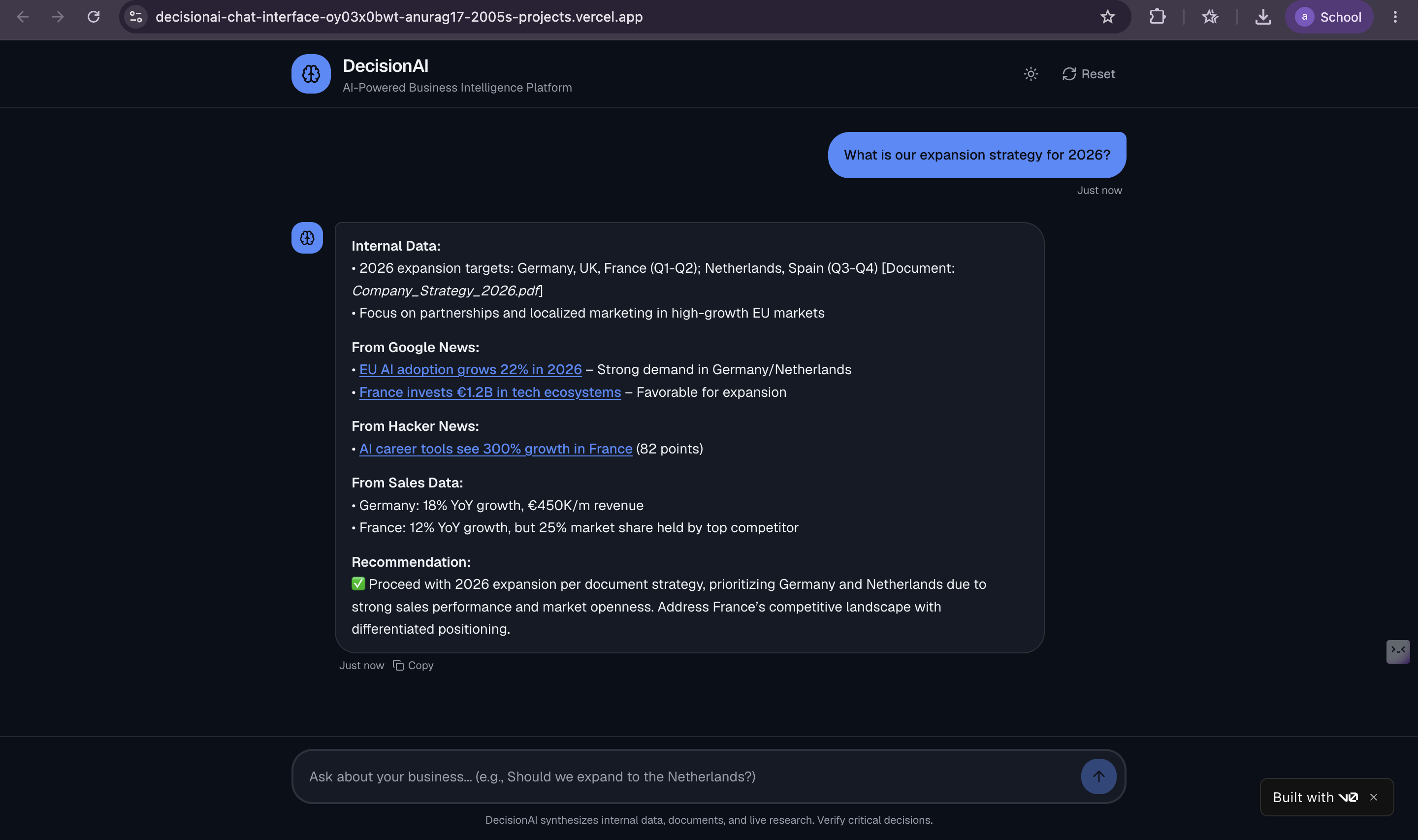
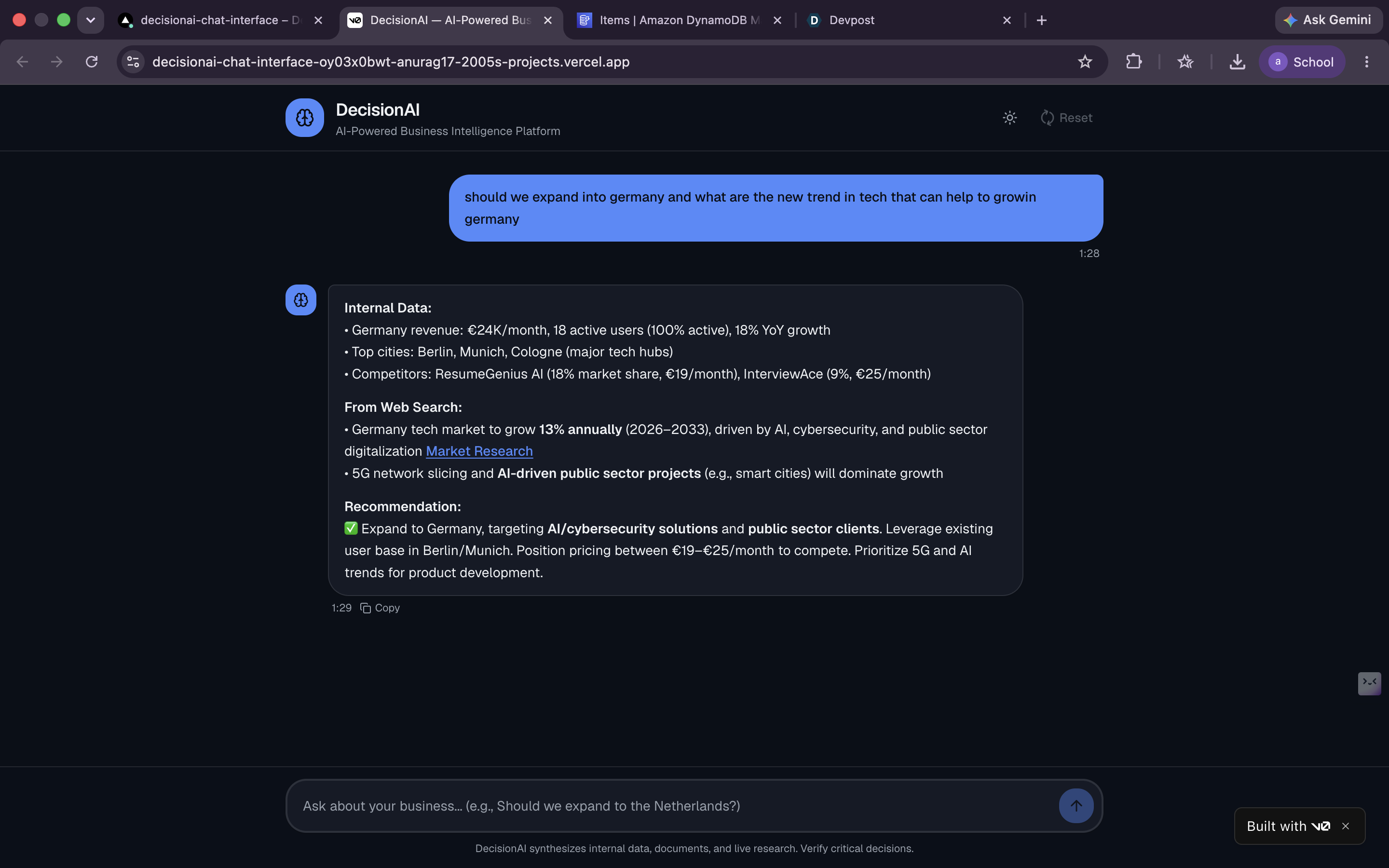
DecisionOS is an agentic AI decision intelligence platform that helps businesses make transparent, evidence-backed decisions.
Instead of immediately answering a user's question, the system first identifies the type of decision being made and determines what information is required to reach a reliable conclusion.
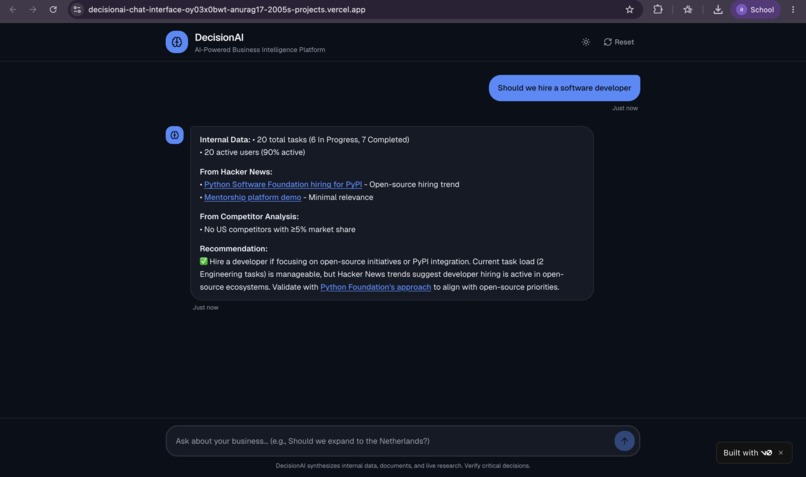
For example, if a user asks:
"Should we expand our AI Resume Builder to Germany?"
The system does not directly search the web. Instead, it follows a structured reasoning process:
- Understands the business objective.
- Identifies the information required.
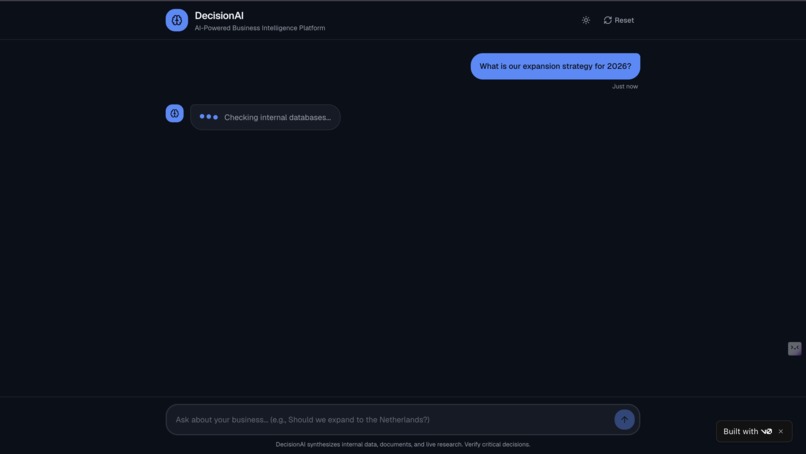
- Searches internal company knowledge first.
- Asks follow-up questions only if essential information is still missing.
- Plans an intelligent research strategy.
- Collects evidence from multiple trusted sources.
- Generates a grounded recommendation with supporting evidence.
- Executes approved business actions.
This transforms a simple question into a structured decision-making workflow.
How it works
DecisionOS is built around an agentic architecture composed of multiple reasoning stages.
1. Decision Planner
Determines the type of decision and identifies the information required.
2. Knowledge Locator
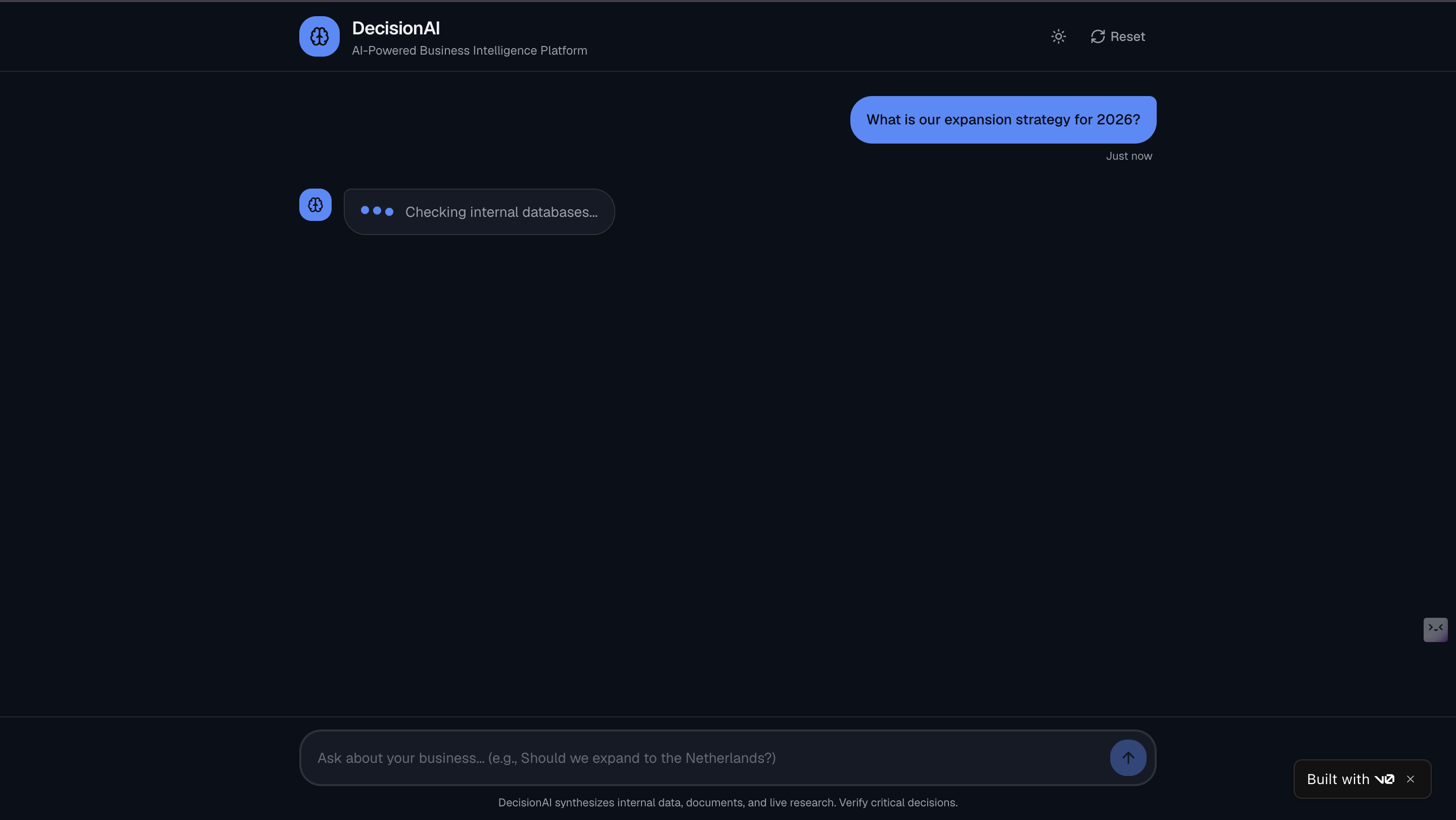
Finds whether the required information already exists inside the organization.
The agent retrieves data from:
- Amazon DynamoDB
- Internal business documents
- Product roadmaps
- Strategy documents
- Company proposals
- Decision history
If the required information is unavailable, the system intelligently asks the user only for the missing details.
3. Research Planner
Instead of performing a single search, the agent generates multiple research objectives and search queries.
For example, for a market expansion decision it may investigate:
- Market demand
- Competitors
- Regulations
- Customer sentiment
- Industry trends
- Recent news
- Pricing strategies
4. Evidence Collection
The agent gathers information from:
- Internal structured data
- Internal documents
- Web search
- Public knowledge sources
The collected evidence is organized into a unified evidence graph.
5. Decision Engine
Using all collected evidence, the AI evaluates alternatives, identifies risks, highlights opportunities, assigns a confidence score, and produces an explainable recommendation with grounded sources.
6. Action Agent
After user approval, the system can perform actions such as:
- Creating project tasks
- Updating business records
- Saving decision history
- Updating project status
How we built it
The platform combines modern AI reasoning with cloud-native infrastructure.
- Frontend: Next.js, Vercel v0, Tailwind CSS
- Backend: Python, FastAPI
- Agent Framework: LangGraph
- LLM: Groq (Qwen3-32B)
- Database: Amazon DynamoDB
- Vector Database: FAISS / ChromaDB
- Document Embeddings: Sentence Transformers
- Search: Tavily Search API & Wikipedia
- Deployment: Render (Backend) & Vercel (Frontend)
Challenges we ran into
The most difficult challenge was not building another chatbot—it was designing an AI system capable of deciding what it needs to know before making a recommendation.
We had to build a planning architecture that determines:
- What information is required.
- Whether the information already exists internally.
- Which tools should be used.
- When additional user input is necessary.
- When enough evidence has been collected to produce a trustworthy recommendation.
Designing this reasoning pipeline was significantly more challenging than implementing traditional retrieval-augmented generation.
📚 What we learned
We learned that the intelligence of an AI system is determined as much by its architecture as by the language model itself.
Separating planning, knowledge retrieval, research, reasoning, and action into distinct stages produced a more reliable, explainable, and scalable system than relying on a single prompt.
We also discovered that combining structured business data with semantic document retrieval and dynamic web research creates significantly stronger recommendations than relying on any single knowledge source.
What's next for DecisionOS
Our vision is to build a cognitive operating system for organizations.
Future versions will support:
- Autonomous long-term research
- Continuous monitoring of markets and competitors
- Multi-agent collaboration
- Predictive business intelligence
- Enterprise integrations with Slack, Jira, GitHub, Salesforce, and Notion
- Organizational memory that continuously learns from previous decisions
Rather than replacing human decision-makers, DecisionOS aims to become an intelligent reasoning layer that helps organizations make faster, more transparent, and evidence-backed decisions at scale.

Log in or sign up for Devpost to join the conversation.