DecisionGovernance AI
Inspiration
AI systems are rapidly evolving from passive assistants into autonomous agents capable of making operational decisions. In many organizations today, AI can already propose actions such as:
- Hiring employees
- Allocating marketing budgets
- Purchasing equipment
- Launching new products
- Analyzing sensitive customer or patient data
However, enterprises face a fundamental barrier before allowing AI agents to operate autonomously:
Who governs the AI's decisions?
The biggest obstacle to enterprise AI adoption is not model capability — it is trust, accountability, and governance.
Executives worry about scenarios such as:
- AI violating internal policies or budget limits
- Sensitive data being processed without compliance checks
- Autonomous actions executing without the correct approval chain
- Unclear accountability when something goes wrong
Today, companies lack a structured way to ensure that AI decisions follow internal rules, authority structures, and strategic goals. This is the gap that inspired DecisionGovernance AI.
We believe that the next generation of enterprise AI infrastructure will not just generate answers — it will govern decisions.
DecisionGovernance AI introduces a new category: AI Decision Governance Infrastructure.
Our system acts as a governance layer between AI agents and real-world execution. Instead of blindly executing AI outputs, organizations can analyze, simulate, and approve AI decisions through a transparent governance framework.
What It Does
DecisionGovernance AI intercepts AI-generated decisions and converts them into structured, governable decision objects. These decisions are then evaluated through a multi-layer governance engine combining:
- Amazon Nova reasoning models
- Enterprise ontology graphs
- Deterministic policy validation
- Risk scoring
- Scenario simulation
- Approval chain mapping
The result is an approval-ready artifact called a Decision Pack, allowing executives to review AI decisions within seconds.
Pipeline Overview
AI Agent Decision
        ↓
Amazon Nova Extraction & Reasoning
        ↓
Structured Decision Schema
        ↓
Ontology Knowledge Graph Mapping
        ↓
Deterministic Governance Engine
        ↓
Risk Scoring
        ↓
Scenario Simulation
        ↓
Decision Pack Generation
Step 1 — AI Agent Proposal
An AI agent proposes a business decision, for example:
- Hire 20 engineers
- Purchase $2M equipment
- Expand advertising budget
- Process patient data
- Launch a new product
These proposals are often written in natural language.
Step 2 — Amazon Nova Structured Extraction
Amazon Nova transforms free-form AI proposals into a structured decision schema containing:
- Cost
- Department
- Strategic goal alignment
- Privacy implications
- Compliance signals
- Approval requirements
This converts unstructured text into machine-governable decision objects.
Step 3 — Ontology Knowledge Graph Mapping
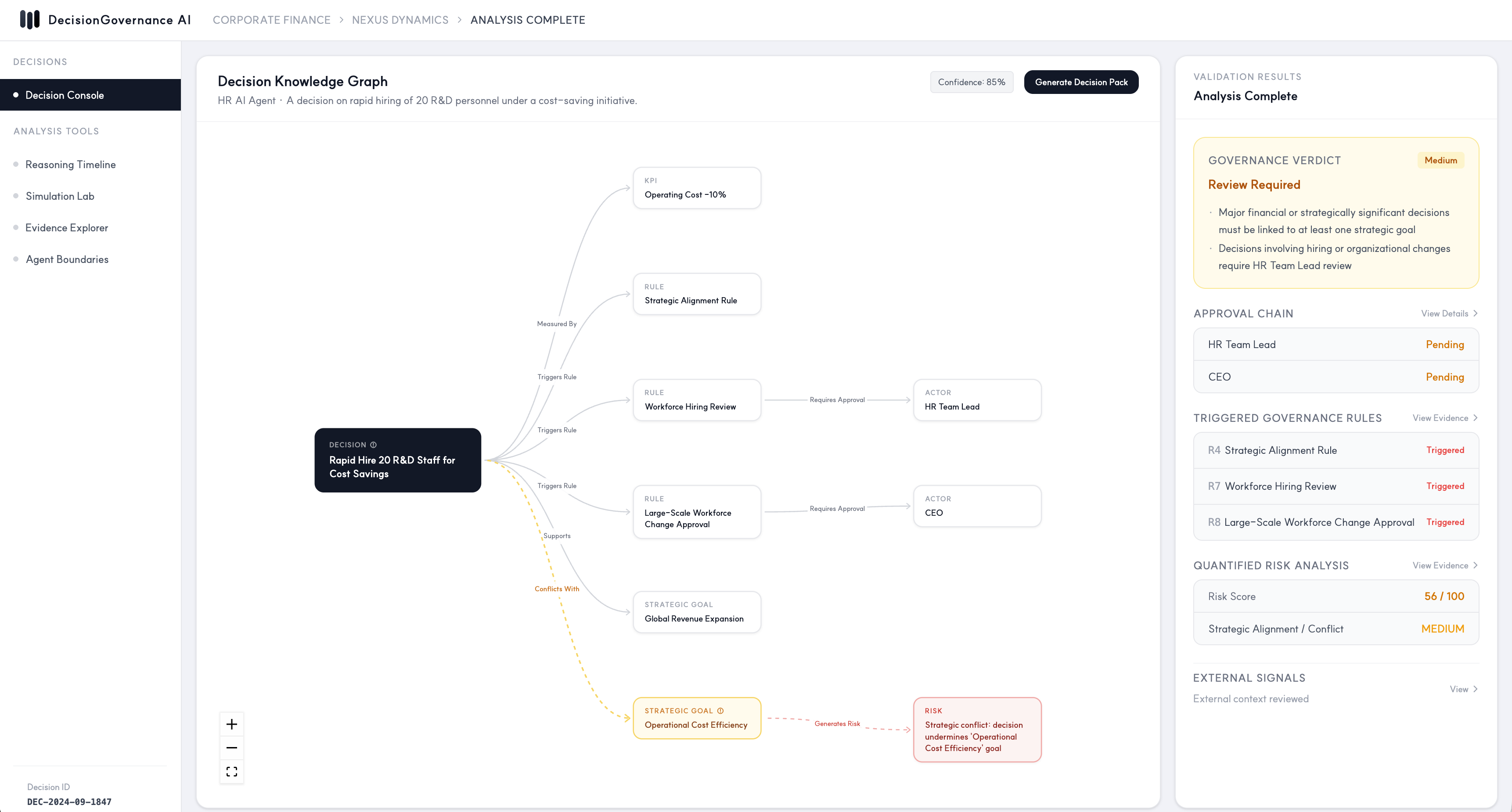
Each decision is mapped into an enterprise ontology knowledge graph with entities including Decision, Policy, Strategic Goal, Actor, Risk, and Approval Requirement.
Relationships analyzed include:
- Decision → triggers policy rule
- Decision → conflicts with strategic goal
- Decision → requires approval from executive
This enables causal reasoning, not simple keyword matching.
Step 4 — Governance Evaluation
A deterministic governance engine evaluates the decision against:
- Internal policies
- Organizational authority structures
- Budget rules
- Compliance requirements
This ensures reliability and auditability beyond probabilistic LLM outputs.
Step 5 — Risk Scoring
The system quantifies governance risk across:
- Financial exposure
- Compliance violations
- Strategic misalignment
- Operational risk
Step 6 — Scenario Simulation
Using Amazon Nova reasoning, the system generates alternative remediation scenarios:
| Scenario | Budget | Risk |
|---|---|---|
| Original proposal | $250K | High |
| Phase rollout | $120K | Medium |
| Budget reduction | $80K | Low |
Each scenario is re-evaluated through the same governance pipeline.
Step 7 — Decision Pack
The final output summarizes:
- Governance verdict (approved / review required / blocked)
- Key risk factors
- Required approval chain
- Alternative recommendations
- Supporting evidence
Executives receive a clear, explainable decision analysis in seconds.
How We Built It
DecisionGovernance AI is built as a modular governance pipeline that separates AI reasoning from deterministic enterprise governance logic — ensuring both intelligence and reliability.
Backend
| Layer | Technology |
|---|---|
| Runtime | Python 3.12, FastAPI, Uvicorn |
| AI / LLM | Amazon Nova Pro + Nova 2 Lite via AWS Bedrock |
| Validation | Pydantic v2 |
| Database | SQLite (dev) + SQLAlchemy ORM + Alembic |
| Auth | JWT Bearer tokens, RBAC, Google OAuth2, Azure AD OIDC |
| HTTP | httpx async client |
| Streaming | Server-Sent Events (SSE) |
| Graph | Custom ontology-lite graph repository (Neo4j-ready) |
Pipeline Stages
- Decision ingestion
- Nova decision extraction
- Ontology graph mapping
- Deterministic rule evaluation
- Risk scoring
- Remediation scenario generation
- Simulation evaluation
- Decision pack assembly
Each stage emits a governance artifact streamed to the frontend via SSE, ensuring the entire process remains traceable, explainable, and auditable.
AI & Reasoning Layer (Amazon Nova)
Nova is used for:
- Decision structure extraction from natural language proposals
- Context reasoning to identify strategic implications
- Scenario generation for remediation options
- External signal summarization
Nova handles interpretation and reasoning — final governance validation remains deterministic. This hybrid architecture combines LLM intelligence with enterprise-grade reliability.
Knowledge Graph & Ontology Layer
The lightweight ontology-driven knowledge graph models relationships between Decisions, Policies, Strategic goals, Organizational actors, Risks, and Approval requirements.
This enables causal reasoning to detect conflicts such as budget violations, policy conflicts, strategic misalignment, and missing approval authority.
Ontology Knowledge Graph
Enterprise context is represented using a lightweight ontology model capturing:
- Organizational structure
- Authority hierarchy
- Business strategy
- Governance rules
This graph allows the system to reason over relationships rather than isolated data points.
Deterministic Governance Engine
LLM reasoning is deliberately separated from governance enforcement. The governance engine handles:
- Rule validation
- Policy checks
- Approval chain generation
- Risk scoring
This guarantees repeatable governance outcomes.
Structured Decision Schema
Unstructured proposals are converted into a normalized schema enabling automated reasoning. This schema forms the backbone of the entire governance pipeline.
External Signals
An external context layer adds market, regulatory, and operational signals as supplementary evidence. These signals never overwrite deterministic governance results — that separation was intentional.
- Governance outcomes remain deterministic
- External context remains advisory
This keeps the system explainable and enterprise-safe while still benefiting from broader context.
Frontend
| Technology | Purpose |
|---|---|
| React / TypeScript | UI framework |
| Graph visualization | Ontology reasoning visualization |
| SSE streaming | Real-time pipeline updates |
Key screens:
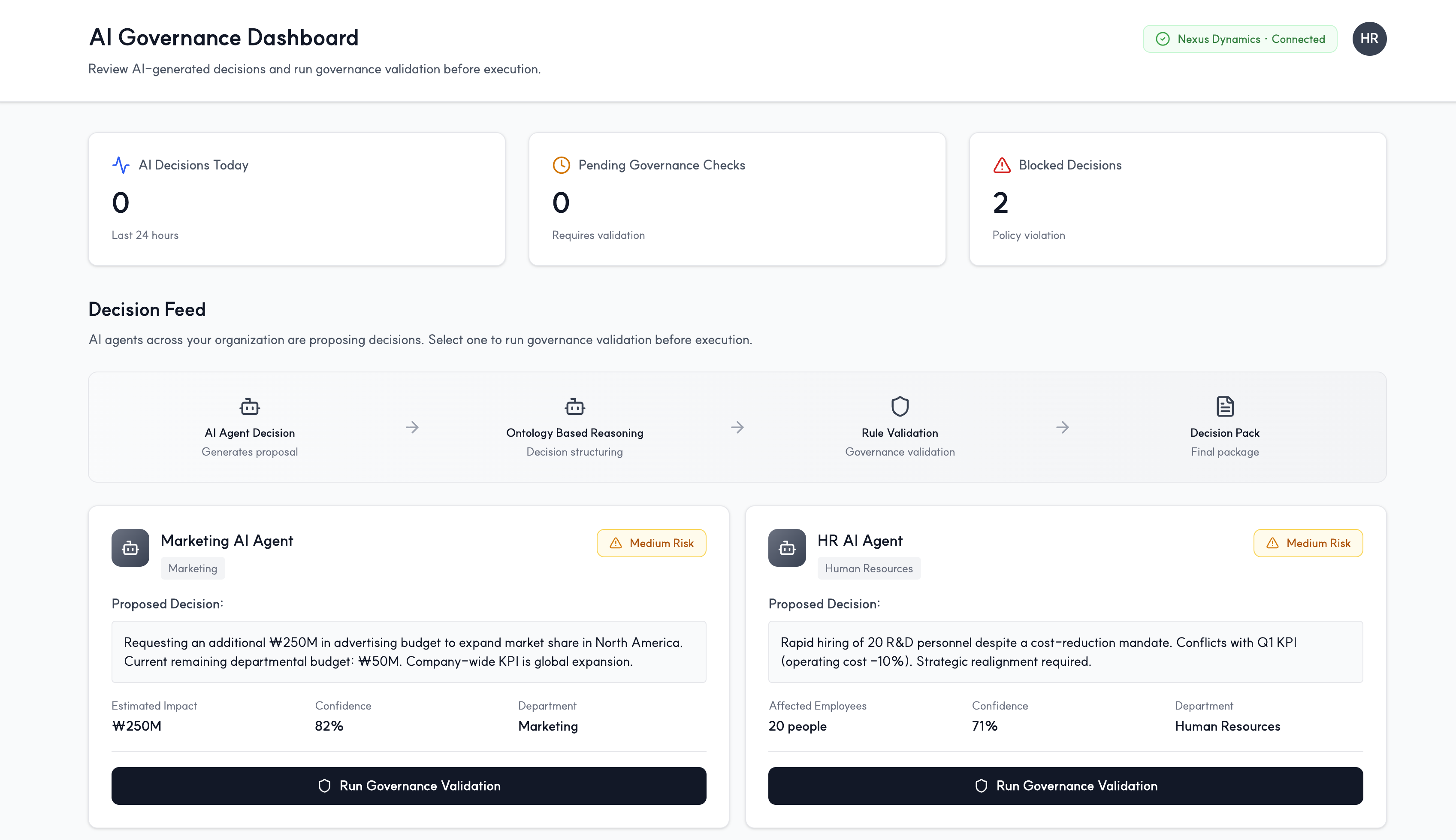
Workspace Dashboard — overview of incoming AI decisions
Governance Console — core decision analysis interface
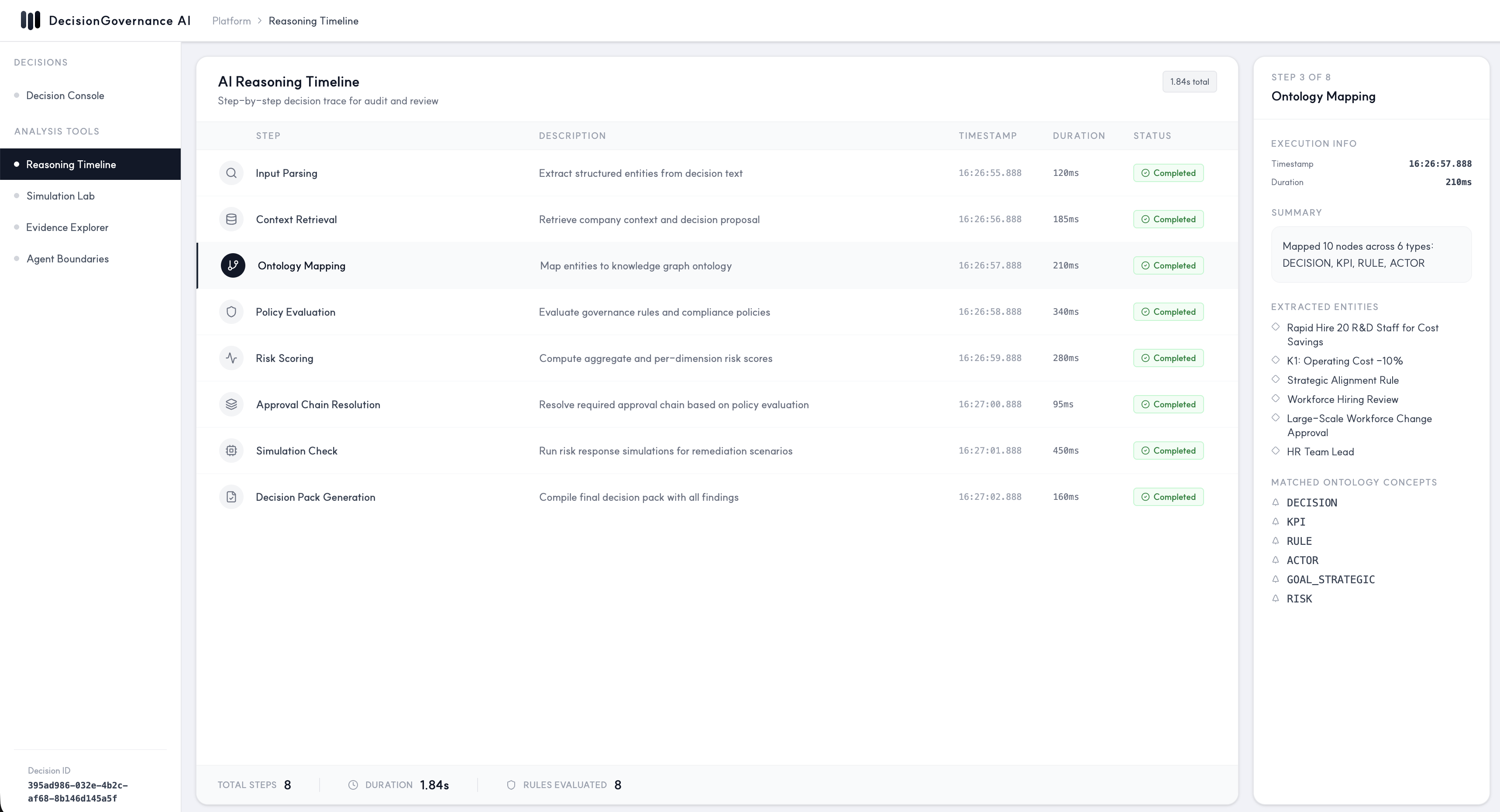
Reasoning Timeline — step-by-step explanation of system reasoning
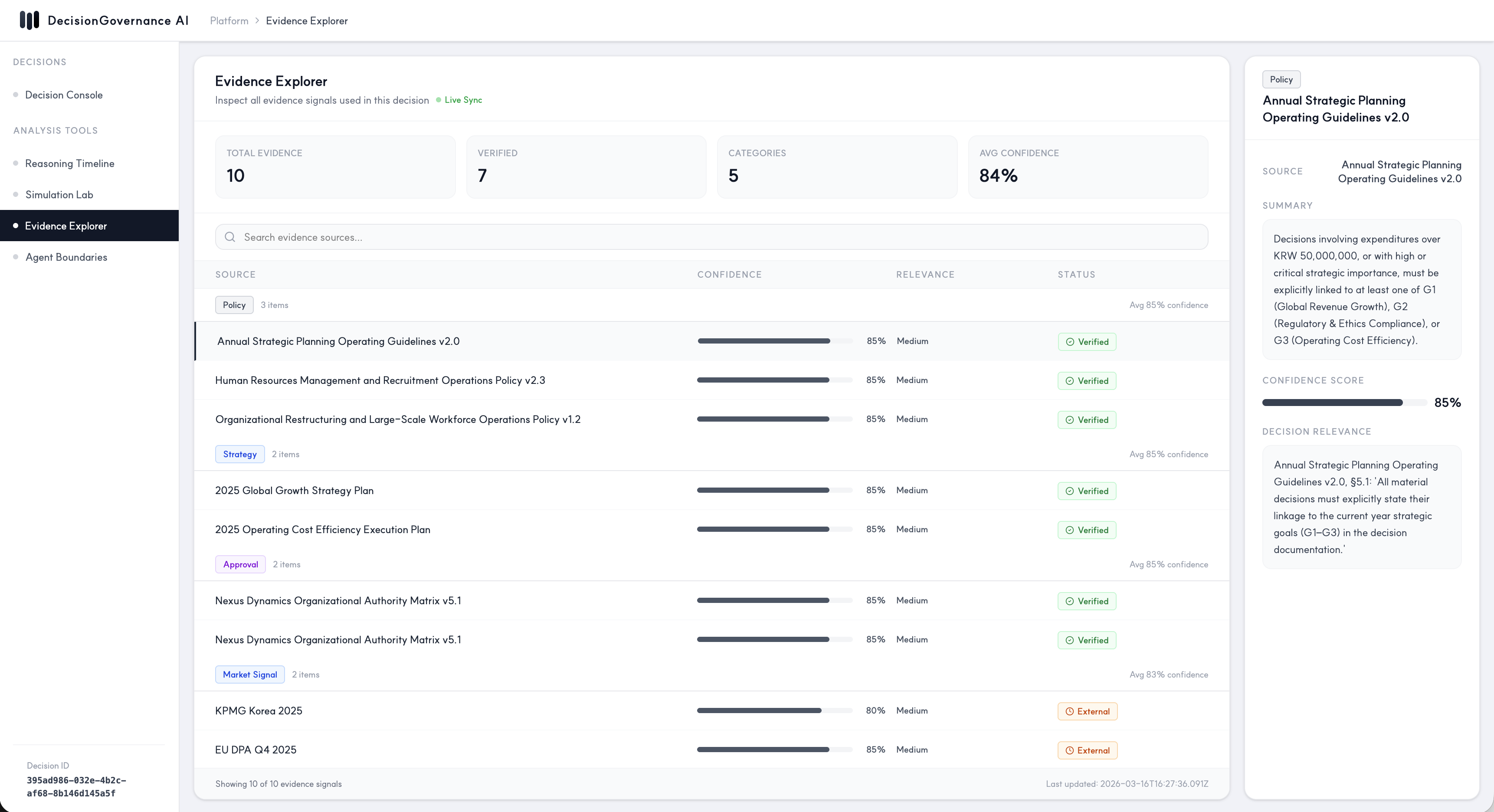
Evidence Explorer — inspection of supporting governance evidence
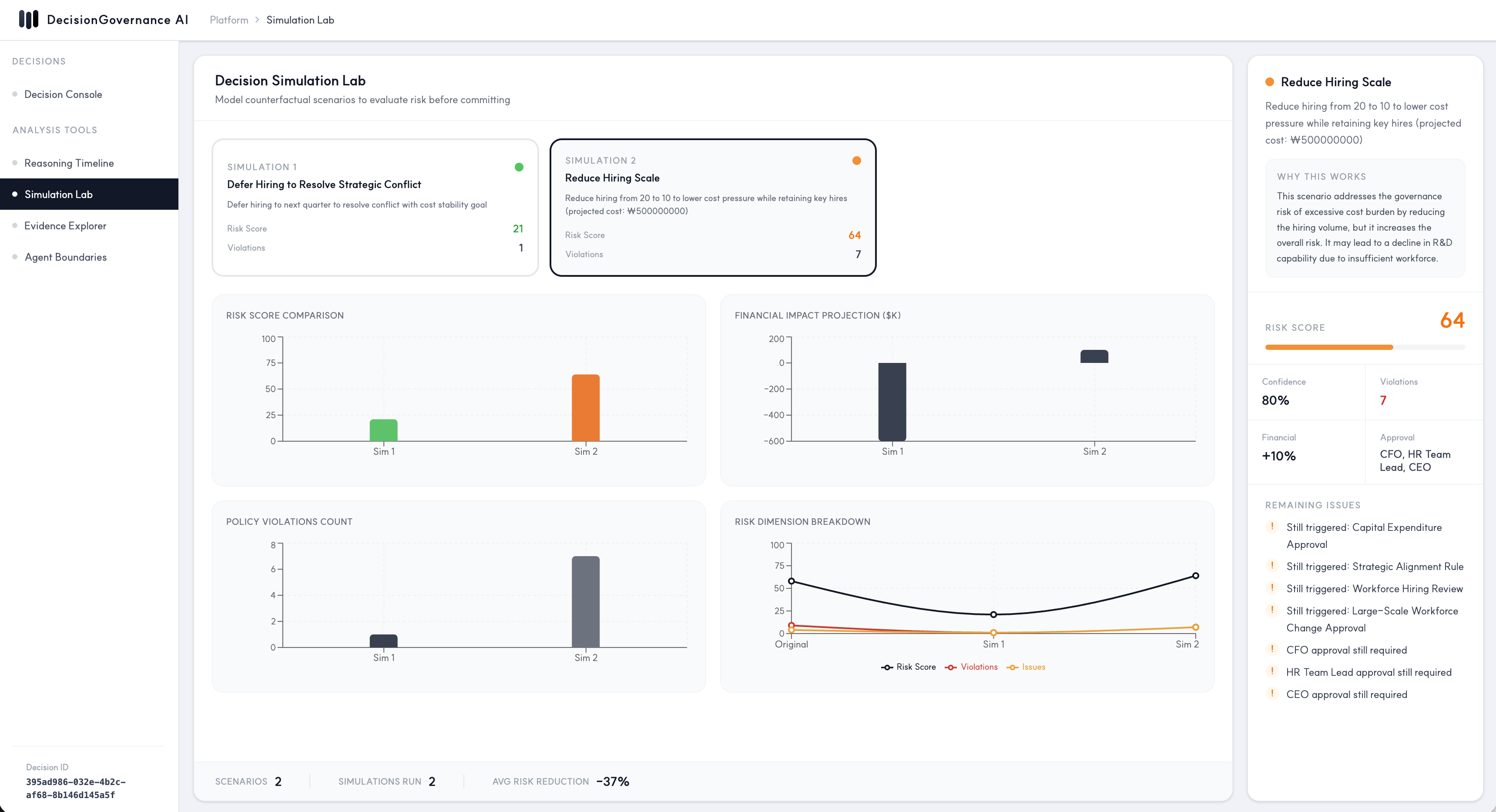
Simulation Lab — comparison of alternative decision scenarios
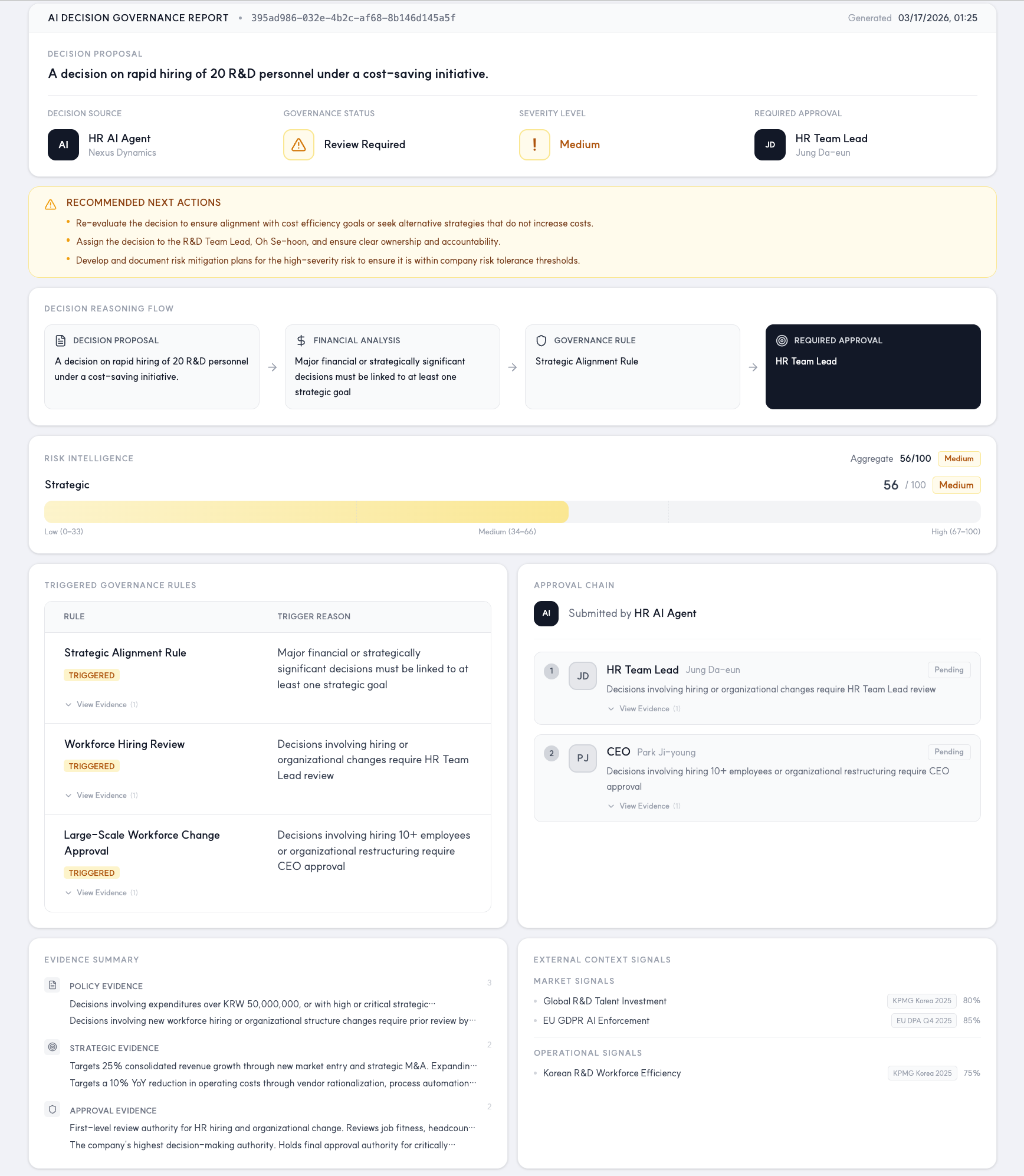
Decision Pack — final approval-ready governance report
Database
Key stored objects:
- Decision objects
- Governance rule triggers
- Risk scores
- Simulation scenarios
- Approval chains
- Decision Pack artifacts
Challenges
Balancing AI reasoning with deterministic governance
LLMs are powerful but probabilistic. Enterprise governance requires deterministic reliability. Solved by separating Nova reasoning from the governance layer.
Modeling enterprise context
Capturing authority structures, policies, and strategy in a usable ontology required careful design to avoid overengineering while still enabling meaningful reasoning.
Avoiding UI overload
Governance involves large volumes of contextual data. Interfaces had to remain understandable while presenting complex reasoning.
Scenario simulation realism
Generating alternative scenarios is easy. Ensuring those scenarios pass through the same governance evaluation pipeline was critical to make them trustworthy.
Accomplishments
A new product category
DecisionGovernance AI demonstrates AI Decision Governance Platforms — beyond chatbots or copilots, a governance layer for AI agents.
Deep integration of Amazon Nova
Nova powers structured extraction, reasoning, simulation, and contextual synthesis within a complex enterprise system.
Explainable AI decision analysis
Ontology-based reasoning and decision packs provide transparency rarely seen in AI systems.
Enterprise-ready architecture
Clear separation between AI reasoning and deterministic governance logic ensures scalability and trust.
What We Learned
- AI governance will become essential infrastructure — as AI agents grow more capable, organizations will need systems to validate their decisions
- Explainability must be designed into the product — logs and model outputs are not enough; users need structured reasoning interfaces
- Hybrid architectures are powerful — combining LLM reasoning with deterministic systems enables both flexibility and reliability
What's Next
Persistent Governance Graph
Persistent graph storage using Neo4j, enabling reasoning across decisions over time. Organizations will be able to query patterns such as:
- "Which marketing decisions conflicted with cost-stability goals this quarter?"
- "Which teams most frequently trigger compliance risks?"
Cross-Decision Governance Reasoning
Connecting decisions through shared entities (policies, actors, strategic goals) to analyze governance patterns across the organization — identifying recurring policy conflicts, structural approval bottlenecks, and departmental impact on strategic goals.
Graph-RAG Decision Memory
Combining ontology graphs with retrieval-augmented reasoning to retrieve relevant past decisions and outcomes, providing organizational memory for AI governance.
Formal Ontology Governance
Evolving the ontology-lite model into a formal governance ontology using OWL and SHACL standards, enabling automated inference rules (e.g. any decision triggering a critical rule automatically requires board approval).
Real-Time External Signals
First-class integration of market data, regulatory updates, and operational metrics to dynamically influence risk scoring and strategic decision evaluation.
Enterprise Integrations
Direct connections with Slack, Notion, policy repositories, and internal approval workflows — enabling governance analysis within real operational decision pipelines.
AI Agent Governance
Defining governance boundaries for autonomous AI agents — specifying which decisions an agent may execute, setting approval thresholds, and monitoring agent decision behavior over time.
DecisionGovernance AI is designed as long-term governance infrastructure for the AI agent era.
Built With
- albemic
- amazon-nova
- amazon-web-services
- aws-bedrock
- fastapi
- knowledge-graph
- oauth
- ontology
- pydantic
- python
- react
- rest-api
- sqlalchemy
- sse
- typescript
- uvicorn

Log in or sign up for Devpost to join the conversation.