Inspiration
Most poor trading decisions do not start with a lack of information. They start with an untested story: a rumor, a popular narrative, or the urge to recover a loss quickly.
We wanted to build something that slows the decision down before money is at risk. Decision Twin is not a stock picker or an auto-trading tool. It helps investors turn “I think this will go up” into a claim with evidence, downside scenarios, and clear conditions that would prove the idea wrong.
What it does
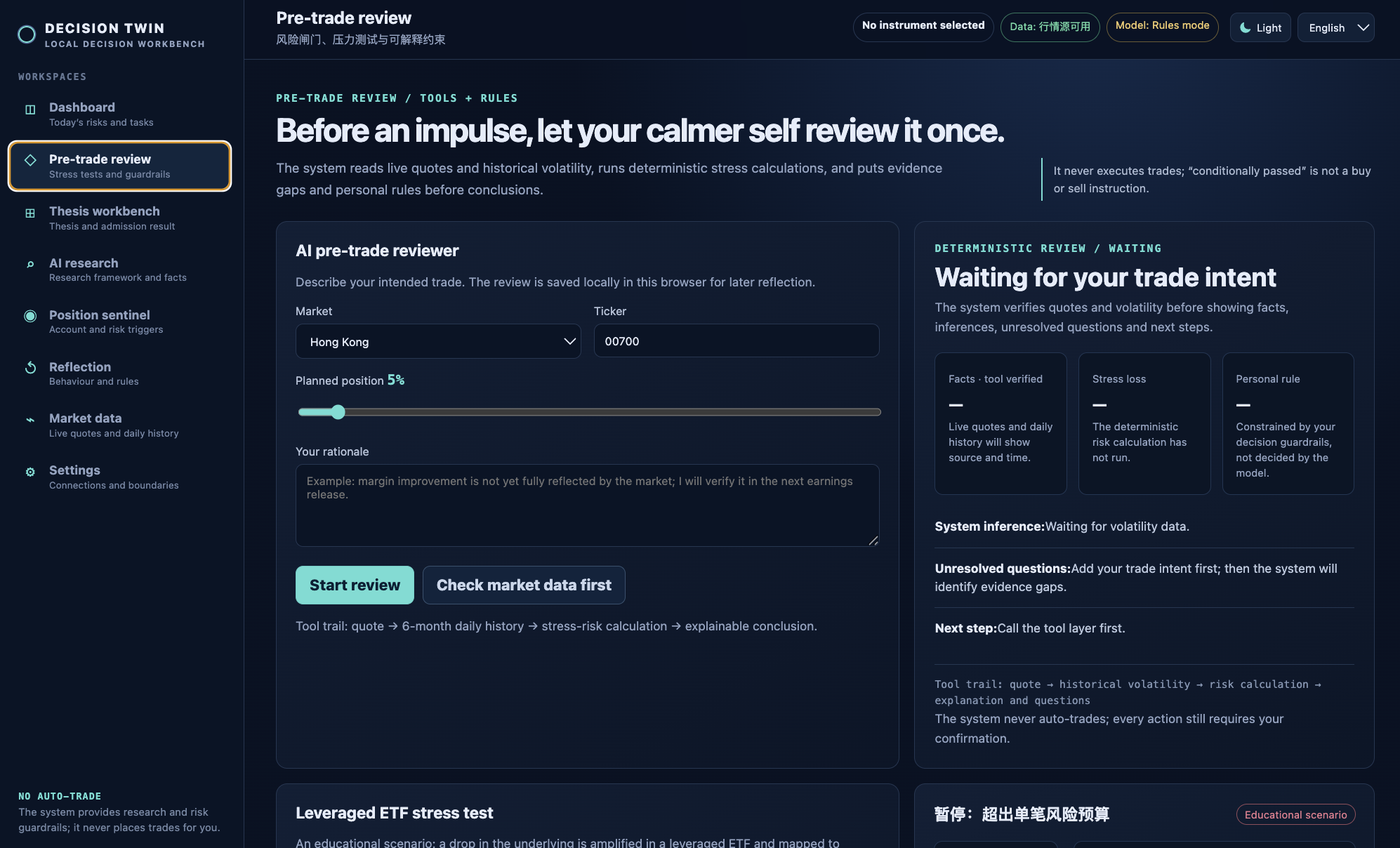
Decision Twin is a local-first research and pre-trade review workspace for US and Hong Kong equities.
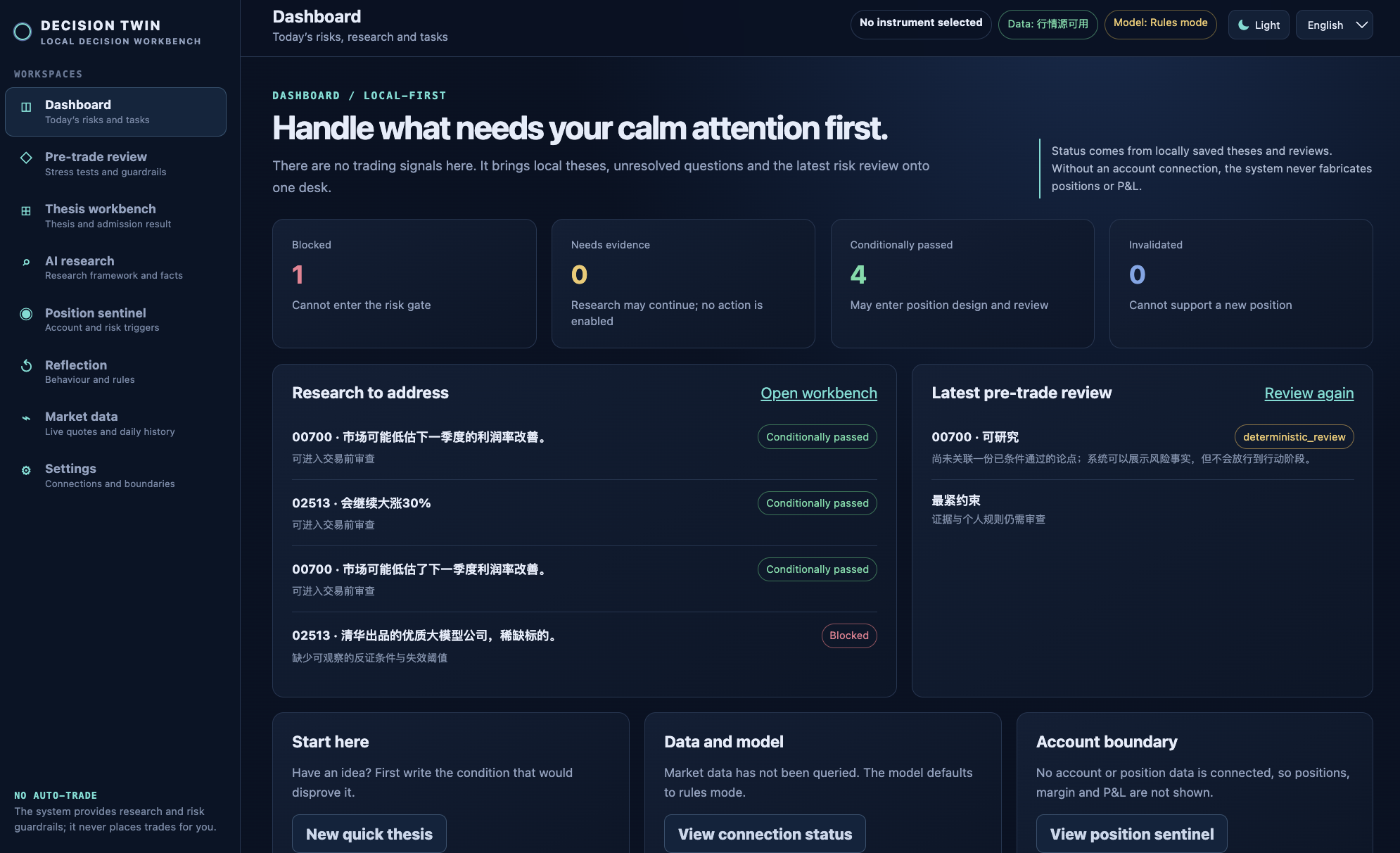
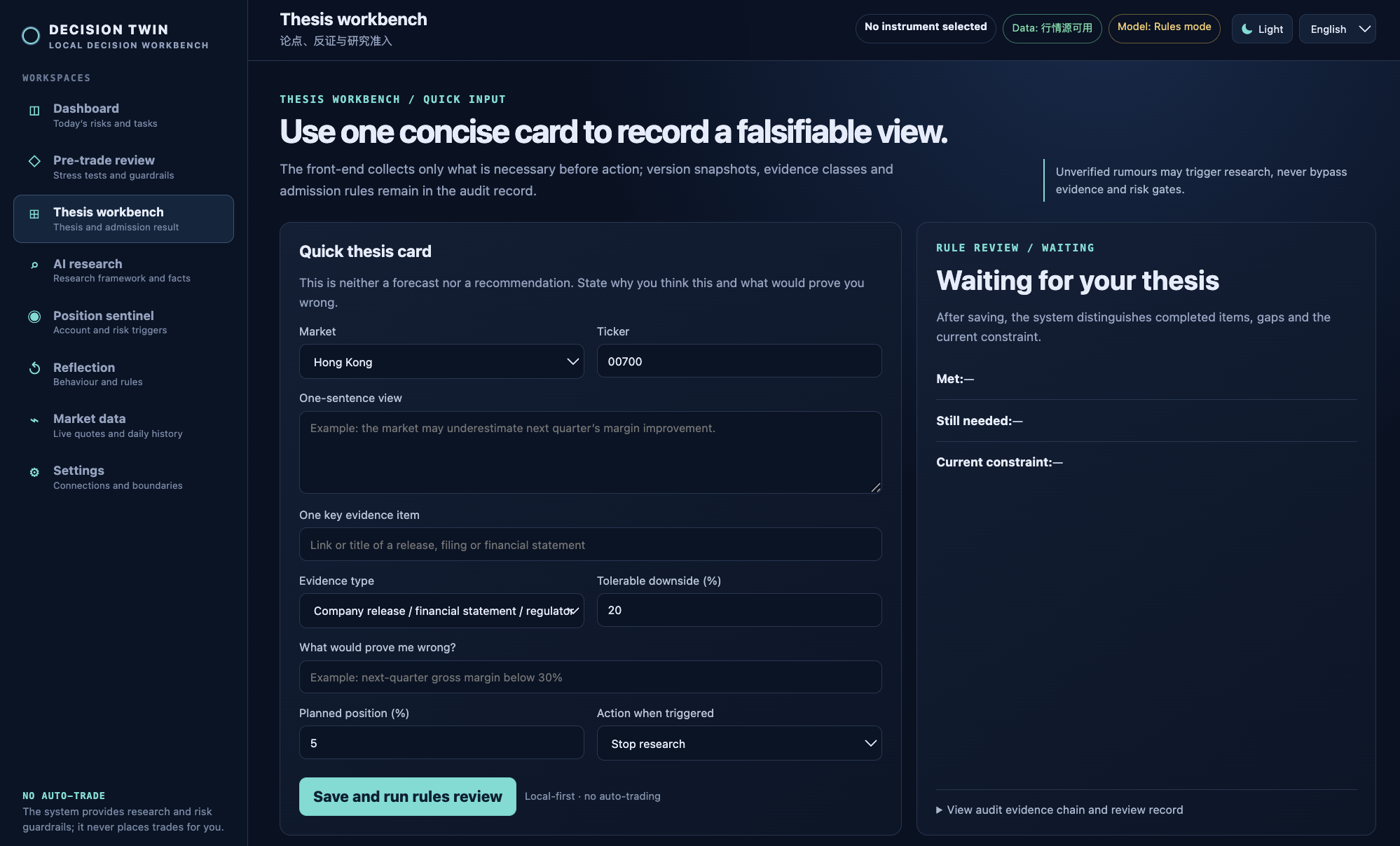
Before a trade, users can record their thesis, planned position size, evidence, catalyst, downside scenario, and invalidation conditions. The system then pulls market data, checks data quality, calculates a deterministic stress scenario, and returns a clear research status: Blocked, Needs Evidence, Conditionally Passed, or Invalidated.
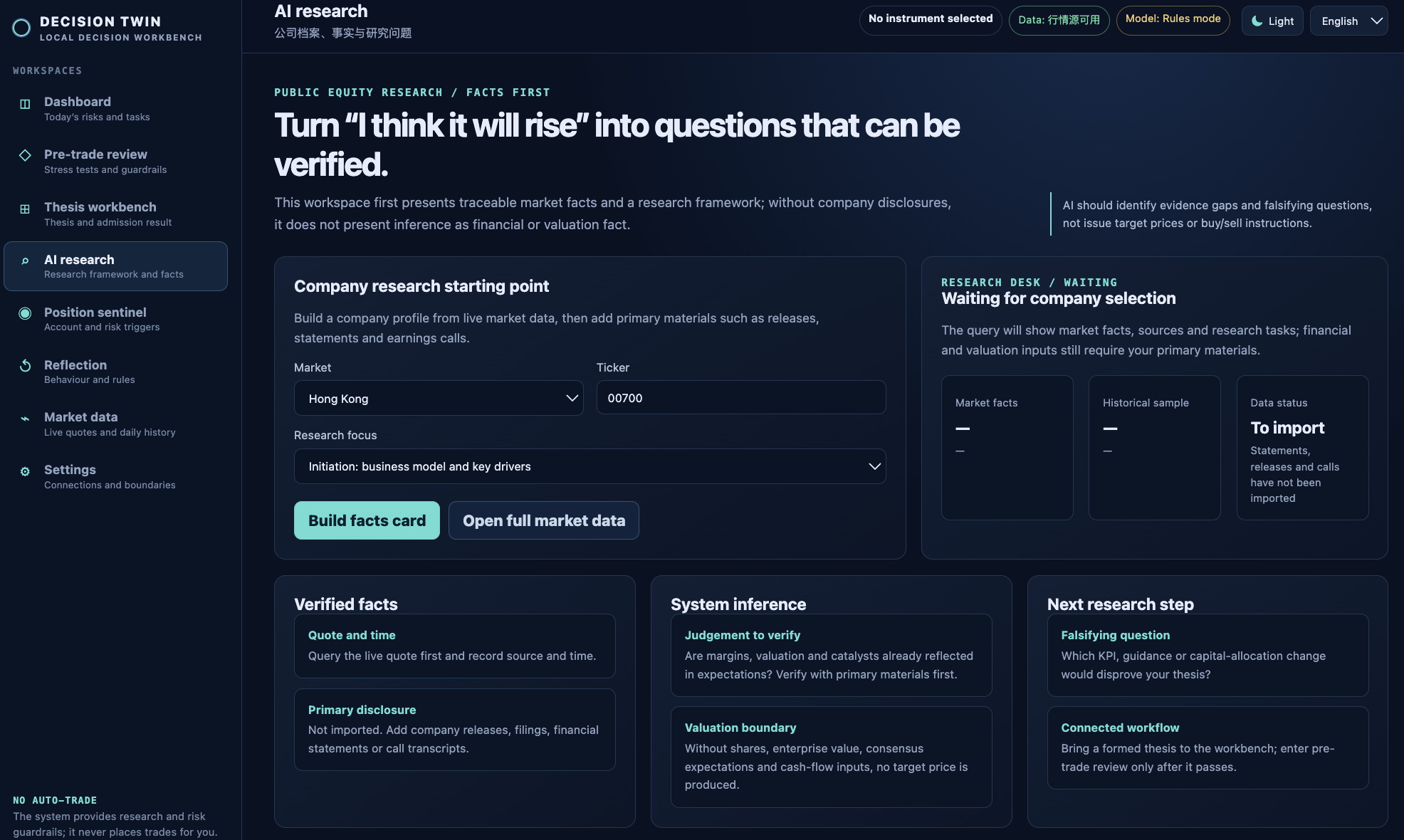
GPT-5.6 is optional and acts as a reasoning assistant. It helps separate facts, inferences, and assumptions, points out evidence gaps, and suggests research questions. It never overrides the risk rules, sends orders, or presents a prediction as financial advice.
How we built it
We built Decision Twin as a lightweight local web app using a Python standard-library server and a static HTML, CSS, and JavaScript interface.
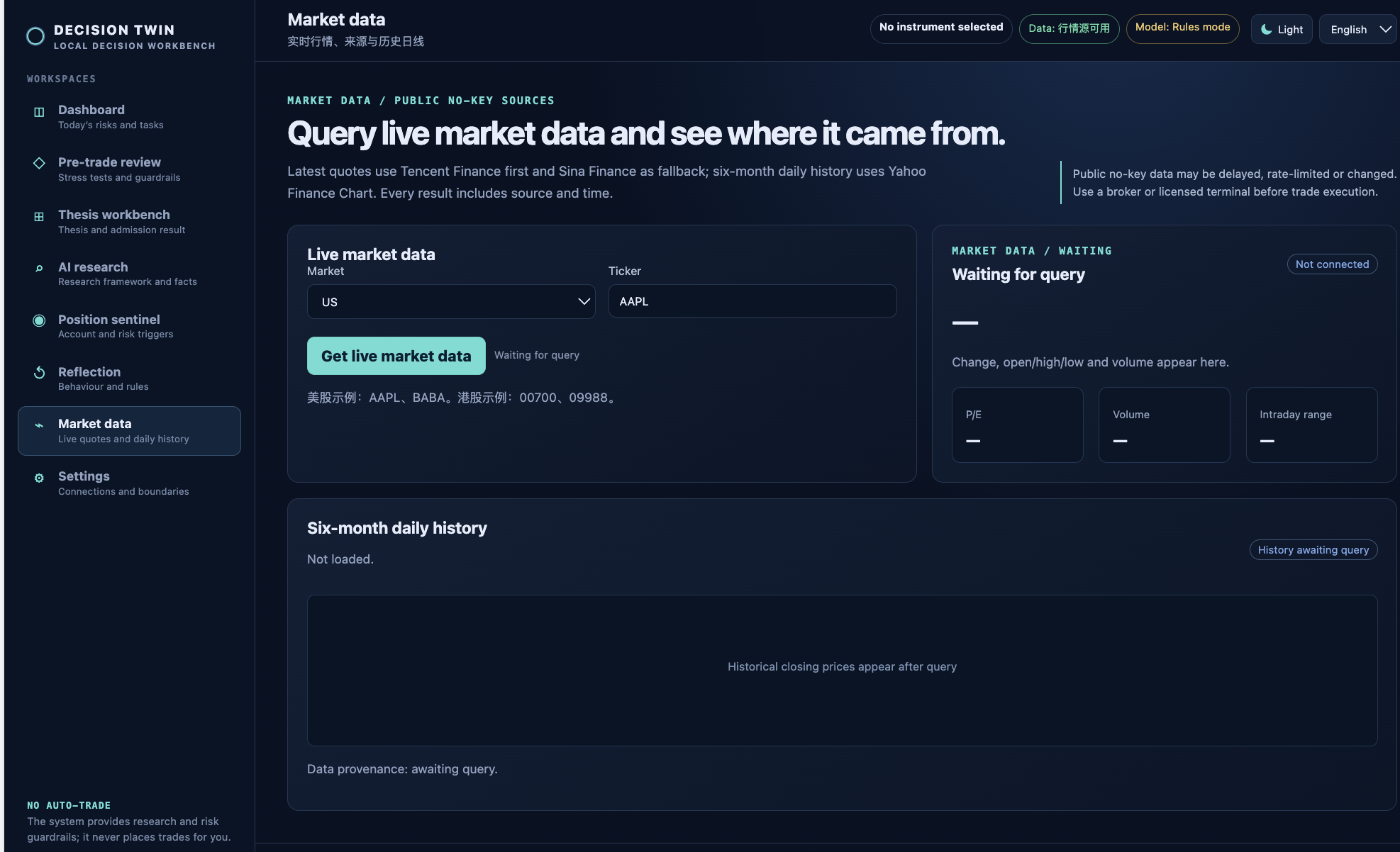
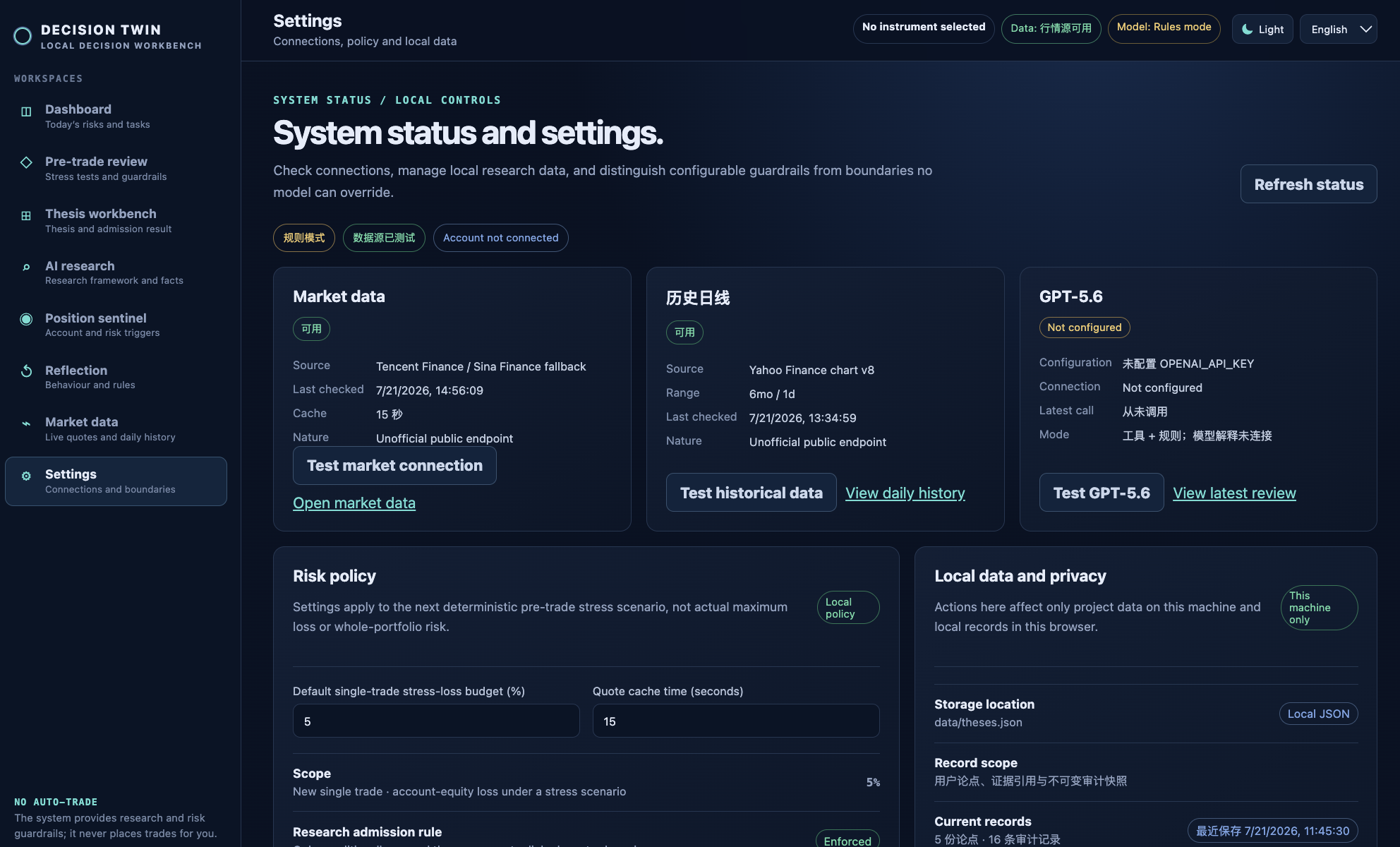
Public market data comes from no-key sources, with source and timestamp shown to the user. The app uses deterministic code for research admission, data freshness checks, position constraints, and stress calculations. Research records and settings are stored locally as JSON, keeping the first version simple and private by default.
We used Codex throughout development to iterate on the workflow, implement the risk guardrails, write focused tests, improve the interface, and document a reproducible setup. GPT-5.6 is connected only as an optional, bounded explanation layer.
Challenges we ran into
The hardest challenge was making the product useful without making it overconfident.
Public market data can be incomplete, delayed, or inconsistent across sources, so we had to treat data freshness and provenance as part of the decision process. We also had to make sure the AI could help users think without becoming an unaccountable source of “buy” or “sell” instructions.
Another challenge was product design. A rigorous evidence chain can easily turn into a long, exhausting form. We moved the detailed audit trail into the background while keeping the visible workflow focused on a few essential questions: What is the thesis? What supports it? What would disprove it? What happens in the downside case?
Accomplishments that we're proud of
We are proud that the app does not pretend uncertainty has disappeared.
Instead of giving a simplistic recommendation, Decision Twin can block a trade idea when its core thesis, falsification condition, evidence, or downside scenario is missing. It still works when no GPT API key is configured, so the core safety workflow does not depend on a model.
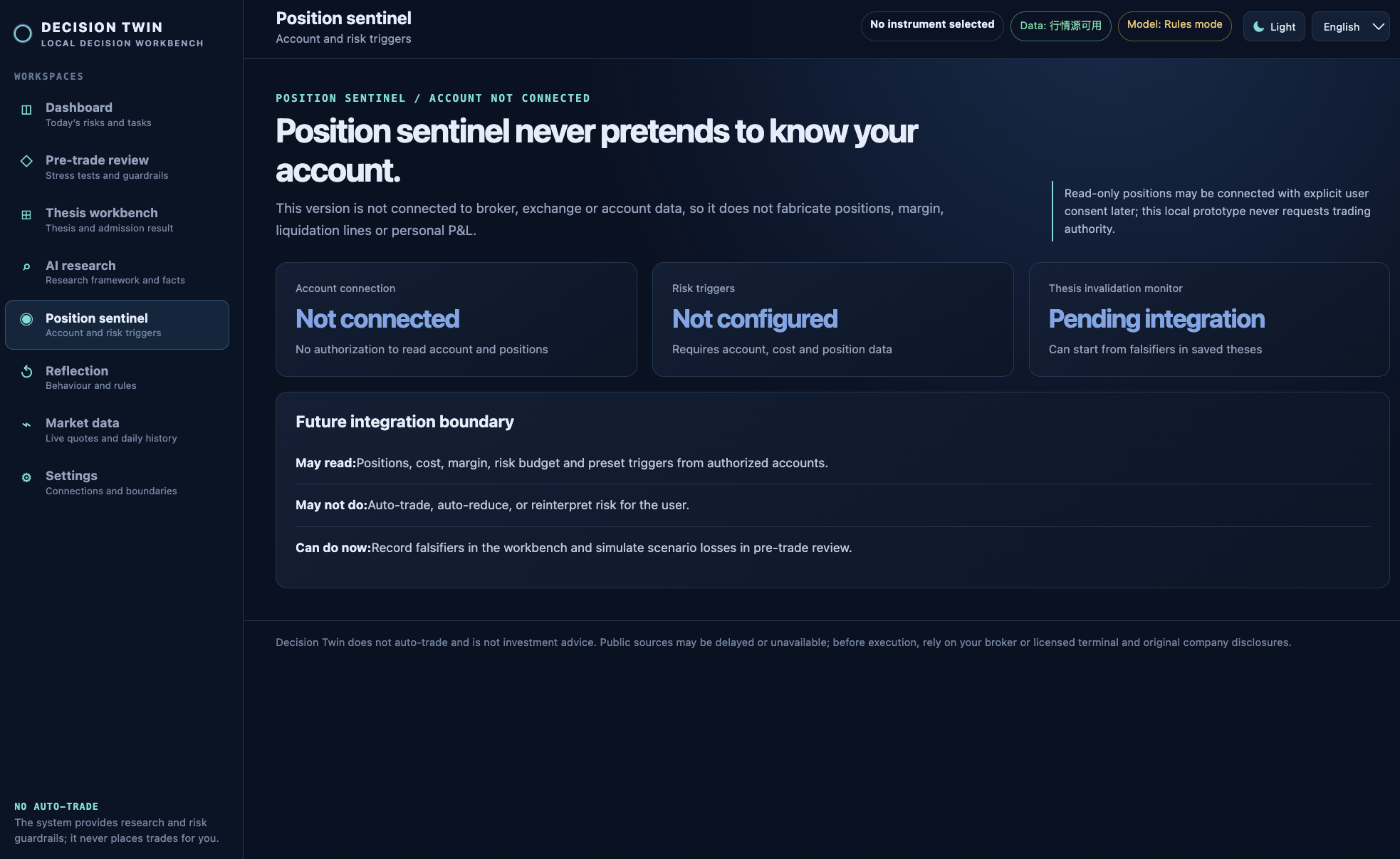
We also built it as a reproducible local project with focused automated tests, transparent calculation rules, local persistence, and clear boundaries: no brokerage connection, no account access, and no automatic trading.
What we learned
The most useful AI in investing may not be the one that sounds most certain. It may be the one that notices what the investor has not checked yet.
We learned that users need a calm, fast interface, but they also need to be able to trace every conclusion back to evidence, assumptions, and rules. We also learned that safety is not a disclaimer at the bottom of the page—it has to shape the product flow itself.
What's next for Decision Twin
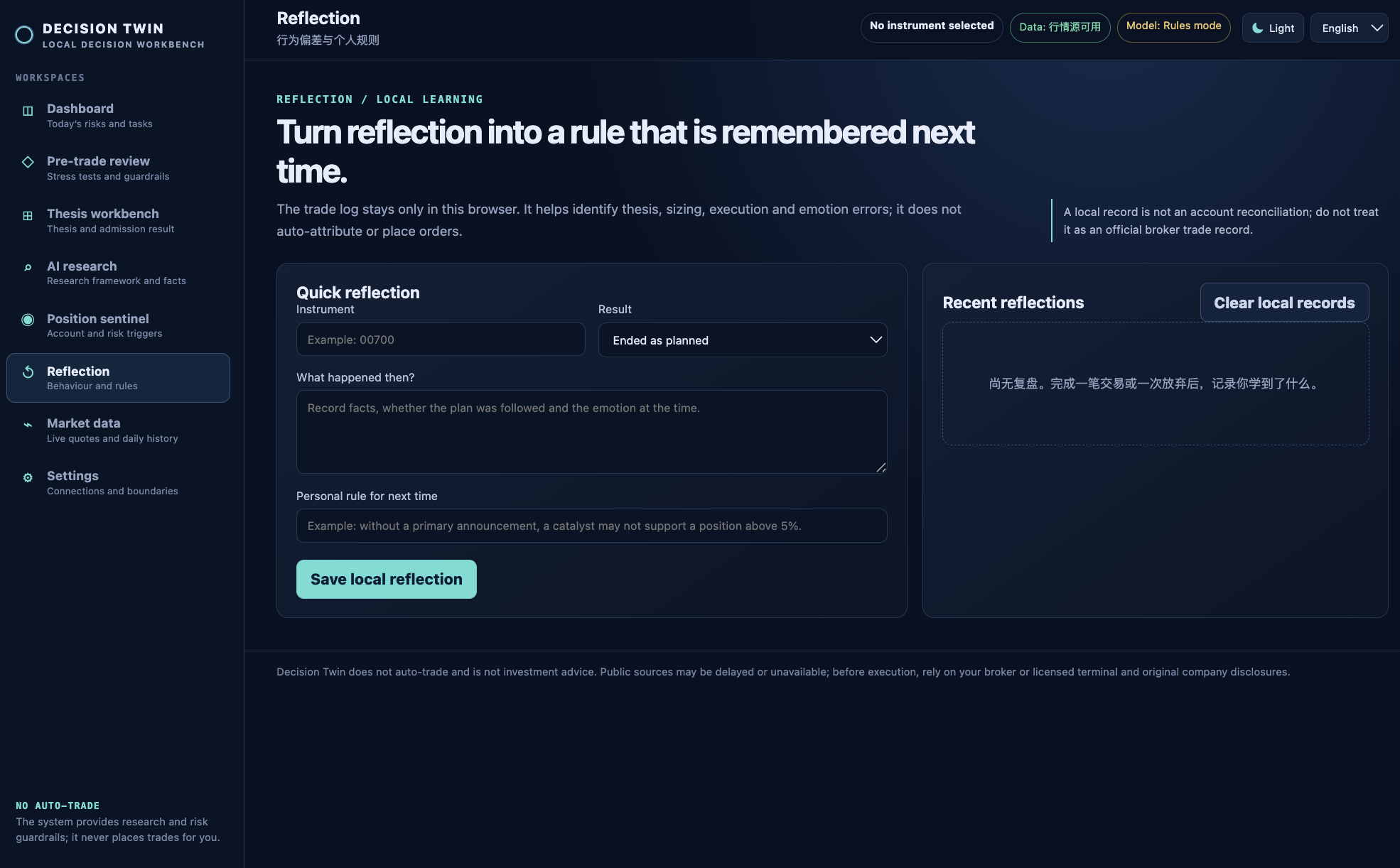
Next, we want to deepen the personal decision loop: connect thesis versions to later outcomes, help users review whether a loss came from the thesis, position sizing, execution, or normal volatility, and turn those lessons into reusable personal rules.
We also plan to expand data reliability and coverage beyond the current US and Hong Kong equity workflow, explore position monitoring with explicit user authorization, and add better support for leveraged ETFs, hedging education, and commodity-related research.
The long-term goal is simple: help investors build a calmer, more disciplined version of themselves before the next impulsive decision.


Log in or sign up for Devpost to join the conversation.