Inspiration
AI agents can remember documents, facts, and past decisions. But memory alone does not establish authority.
A system may perfectly recall what happened while still not knowing which facts actually influenced a decision, whether those reasons still apply today, or whether there is enough authority to safely reuse that decision.
That led to one principle:
Memory is not authority.
Decision Recall was built to preserve what was actually established, identify what is still valid as the world changes, and stop reuse when required authority is missing.
What it does
Decision Recall is a bounded multi-decision authority runtime for agents revisiting consequential decisions.
It leads the process until it reaches something the available evidence cannot establish.
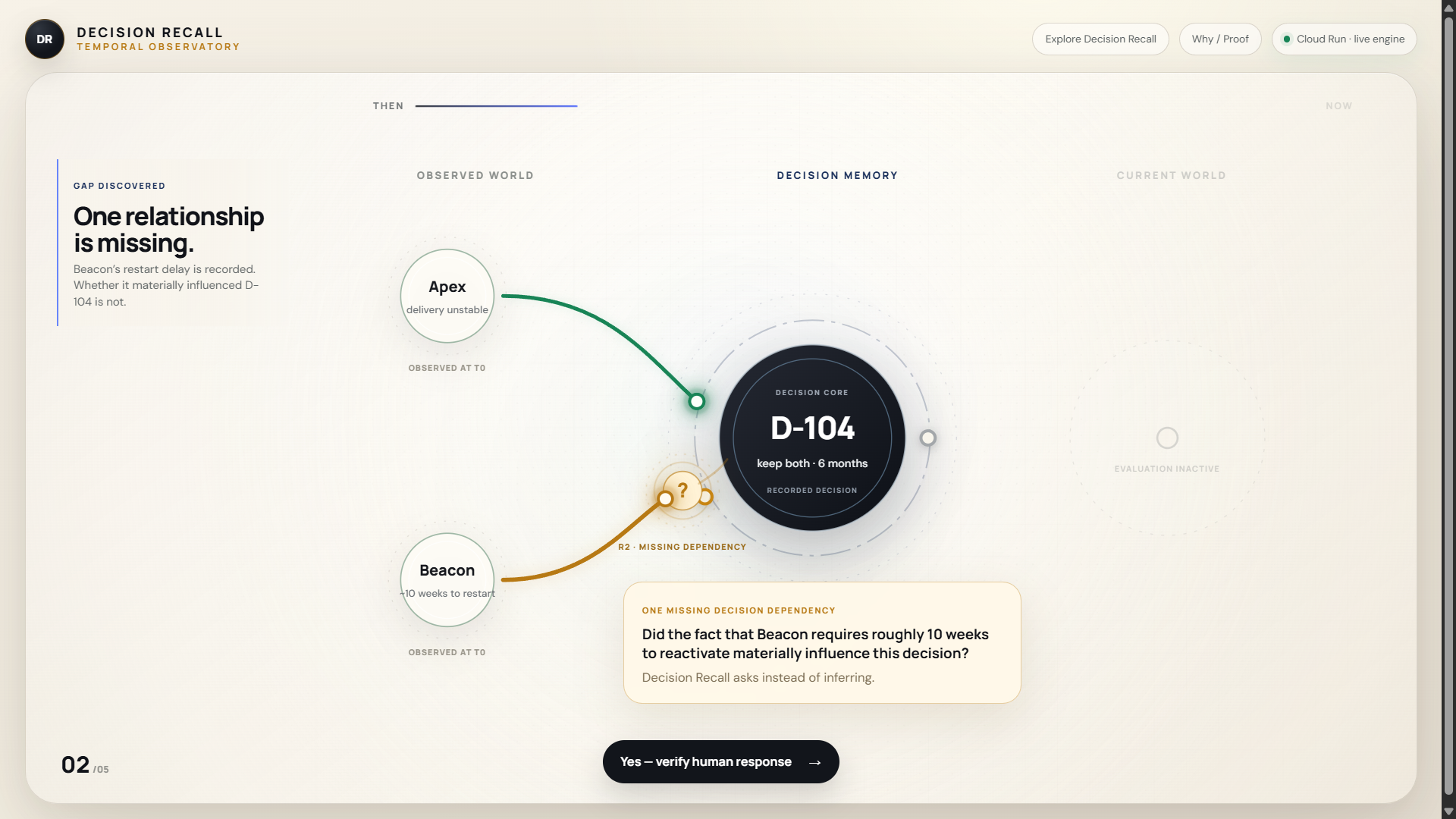
Instead of guessing or asking the human to reconstruct everything, Decision Recall identifies the exact missing relationship and asks one precise clarification.
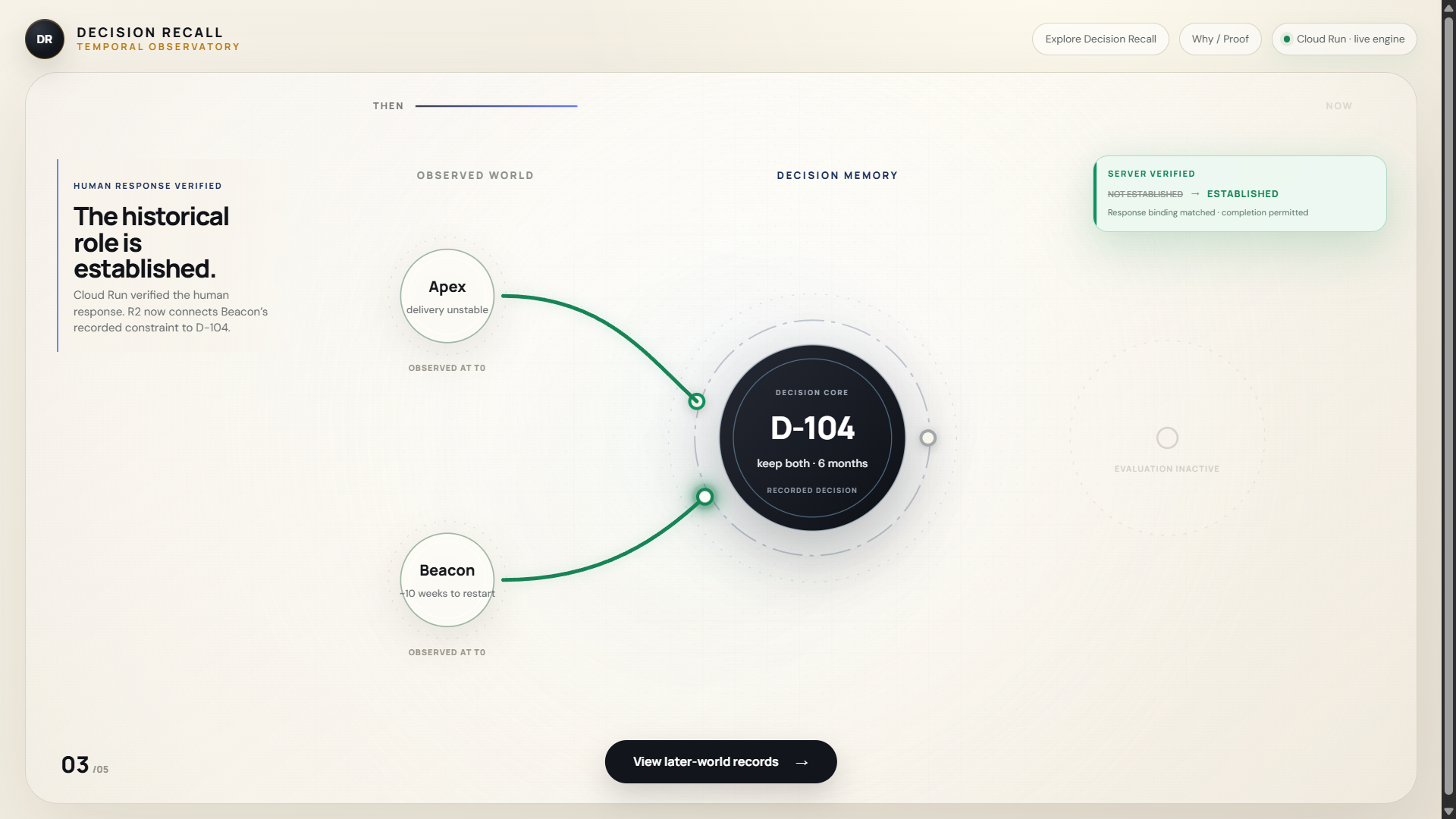
The human response is verified server-side and changes structured historical authority rather than simply adding another chat message.
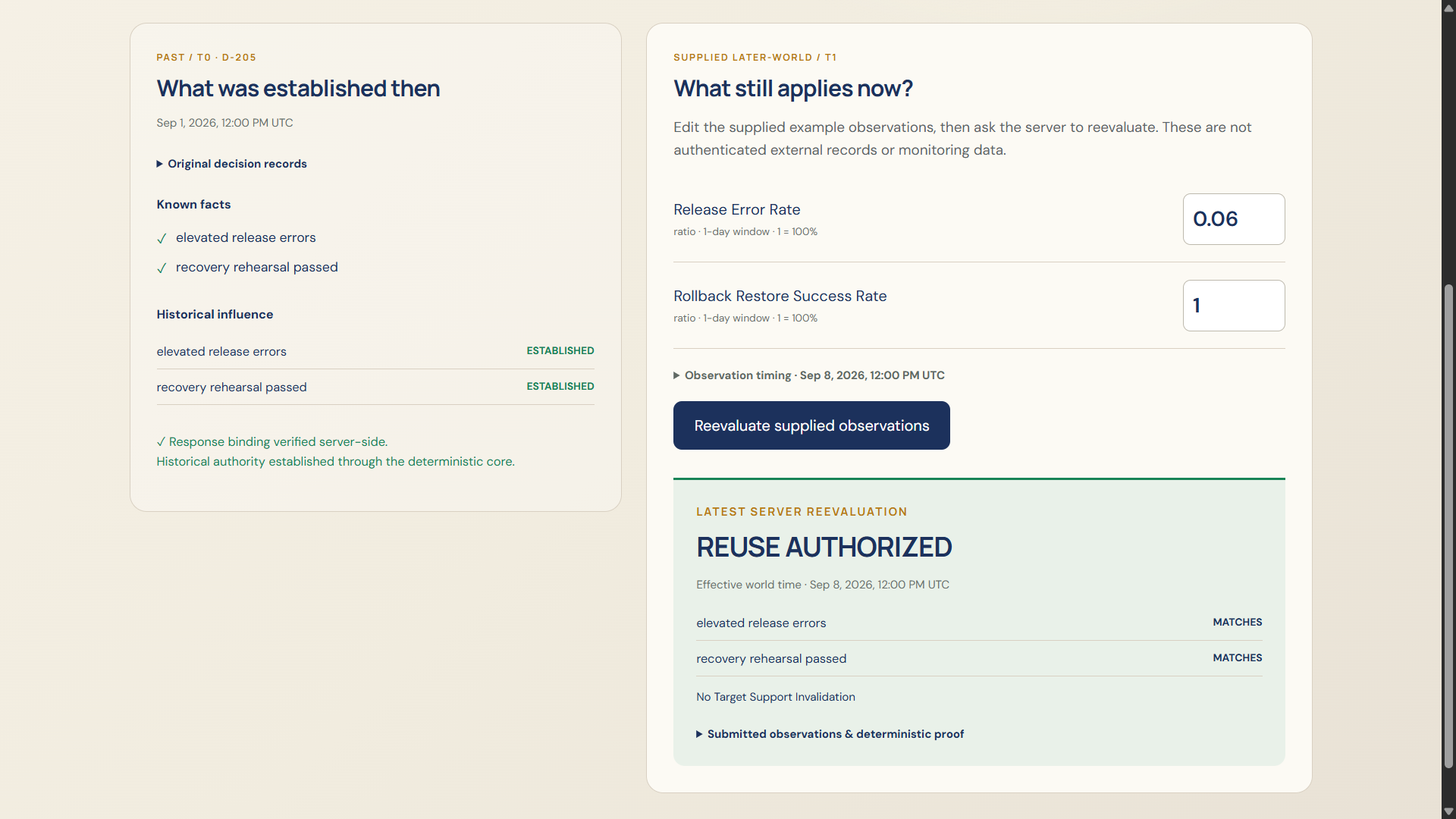
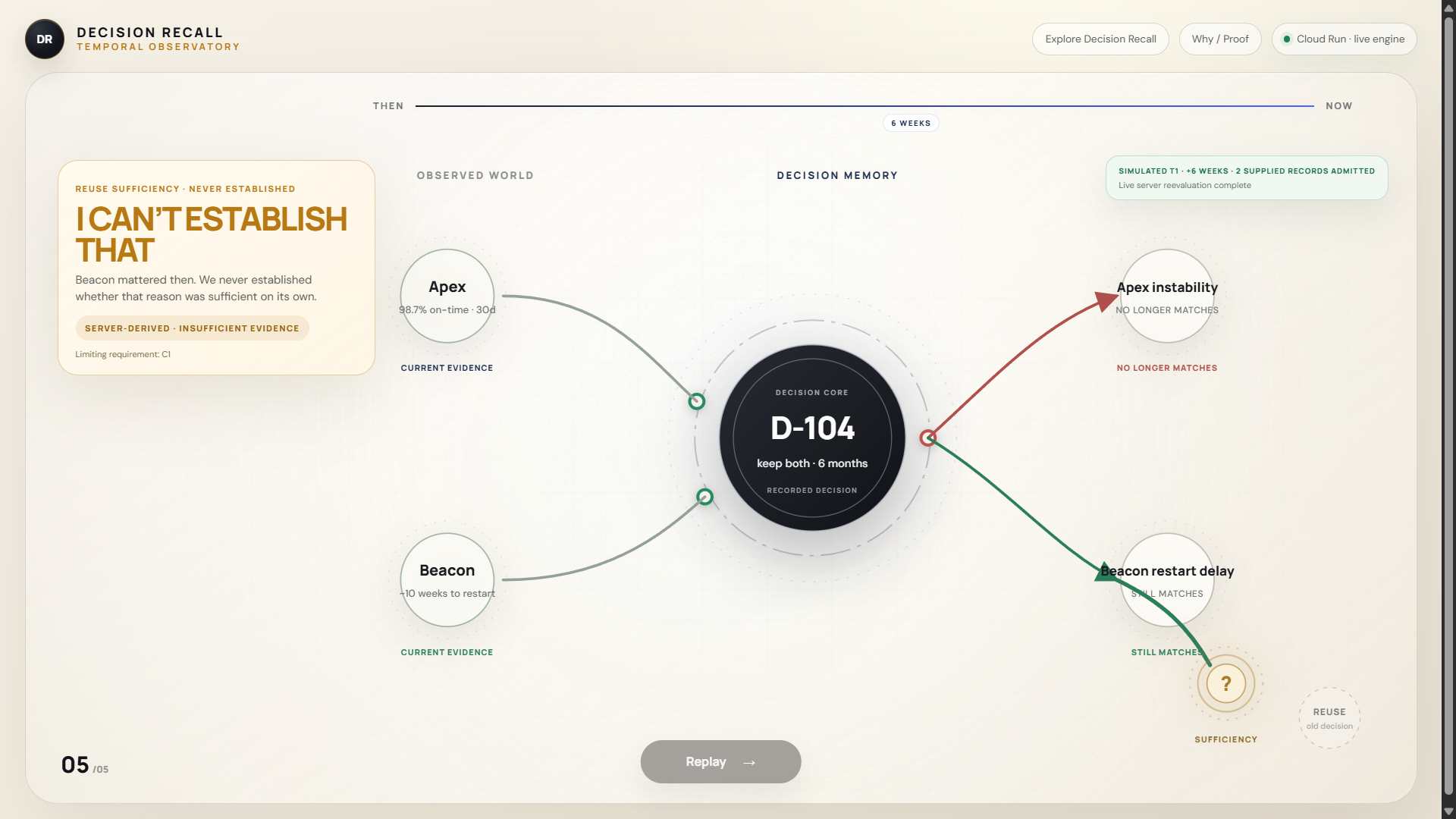
Later, when new evidence is supplied, Decision Recall keeps the historical state intact and separately reevaluates what still applies now.
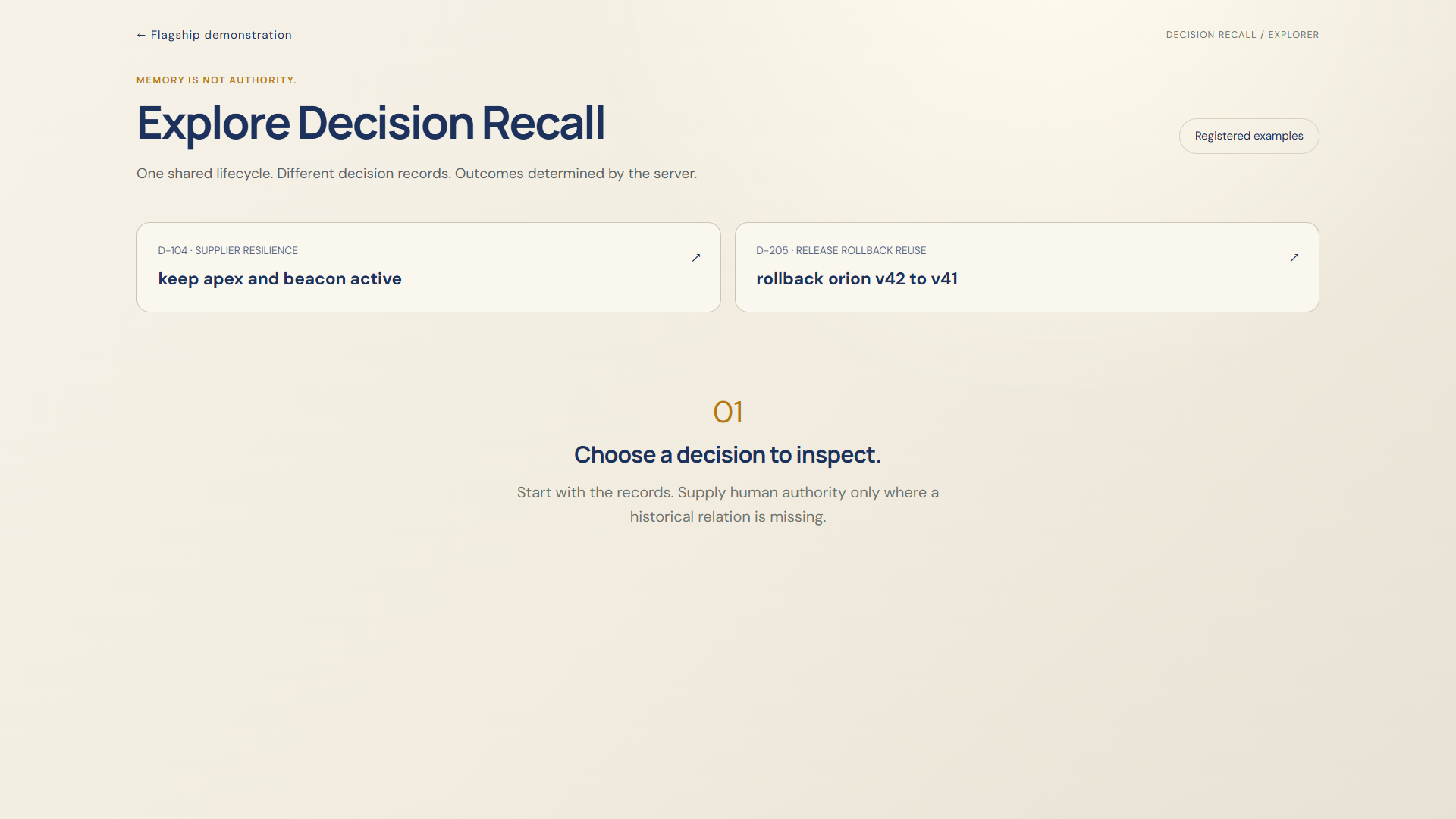
The deployed product demonstrates the same shared lifecycle across two registered decision profiles:
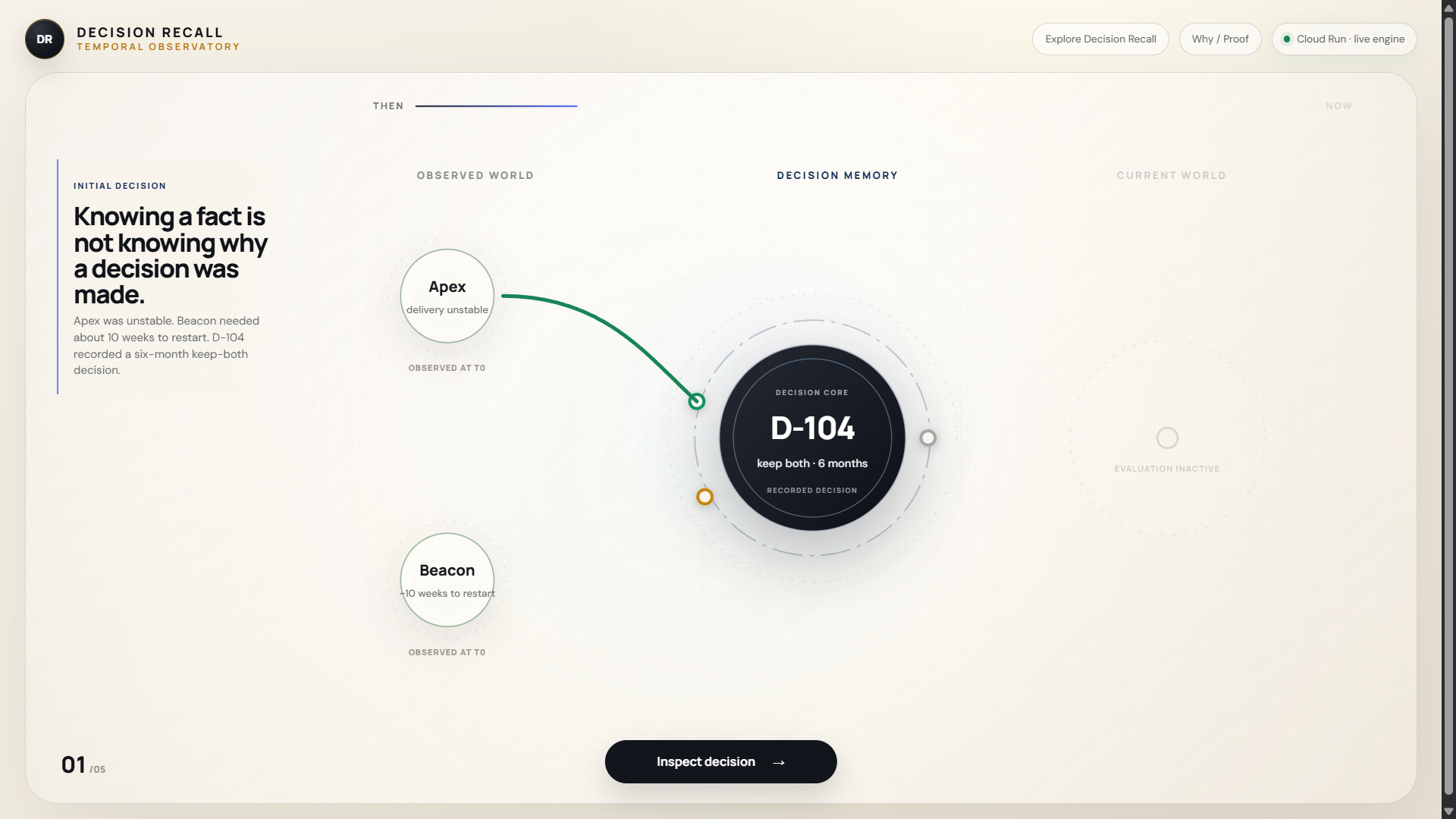
- D-104 — Supplier Resilience: later evidence leaves one historical reason applicable, but reuse sufficiency was never established, producing INSUFFICIENT EVIDENCE.
- D-205 — Release Rollback Reuse: with restore success at 80%, the server returns REUSE NOT AUTHORIZED. Changing only the current evidence to 100% makes the old result stale and a new server reevaluation returns REUSE AUTHORIZED.
Same lifecycle. Different decisions. Different evidence. Different outcomes.
Collaborative Partner behavior
Decision Recall is designed to collaborate with a human only where human authority is genuinely required.
The agent:
- reconstructs the available decision state;
- identifies the unresolved required relationship;
- asks one precise human clarification;
- verifies and captures that feedback as structured authority;
- reevaluates later-world evidence without rewriting history;
- returns a server-derived reuse outcome.
The human does not have to redo the agent's work. The system leads until it reaches a boundary it cannot legitimately cross alone.
How we built it
The architecture deliberately separates interpretation from authority.
Gemini 3.7 Flash, accessed through the Google GenAI SDK, is used for bounded source interpretation in the credentialed release-evidence path.
Gemini does not create historical authority or decide the final reuse outcome.
Decision Recall's deterministic server-side runtime controls grounding, human-response binding, temporal state, reevaluation, and reuse authorization.
The product is deployed on Google Cloud Run. Cloud Build creates the container image, and Artifact Registry stores the deployed artifact.
The React frontend exposes two surfaces:
- a flagship D-104 walkthrough showing the complete temporal authority lifecycle;
- a shared Explorer that runs D-104 and D-205 through the same registered-case API and lifecycle.
The Explorer uses configured, mechanically grounded example candidates and does not claim a live Gemini call for each Explorer interaction.
Why it matters
As agents revisit increasingly important decisions, remembering information will not be enough.
They need to distinguish:
- what was actually established then;
- what still applies now;
- what was never established;
- and whether enough authorized support exists to reuse the decision.
This is different from ordinary retrieval or memory.
Retrieval can bring the evidence back.
Decision Recall models what that evidence is authorized to establish over time.
Gemini interprets. Decision Recall authorizes.
Challenges
One of the hardest challenges was separating historical authority from current applicability.
Later evidence must be allowed to change what applies now without silently rewriting what was established in the past.
Another challenge was making human collaboration narrow and meaningful: the system should ask for human input only when a required relationship cannot legitimately be inferred.
We also had to ensure that changing current evidence immediately invalidates the previous result instead of letting stale conclusions appear current.
What we learned
We learned that agent memory and decision authority are fundamentally different concepts.
A system can remember a fact perfectly and still lack the authority needed to reuse the decision that fact once supported.
We also learned that uncertainty should sometimes produce an explicit stop rather than another model-generated answer.
What was never established stays unestablished.
What's next
Decision Recall currently operates across bounded, registered decision profiles.
The next step is extending the authority layer with authenticated external integrations, durable multi-user decision state, additional decision profiles, and interfaces that other enterprise agents can consult before reusing consequential decisions.
Built With
- artifact-registry
- gemini-3.7-flash
- google-cloud-build
- google-cloud-run
- google-genai-sdk
- javascript
- python
- react

Log in or sign up for Devpost to join the conversation.