-
-
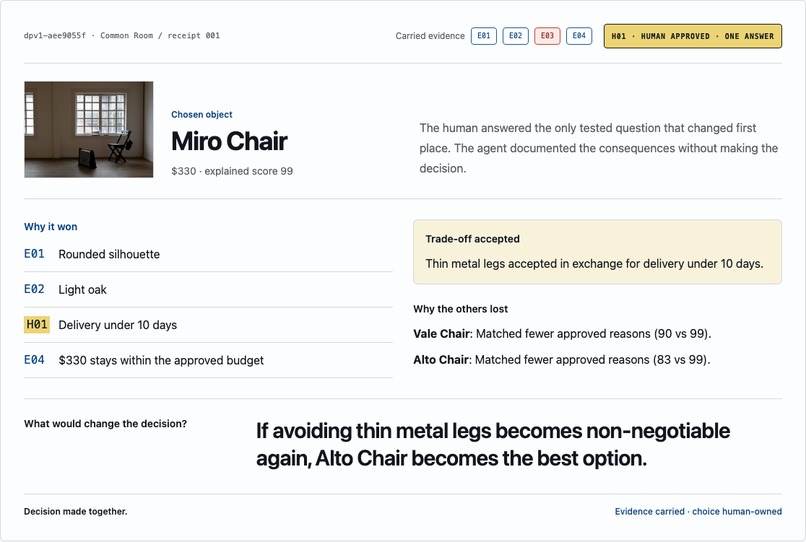
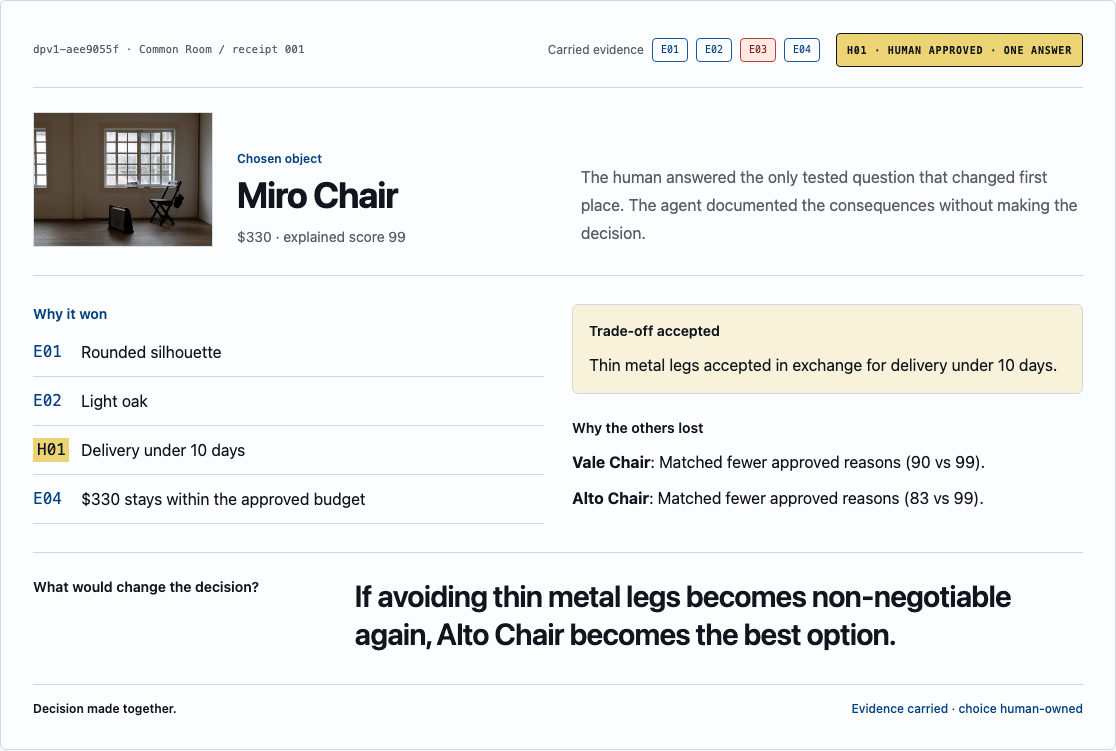
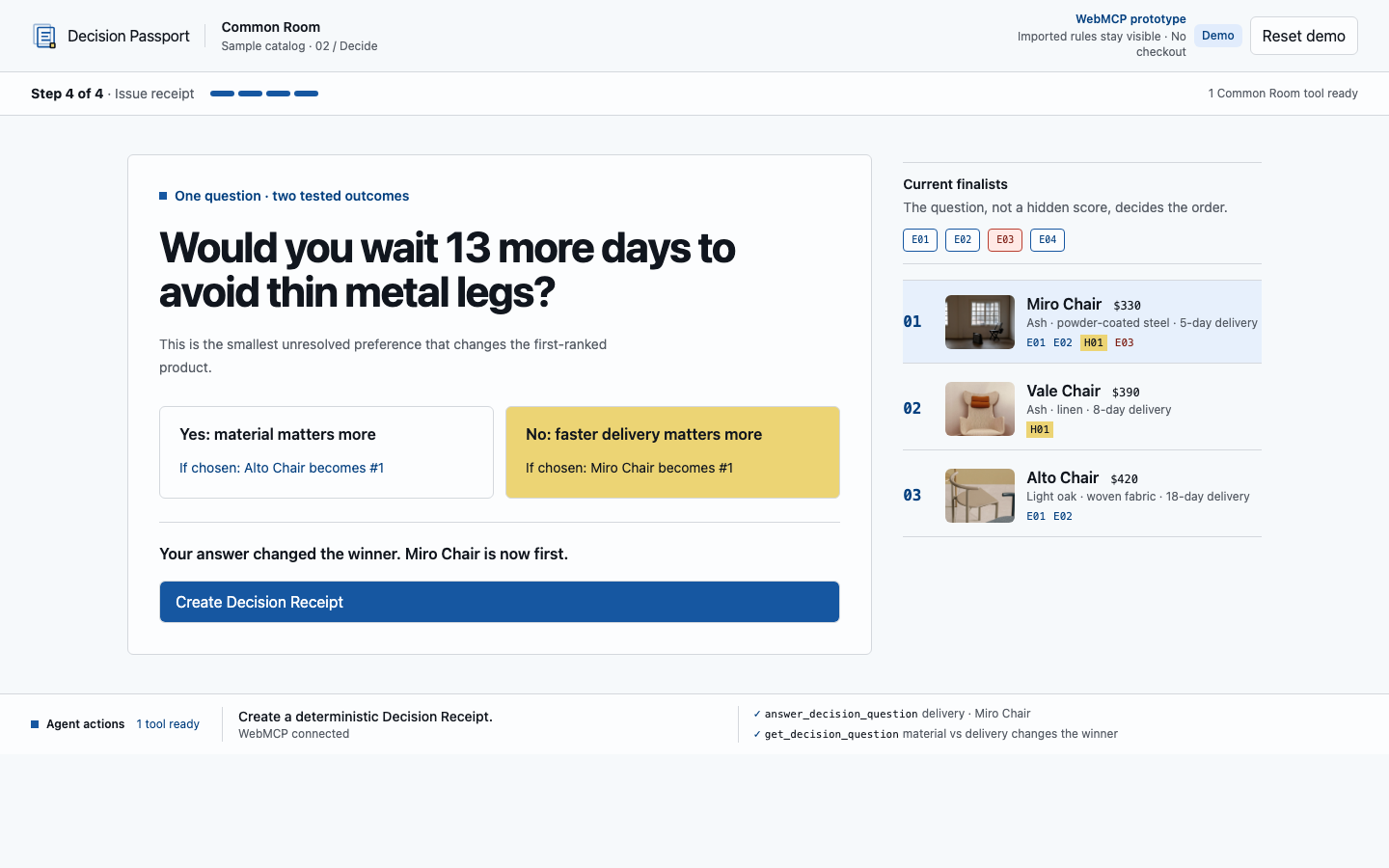
Decision Receipt: explain the winner, losses, accepted trade-off, and counterfactual.
-
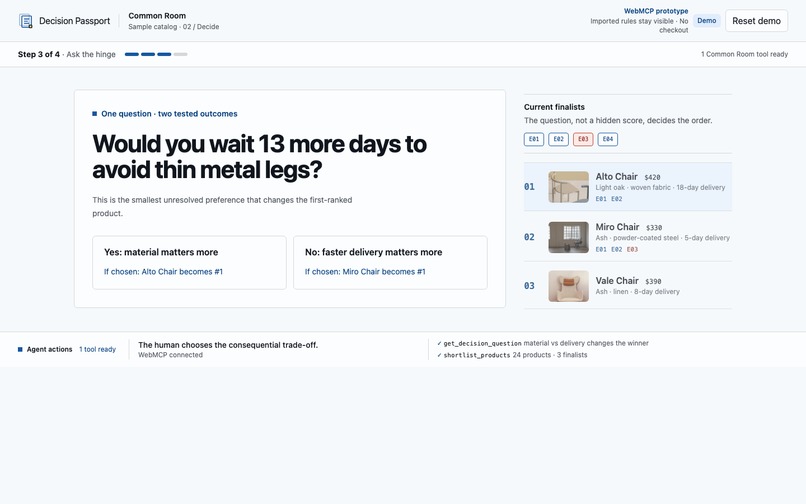
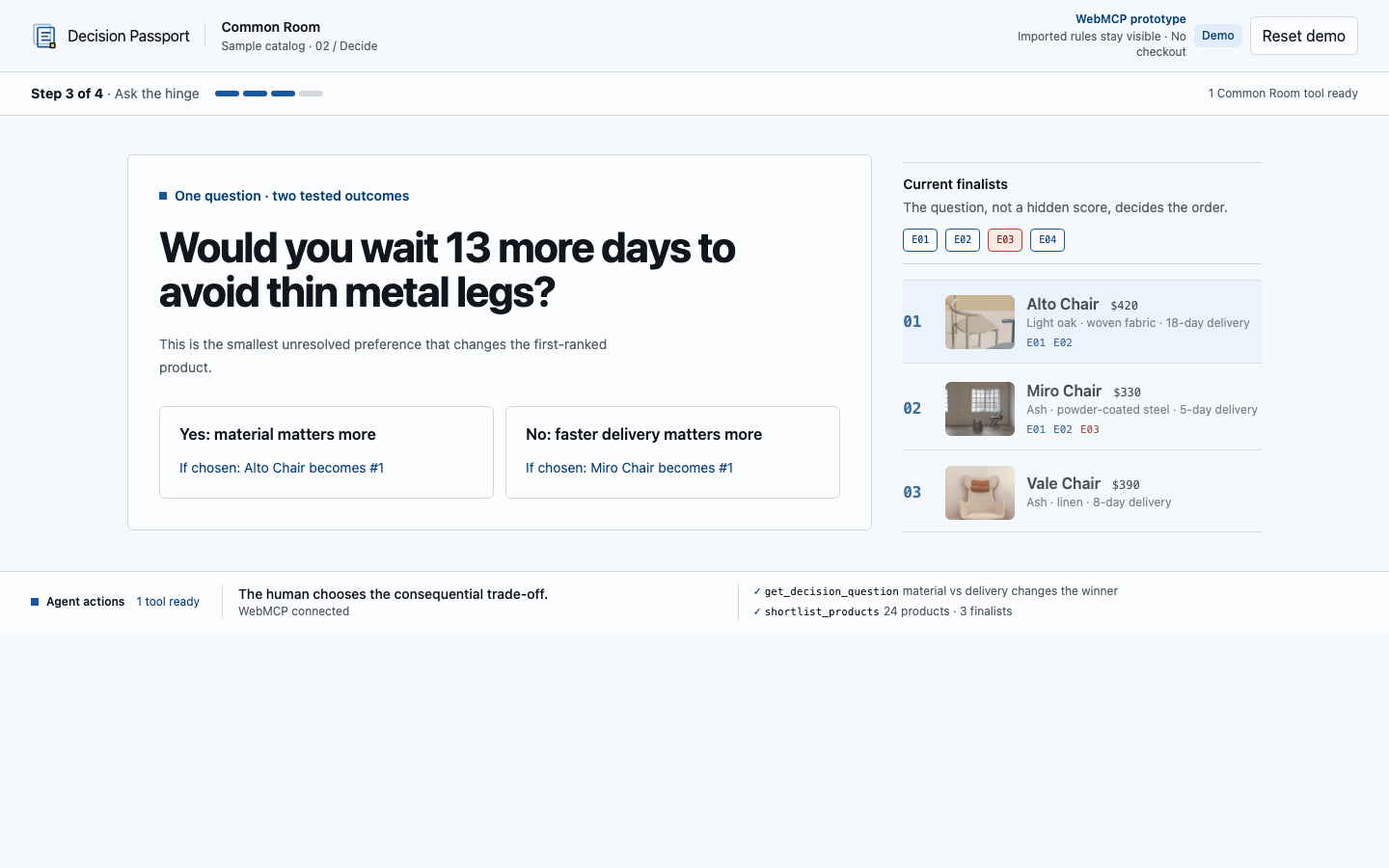
One Question Engine: ask the smallest human-owned question that can change first place.
-
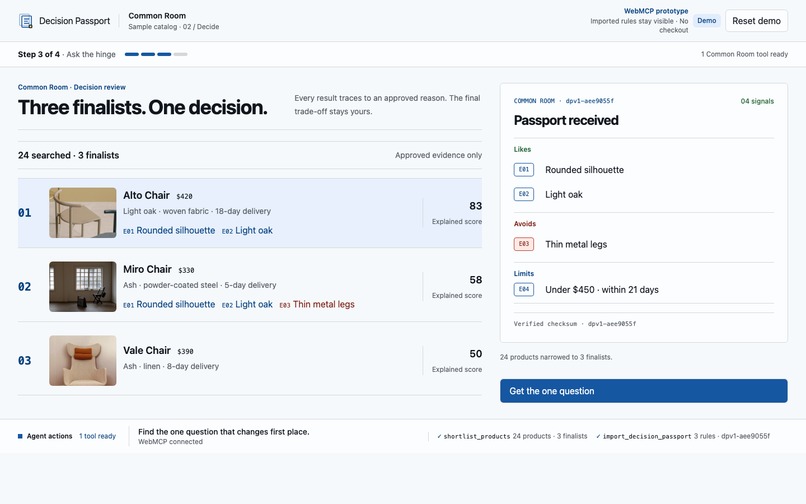
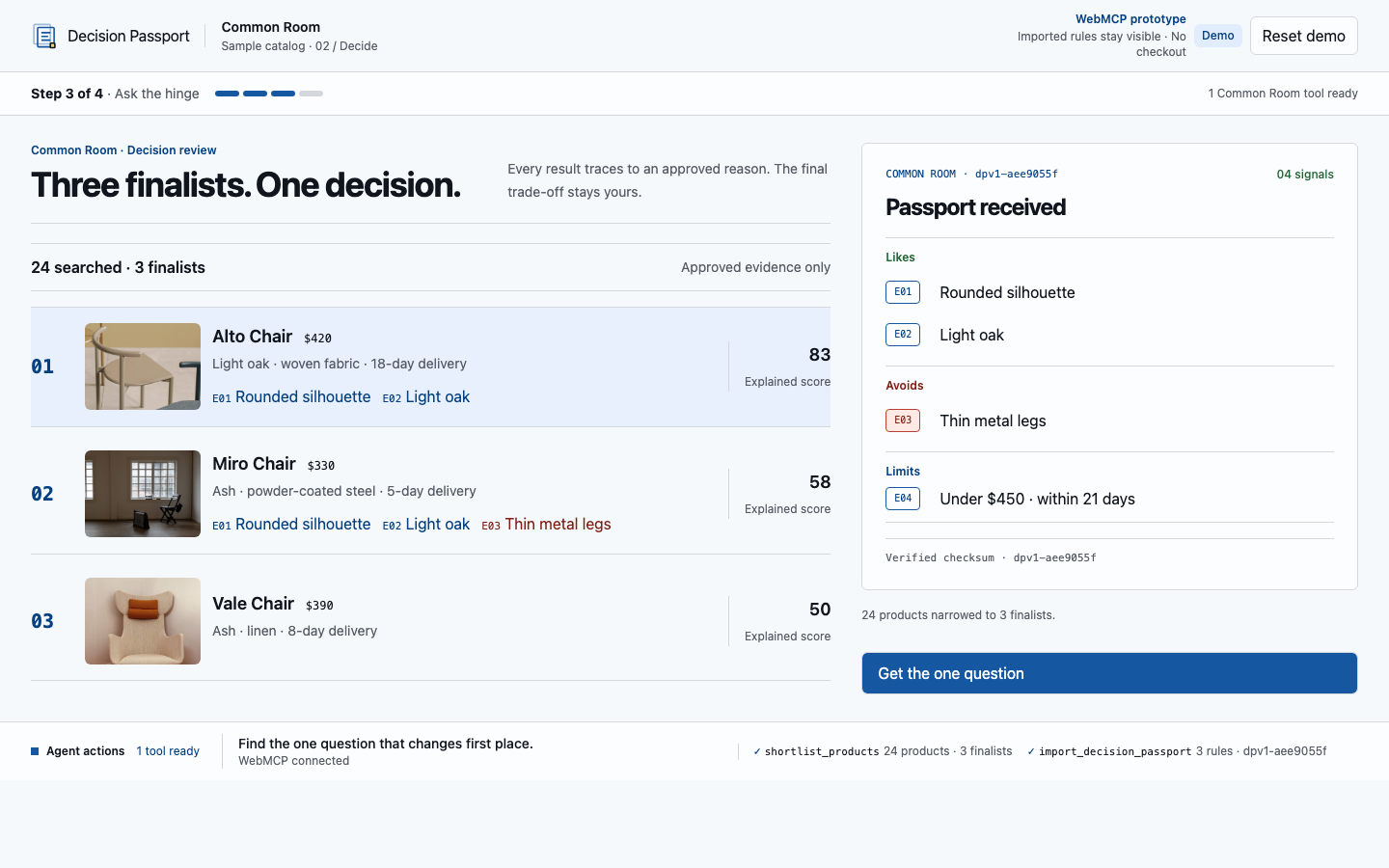
Common Room: import the checksum-bound Passport and rank 24 samples down to three.
-
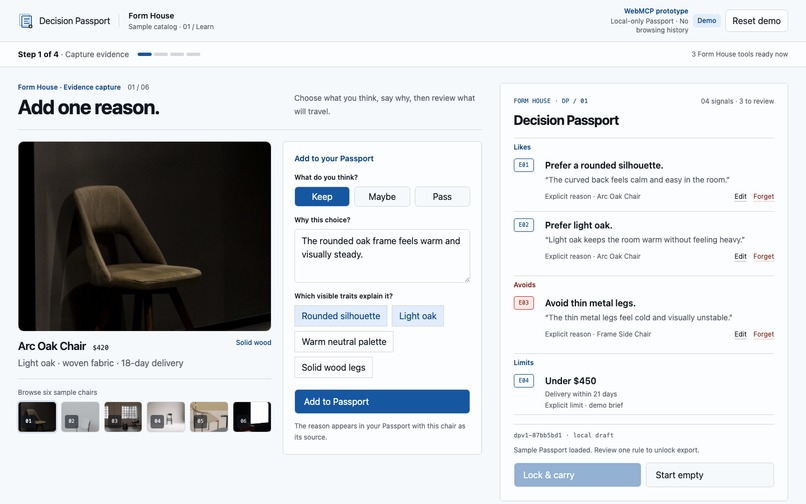
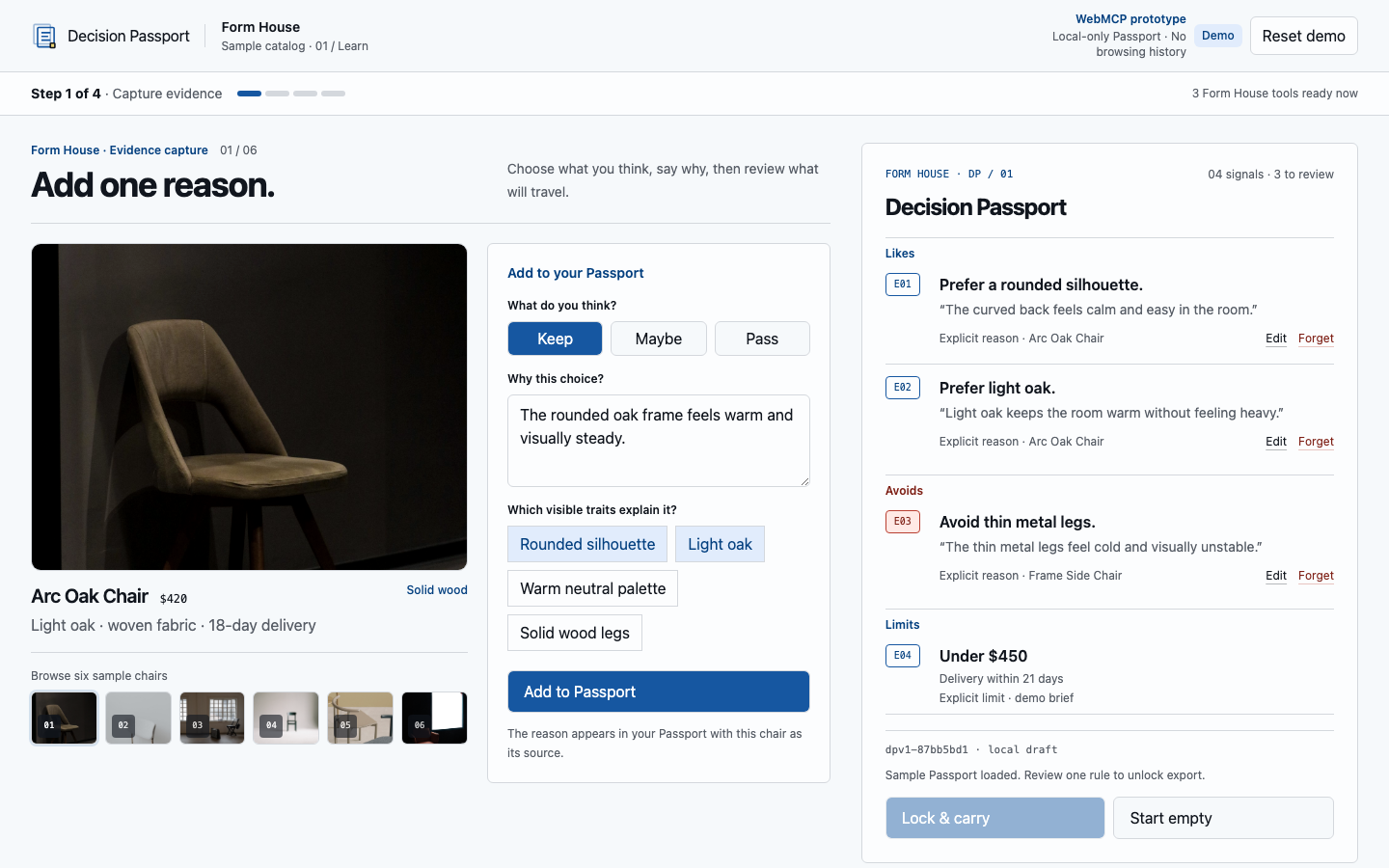
Form House: capture and edit explicit evidence before export.
-
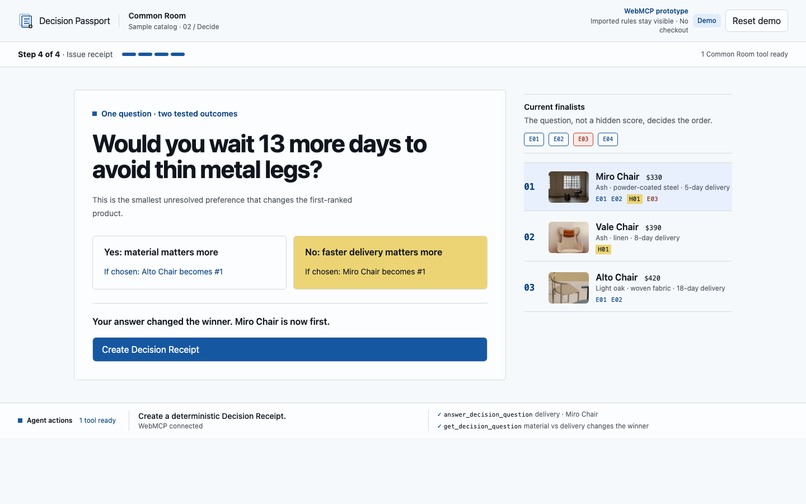
Answer reversal: H01 flips the winner while the carried evidence stays visible.
Inspiration
Shopping agents can search faster than people, but speed does not solve the harder problem: preferences are fragmented across stores, and recommendations rarely show which trade-off decided the outcome. We wanted an agent that remembers only what a person explicitly approved—and knows when to stop and ask.
What it does
Decision Passport is a two-store WebMCP journey.
At Form House, a person records why a sample chair was a yes, maybe, or no. The agent turns those explicit reasons into an editable decision-passport-v1; the person can correct or remove any rule before export.
The agent carries that checksum-bound envelope to Common Room, where it reduces 24 fictional sample chairs to three evidence-backed options. A deterministic One Question Engine simulates both sides of the unresolved trade-off and asks the smallest question whose answer can change first place.
The final Decision Receipt explains why the winner won, why the alternatives lost, which trade-off was accepted, and what would reverse the result.
Why WebMCP is the right interface
WebMCP is the product boundary, not a decorative integration. It lets the agent operate each store's live, inspectable state and carry an exact user-approved object across origins. Dynamic registration exposes only the next valid tool. Tool annotations distinguish read-only operations and untrusted text.
The same E01–E04 evidence trace remains visible from the corrected rule, through checksum handoff and shortlist, to one human-owned H01 answer and the final receipt. People stay in control of meaning; the agent handles the tedious transfer and comparison work.
How we built it
We used React, TypeScript, Vinext, Tailwind CSS, Zod, and the WebMCP imperative API. Nine single-purpose tools span two store-specific deployments. Form House changes its exposed tool set as evidence becomes reviewable; Common Room exposes exactly one next tool at a time.
Strict Zod contracts and a deterministic checksum validate transferred data. Scoring, hinge simulation, ranking, and receipt generation are deterministic, so judges can reproduce the same result without an API key, model call, account, or live commerce data.
Challenges we ran into
The central design challenge was preserving human agency without reducing the experience to a chatbot. Every preference needed to remain traceable to an explicit statement. The final question also had to be genuinely consequential, so the engine simulates both answers and asks only when the winner changes.
Technically, we kept every tool bounded, every state reproducible offline, and the two origins cleanly separated while preserving one coherent visual protocol.
Accomplishments that we're proud of
- A complete two-store WebMCP journey with nine bounded tools
- A visible, editable, portable decision contract
- A question whose two answers provably produce different winners
- A deterministic receipt with a counterfactual
- Responsive, keyboard-visible, reduced-motion-aware interfaces
- No login, payment, tracking, browser history, hidden behavioral inference, or model API required
- A public 77-second captioned demo of the working flow
What we learned
Agents become more trustworthy when their action space shrinks as the task progresses. Portable context is also more useful when it is explicit, editable, checksum-bound, and visibly distinct from the one decision that remains human-owned.
What's next
The hackathon prototype intentionally stays narrow. A future version could standardize portable decision contracts across participating merchants and add other considered-purchase categories while preserving explicit consent, source evidence, and the human-owned decision hinge.
Try it
- Open Form House in ChatGPT's in-app browser and complete the evidence-to-export flow.
- Copy the exact exported envelope.
- Open Common Room, import it, and follow the one-tool-at-a-time sequence.
- Watch the 77-second demo or inspect the MIT-licensed source.
New-work disclosure
All application code, copy, catalogs, WebMCP contracts, tests, and documentation were created for this challenge beginning September 1, 2026. Product names and attributes are fictional sample data. Openly licensed Pexels photographs, the local Kokoro demo voice model, the Montserrat caption font, and open-source packages are disclosed in the repository. The four quiet demo accents are procedurally generated; no stock music is used.
Built With
- chatgpt
- cloudflare
- javascript
- playwright
- react
- sites
- tailwind
- typescript
- vinext
- webmcp
- zod

Log in or sign up for Devpost to join the conversation.