
Inspiration
Artificial Intelligence is increasingly making decisions that affect people’s lives—approving loans, diagnosing diseases, recommending policies, and guiding public services. However, most AI systems operate as black boxes, where decisions are produced without clear explanations or traceability. This lack of transparency creates a major barrier to trust, accountability, and responsible deployment of AI. We built Decision Ledger to solve this problem. Our vision is simple: every AI decision should leave a traceable record of how and why it happened. By transforming AI outputs into structured, auditable decision logs, Decision Ledger introduces a new layer of transparency for modern AI systems.
What it does
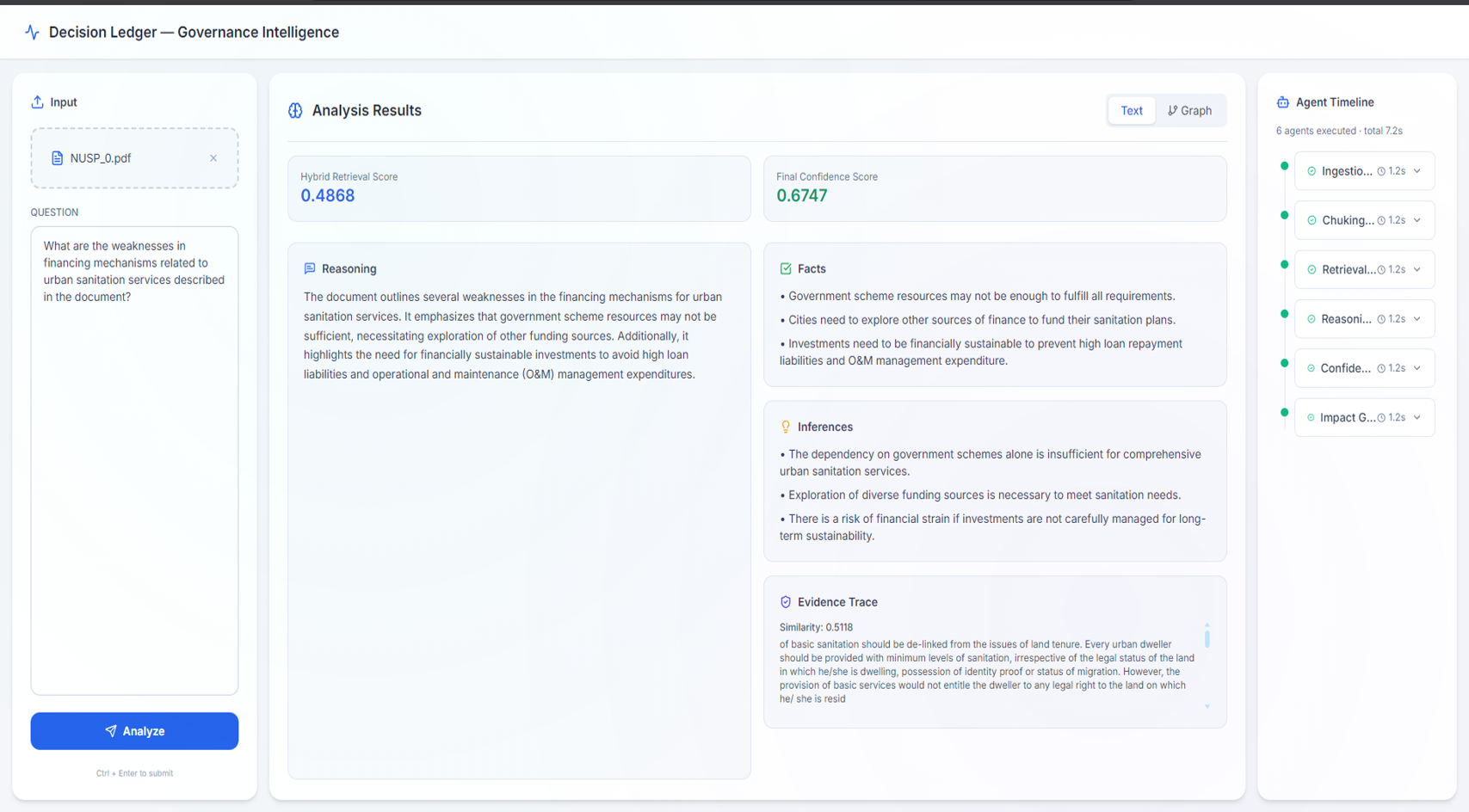
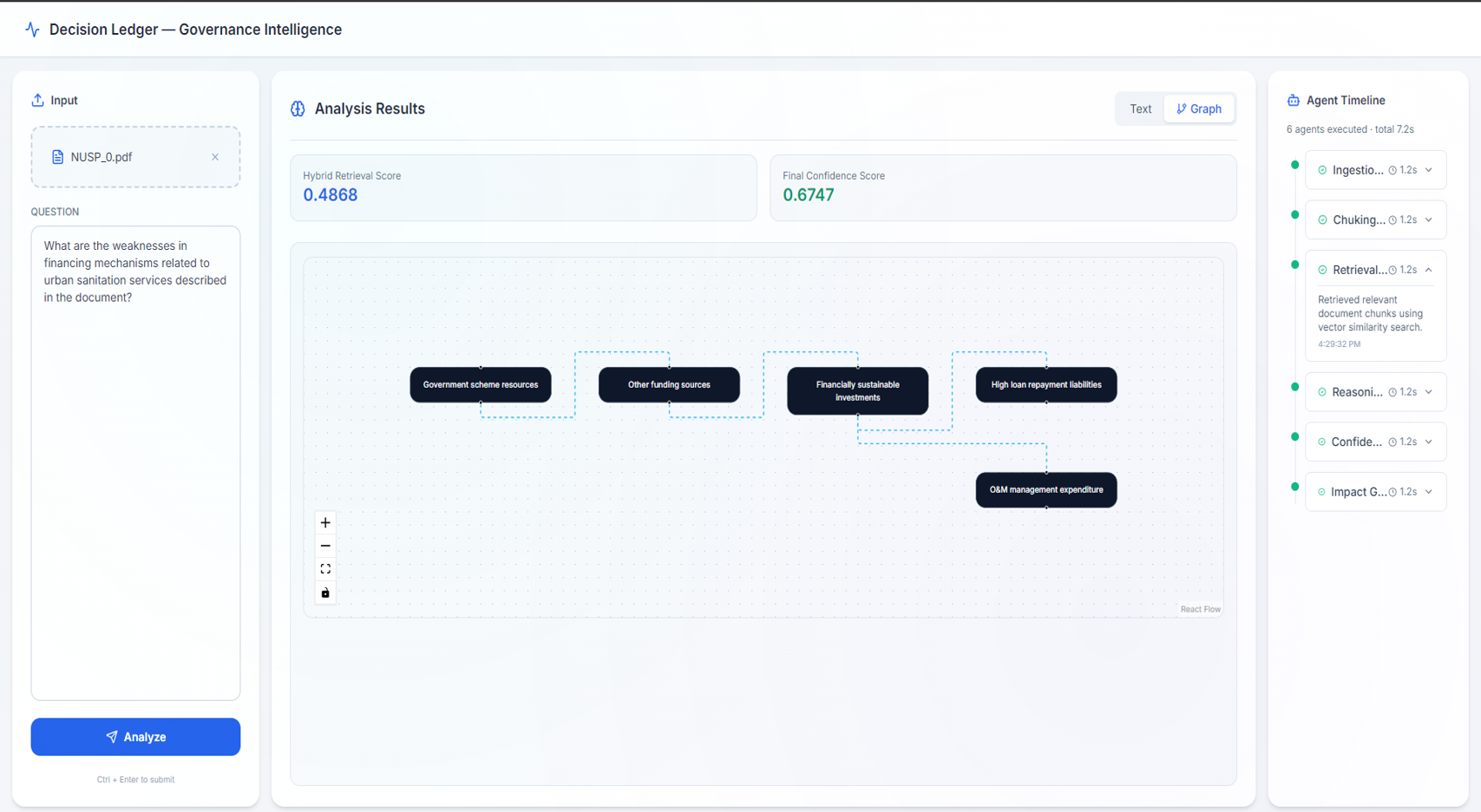
Decision Ledger is an AI decision accountability framework that records, explains, and tracks every AI-generated output. For each decision, the system captures: 1.Input context used by the AI model 2.Model output and confidence level 3.Structured reasoning or explanation 4.Timestamp and decision metadata These entries form a secure, queryable decision history, enabling developers, regulators, and organizations to understand how AI reached a specific outcome. Instead of opaque AI outputs, Decision Ledger creates a transparent chain of reasoning for every decision.
How we built it
The architecture is designed around a three-layer accountability pipeline:
Decision Capture Layer This layer intercepts AI outputs and extracts relevant metadata such as inputs, predictions, and context.
Explainability Engine Using LLM-assisted reasoning extraction, the system generates structured summaries that explain why the model produced a particular decision.
Ledger Storage Layer All decision records are stored in a tamper-resistant ledger-style log, ensuring traceability and enabling future audits.
The system combines AI explainability techniques, structured logging, and scalable data storage to ensure transparency without compromising performance.
Challenges we ran into
One of the biggest challenges was translating probabilistic AI outputs into meaningful, structured explanations. AI models often produce results without explicit reasoning, so we designed a framework that converts these outputs into interpretable logs. Another challenge was maintaining low-latency performance while capturing decision metadata, ensuring the system can work alongside real-time AI applications.
Accomplishments that we're proud of
One of our biggest accomplishments was designing a structured accountability framework for AI decisions. Instead of treating AI outputs as isolated results, we successfully created a system that records inputs, reasoning, outputs, and context for every decision. We are particularly proud of building a transparent decision logging pipeline that converts complex AI outputs into clear, auditable records. This transforms traditionally opaque AI systems into traceable and explainable systems. Another key achievement was designing an architecture that balances explainability, scalability, and performance, ensuring that transparency does not come at the cost of efficiency. Decision Ledger demonstrates that AI accountability can be built directly into AI systems rather than added as an afterthought.
What we learned
Building Decision Ledger helped us understand the practical challenges of implementing Responsible AI principles in real-world systems. While explainability is widely discussed in research, translating AI reasoning into structured, interpretable decision records requires careful system design. We also learned the importance of transparency in AI-driven environments, especially when systems are used in sensitive domains like healthcare, governance, and finance. Ensuring that AI decisions can be audited, traced, and explained is critical for building long-term trust. This project strengthened our understanding of AI system architecture, explainability techniques, and accountability frameworks, and reinforced the idea that the future of AI will depend not only on performance but also on trust, transparency, and responsible deployment.
What's next for Decision Ledger
While Decision Ledger establishes a foundation for AI accountability, several enhancements can further strengthen its capabilities. Future developments include: 1.Automated bias detection to identify potential fairness issues in AI decisions. 2.Regulatory compliance modules aligned with emerging AI governance frameworks. 3.Visual decision dashboards that allow stakeholders to explore AI decision histories intuitively. 4.Cross-model compatibility to integrate Decision Ledger with multiple AI frameworks and model architectures. These improvements will transform Decision Ledger into a comprehensive AI governance platform for responsible AI deployment.
System Architecture
Decision Ledger is designed as a transparent accountability layer for AI systems, capturing and structuring the reasoning behind every AI decision. The system follows a modular pipeline that intercepts AI outputs, extracts explanations, and stores them in a secure decision ledger.
Architecture Workflow User Query / Input The system receives a user request or decision input.
AI Model Processing The input is processed by the AI model (LLM or ML model) which generates predictions or recommendations.
Decision Capture Layer The output, input context, and model metadata are intercepted and structured into a decision record.
Explainability Engine The system generates a structured reasoning trace that explains why the AI produced the decision.
Decision Ledger Storage All records are stored in a tamper-resistant ledger-style database, creating an auditable decision history.
Audit & Transparency Dashboard Developers, regulators, or stakeholders can review decision logs, analyze reasoning, and ensure accountability.
Simplified System Flow User Input │ ▼ AI Model / LLM │ ▼ Decision Capture Layer │ ▼ Explainability Engine │ ▼ Decision Ledger Database │ ▼ Audit Dashboard / Transparency Interface
Built With
- amazon-web-services
- cloudinfrastructure
- llm
- python
- rag
- vectordatabase


Log in or sign up for Devpost to join the conversation.