-
-
 GIF
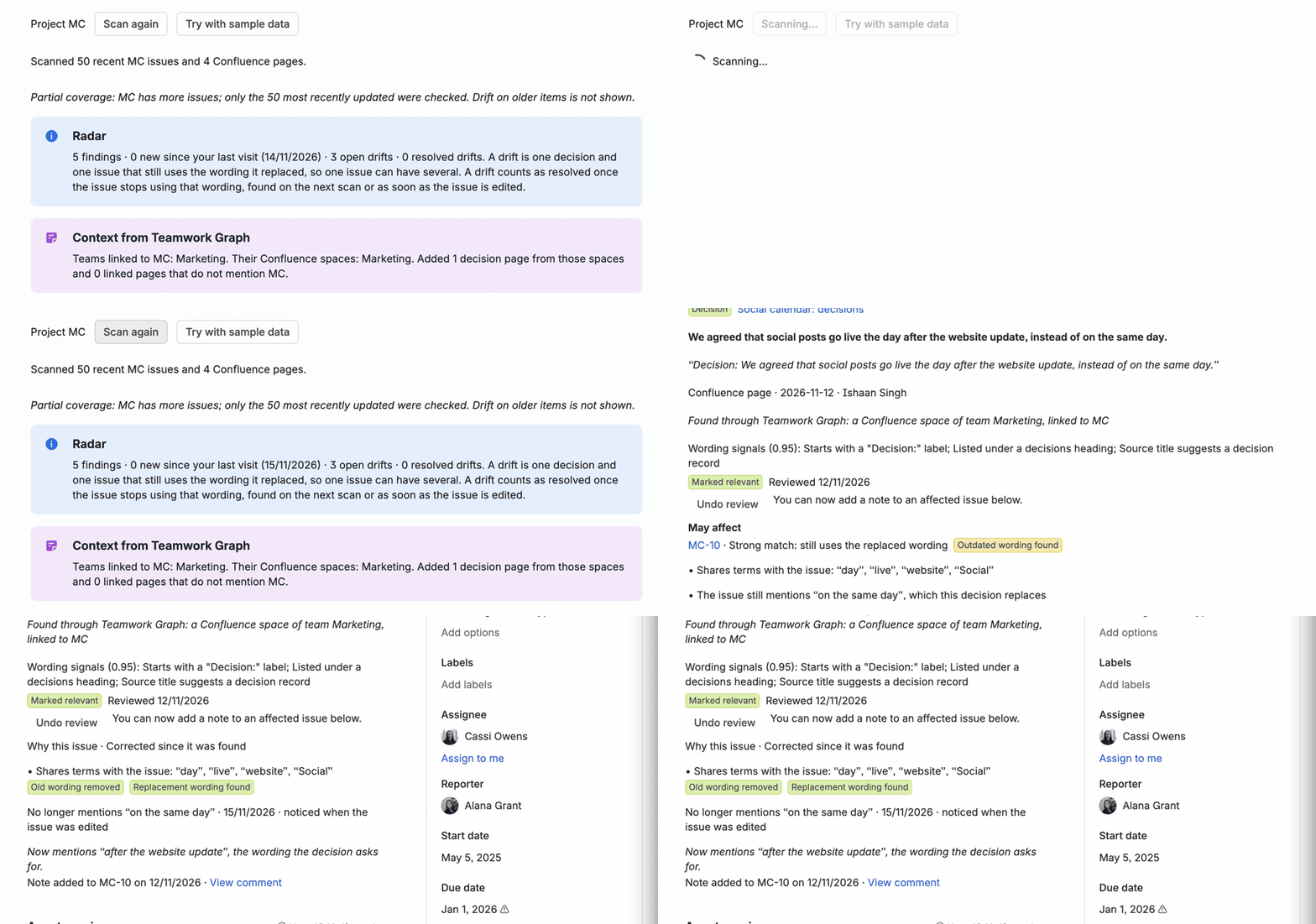
A real scan: Teamwork Graph finds the decision, Radar flags MC-10, then shows the correction.
-
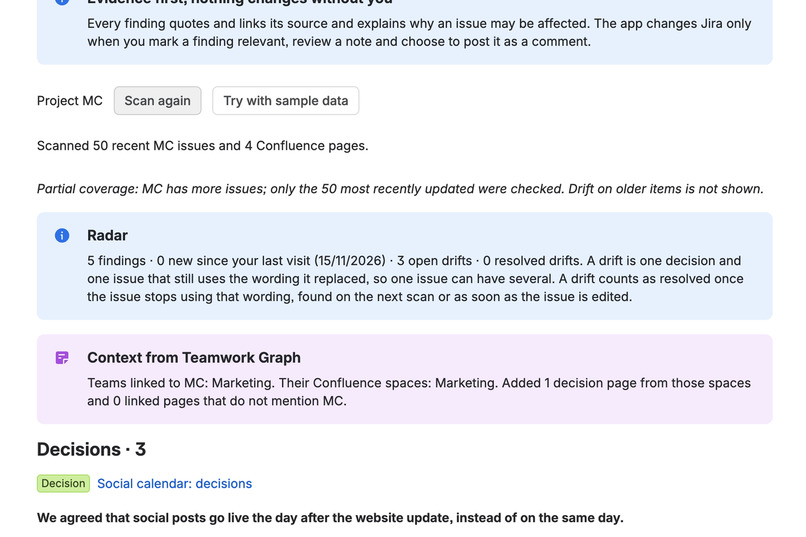
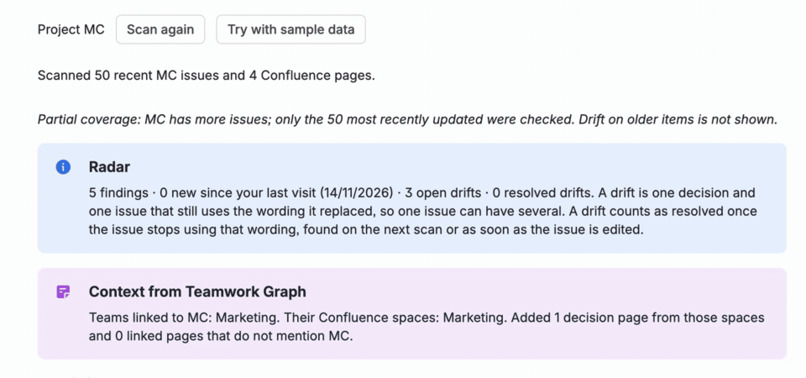
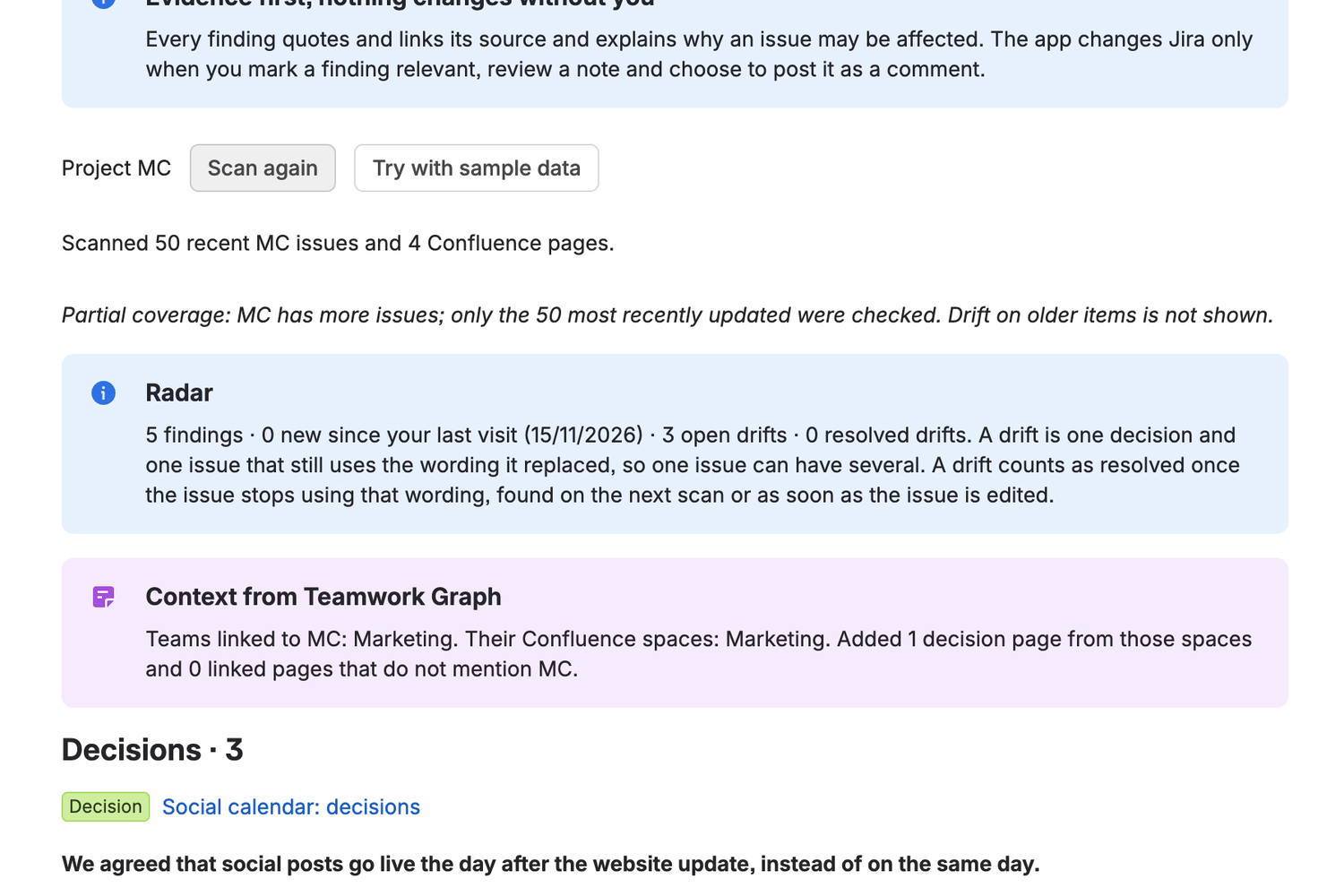
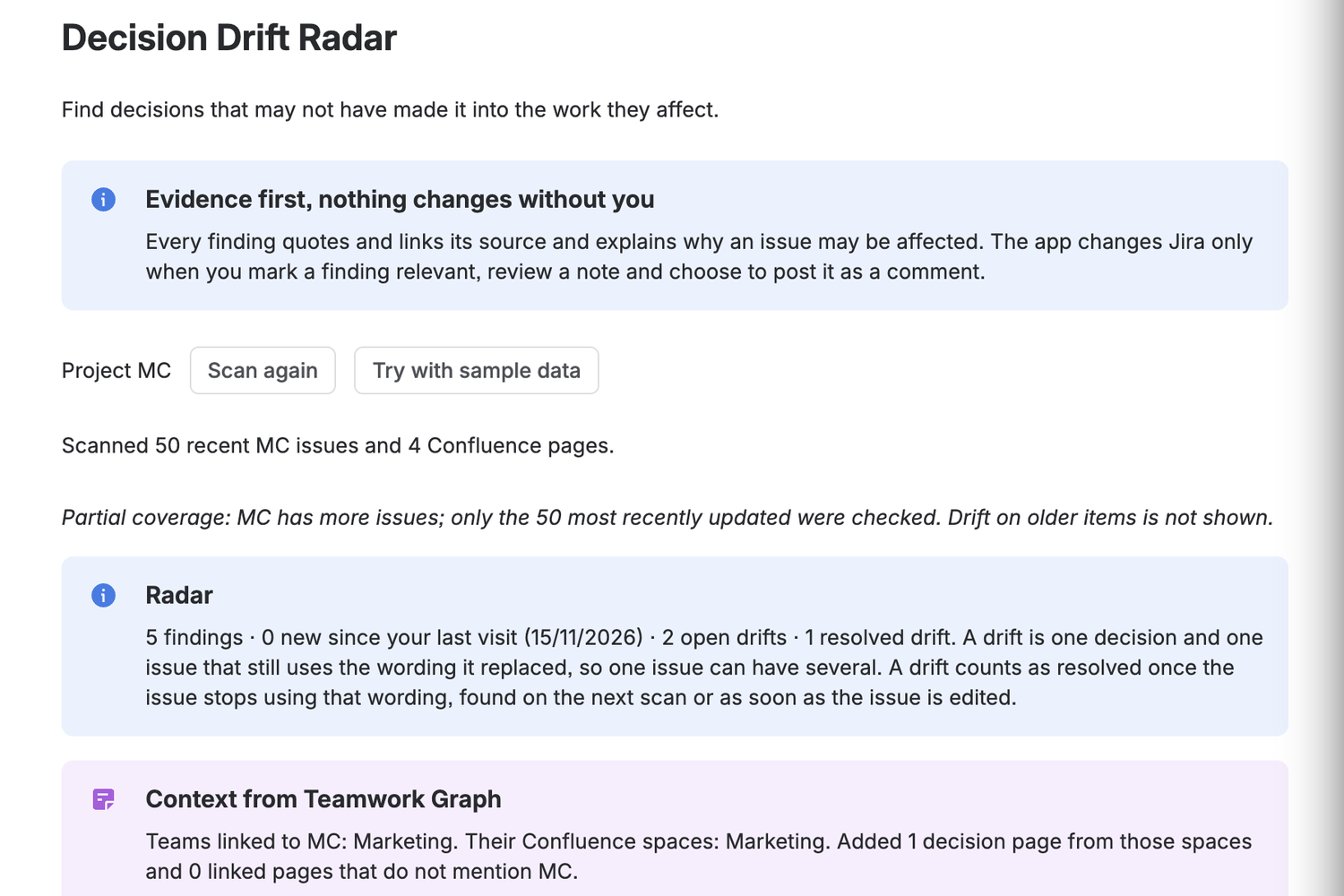
A live scan of the MC project: Teamwork Graph links MC to the Marketing team's Confluence space.
-
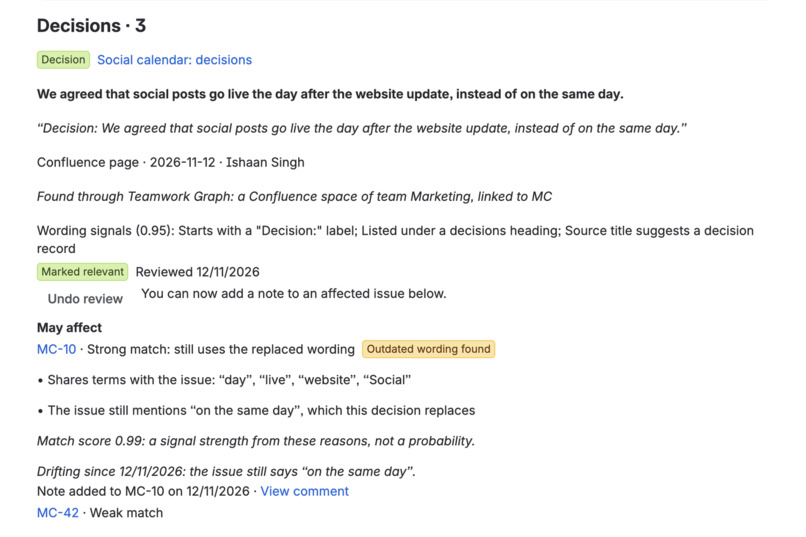
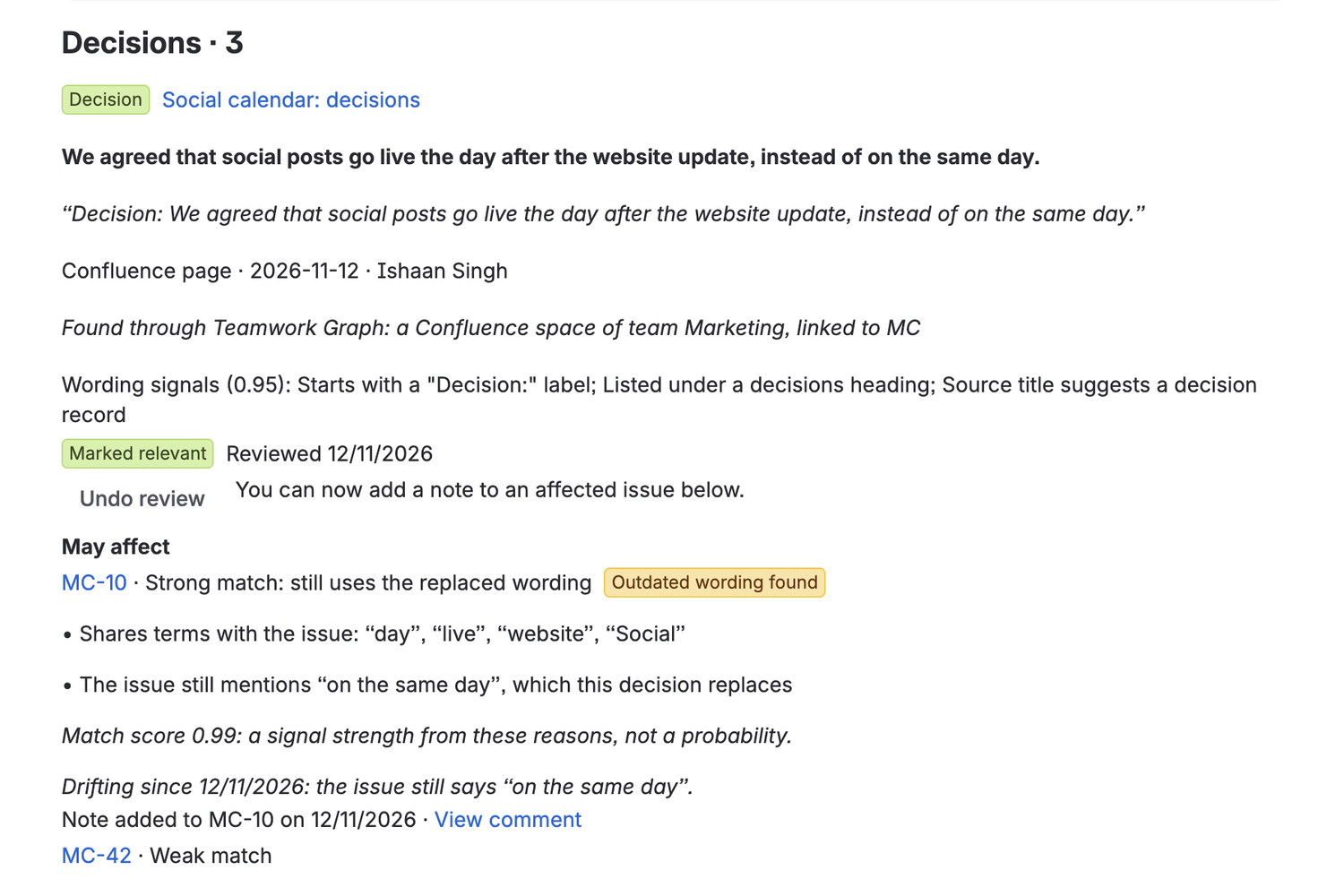
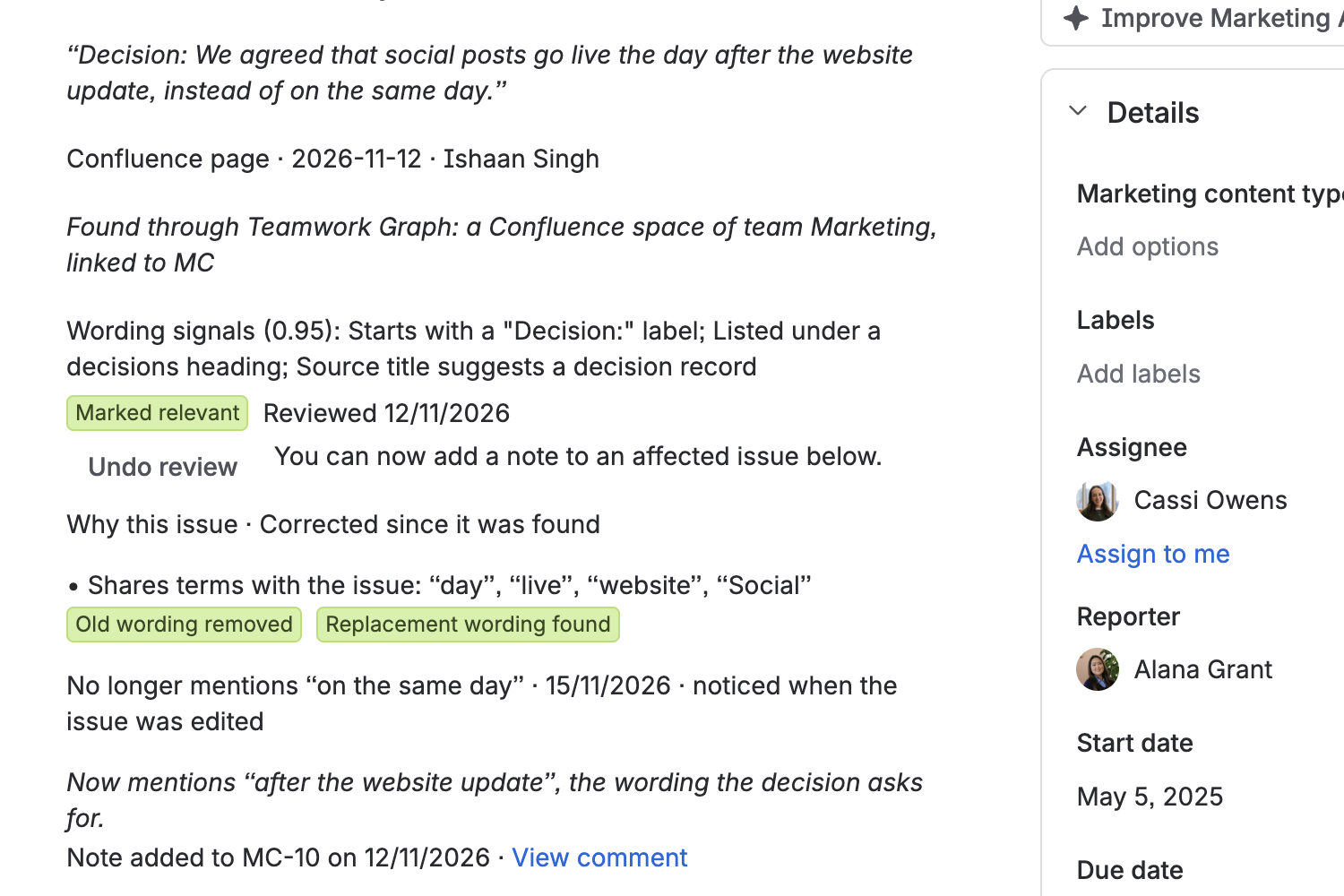
The decision, quoted and found through Teamwork Graph. MC-10 still says “on the same day”.
-
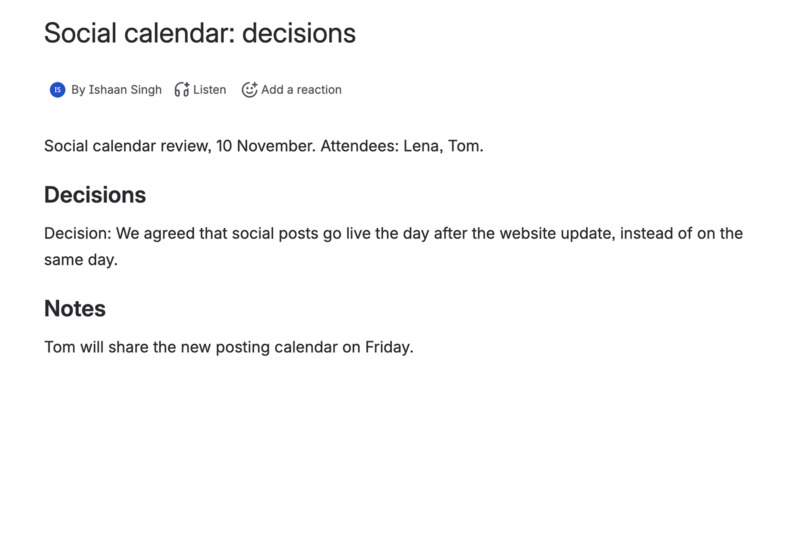
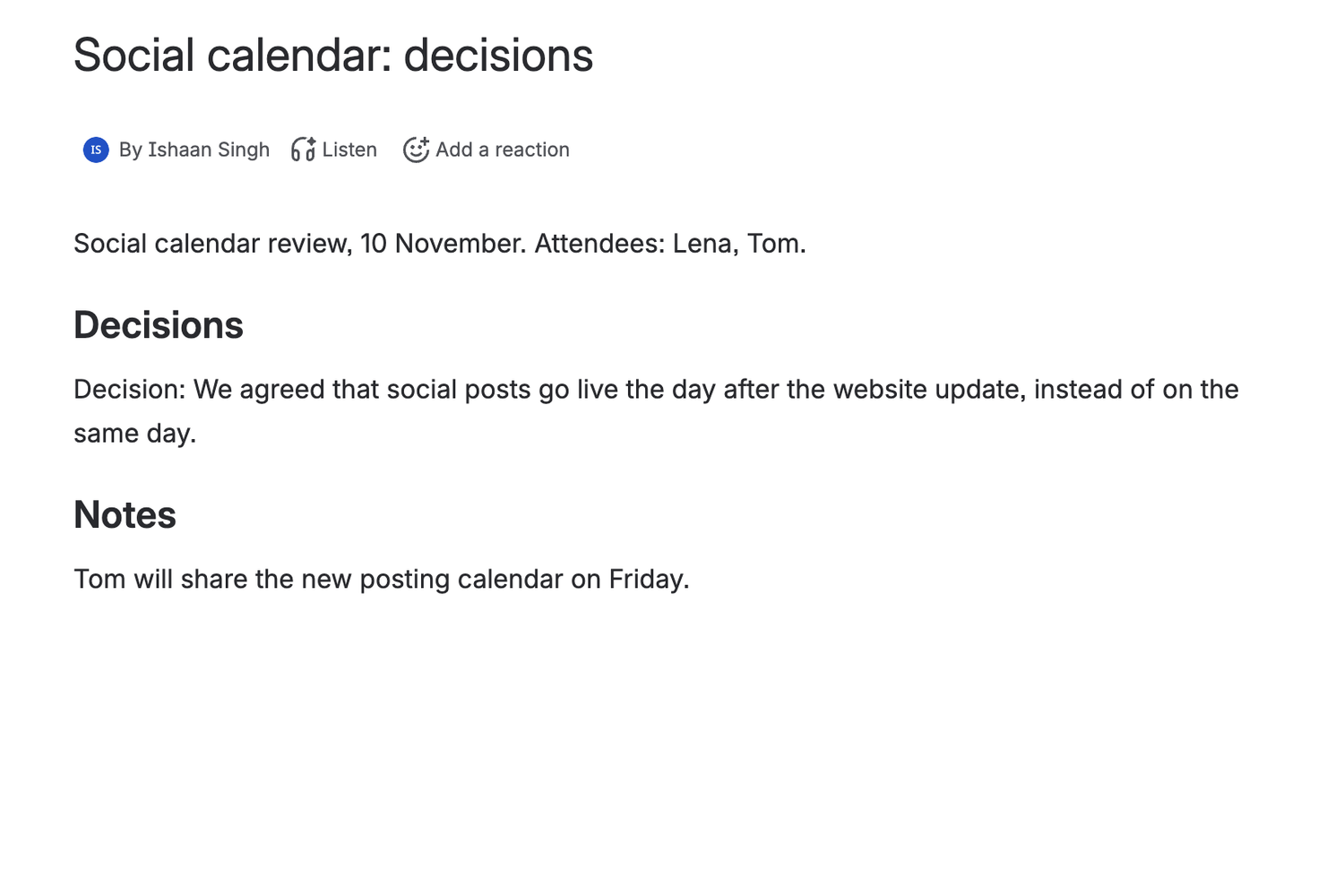
The Confluence decision page never mentions MC or MC-10, so a key search can't find it.
-
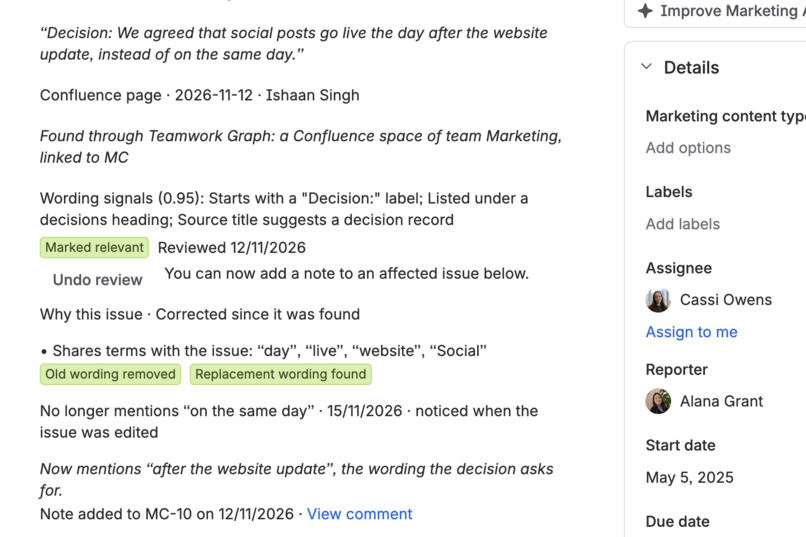
After the fix: Old wording removed, Replacement wording found, noticed when the issue was edited.
-
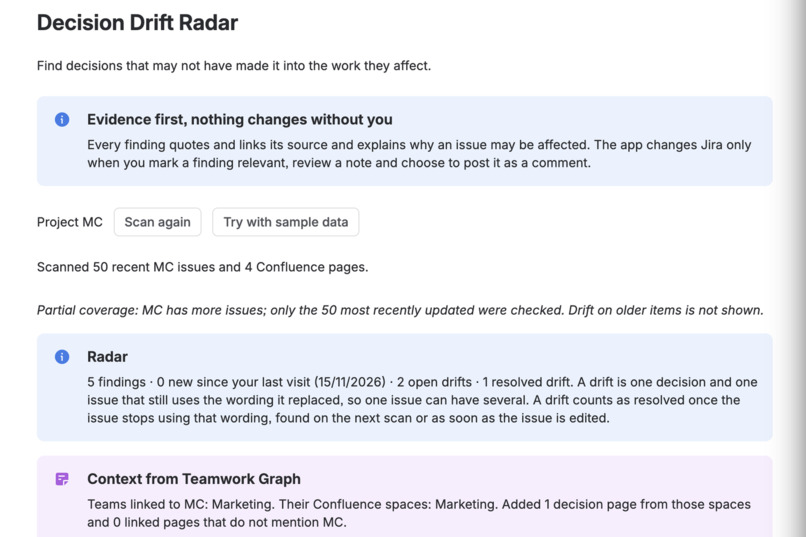
The project radar counts open and resolved drifts, and says when a scan covered only part of a project.
-
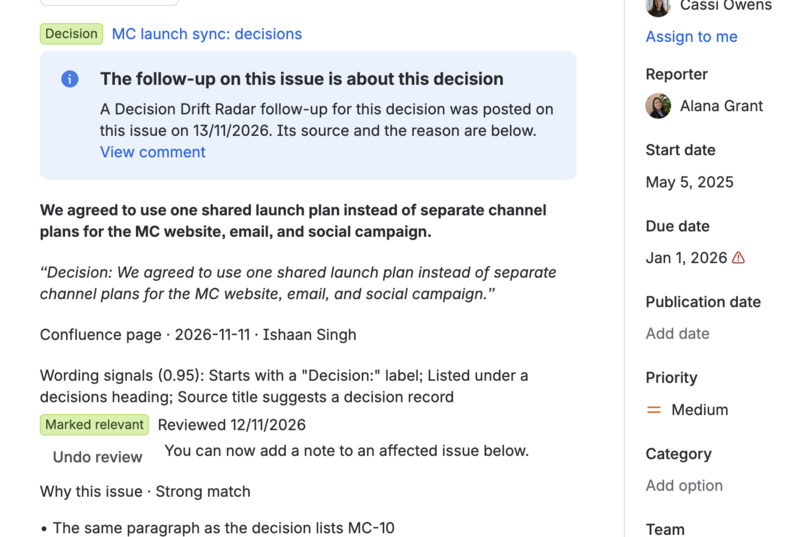
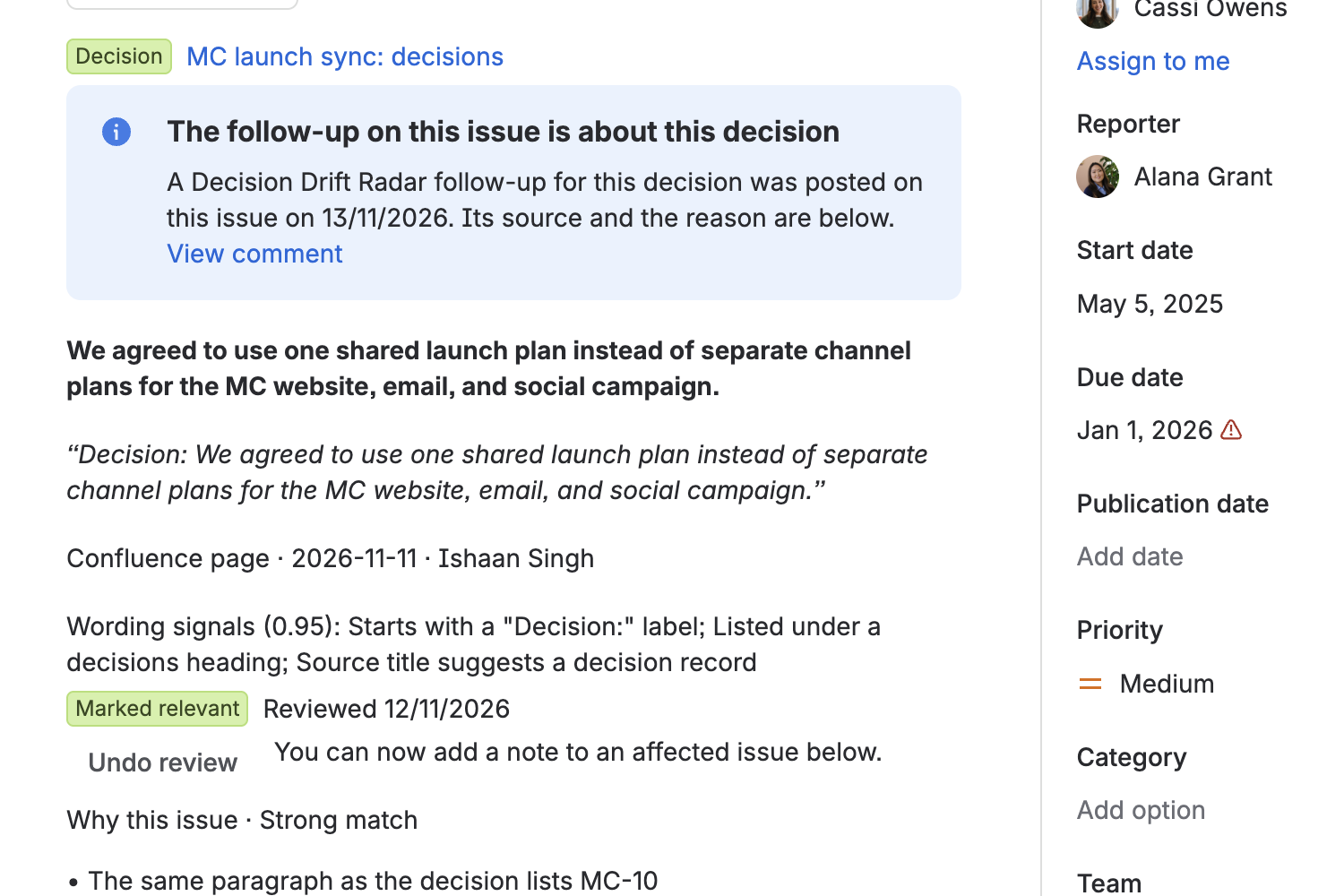
A teammate's follow-up names no source. The issue panel shows which decision it refers to.
-
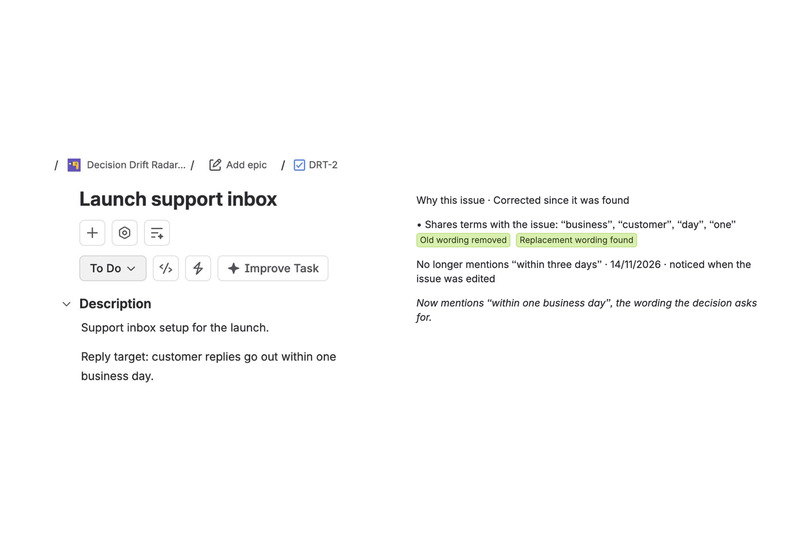
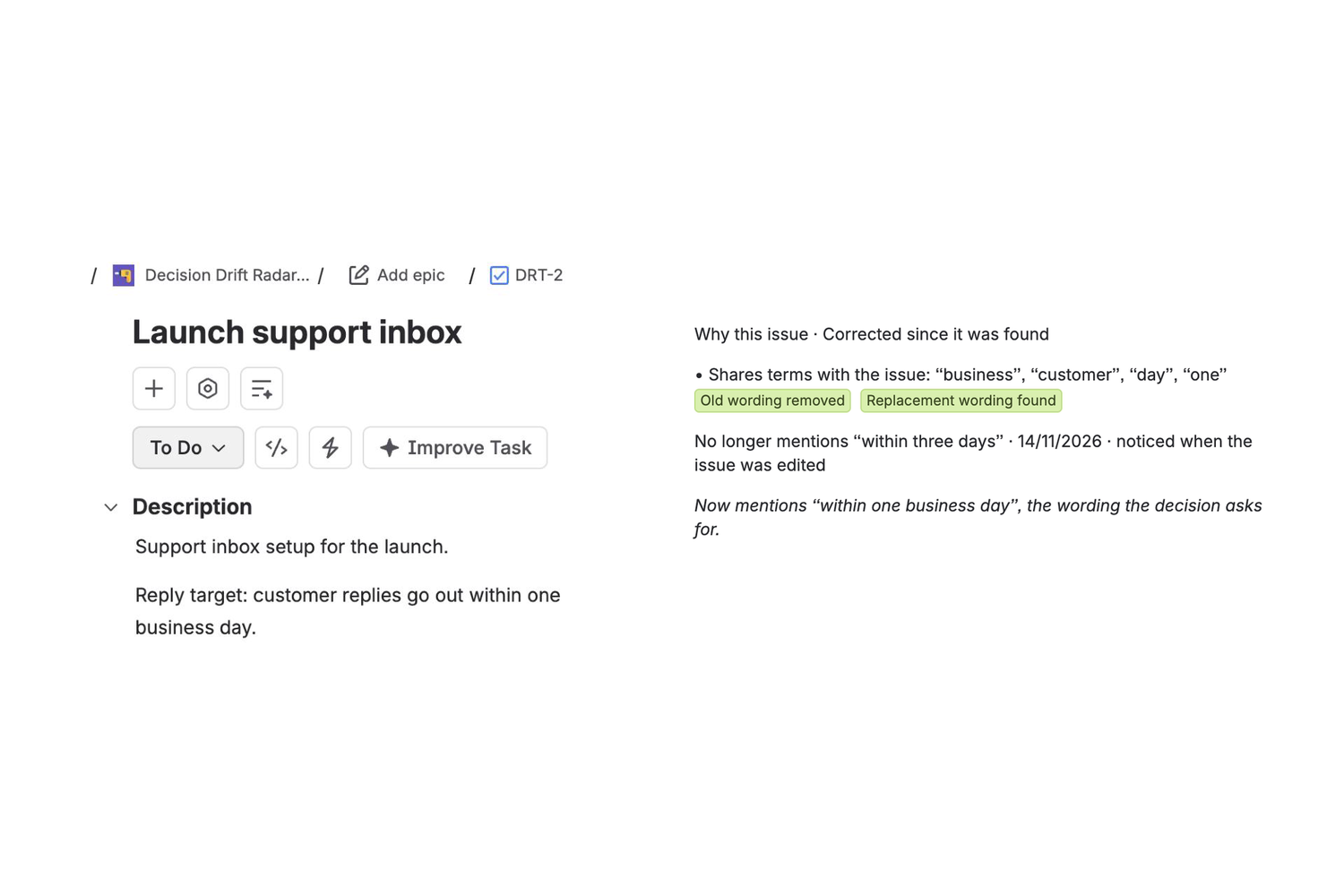
The same check on a separate production site, on a different issue: DRT-2, corrected.
Inspiration
Teams decide things in the places where discussion happens: a Confluence decision log, meeting notes, a comment on a Jira issue. The decision is real, but the work items it changes are somewhere else, and nobody goes back to update them. Weeks later someone builds from an issue that still describes the old plan. The information existed the whole time. It was just never connected to the work.
Codegeist 2026 asks for apps that use context to help teams ship with confidence, including "what's already been decided". Decision Drift Radar is built around that one piece of context.
What it does
Decision Drift Radar scans a Jira project and related Confluence pages, finds decisions, and highlights issues that may still describe an older plan.
The core workflow: Teamwork Graph discovers a decision written outside the project, on a team page that never mentions the project key. Radar flags the Jira issue that still uses the wording the decision replaced, quoting the decision and naming the stale phrase. When someone corrects the issue, the team can verify it: the issue shows Old wording removed and, when the new wording is there, Replacement wording found, and the drift totals update.
What Radar detects. Radar works best with explicit decision wording such as “Decision:”, “we agreed” or “we decided”. To flag an issue that still uses old wording, the decision has to name what it replaces, for example “X instead of Y” or “move from X to Y”. The optional AI pass can surface indirectly worded decisions for teammate review: its exact quote shows the text is in the source, and a teammate still judges whether it records a decision.
- Finds decisions where they were written. It reads issue descriptions, issue comments and Confluence pages, and picks out decisions, open questions and proposals. Confluence decision items are recognised as well as plain wording such as "Decision:", "we agreed" or "we decided to".
- Finds context beyond keyword search. Teamwork Graph connects the Jira project to Atlassian teams, their Confluence spaces and linked pages. A decision can be discovered even when its page never mentions the project key; the app shows how it was found.
- Finds indirectly worded decisions on request. An optional Forge LLM pass looks for wording the rules missed. AI findings are labelled, saved when their quote matches the source word for word, and checked again against current sources before they appear on later scans. People still review relevance.
- Shows the evidence. Every finding carries the exact quote, a link to its source, the date and author, and the wording signals that made it a finding. On a Jira issue, the card tied to a posted follow-up identifies the decision the comment was about and offers a View comment link.
- Explains the drift. For each affected issue it lists the reasons in plain words. The strongest one is drift itself: "The issue still mentions 'separate channel plans', which this decision replaces." Other reasons include the decision naming the issue, and shared terms.
- Tracks drift after discovery. Scans find decisions and record which Jira issues still use wording they replace. The radar shows newly seen findings and counts open and resolved drifts (a drift is one decision on one issue, so an issue can have several). A Jira trigger also watches issues as they change: when an issue is created or edited to use wording a decision the project's scans already found replaced, Radar records a new drift right away, without a scan ("Drifting since …, when the issue was edited"), and the summary counts drifts new since your last visit. When someone edits a tracked issue and the old wording is gone, it records Old wording removed before the next scan. That is all it has verified, since deleting the line does it too; when the decision names its replacement and the issue now contains it, the radar also shows Replacement wording found. If the old wording returns, the drift reopens with its original date, on that edit or the next scan.
- Keeps people in charge. A teammate marks a finding relevant or dismisses it. The review is saved for the whole project, so findings do not keep coming back as new.
- Turns evidence into a reviewed next step. Once a finding is marked relevant, a teammate can edit a suggested note or ask the app to draft one with AI. The app can suggest wording for the issue description and leaves any description edit to the teammate. The app shows the exact comment first and posts it, in that person's name, only if it is still exactly what they previewed. It copies the source into Jira only when it can show that everyone who can see the issue may read it (a Jira issue or comment in the same project with no security level or comment restriction); then the comment carries the note, the quote and a link. A decision from a Confluence page is posted as a fixed follow-up with no quote, source title, link or text drafted from the source, because the app cannot check that the page's audience includes everyone on the issue. Whoever reads the follow-up can open the issue's Decision Drift Radar panel to inspect the evidence, if their account can read the page. It is the only change the app ever makes to Jira, and the app reserves each finding and issue before posting and can recover a missing receipt from the comment.
- Works where people are. There is a page under Apps with a project picker, a page inside each Jira project that scans it straight away, and a panel on every issue showing the decisions that point at it.
- Works from Rovo Chat. The Decision Drift Radar agent finds evidence for a project or issue, can run the optional AI pass on request, and prepares a comment for review. A teammate previews and posts the exact comment in the Jira issue panel. We verified that flow on the development demo site, where the AI pass also found and saved an indirectly worded decision.
- Shows value in one click. "Try with sample data" runs the real analysis on a small bundled project, so a new site sees a full result before it has any decision pages. A judge can also mark a sample finding relevant and preview the exact comment it would get; the sample never saves or posts anything.
How we built it
- Atlassian Forge, with UI Kit (
@forge/react) on the Node.js 24 runtime. - Forge modules:
jira:globalPage,jira:projectPage,jira:issuePanel,rovo:agent, fouractionmodules, atriggeronavi:jira:created:issueandavi:jira:updated:issue, and resolver functions. - Jira and Confluence in one app. Jira is the required product and Confluence is connected as an optional one, so one installation reads both. All product calls use
asUser(), so the app only ever sees what the signed-in person can see. - Forge storage holds review status, posted-note receipts, AI usage counters and verified AI proposals.
@forge/kvsholds each project's radar (first-seen times and drift states), each person's last visit (keyed by a hash of the account id), and expiring Rovo drafts scoped to the requesting account. A custom entity reserves each finding and issue while a note is posted. The privacy policy describes retained data. - The issue trigger ignores the app's own events and acts only when an issue is created or its summary or description changes. It reads that one issue as the app, resolves open drifts whose wording is gone, and opens or reopens a drift when the issue uses wording a known decision replaced (only phrases of two or more words). It stores drift states and times, never issue text, and a drift it opens is shown only in a viewer's own scan.
- A separate extraction module (
src/domain, TypeScript) does the analysis. It is pure and deterministic: no network, no clock, no randomness, and no AI model, so the same input always gives the same findings and every finding can be traced to a rule. It splits text into sentences with exact offsets, classifies each one, removes duplicates, and matches findings to issues using issue keys, weighted shared terms, and "replaced term" detection ("X instead of Y", "move from X to Y", "X is out of scope"). - Tests. 28 fixture checks cover the extraction module, including an exact-match expected output and regression cases. 88 resolver, agent, Teamwork Graph, radar, issue-trigger, notification, first-run, posting-safety and AI-pass tests exercise mocked Jira, Confluence, Teamwork Graph, Forge storage, KVS and model responses. GitHub Actions runs both suites.
- An accuracy benchmark on real notes. We measured the rules on 16 openly licensed meeting-notes files from the OpenJS Foundation and the Rust project, labelled by hand. Half were used to improve the rules. The other half were labelled afterwards for an initial held-out check and a separately reported rerun after a bug fix. The rules were also tested on eight more notes labelled for decision recall. A later change that drops reversed decisions, hedged opinions and already-answered questions was measured once on a fourth set of eight fresh notes, labelled and frozen before the run: decision results did not change on any set, while false alarms fell from 13 to 4 on the held-out notes and from 13 to 10 on the fresh notes (a small set: 9 strict labels). The method and results for the rule-based extractor are in the repository (
npm run benchmark). - Teamwork Graph and Forge LLMs. Graph relationships expand source discovery. A separate, user-triggered
@forge/llmpass supplements the deterministic results and checks each proposed quote against the retrieved source. Later scans revalidate saved findings against the user's current sources. The project view, issue panel and Rovo actions can surface the verified results. - No external services. The app calls nothing outside Atlassian. The Forge CLI reports it as eligible for the Runs on Atlassian program.
Challenges we ran into
- False positives from honest text. A demo page's own disclaimer, "This is a sample decision, not an approved Marketing team decision", was first reported as a decision. We added handling for disclaimers and negated approvals, and limited "approved" to verb and label uses.
- Links inside Forge. Jira's API returns addresses on the API gateway, and Confluence's base address can omit
/wiki. Links built from them were dead. The app now returns site-relative paths and the UI resolves them against the site. - Reading Jira and Confluence from one app. A Jira-only installation gets a 403 from Confluence. The app had to declare Confluence as an optional product and be connected to it.
- Writing safely. Posting to Jira needed several guards: only after a human review, an exact server-built preview that must still match when posted, a receipt to suppress repeat posting, clear messages about whether anything was posted, and skipping the app's own comments in later scans. The hardest was audience: a person who can read a Confluence page may be commenting to a Jira audience that cannot, and reading the page or confirming the comment doesn't prove otherwise. So the server only quotes sources it can show are visible to everyone on the issue, on every posting path including Rovo.
- Templates looked like decisions. When Teamwork Graph brought in a team's whole Confluence space, DACI and premortem templates produced nine junk findings through one loose rule. Graph pages are now chosen by title as decision records, and only bulleted items under a "Decisions" heading count as implicit decisions.
- Keeping an AI honest. A model will paraphrase or invent. We made it a proposer only: every quote is checked word for word against the source, duplicates and unknown sources are dropped, and the prompt excludes issue descriptions that merely state the current plan.
- Measuring honestly. Tuning the rules on one set of real meeting notes raised decision recall there from 30% to 70%. On notes the rules had never seen, it stayed at 25% (2 of 8). On a third set, labelled and frozen before anything ran on it, the rules found 7 of 10: 9 of 18 decisions (50%) across both untouched sets, with no false decision calls. Both are small samples, and recall depends heavily on how a team writes. The held-out run also exposed a real bug: typographic apostrophes ("Let’s"), which Confluence stores, were ignored by every rule.
- Teamwork Graph in Preview. New apps can't run ad-hoc queries, so the traversal had to fit the curated fields; reading the live schema on our site showed which ones existed. Queries must also be named
company_operation, or they are rejected, which we only saw in our logs because the app falls back gracefully.
Accomplishments that we're proud of
- Every claim the app makes can be checked: a quote, a link, and a stated reason.
- The full journey works on a live site: find the decision, see the drifted issue, review it, post the note, and see it on the issue.
- A reviewer on an empty site sees a complete result in one click.
- On production 3.11.0 (judge test site, 14 November 2026), following the published Teamwork Graph steps, we added a new team page, "Support decisions" ("Decision: Customer replies go out within one business day instead of within three days."), which mentions no project or issue key. We also added a new issue that still said "within three days". The first scan found the page through Teamwork Graph and flagged the issue as a strong match that still mentions “within three days”. We then corrected the issue's line, and the issue panel, opened about three minutes later, showed Old wording removed, Replacement wording found and "noticed when the issue was edited". The totals moved from 3 open drifts · 0 resolved to 2 open · 1 resolved.
- On the development demo site (6.21.0, 14 November 2026), we changed MC-10's schedule to "Scheduling: social posts go live the day after the website update." The Jira trigger logged the resolution two seconds later, and the issue panel showed Old wording removed and Replacement wording found, "No longer mentions “on the same day” · noticed when the issue was edited" and "Now mentions “after the website update”, the wording the decision asks for." After restoring the original sentence, a rescan reopened the drift with its original date. (Builds before 3.11.0 labelled this state Resolved; an earlier run on 6.8.0 showed that label.)
- On our production test site (3.16.0, 16 November 2026), in a private test project with notifications turned on, creating an issue that used the replaced wording opened a drift without a scan, and its assignee and reporter (one person) received exactly one Jira email with the fixed subject and message. An earlier test sent two emails and no message text; we fixed both before this run.
- On eight held-out meeting notes, the current rules found 2 of 8 labelled decisions and made zero false decision calls. Across decisions, questions and proposals combined, the current rules found 29 of 37 labelled items and made 4 false calls (88% precision, 78% recall). The scorer excludes 14 borderline matches. Counting those as false calls would give 62% precision (29 of 47). The benchmark publishes the labels, misses and false alarms.
- We evaluated the numbered-sentence AI pass with Claude Sonnet 5 in a Forge development background worker, one page per call. On the frozen recall set, rules alone found 7 of 10 decisions with zero false decision flags. Adding AI found 9 of 10 with one false flag. On the held-out set, both modes found 2 of 8. Rules alone had zero false decision flags and adding AI produced eight. The app's AI pass now uses the same prompt, numbering, input budget and output cap, as a background job. A real project scan can send up to 15 sources in one call, so these per-page results are an estimate. The latest rule changes (dropping reversed decisions, hedged opinions and already-answered questions) have not yet been re-measured with the AI pass.
- Teamwork Graph finds decisions that a search for the project key misses: on our demo site, a page that never mentions the project flags a drifted issue at 0.99.
- AI findings carry the same evidence as rule-based ones: a quote verified word for word, a source link, and the same issue matching and reasons. The model's own explanations are discarded, so nothing it writes is shown as fact.
- The agent and app share evidence from the baseline scan and the optional AI pass. On our development demo site, Rovo prepared a draft, the teammate reviewed it in the Jira issue panel, and the confirmed comment appeared in their name.
What we learned
- For a tool that tells people their work is out of date, being explainable matters more than being clever. Deterministic rules with visible reasons were easier to trust and to debug than a score.
- The best drift signal is simple: the decision says what it replaces, and the issue still says the old thing.
- Small details of the platform, such as where API links point, decide whether an app feels finished.
- AI works best on top of explainable rules, as a proposer whose output is verified, not as the source of truth.
- Context is the hard part. Teamwork Graph links between projects, teams and spaces found decisions that no amount of text search would.
- A held-out test set keeps you honest. Our improvements looked large on the notes we tuned on and much smaller on fresh ones.
What's next for Decision Drift Radar
- Extend the existing Teamwork Graph discovery to more relationships, including goals and related work.
- Track reversals, so a newer decision that overturns an older one is flagged.
- Raise decision recall on real notes and validate improvements on fresh notes. In particular, reduce the false decision flags seen when the experimental AI pass was added to the held-out set.
- Keep a review attached to a decision when its source sentence is reworded.
- Strengthen concurrency handling for note receipts and AI usage limits.
Bonus prize write-up: Best apps with Teamwork Graph integration
Decisions are rarely written where the work is tracked, and they often don't mention the project at all. Decision Drift Radar uses the Teamwork Graph to find them by relationship instead of by keyword.
For every scan, as the signed-in user, it queries the graph with curated queries:
atlassianTeamsBySpacefor the Jira project's ARI: the teams linked to the project.spacesByAtlassianTeamfor each team: those teams' Confluence spaces.- A search of those spaces for pages titled as decision records.
confluencePageLinkedConfluencePagesfrom the decision pages: pages they link to, such as meeting notes.
Pages found this way are analysed like any other source, and every finding from them says how it was found ("Found through Teamwork Graph: a Confluence space of team Marketing, linked to MC"). The scan shows a "Context from Teamwork Graph" box naming the teams and spaces it followed, and the Rovo agent reports the same provenance.
On our demo site, the Marketing team is linked to the Marketing Content project and to the Marketing Confluence space. A "Social calendar: decisions" page in that space never mentions the project, yet the scan finds its decision and flags MC-10 at 0.99: "The issue still mentions 'on the same day', which this decision replaces." The project-key search did not find that page. We also verified the same path on a separate production test site: a team-space decision page that omitted the project key surfaced the outdated wording on DRT-1, and the reviewed note posted once.
The same Graph finding stays traceable after a correction. On the development demo site (6.8.0), a teammate replaced the outdated sentence in MC-10. When the issue panel was opened after four minutes, it showed Resolved (the label builds before 3.11.0 used) and noticed when the issue was edited on the Graph finding. On 6.21.0 (14 November 2026), the same edit showed Old wording removed and Replacement wording found. The production test verified Graph discovery and posting the reviewed note. On production 3.11.0 (14 November 2026), we added a new team page with no project key. The first scan found it and flagged a new issue that still used the replaced wording. After the issue was corrected, its panel showed Old wording removed, Replacement wording found and "noticed when the issue was edited".
The integration is built for a Preview API: named operations and curated fields only, per-object-type graph scopes, and a fallback to the project-key search if the graph is unavailable or no team is linked. Each step of the traversal reports its own status, so the note on screen says exactly what was found and what failed (for example "Partial results: Teamwork Graph found Launch, but Confluence could not search it (HTTP 403), so no decision pages were added from team spaces. Scan again in a minute."). The same note reaches the issue panel and the Rovo agent.
Built With
- atlassian-forge
- confluence
- forge-llm
- forge-storage
- forge-ui-kit
- javascript
- jira
- node.js
- react
- rovo
- teamwork-graph
- typescript
