Inspiration
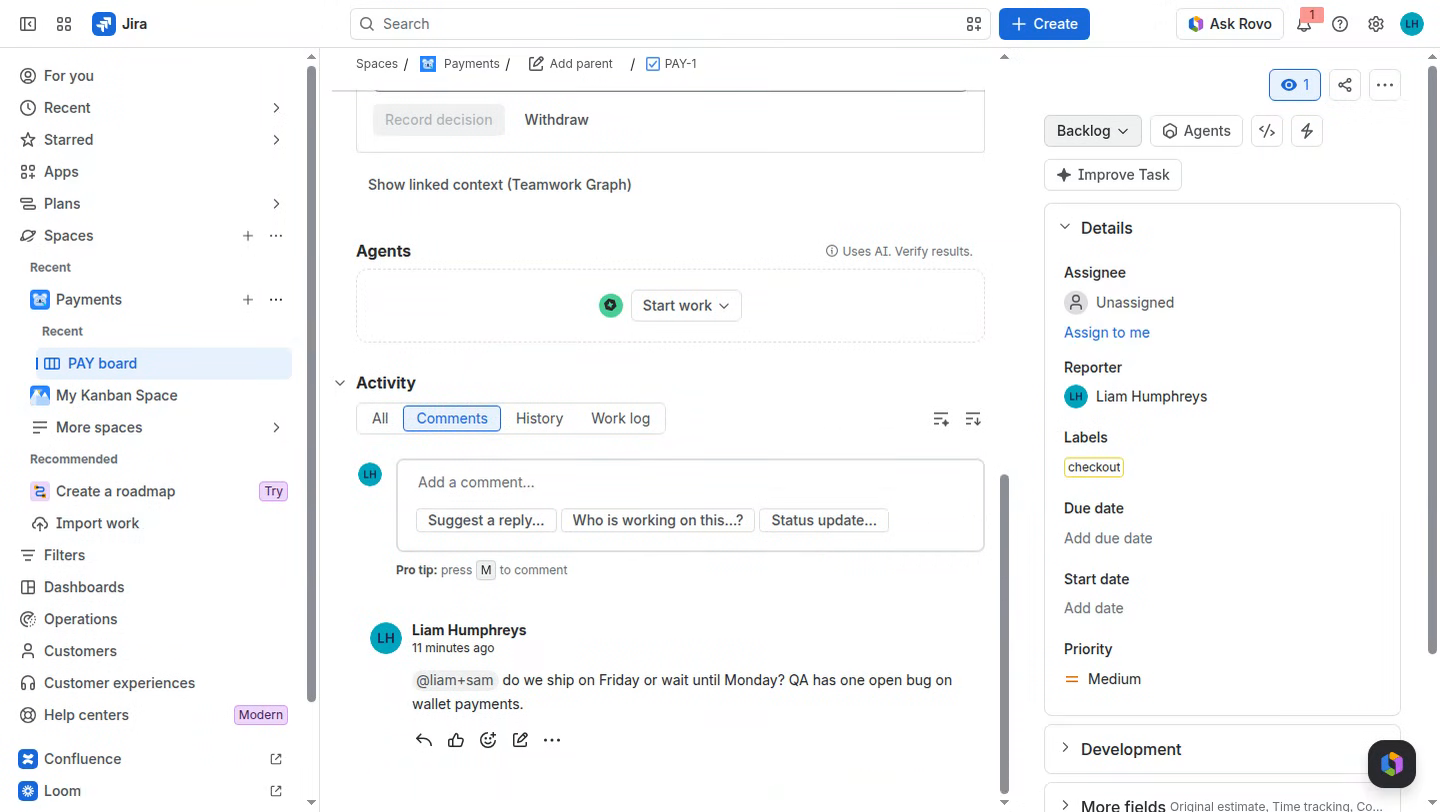
Decisions stall in Jira comment threads. "@Sam do we ship Friday or Monday?" gets buried, the work waits, and months later nobody can say what was decided or why. We run a one-person software company with AI agents, and the same thing happens to us: an agent needs a human decision, asks in a comment, and the answer takes days. A tiny board of "decisions waiting on me" with one-click answers fixed it for us internally. Decision Desk is that idea rebuilt for Jira, as new code, with the answer written back where the work is.
What it does
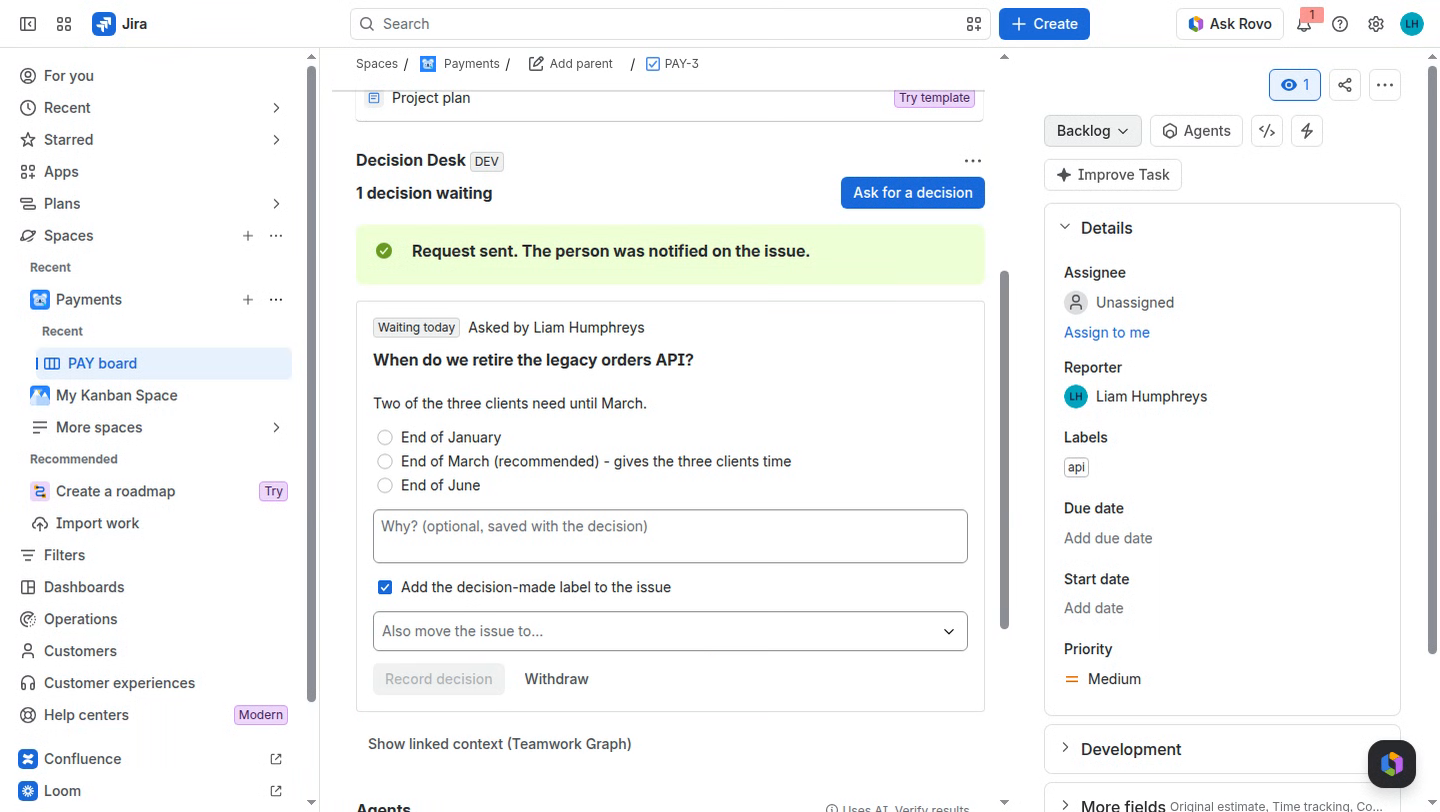
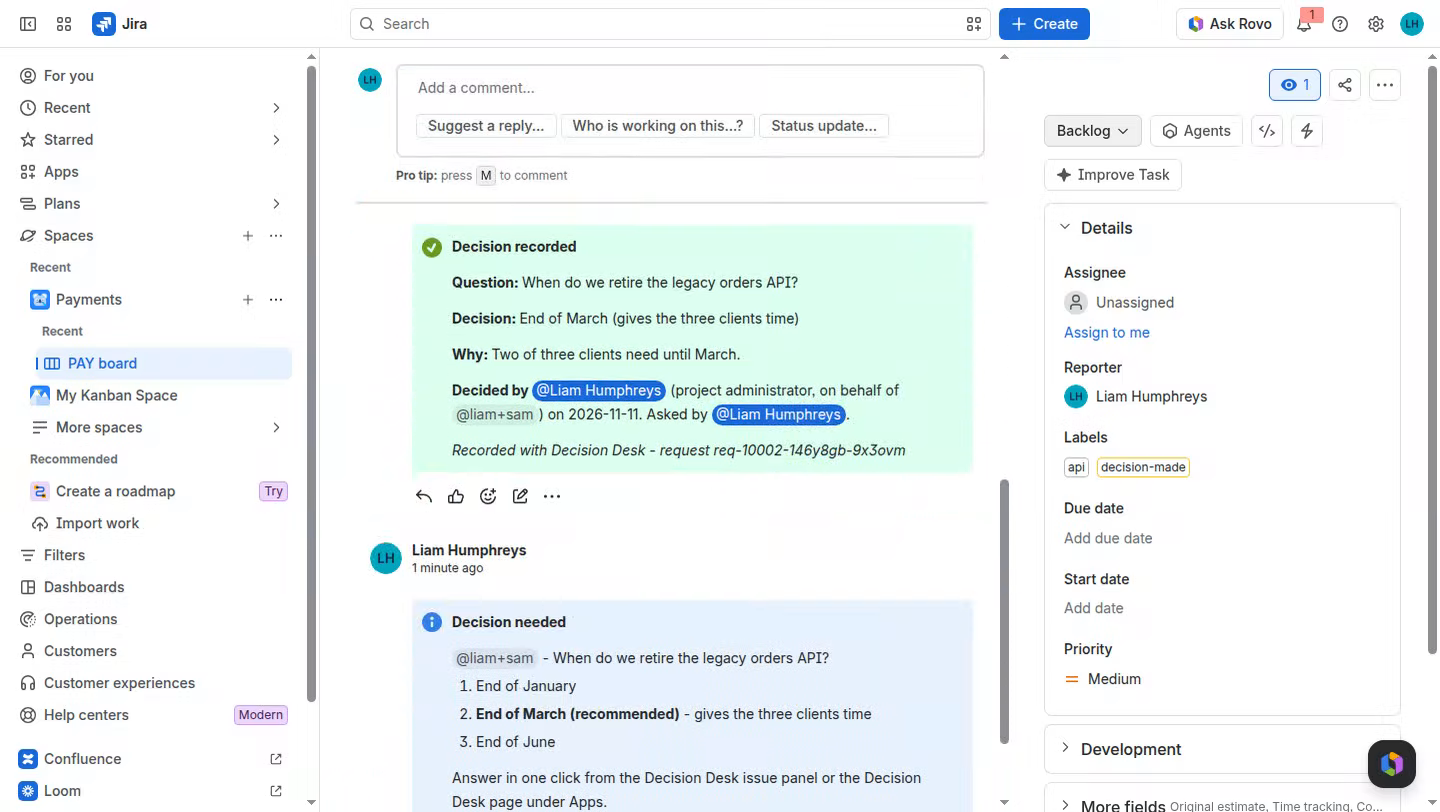
- Ask for a decision from any issue: a question, two to six options, an optional recommended option and rationale, who decides, an optional due date. The person is notified by an @mention comment on the issue.
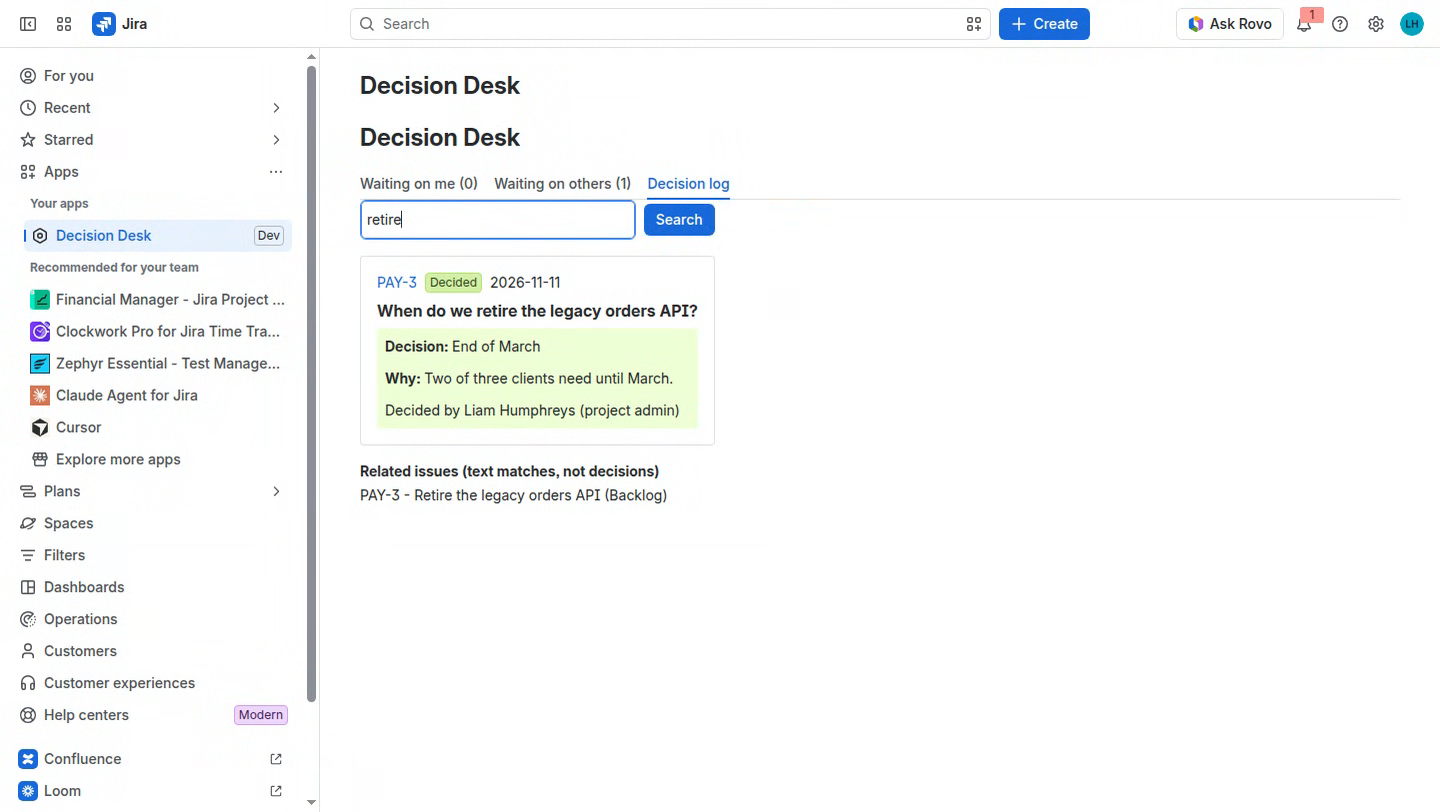
- The Decision Desk page (Apps menu) shows decisions waiting on you, decisions you are waiting on, and a searchable decision log. Each card shows the issue, how long it has waited, the options, and the recommended option.
- One click picks an option. An optional note records why. The app writes a structured comment to the issue, can add a
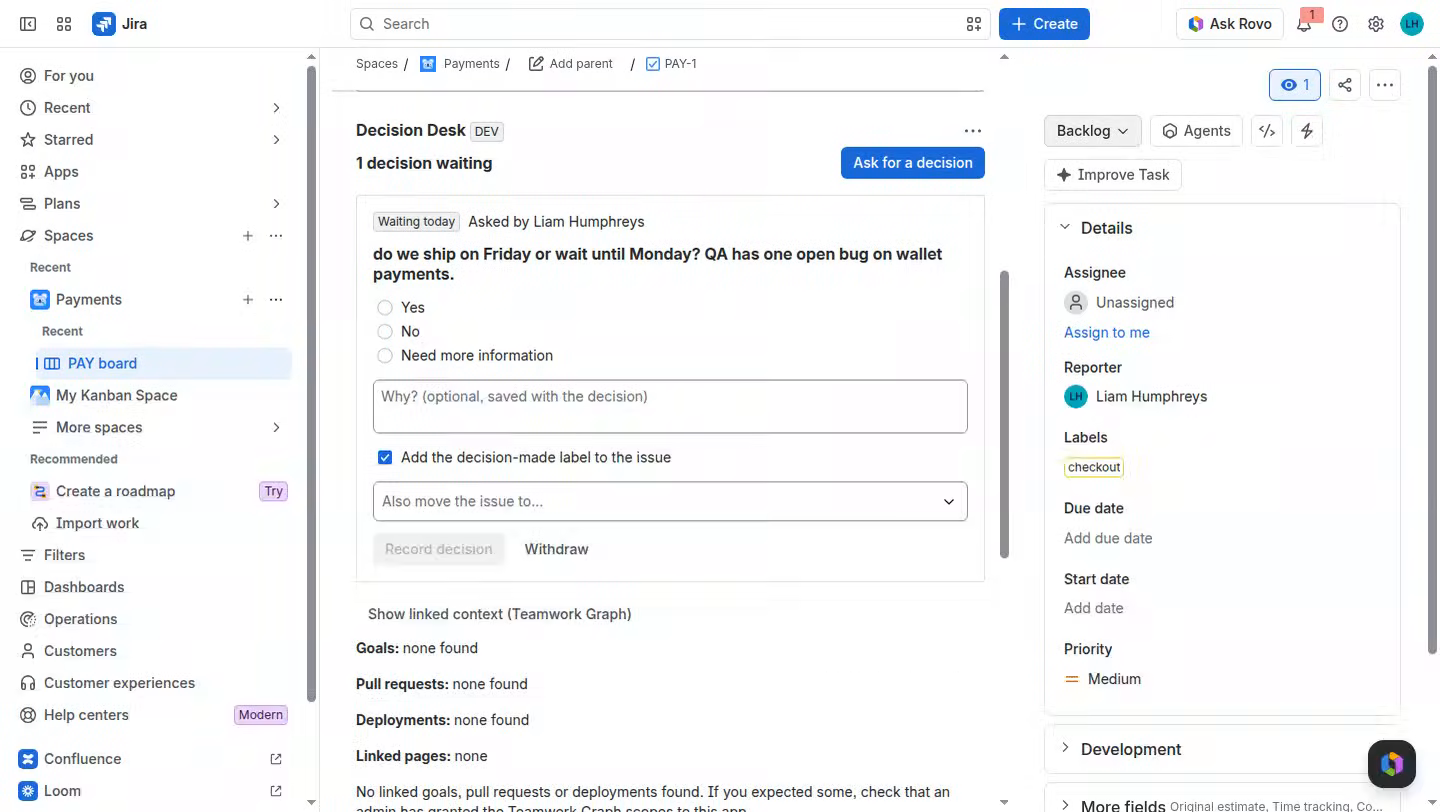
decision-madelabel, can move the issue to another status, and updates a searchable issue property (JQL:decisionsPending,decisionsMade,decisionWaitingOn,lastDecisionDate). - Questions already in the comments are picked up: an @mention in a paragraph with a question becomes a pending Yes / No / Need more information request, and closes if the person replies in the thread.
- A daily reminder comment nudges requests that have waited three days.
- Rovo agent "Decision Desk": lists what is waiting on you, reads the issue's context and drafts options, asks someone to decide (after you confirm the draft), checks whether they answered, records your decision when you state it, and finds past decisions.
- Rovo MCP server: the same six tools for Rovo Studio agents and third-party MCP clients, so another agent can ask a human and read the answer.
How we built it
Forge, nodejs24.x, UI Kit (@forge/react) for the issue panel and the global page. Backend logic is plain JavaScript modules with injected dependencies. Decisions are stored in the Forge Custom Entity Store with four indexes; the Jira comment, label and issue property are written from that record. Answering uses a conditional transaction (status = pending) so exactly one answer wins. Requests are idempotent (same issue, person and question gives the same record; Jira event retries do not duplicate). Reads from Jira run as the user. Rovo actions take identity from the platform context and never from model input; record-decision needs an explicit userConfirmed flag from the user. The agent reasons over what get-issue-context returns (summary, recent comments, linked issues, remote links, Teamwork Graph goals, pull requests, deployments), so there is no paid or external AI service. 120 unit tests run against fakes, including a fake storage layer that reads the manifest's entity and index definitions.
Challenges
- Forge storage rejects empty strings and undeclared attributes; our own fake storage layer caught a bug where the record id was stored as an attribute.
- Two people answering at once, and Jira events being delivered twice, needed conditional writes and deterministic keys.
- Rovo action inputs can only be strings, numbers and booleans, so options travel as a pipe-separated string and are parsed and validated on our side.
- LLM inputs are untrusted: identity, permissions and the "user really said this" check had to live in code, not in the prompt.
- Teamwork Graph: raw Cypher is closed to new apps, so we use curated queries. We could not run them without a site; see the list of unverified items.
What we learned
Keeping the domain logic free of Forge imports made almost everything testable offline. Writing the agent prompt, the skill and the tool descriptions as one set made the tools easier to name and constrain. Most of the value is in the boring parts: who is allowed to answer, what happens on a retry, and what is written back.
How it meets the technology requirement
The app is a Forge app (manifest.yml, nodejs24.x) using Jira (issue panel, global page, issue property and JQL, comment event trigger, REST API), Rovo (agent, skill, actions, MCP) and the Teamwork Graph API (curated queries via requestTeamworkGraph), plus Forge storage and a scheduled trigger. It was created after the submission period began.
Modules: jira:issuePanel, jira:globalPage, jira:entityProperty, trigger, scheduledTrigger, rovo:agent, rovo:skill, rovo:mcp, action (6), function (9). Scopes: storage:app, read:jira-work, write:jira-work, read:jira-user, read:graph:issue:jira, read:graph:goal:atlassian, read:graph:pull-request:external, read:graph:deployment:external.
Bonus prizes
Best Agents. The Decision Desk agent (rovo:agent) has a role, four jobs with numbered steps, guardrails (no invented facts, never choose for the user, confirm before creating or recording) and six actions. A rovo:skill (decision-desk-playbook, with SKILL.md) packages the same workflow as a reusable playbook, and the six action modules can be invoked by other agents. What makes it more than a chat wrapper: the agent drafts the options and recommendation from issue context, but the human decides, the decision is enforced by permissions (only the addressee or a project admin), written back to Jira and searchable later.
Best app with Atlassian MCP. One rovo:mcp module exposes six tools: list-pending-decisions, get-issue-context, create-decision-request, get-decision-request, record-decision, find-past-decisions. An agent in Claude, Cursor or any MCP client can ask a named person for a decision, poll get-decision-request until they answer, and read past decisions before it acts. SKILL.md in skills/decision-desk-playbook/ is plain Agent Skills format and can be added to a third-party agent. Calls run as the connecting user, so the app's permission rules apply. External exposure is off by default; a site admin enables it per site.
Best apps with Teamwork Graph integration. Consumes the Teamwork Graph API: jiraWorkItemGoals, jiraWorkItemLinkedExternalPullRequests and jiraWorkItemLinkedExternalDeployments curated queries run as the user for the current issue, and the results appear in the issue panel and in the agent's get-issue-context output, so options are drafted with the goals, pull requests and deployments in view. We do not connect data into the graph. If the graph returns nothing, the app says that this can mean no data or a scope that was not granted.
Best Marketplace published app. Not selected unless a listing or review ticket exists by the deadline.
Judge install and test instructions
- Open the install link (Jira Cloud): https://developer.atlassian.com/console/install/872be8ab-0dd9-4e49-886b-36eab9850cf9?signature=AYABeLUBZmjTPBqMMyDQ6h0is5UAAAADAAdhd3Mta21zAEthcm46YXdzOmttczp1cy13ZXN0LTI6NzA5NTg3ODM1MjQzOmtleS83MDVlZDY3MC1mNTdjLTQxYjUtOWY5Yi1lM2YyZGNjMTQ2ZTcAuAECAQB4CxqLTo9l4lqXuFjNim1xJM%2Bp%2F3TVP9xHS2BrU5DRRucBBGkKOe0%2FvccRxu918mRRxQAAAH4wfAYJKoZIhvcNAQcGoG8wbQIBADBoBgkqhkiG9w0BBwEwHgYJYIZIAWUDBAEuMBEEDGnUJZO%2BP6fZzIYHawIBEIA7%2FLJbWz1Wgou7E6blbEy7%2Bf%2FhagpCkz1Z1k6Nw9bkb9uTOgquby%2FGpEoV%2FWBBNMVsT6aqZLUsbk%2Bl%2F3wAB2F3cy1rbXMAS2Fybjphd3M6a21zOmV1LXdlc3QtMTo3MDk1ODc4MzUyNDM6a2V5LzQ2MzBjZTZiLTAwYzMtNGRlMi04NzdiLTYyN2UyMDYwZTVjYwC4AQICAHi9bVMAkme4qVQX1fQHo6ePw3H40A7cGfz7yrmSfBWMXgGc8A3ksbtLvz81ATrPybd1AAAAfjB8BgkqhkiG9w0BBwagbzBtAgEAMGgGCSqGSIb3DQEHATAeBglghkgBZQMEAS4wEQQM8kuGyM%2F4RiRFR1pbAgEQgDtslbfng%2FctfzdXkBuVxD%2FZ3Bn%2F%2FZqFeL3kQOOW%2FHHfuG%2FdLFDWgNsgAdjfBhgeH58TvnJULklEXcO8DQAHYXdzLWttcwBLYXJuOmF3czprbXM6dXMtZWFzdC0xOjcwOTU4NzgzNTI0MzprZXkvNmMxMjBiYTAtNGNkNS00OTg1LWI4MmUtNDBhMDQ5NTJjYzU3ALgBAgIAeDYASx0XCjkny4iLV6vz%2BKtEGSGT6kdt0QRpkn6D%2FlVEATa7vBTu8clWoy%2F0Df57nOUAAAB%2BMHwGCSqGSIb3DQEHBqBvMG0CAQAwaAYJKoZIhvcNAQcBMB4GCWCGSAFlAwQBLjARBAxTuBdnO6SIydTy74ECARCAO2LkZ1%2FqLnWR7RJ5bJnJymaVMNymPTqxgHoTlttTyoG0WExeUn7yicWSDKcF1uBOEDJRq0D%2Frh397b4AAgAAAAAMAAAQAAAAAAAAAAAAAAAAABWe6mdV006D6hnf7OH9FAn%2F%2F%2F%2F%2FAAAAAQAAAAAAAAAAAAAAAQAAADLwUnluX%2BmW%2F0ZDkWbN9UfA%2FA8%2Fi6ENZW7MBwoT9fNS9aufOI7fiRxZb1QaocMEEfGUPpUMR4t945Ae6WzPpAKvNLk%3D&product=jira Privacy, terms, support: https://decision-desk-codegeist.pages.dev/
- Choose the Jira site (you must be a site admin). The install asks for approval of Teamwork Graph scopes, which needs an organisation admin. If you cannot approve them, use our demo site instead: [DEMO SITE URL and judge login, only if the founder decides to provide one].
- Wait one minute after install for indexes to finish.
- Open Apps, Decision Desk. "Waiting on me" is empty for a new site.
- Open any issue, open the Decision Desk panel (the panel button appears next to the issue's other app buttons), choose Ask for a decision, pick another user, write two options, send. You will see an @mention comment on the issue.
- As that other user (a second account on the site) open Apps, Decision Desk, choose an option, add a note, Record decision. The issue gets a comment, a
decision-madelabel, and the log now finds it by keyword. - In a comment write:
@<user> should we approve this?The user's Decision Desk gets a pending item within about three minutes (Atlassian event delay). - Rovo: open Rovo chat, choose the Decision Desk agent, ask "What decisions are waiting on me?". To use the MCP server, an admin enables the tools under Administration, Apps, Connected apps, Decision Desk, then connect a client to
https://mcp.atlassian.com/forge/[APP UUID]. - JQL:
decisionsPending > 0anddecisionsMade > 0work in issue search.
Disclosure
The code, tests and documents for this project were written by AI coding agents directed by the founder of TurboKast Ltd, who is the entrant. The demonstration video was also produced by AI agents: they drove the real app on a Jira developer site and recorded the screen, and the narration is a synthetic voice (the open-source Kokoro text-to-speech model, run locally). The official rules do not mention AI use; we disclose it anyway. No code was copied from other repositories.
What was tested on a live Jira site
Works, seen running: install with all eight scopes approved; entity indexes ACTIVE; issue panel; asking for a decision (question, options, recommendation, reason) which writes an @mention comment listing the options; recording a decision as project admin (comment, decision-made label, issue property, decisionsMade > 0 JQL); withdrawing a request and asking the same question again; the Decision Desk page (waiting on me, waiting on others, decision log search); automatic detection of an @mention question in a comment (about 3 minutes after the comment); the Rovo agent in Rovo chat (reads the issue, drafts options, asks for confirmation, creates the request); Teamwork Graph queries run and return empty on a site with no graph data.
Bugs the live run found and fixed: every backend function crashed at load (CommonJS default import of @forge/resolver); option text boxes dropped keystrokes (controlled input in UI Kit); asking again after a withdrawal silently returned the withdrawn record; the pull-request Teamwork Graph query had an invalid operation name; the demo project had no project administrator.
Not verified: answering as the addressee in a second user's own session (the second demo account could not be activated: its sign-up needs a CAPTCHA); the Rovo MCP server from an external MCP client; the Rovo skill outside Rovo chat; the 3-day reminder; Teamwork Graph results with real goals, pull requests or deployments; screen reader and keyboard use; behaviour on a site where the Teamwork Graph scopes were not approved.
Not built: reading Confluence page content; writing data into the Teamwork Graph; a settings screen; personal data reporting and erasure flows (needed before a Marketplace listing).
Built With
- atlassian-forge
- javascript
- jira
- mcp
- react
- rovo
- teamwork-graph
