Inspiration
Decision Architect began with a decision I was struggling to make myself: whether to stay in chemistry or transfer to physics.
It was not a simple comparison. I had to think about academic interest, career direction, family circumstances, graduation time, uncertainty, and the possibility that waiting could give me better information. I could discuss the decision with an AI, but a confident-sounding answer was not enough. I wanted to see the assumptions, understand why one option ranked above another, and know what would have to change for the recommendation to change.
That experience inspired me to build a tool that combines a natural conversation with transparent and reproducible mathematics.
What it does
Decision Architect is a repository-scoped Codex Skill that turns an ordinary description of a difficult choice into a reviewed mathematical decision model.
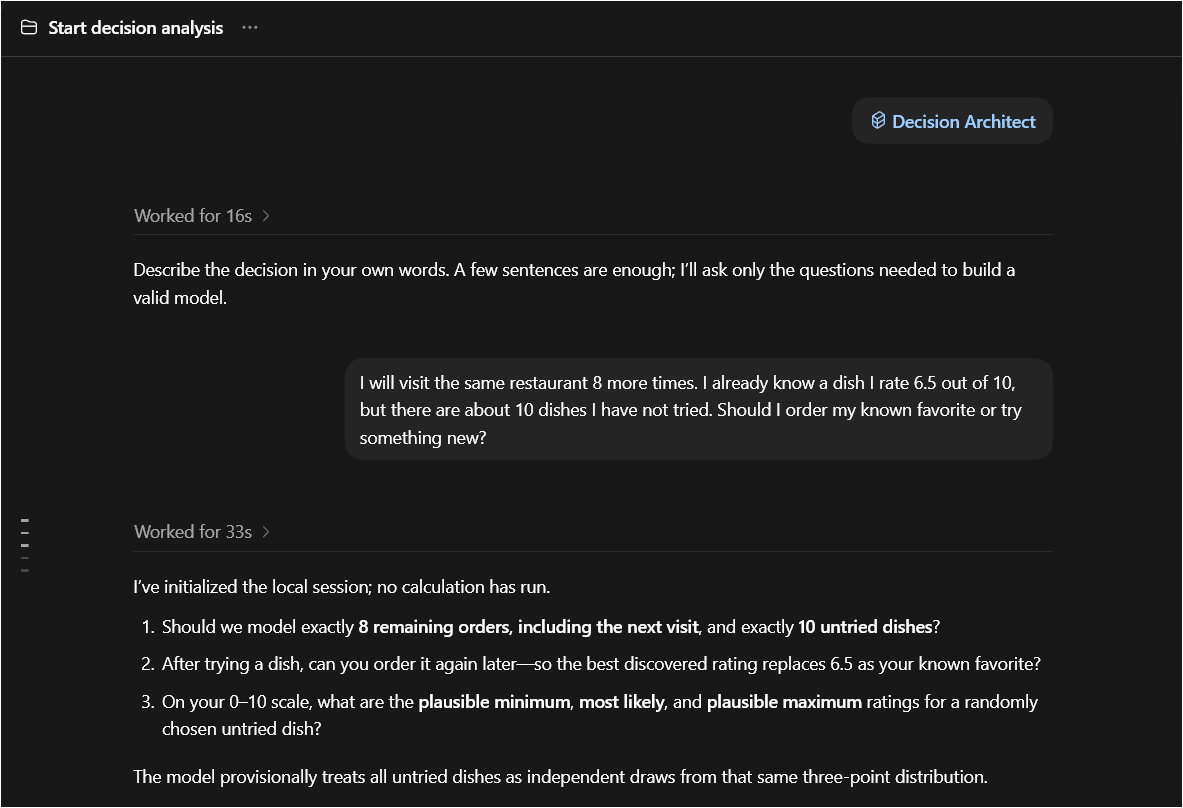
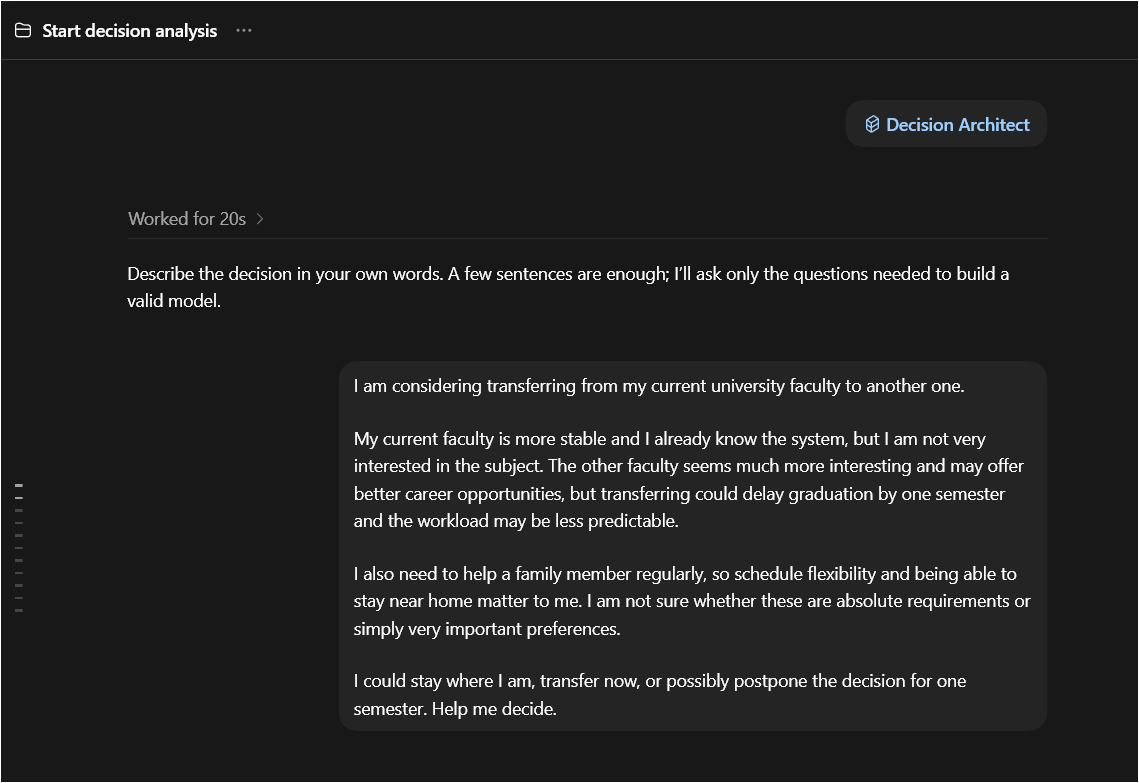
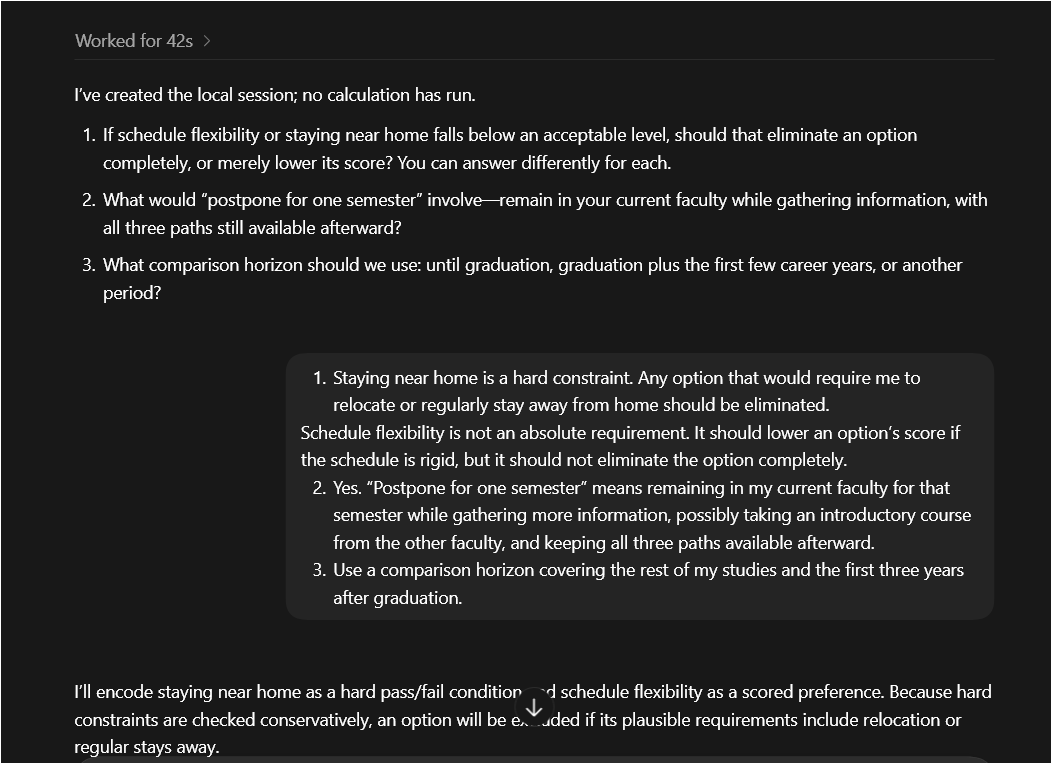
The user opens the repository in Codex, invokes $decision-analysis, and describes the situation in normal language. GPT-5.6 conducts an adaptive interview and asks only for information needed by the selected model.
Before any authoritative calculation occurs, Decision Architect presents the complete proposed model for review. The user can correct the assumptions, constraints, probabilities, scales, and preferences. The deterministic analysis begins only after the user enters the exact confirmation word CONFIRM.
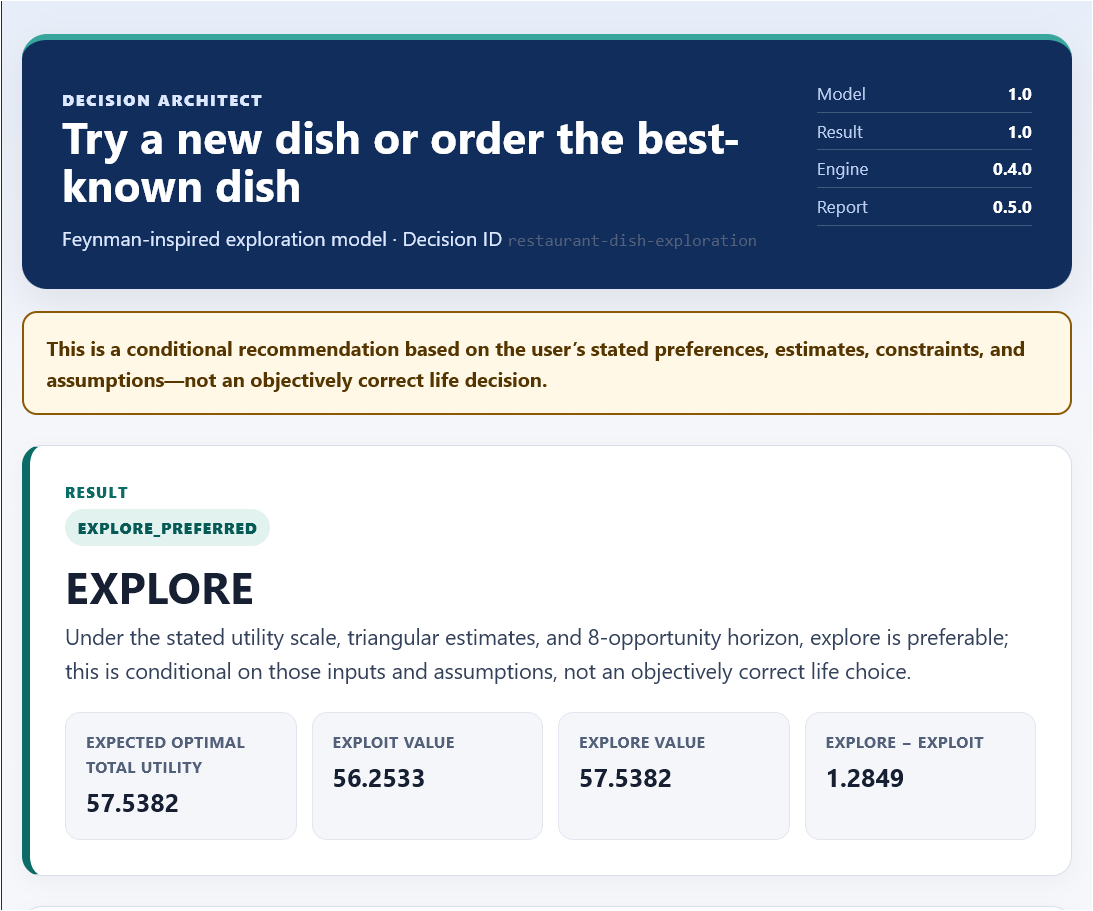
The result is explained in the Codex conversation and saved as a self-contained local HTML report containing the inputs, methodology, ranking, sensitivity results, limitations, and assumptions.
Decision engines
Decision Architect currently supports two complementary modes.
Sequential exploration
This mode handles repeated explore-versus-exploit decisions. It uses finite-horizon dynamic programming to compare the value of choosing a known option with the value of trying something uncertain that may improve future opportunities.
In the restaurant demonstration, the user has eight visits remaining and must choose between a known dish rated 6.5 and an untried dish. The model recommends exploring now because a successful discovery can create value over several later visits. With only one or two visits remaining, it recommends the known dish. The policy switches at three remaining visits.
Multi-criteria analysis
This mode handles decisions with multiple alternatives, hard requirements, weighted preferences, and uncertain outcomes.
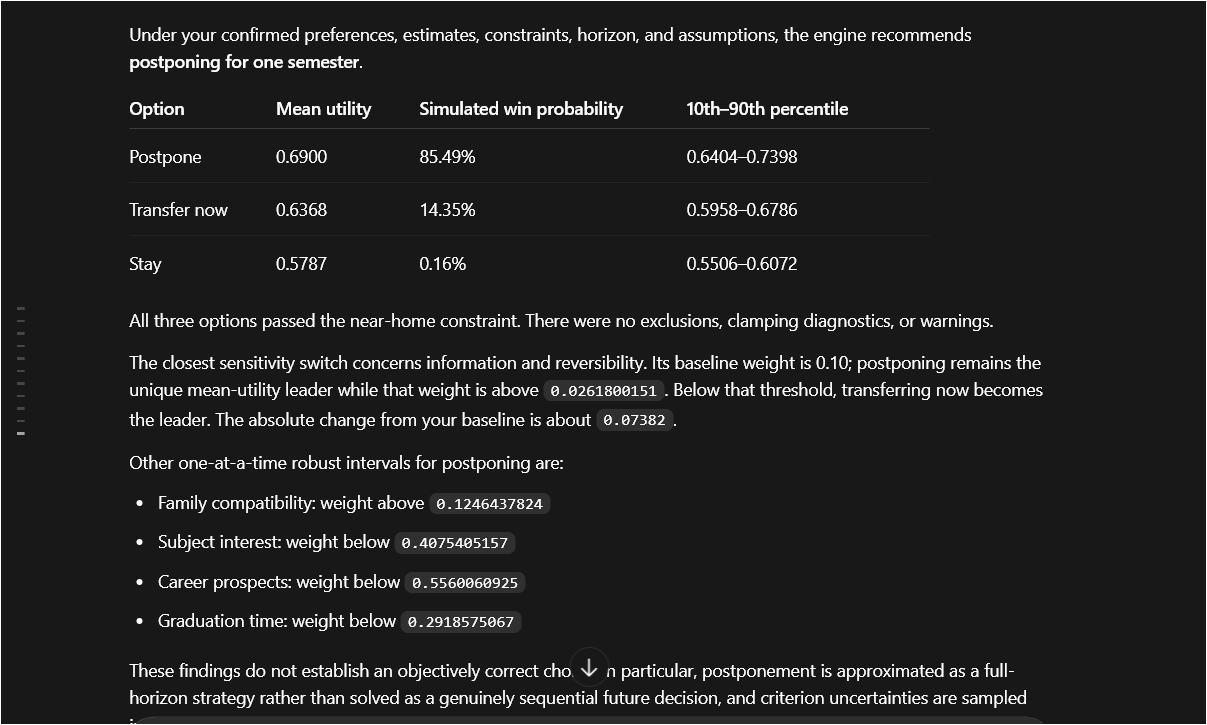
It separates non-negotiable constraints from tradeoffs, evaluates uncertain criteria across Monte Carlo scenarios, reports how often each option ranks first inside the confirmed model, and performs sensitivity analysis.
In the university-transfer example, postponing for one semester ranks first under the confirmed assumptions. The report also identifies the change in criterion weights that would make transferring immediately the leading option.
These simulated win frequencies are not predictions of real-life success. They describe the stability of the ranking within the model.
How I used Codex and GPT-5.6
Decision Architect was designed, implemented, tested, documented, and release-verified in the Codex app using GPT-5.6 Sol.
Codex and GPT-5.6 helped me:
- design the repository and Skill architecture;
- implement the deterministic decision engines;
- create structured schemas and validation rules;
- build the adaptive interview and confirmation workflow;
- generate and review automated tests;
- verify mathematical acceptance examples;
- improve the Windows onboarding experience;
- prepare the documentation and public release.
Inside the finished product, GPT-5.6 provides the conversational layer. It understands the user's situation, selects the appropriate model, conducts the adaptive interview, presents assumptions for review, and explains the result in accessible language.
GPT-5.6 is deliberately not the authoritative numerical calculator. After CONFIRM, the repository's deterministic engine validates the structured model, performs the mathematics, and generates the local report.
Challenges
The central design challenge was separating conversational intelligence from mathematical authority.
A language model is well suited to understanding an ambiguous real-world situation and helping transform it into a structured model. However, it should not silently invent numerical assumptions or present an unaudited calculation as fact.
I addressed this with an explicit confirmation gate, validated structured inputs, deterministic computation, reproducible outputs, and reports that expose the model's limitations.
Another challenge was making a technically rigorous tool approachable for a first-time user. Decision Architect requires no API key, no external backend, and no separate Skill installation. The complete repository can be opened directly in Codex, and the user can begin with a normal sentence rather than a configuration file.
The release also includes more than 200 automated tests, documented acceptance examples, schemas, generated reports, and cross-platform reproducibility checks.
What I learned
The project taught me that responsible decision support is not about hiding complexity or replacing human judgment.
It is about making assumptions visible, identifying which uncertainties actually matter, and showing how conclusions change when the model changes.
Decision Architect does not decide for the user. The human remains in control, the reasoning remains inspectable, and the mathematics remains reproducible.

Log in or sign up for Devpost to join the conversation.