Inspiration
The idea for DeCipher came from a simple observation: some of the most important decisions people make are triggered by documents they barely understand.
A parent receives a school notice and isn't sure whether immediate action is required. A caregiver is handed pages of discharge instructions after a stressful hospital visit. A family receives a government benefits letter filled with unfamiliar terminology and hidden deadlines. In many cases, the information exists - but clarity does not.
What struck us was that these moments often happen when people are already overwhelmed. Stress, uncertainty, and complex language create a barrier between people and the help, services, or opportunities available to them. Missing a single sentence in a document can sometimes mean missing a deadline, losing access to support, or failing to take an important next step.
As students, we've experienced how confusing official documents can be even when we have time to read them carefully. That led us to ask a bigger question:
What if AI could act as a bridge between complex systems and the people they're meant to serve?
Not by replacing human judgment, but by helping people understand what matters, what is urgent, and what they should do next.
That question became DeCipher.
We envisioned more than a document summarizer. We wanted to create an AI-powered guidance system capable of transforming confusion into clarity and clarity into action. A system that could take a dense, intimidating document and instantly answer the questions every stressed person is asking:
- What does this actually mean?
- How urgent is it?
- What do I need to do?
- Who should I contact?
- What happens next?
At its core, DeCipher is built on a simple belief:
Access to support should not depend on someone's ability to decode bureaucracy.
What it does
DeCipher transforms information overload into intelligent action.
In critical moments, people are often overwhelmed not by a lack of information, but by an inability to quickly understand what matters most. Government notices, school communications, healthcare instructions, housing documents, and benefits letters frequently contain important decisions, deadlines, and obligations hidden within dense administrative language.
DeCipher acts as an AI-powered interpretation and action-support layer between complex institutions and the people they serve.
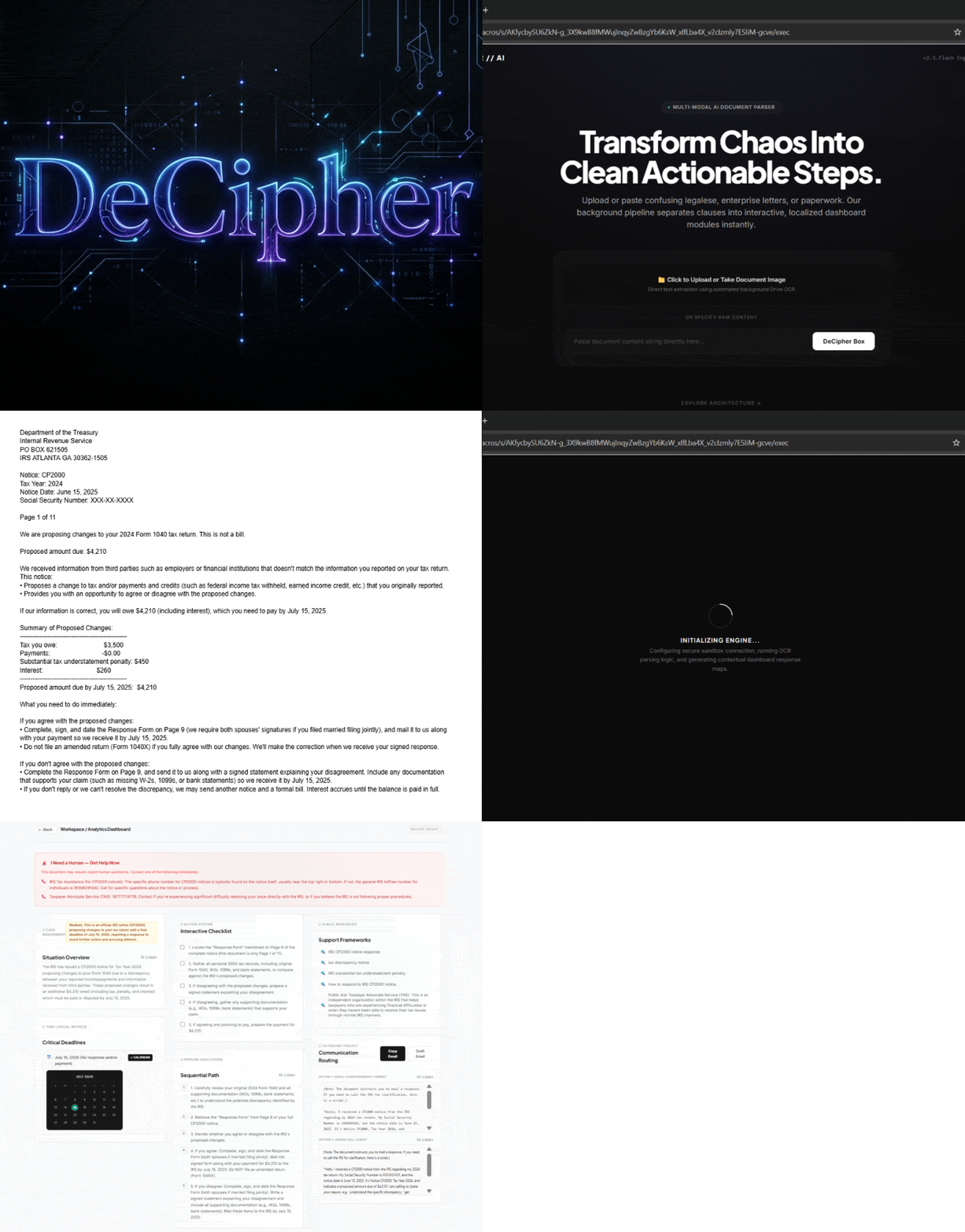
Users can upload a document image or paste text directly into the platform. DeCipher then analyzes the content through a multi-stage reasoning pipeline designed to identify urgency, extract critical information, surface hidden obligations, and generate actionable guidance.
Rather than simply summarizing a document, DeCipher reconstructs it into a decision-ready experience.
The platform automatically:
- Interprets complex and unstructured documents
- Detects urgency and potential risk factors
- Identifies critical deadlines and required actions
- Extracts obligations, requirements, and next steps
- Generates personalized action checklists
- Creates professional communication drafts
- Recommends relevant support pathways and public resources
- Converts important deadlines into calendar reminders
- Escalates high-risk situations that require human intervention
- Improves accessibility through voice-enabled document guidance
At its core, DeCipher functions as an AI-powered cognitive support system that helps users navigate complexity with confidence.
Instead of forcing people to decode bureaucracy, policies, or administrative language on their own, DeCipher translates complexity into clarity and clarity into action.
The result is a system that helps users move from:
Confusion → Understanding → Confidence → Action
in a matter of seconds.
Our vision is not merely to help people read documents better. It is to help people make better decisions when those documents have the greatest impact on their lives.
How we built it
We built DeCipher around a simple but ambitious idea: transforming complex documents into actionable intelligence for everyday users.
To achieve this, we designed DeCipher as a multi-stage AI workflow that combines document understanding, contextual reasoning, action planning, and workflow automation into a single user experience.
The platform was developed using Google Apps Script, JavaScript, HTML, Tailwind CSS, and Google Workspace integrations, with Google Gemini 2.5 Flash serving as the core intelligence layer.
Document Understanding Pipeline
DeCipher accepts both text-based and image-based inputs. When a user uploads a document image, an OCR processing layer extracts machine-readable content before it enters the analysis pipeline.
This allows the platform to work with real-world documents such as:
- School notices
- Government letters
- Benefits notifications
- Housing documents
- Medical instructions
- Administrative forms
AI Reasoning Engine
Once document content is extracted, Gemini performs a series of reasoning tasks designed to simulate how a knowledgeable advisor would approach the document.
The AI:
- Interprets the document's purpose and context
- Identifies critical information and hidden obligations
- Detects urgency and potential risk indicators
- Extracts deadlines and time-sensitive requirements
- Prioritizes actions based on importance
- Generates personalized guidance pathways
- Produces communication drafts and support recommendations
Instead of treating document analysis as a single prompt-response interaction, we engineered the workflow to break the problem into multiple decision-support stages that progressively transform raw information into meaningful guidance.
Action-Support Layer
Understanding information is only half the challenge.
The next challenge is helping users act on it.
To bridge this gap, we built an action-support system that converts AI insights into practical tools, including:
- Interactive action checklists
- Step-by-step response plans
- Professional email drafts
- Communication scripts
- Deadline tracking
- Google Calendar integration
This allows users to move directly from understanding a document to taking meaningful action.
Human-Centered Safety Design
Because DeCipher may be used in situations involving healthcare, housing, education, public services, or financial support, we intentionally designed the system to support human decision-making rather than replace it.
The platform identifies situations that may require expert assistance and encourages users to seek help from relevant professionals, organizations, or authorities when appropriate.
Building Beyond Summarization
One of our core design goals was ensuring that DeCipher would not become just another document summarizer.
Many AI tools stop at explaining information.
We wanted DeCipher to go further by combining document intelligence, urgency detection, action planning, communication support, and workflow automation into a single experience.
The result is an AI-powered Crisis-to-Action Translator capable of helping users move from information overload to informed action within minutes.
Challenges we ran into
Building DeCipher challenged us to rethink what document intelligence should actually accomplish.
At first glance, the problem appears simple: upload a document and generate a summary. However, we quickly realized that summarization does not solve the user's real problem.
A stressed parent receiving a school notice does not just need a summary.
They need to know:
- What is important?
- How urgent is it?
- What happens if they do nothing?
- What action should they take first?
- Who should they contact?
The challenge was transforming information into action.
Moving Beyond Summarization
One of our biggest technical challenges was designing an AI workflow that could reason about a document rather than simply describe it.
We needed the system to:
- Understand context
- Detect urgency
- Extract deadlines
- Identify obligations
- Prioritize actions
- Generate useful next steps
This required extensive prompt engineering and workflow design to ensure outputs remained practical, actionable, and easy to understand.
Handling Real-World Documents
Unlike clean datasets, real documents are messy.
Users may upload:
- Blurry photos
- Scanned documents
- Documents with inconsistent formatting
- Long administrative notices
- Forms containing dense legal or institutional language
Building a pipeline capable of extracting meaningful information from diverse document types while maintaining reliable outputs was a significant challenge.
Designing for People Under Stress
A surprising challenge was reducing cognitive overload.
We discovered that giving users more information often made the experience worse.
Instead, we focused on prioritization.
Every part of the platform was designed around a simple principle:
The user should immediately understand what matters most and what action to take next.
This required carefully balancing detail with simplicity.
Responsible AI and Trust
Perhaps the most important challenge was ensuring DeCipher remained a support system rather than a decision-maker.
Documents involving healthcare, housing, education, or public benefits can have serious consequences if interpreted incorrectly.
We needed to build a system that provides meaningful guidance while still recognizing the limits of AI.
As a result, we incorporated human-centered safeguards, escalation pathways, and recommendations for professional assistance in situations where human expertise remains essential.
Building an End-to-End Experience
The final challenge was integrating multiple capabilities into a seamless workflow.
Document understanding, OCR extraction, urgency assessment, action planning, communication generation, calendar integration, and accessibility features all needed to work together as a single experience.
Bringing these components together transformed DeCipher from a document analysis tool into what we envisioned from the beginning:
an AI-powered bridge between complexity and action.
Accomplishments that we're proud of
What we're most proud of is that DeCipher evolved far beyond a document summarization tool. We successfully built an end-to-end AI-powered guidance system capable of transforming complex, often intimidating documents into clear, actionable support.
Some of our key accomplishments include:
Developing a multi-modal document understanding workflow that accepts both text and image-based inputs Building an AI reasoning pipeline that identifies urgency, extracts deadlines, and prioritizes actions Transforming document analysis into personalized action plans rather than generic summaries Creating AI-generated communication assistance through professional email and response drafts Integrating Google Calendar workflows to help users avoid missing critical deadlines Designing escalation pathways that encourage human intervention when situations become high-impact or time-sensitive Incorporating accessibility features such as text-to-speech support Building a complete prototype that demonstrates how AI can help people navigate real-world systems more effectively
Most importantly, we're proud that DeCipher directly addresses a problem that affects millions of people: understanding what to do when faced with complex information during stressful moments.
For us, the greatest accomplishment isn't the technology itself - it's creating a system that helps people move from uncertainty to confident action.
What we learned
Building DeCipher fundamentally changed the way we think about AI.
We started with the assumption that understanding information was the primary challenge. Through development, we discovered that the real challenge is helping people act on information.
This taught us an important lesson:
The future of AI is not just generating answers—it is enabling better decisions.
Throughout the project, we gained hands-on experience in:
Prompt engineering and AI workflow design Document intelligence systems OCR-based information extraction Human-centered AI development Accessibility-focused product design Workflow automation and integrations Responsible AI implementation
We also learned that trust is one of the most important components of any AI system.
Users are more likely to benefit from AI when the system is transparent, actionable, and designed to work alongside human judgment rather than replace it.
Perhaps our biggest takeaway is that impactful AI doesn't always require solving the world's biggest problems. Sometimes the greatest impact comes from helping people navigate everyday challenges with greater confidence and clarity.
What's next for DeCipher
Our vision for DeCipher extends far beyond this hackathon. We see DeCipher evolving into an intelligent support platform capable of helping individuals navigate complex institutions, services, and life decisions with confidence.
Future development plans include:
Expanding Accessibility Multilingual document understanding and translation Voice-first interactions Enhanced accessibility features for diverse user needs Advancing AI Capabilities Support for multi-page PDFs and large document collections Personalized action plans based on user context Confidence indicators and explainable AI outputs More sophisticated urgency and risk assessment models Strengthening Community Impact Localized resource discovery and support recommendations Integration with schools, nonprofits, and community organizations Expanded support for healthcare, education, housing, and public assistance workflows Building an AI Action Layer
Our long-term vision is to transform DeCipher into an AI-powered action layer that sits between complex information and human decision-making.
Instead of simply helping users understand documents, future versions of DeCipher will help users navigate entire journeys—from receiving information to successfully completing the actions required.
We believe a future where support is truly accessible begins with understanding.
And our goal is to ensure that no one misses an opportunity, loses access to assistance, or feels overwhelmed simply because critical information was too difficult to understand.
Built With
- ai-reasoning
- css3
- document-intelligence
- gemini-api
- generative-ai
- gmail-api
- gmail-integration
- google-ai-studio
- google-ai-studio-api
- google-apps-script
- google-calendar-api
- google-calendar-integration
- google-gemini-2.5-flash
- google-workspace
- html5
- javascript
- natural-language-processing
- ocr-based-document-processing
- ocr-document-processing
- prompt-engineering
- tailwind-css
- text-to-speech
- workflow-automation


Log in or sign up for Devpost to join the conversation.