Here is a formal, cohesive narrative version of your project description. This format weaves all the key points into professional paragraphs, making it perfect for a formal project report, a GitHub README introduction, or a structured hackathon submission.
Project Overview & Inspiration In today’s fast-paced digital environment, individuals are constantly inundated with tasks, responsibilities, and competing choices. This continuous influx often culminates in a state of cognitive overload known as decision fatigue—a psychological gridlock where the simple act of choosing what to do next consumes the mental energy required to actually perform the task. Traditional productivity frameworks often exacerbate this issue by mandating rigid, timestamped schedules that completely ignore human energy fluctuations. Inspired by the need to mitigate this friction, we developed Decidr AI: an adaptive, human-centric productivity ecosystem engineered to alleviate analysis paralysis and transform chaotic mental inputs into clear, actionable outcomes.
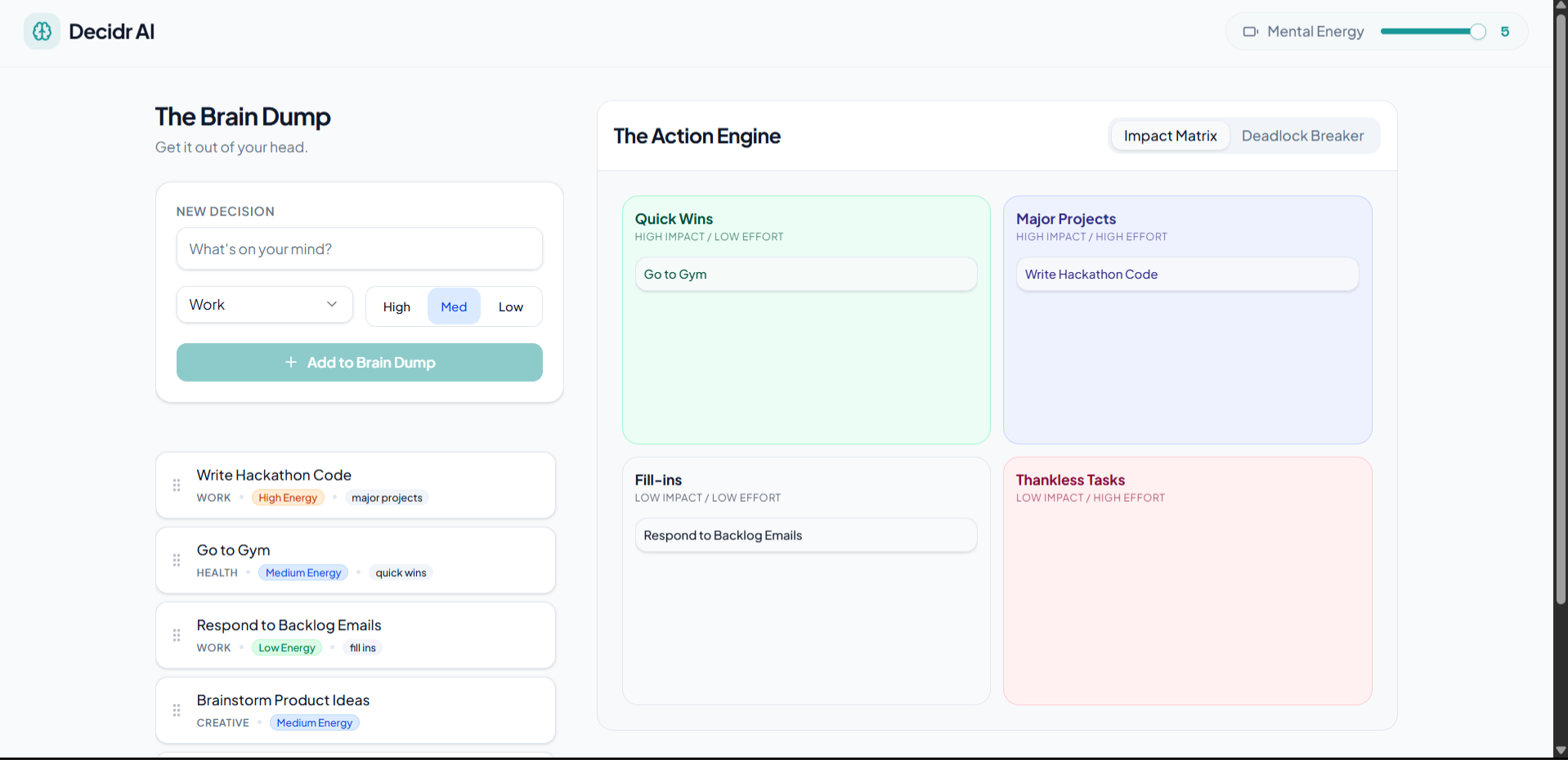
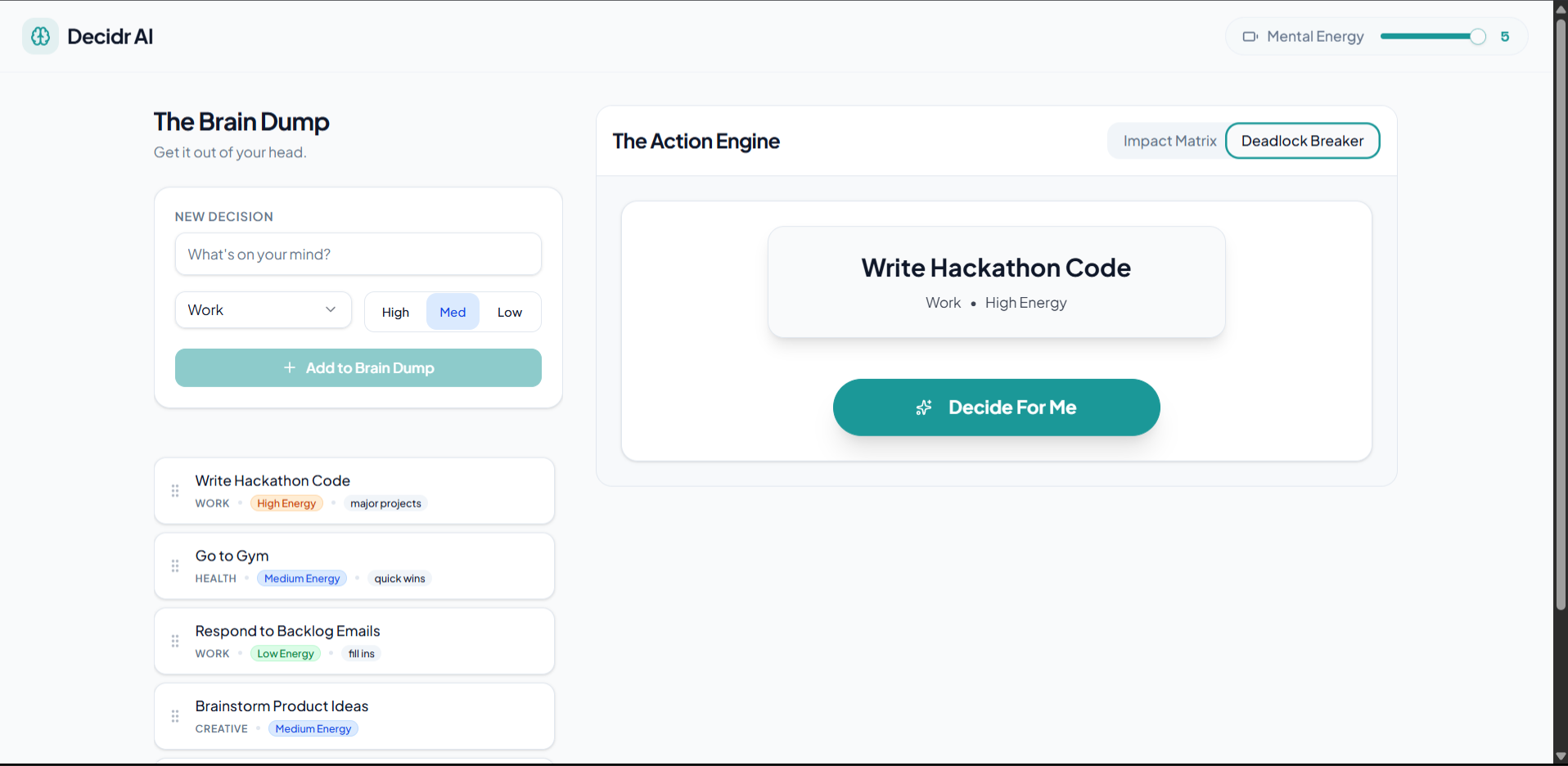
Functional Design & Core Features Decidr AI operates as a centralized command center designed to optimize everyday decision-making through intuitive UI/UX workflows. The core application interface is divided into distinct, interactive modules. It begins with the Chaotic Brain Dump, a streamlined intake zone where users can offload unorganized tasks and categorize them by expenditure metrics. This is augmented by a global Mental Energy Tracker slider; when a user adjusts their current cognitive bandwidth, the system dynamically filters the task queue, dimming overwhelming projects and prioritizing low-friction, high-impact tasks. For macro-organization, the 2x2 Impact Matrix automatically maps objectives into logical priority quadrants. Finally, to completely break behavioral deadlocks, the platform features a Deadlock Breaker engine. Upon activation, the system utilizes a randomized algorithmic shuffle animation to eliminate choice hesitation, isolating a single, high-priority objective accompanied by an explicit call to action.
Technical Implementation & Challenges The platform was built entirely within a unified development workspace utilizing a modern full-stack architecture. The user interface was engineered using Vite and React.js, ensuring rapid client-side rendering and predictable state mutations. Styling was implemented via Tailwind CSS, adopting a sophisticated slate-dark aesthetic optimized to reduce ocular strain during prolonged use. All data states are handled natively through declarative React Hooks, allowing immediate global propagation whenever a user interacts with the energy filters or matrices.
During development, the team encountered significant engineering hurdles regarding responsive UI layout parameters. Dynamically scaling a 2x2 categorical matrix on restricted mobile screens while preserving text readability required complex CSS utility configurations. Furthermore, we had to carefully calibrate the task-filtering algorithm; early iterations completely removed high-energy items, resulting in a sparse interface that induced user guilt. We overcame this by shifting the design paradigm from absolute data filtering to behavioral highlighting, maintaining user perspective while lowering cognitive demand.
Accomplishments, Key Learnings, and Future Horizons We are highly satisfied with the seamless integration of psychological principles into a functional software architecture. Decidr AI successfully transforms a universally stressful experience into a rewarding, gamified workflow. This development cycle reinforced a critical product management principle: effective productivity software must prioritize the elimination of user friction over the accumulation of complex analytics features.
Moving forward, the roadmap for Decidr AI involves expanding its technological capabilities. We aim to integrate a lightweight Large Language Model (LLM) endpoint to natively parse ambiguous user inputs and decompose vague goals into structured micro-steps. Additionally, we plan to transition the core intake engine into a native browser extension to facilitate real-time task capture, alongside building a secure data warehouse to provide users with historical insights regarding their peak weekly energy cycles.


Log in or sign up for Devpost to join the conversation.