-
-
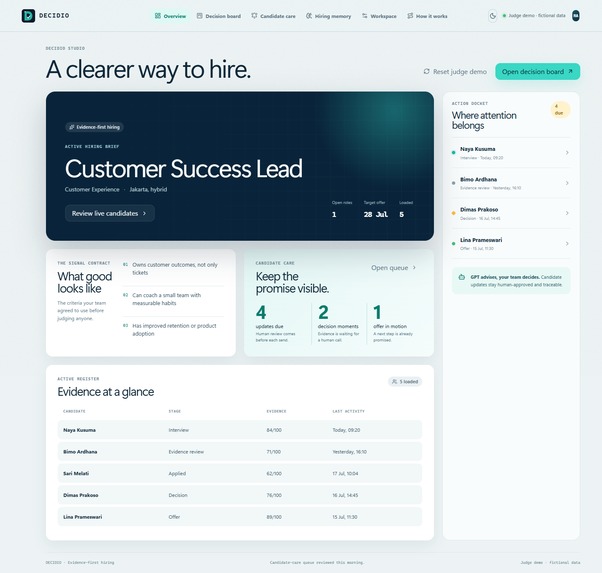
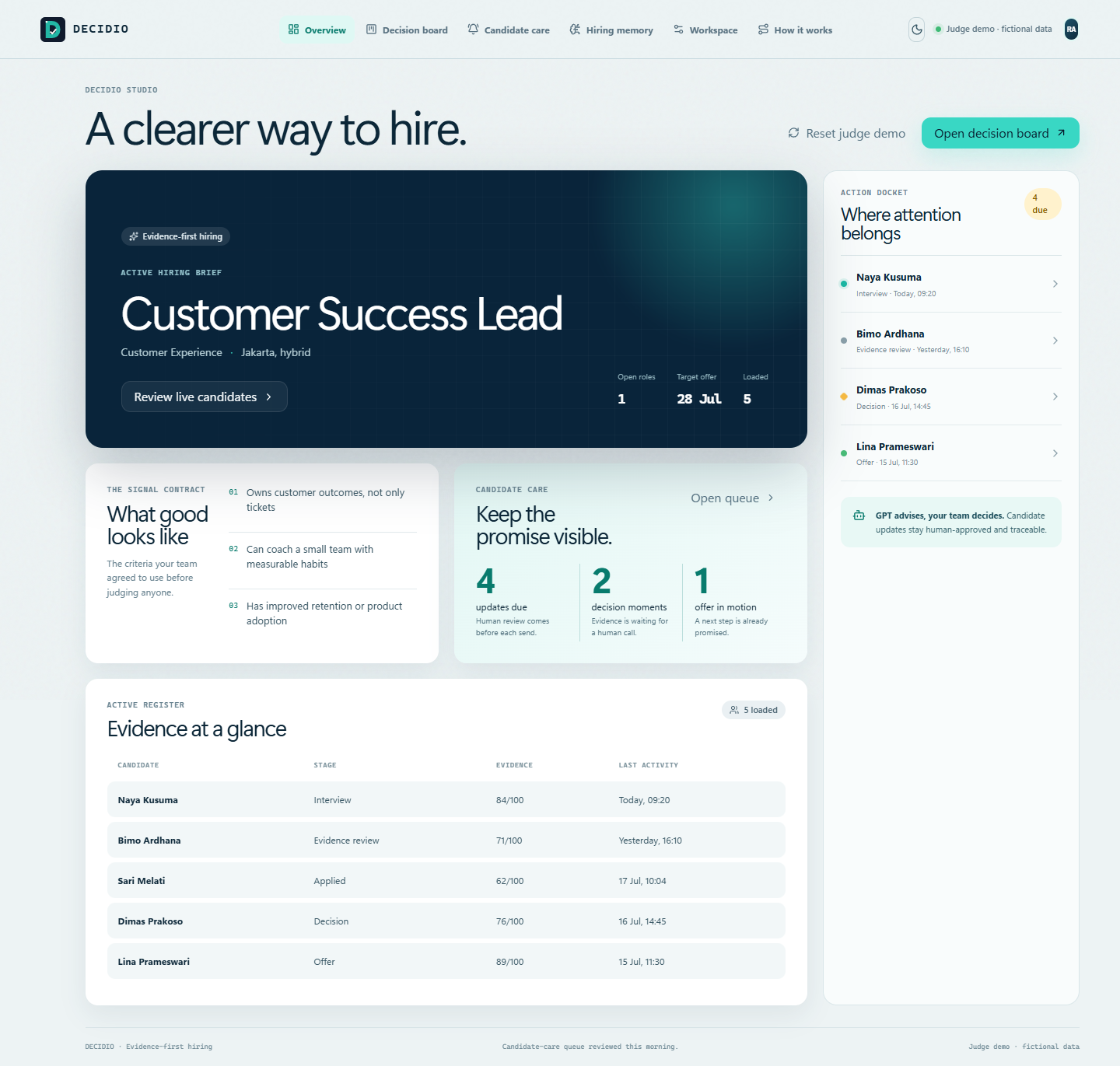
An evidence-first overview of the active role, signal contract, candidates, and decisions requiring attention.
-
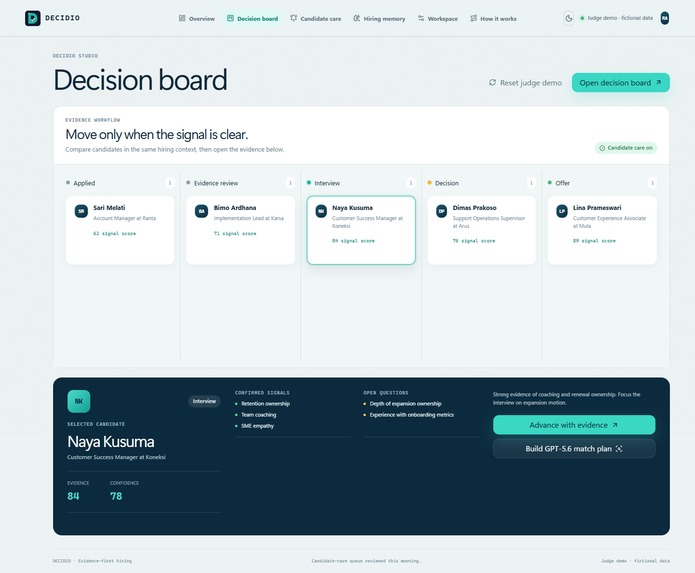
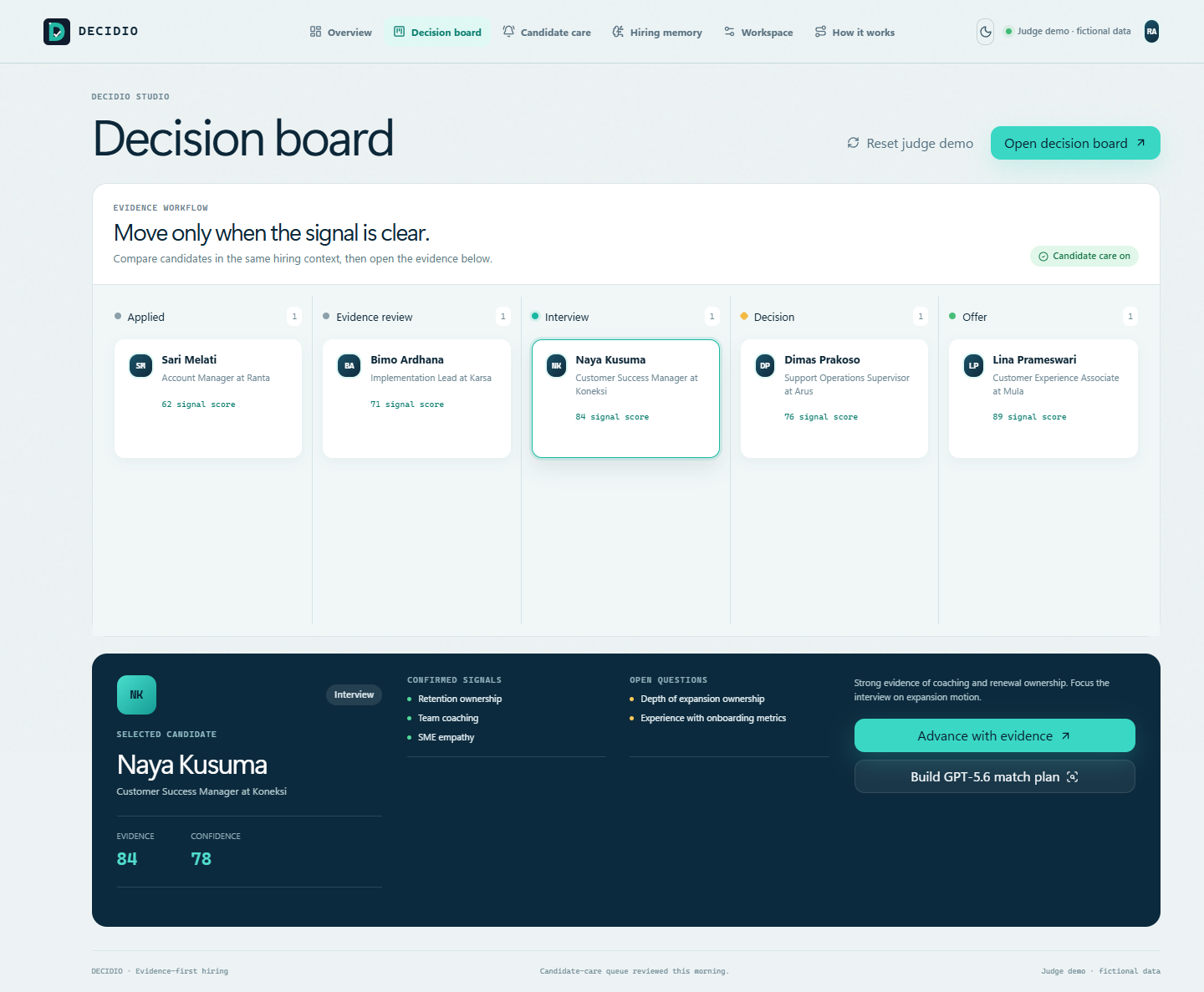
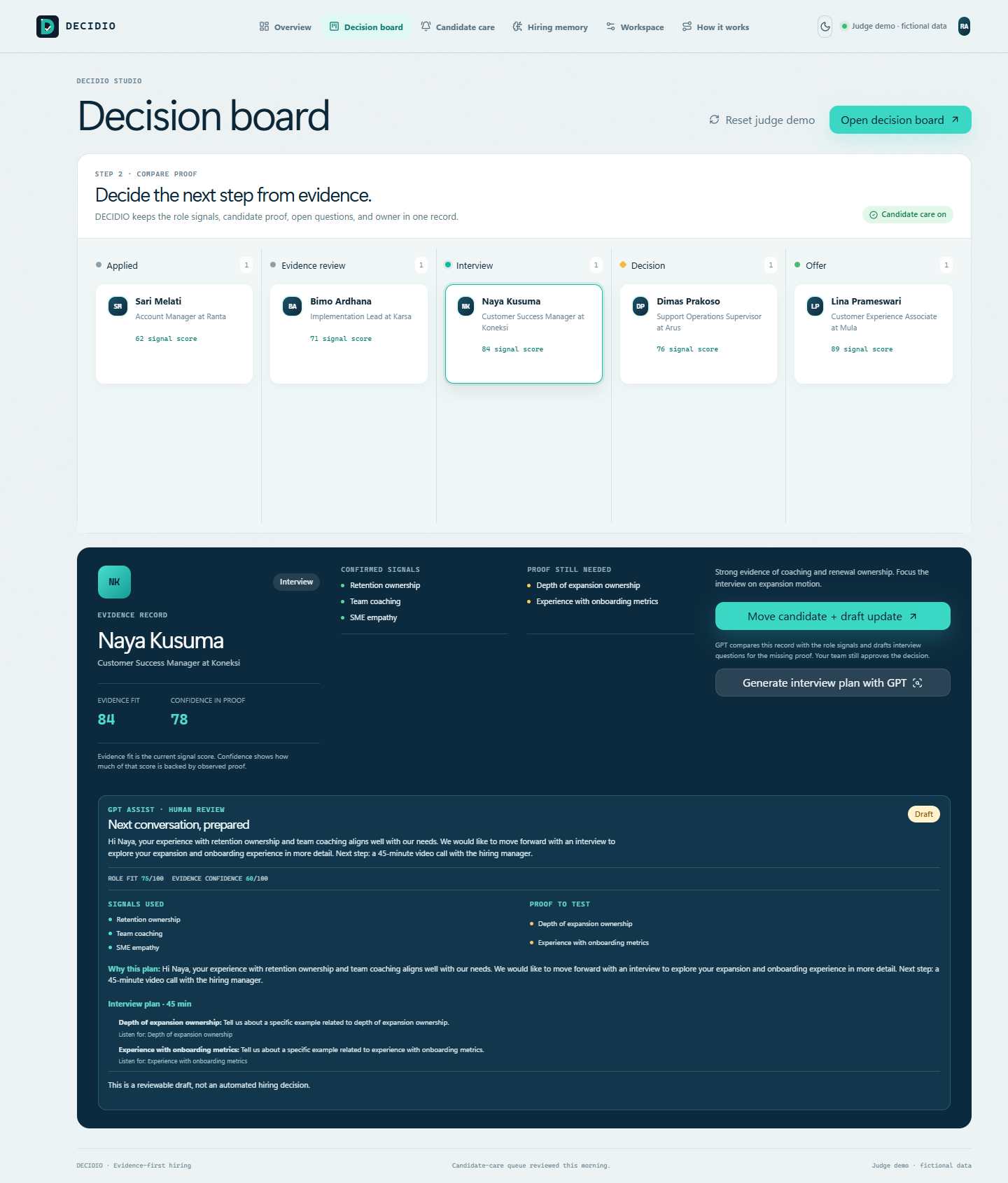
The decision board keeps candidate stages, evidence fit, confirmed signals, and missing proof visible.
-
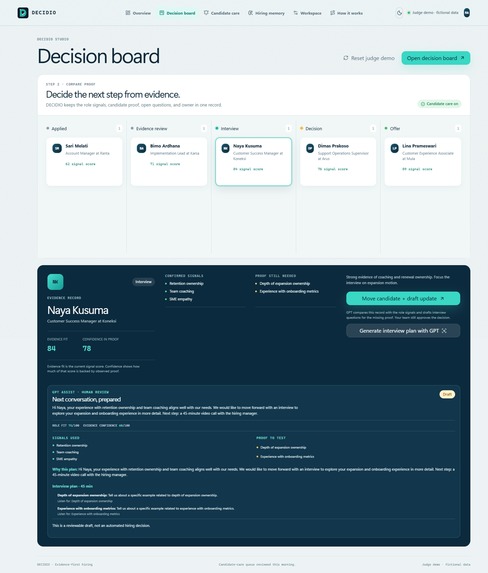
GPT turns role signals and candidate evidence into a reviewable interview plan without making the hiring decision.
-
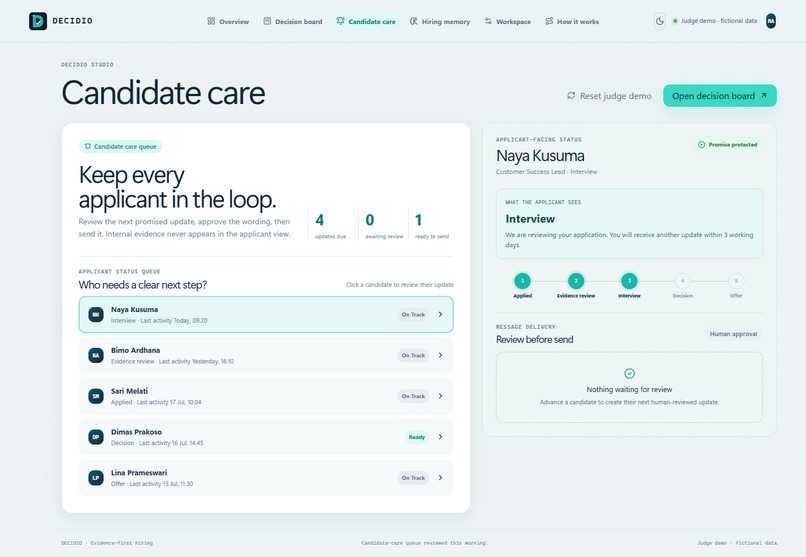
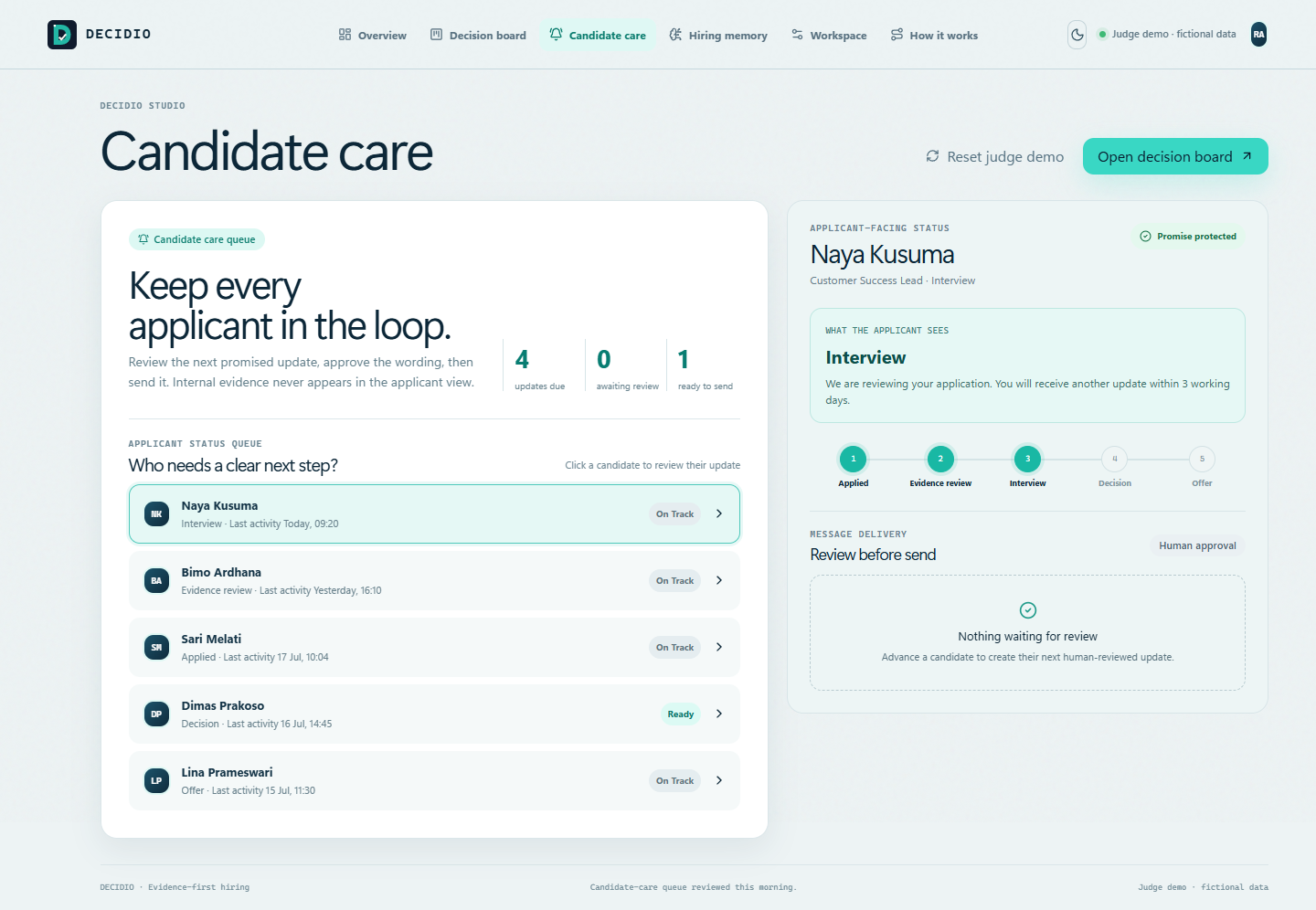
Candidate Care connects each hiring decision with a clear, human-approved applicant update.
-
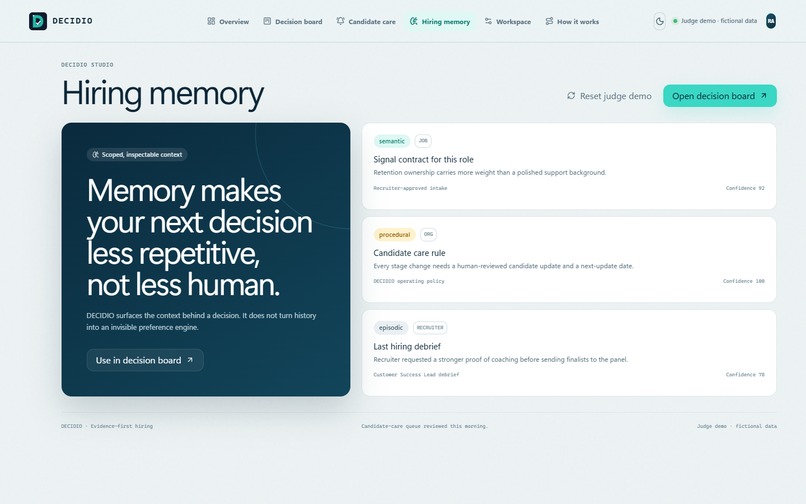
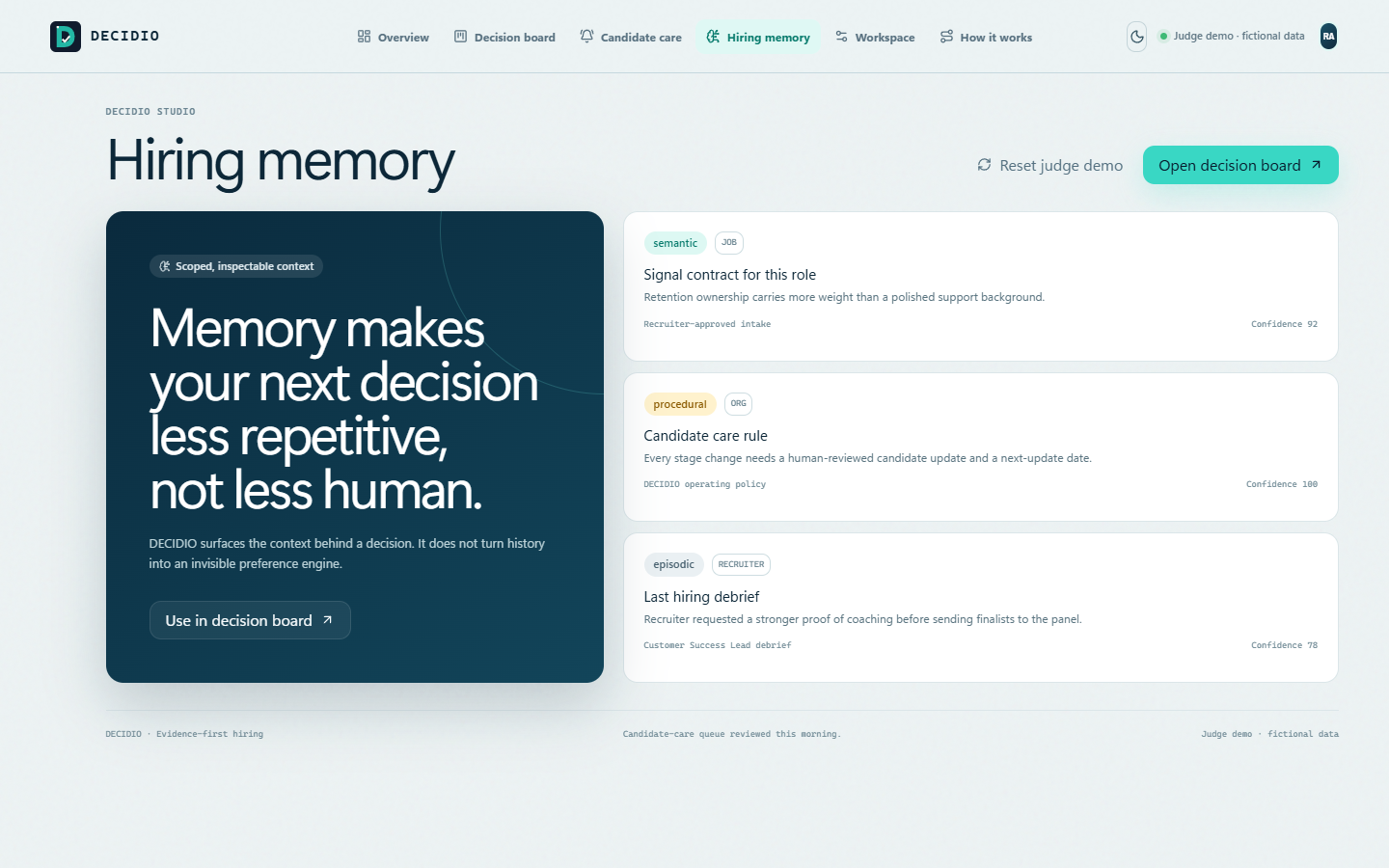
Hiring Memory reuses approved, workspace-scoped context while keeping every source inspectable.
-
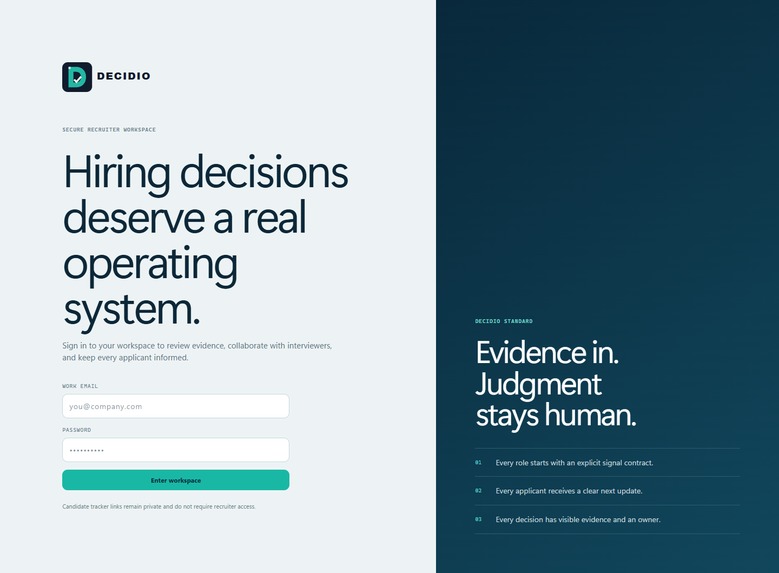
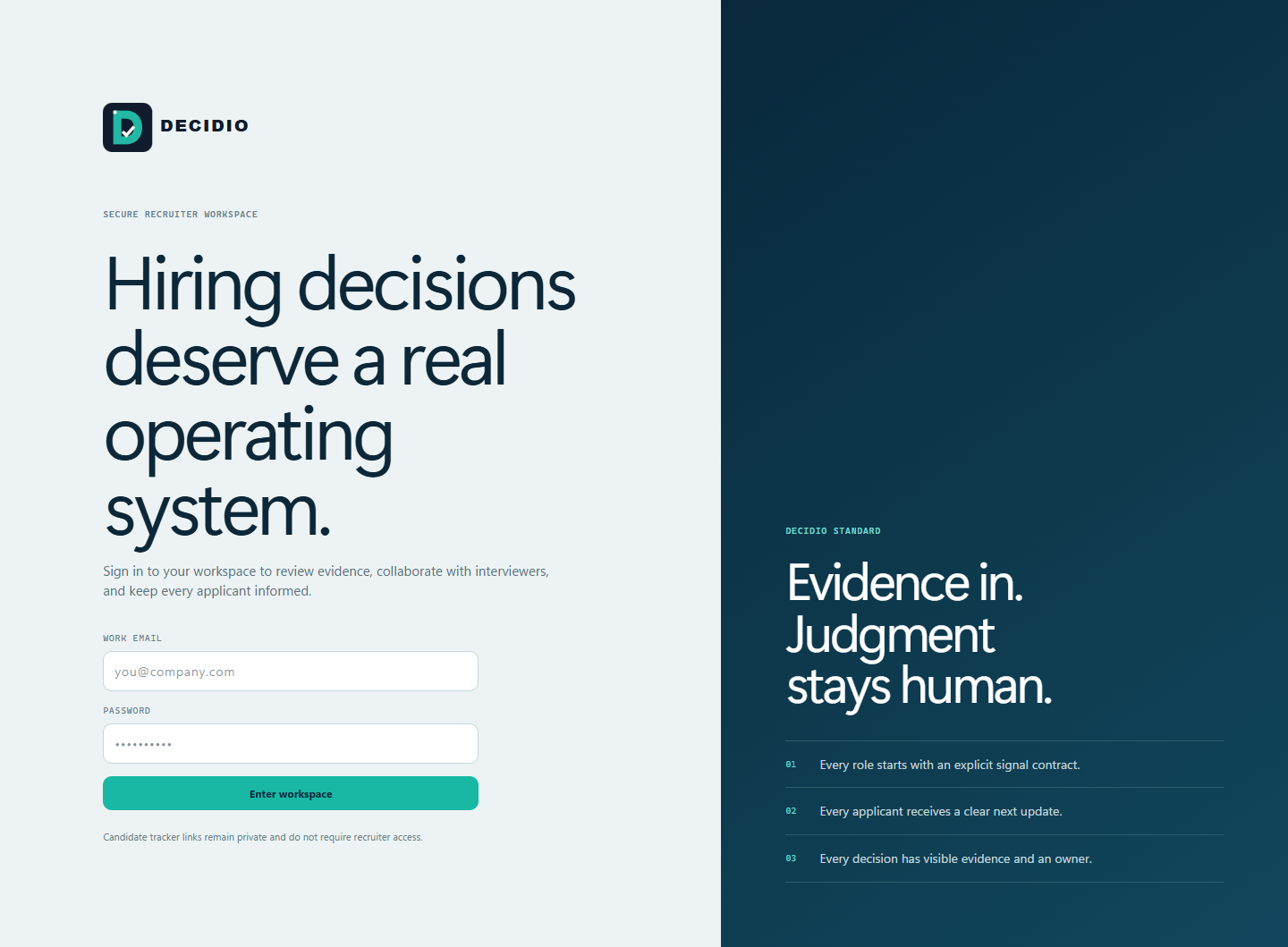
The secure recruiter entry point reinforces DECIDIO's core principle: evidence in, judgment stays human.
Inspiration
Hiring teams have more data than ever, but many decisions are still driven by scattered notes, inconsistent interview criteria, and personal impressions. Recruiters may use one definition of a strong candidate while interviewers use another. Important evidence gets lost, decisions become difficult to explain, and candidates are often left without a clear update.
We built DECIDIO to make hiring decisions more structured, transparent, and human. DECIDIO transforms opinion-driven hiring into an evidence-based decision workflow: recruiters define the criteria, GPT identifies missing evidence and prepares the interview, while humans retain control over hiring decisions and candidate communication.
What it does
DECIDIO is an evidence-first hiring workspace that connects the complete decision flow:
Define the role and signal contract Recruiters specify the role, the expected 90-day outcome, and the observable signals every interviewer should evaluate.
Collect candidates and evidence Candidates can enter through a public career page, CSV import, or recruiter workflow. Each candidate receives an isolated evidence record and private status-tracking capability.
Compare proof on the decision board DECIDIO separates confirmed signals from unanswered questions. Recruiters can see evidence fit, confidence in that evidence, candidate stage, and the proof still needed.
Generate an interview plan with GPT GPT receives bounded role criteria, candidate evidence, visible gaps, and approved workspace context. It returns a structured, reviewable packet containing role fit, evidence confidence, signals used, missing proof, reasoning, and targeted interview questions.
Keep the decision human-owned GPT cannot reject, advance, hire, or message a candidate. Recruiters review the evidence and explicitly move the candidate.
Close the candidate communication loop Moving a candidate creates a candidate-update draft. The recruiter reviews what the applicant will see and must approve the message before delivery.
Reuse approved hiring context Hiring Memory stores workspace-scoped, inspectable context so teams can learn from previous decisions without creating a hidden preference engine.
How we built it
DECIDIO is a full-stack TypeScript web application built with Next.js 16, React 19, and server-side route handlers.
The interface uses TanStack Query, TanStack Table, Motion, GSAP, Lucide, and a custom DECIDIO design system. API inputs and GPT outputs are validated with Zod.
GPT reasoning runs server-side through the official OpenAI SDK and an OpenAI-compatible provider boundary. The live judge deployment uses real GPT-5.6 inference through Moyra. The model receives only bounded, authorized hiring context and returns a structured evidence packet.
The production architecture includes:
- tenant-aware APIs and role permissions;
- opaque server-side sessions;
- a PocketBase repository, identity, and storage path;
- immutable scorecard evidence;
- private candidate tracker capabilities;
- idempotent outbox processing;
- provider adapters for GPT reasoning, document extraction, email, billing, and interview delivery;
- rate limiting, request validation, audit events, and production configuration gates.
The public judge demo is deployed on Railway with fictional data, real GPT inference, and no installation required.
How we used Codex
Codex accelerated the project across the complete Build Week workflow. We used Codex to:
- transform the original prototype into an evidence-first hiring product;
- design the application architecture and provider boundaries;
- implement the Next.js UI, APIs, repositories, and domain workflows;
- build the GPT evidence and interview-planning pipeline;
- create candidate-care, scorecard, tracker, interview, billing, and outbox flows;
- review security and multi-tenant boundaries;
- diagnose CI, deployment, provider, and structured-output failures;
- build automated tests and production verification scripts;
- refine the product story, user experience, and judge-facing demo.
The important product decisions remain deliberately human-owned. GPT advises, candidate communications require approval, provider success is never fabricated, and the judge demo is clearly labeled as fictional data.
Challenges we ran into
Our first major constraint was time. We discovered the OpenAI Build Week challenge only three days before the submission deadline, so we had to move quickly from product definition to implementation, testing, deployment, and demo preparation.
The complimentary Codex credits provided for the event were also consumed faster than expected during intensive architecture, implementation, debugging, and review sessions. We continued the remaining work through another Codex account while preserving the original event session as the primary /feedback submission reference. This required careful handoffs and documentation so development could continue without losing important technical decisions.
The hardest product challenge was making AI genuinely useful without turning it into an automated hiring authority.
We needed GPT to reason over candidate evidence while keeping every signal, gap, and recommendation visible to the recruiter. We solved this with bounded server-side context, structured output validation, evidence confidence, explicit uncertainty, and a human approval boundary.
We also had to handle differences between OpenAI-compatible provider responses without exposing unreliable output to the interface. DECIDIO normalizes and validates every response before it becomes a reviewable hiring packet.
Another challenge was connecting recruiter decisions with candidate communication. In DECIDIO, advancing a candidate is not only a pipeline change; it also creates an auditable, human-reviewed applicant update.
Finally, we needed to provide judges with a no-install experience while preserving a credible production architecture. The public judge deployment uses fictional data and real GPT inference, while the production path supports PocketBase, durable jobs, private storage, email delivery, billing, and external providers.
Despite the limited timeline and compute credits, we delivered a deployed end-to-end product, real GPT inference, a documented architecture, CI validation, and 62 passing automated tests.
Accomplishments that we're proud of
- A working public deployment with real GPT-5.6 inference.
- A complete role-signal-to-candidate-update product story.
- Structured GPT outputs that expose evidence, uncertainty, and interview questions.
- Human approval before candidate movement or communication.
- Public career pages and private candidate status tracking.
- Workspace-scoped and inspectable hiring memory.
- Tenant-aware APIs and provider-portable architecture.
- 62 automated tests covering security boundaries, candidate care, GPT workflows, billing, trackers, interviews, outbox retries, and repository behavior.
- Passing lint, TypeScript, automated tests, CI, and production build gates.
What we learned
AI is most valuable in hiring when it improves the next human conversation, not when it replaces human judgment.
Explicit criteria make model output more useful. Visible uncertainty makes it safer. Connecting decisions with candidate communication makes the entire workflow more accountable.
We also learned that candidate experience should not be treated as a separate notification feature. It is part of the decision system itself.
What's next for DECIDIO
Next, we plan to expand DECIDIO with production workspace onboarding, Google OAuth, managed PocketBase deployment, additional ATS integrations, document extraction and OCR, recruiter analytics, and more configurable interview providers.
Our long-term goal is to make evidence-first, explainable, and candidate-aware hiring accessible to every focused team.
Built With
- codex
- github
- gpt-5.6
- gsap
- next.js
- openai
- openai-sdk
- pocketbase
- railway
- react
- resend
- tanstack
- typescript
- zod

Log in or sign up for Devpost to join the conversation.