Inspiration
During my internship on an AI-transformation team I built a "team memory" prototype. AI extracted the decisions, reusable assets and lessons from three of my team's projects, a second AI checked each one against the current code and run logs, and only what survived became a card — 86 cards and 203 evidence quotes, with no invented quotes. The test that convinced me was on the largest project: answering a question from the raw files took about 15 minutes, and the AI reading those files confidently treated an outdated copy as the current version. With the verified cards it took under four minutes, and the answer was right.
Two lessons from that prototype became Decided. First, an agent doesn't just need context — it needs to know which version of a decision is current. Second, one person confirming something is not the same as it being the team's rule; a decision should reach further only as the evidence grows.
Every software team has the same quiet failure: something was decided in a meeting, written in a comment or a Confluence page, and then forgotten. Someone re-opens the debate, or worse, ships code against an old rule. Coding agents make this worse. Claude, Cursor or Rovo will happily read a two-year-old onboarding page and a last-week meeting note, and treat both as truth. Context is not the problem any more; trustworthy context is.
Codegeist asks us to use the Teamwork Graph as an organisation's associative memory — to know what has already been decided. We built the missing piece: a decision register that lives inside Jira and Confluence, that only contains what people actually confirmed, and that tells everyone — humans and agents — when a decision changes.
What it does
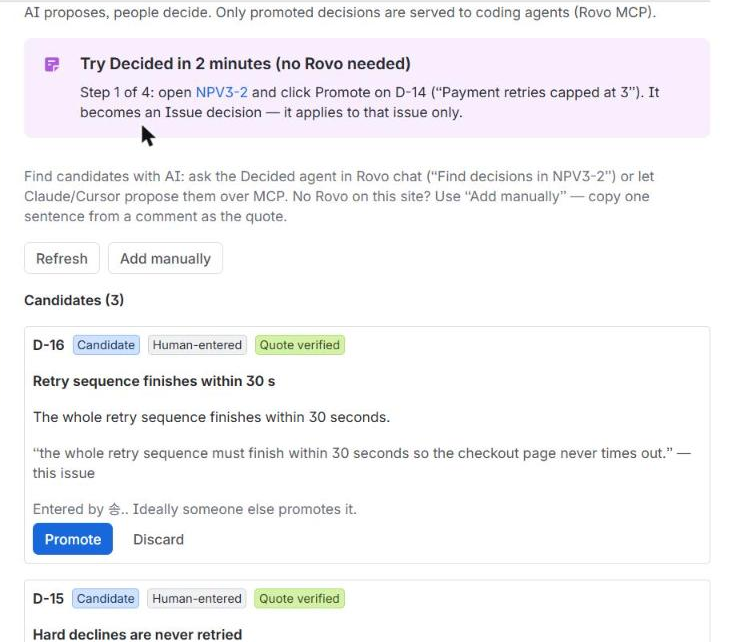
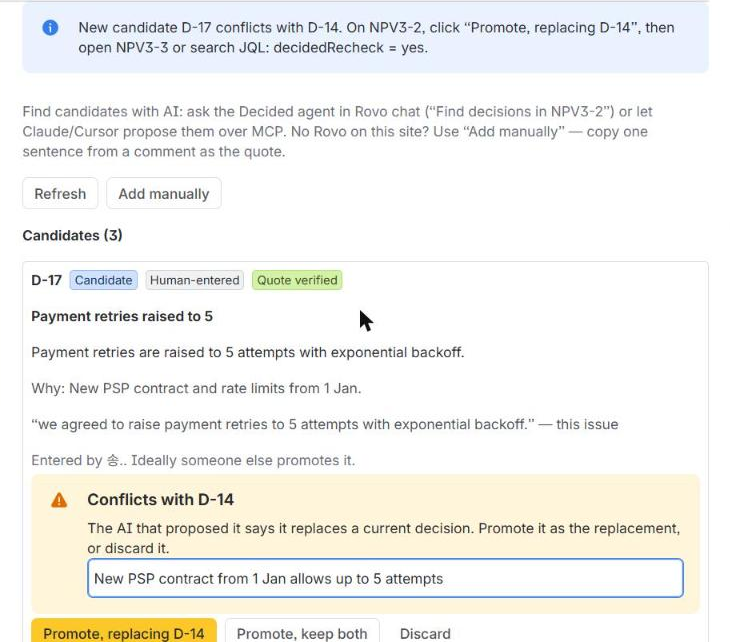
1. AI proposes, people decide. The Decided Rovo agent reads a Jira issue (description and comments) or a Confluence page and proposes the decisions in it — not the ideas, open questions or action items. Every candidate must carry a quote copied verbatim from the source; Decided checks the quote against the source text and marks it Quote verified or Quote not found. A candidate only becomes a team decision when a person clicks Promote in the Jira issue panel. Decisions get short ids (D-1, D-2…) people can say out loud.
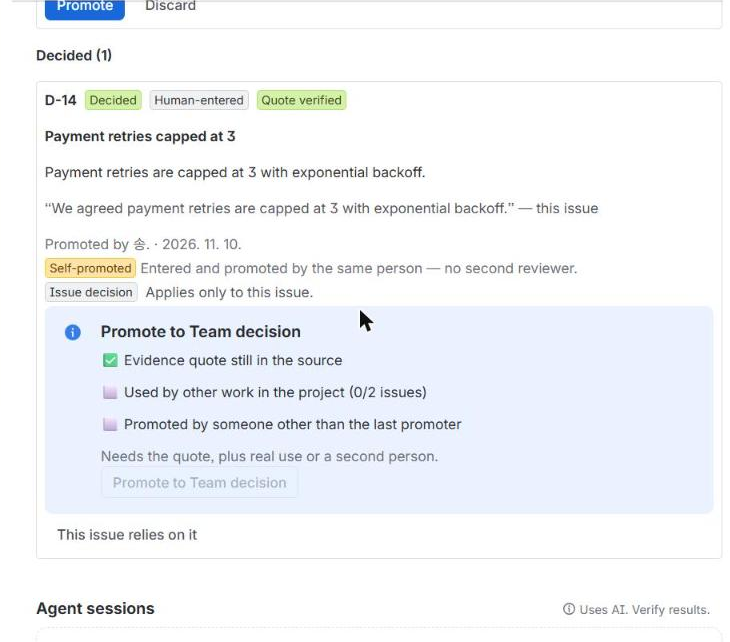
2. Promotion widens a decision's reach — and needs evidence at every rung. Promotion in Decided is not an "allow" button. It decides who the decision applies to:
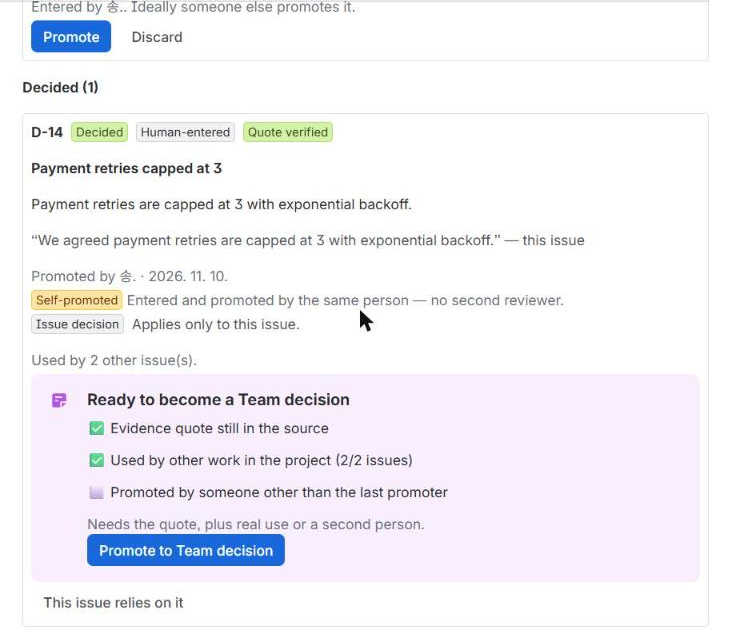
- Issue decision — promoted from a candidate; applies only to its own issue.
- Team decision — applies to all work in the project; every agent working in that project receives it.
- Org standard — applies to every project on the site.
Each rung has checks, like CI on a pull request: the evidence quote must still be in the source, and either the decision has really been used (by two other issues in the project for Team; outside its own project for Org) or a second person promotes it. Decided records every time a coding agent or a person relies on a decision — only when the decision actually matched what they asked about, and never counting the promoter's own clicks — so it can say "Used by 2 other issues — ready to become a Team decision". A decision that replaces another inherits its reach, so replacing follows the same policy: a decision you typed in yourself needs a second person to replace a Team decision.
Agents working on another issue in the same project can see an Issue decision, clearly labelled not a team rule yet; if they follow it, that use is recorded — which is exactly the evidence that lets it climb. A Jira admin can tighten the ladder on Decided's admin page: name decision owners who alone may widen a decision's reach, and/or always require a second person.
3. Coding agents get only the decisions in scope — over MCP.
Decided exposes three tools through the Forge rovo:mcp module, so Claude Code, Cursor or any MCP client can use them:
find-decisions— "what has the team already decided about X?" Given the issue the agent is working on, it returns org standards, that project's team decisions and that issue's own decisions — only human-promoted ones, each with its evidence quote, source link, who promoted it, and whether it replaced an older one.read-source— reads a Jira issue or Confluence page with the caller's own permissions, so an agent can find decisions and quote them exactly.propose-decision— saves a candidate (never a decision) for a human to promote.
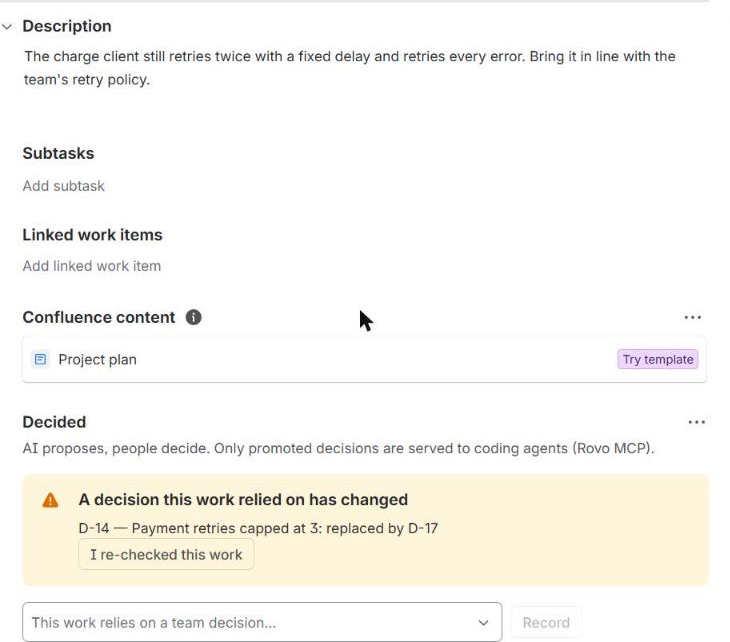
When an agent calls find-decisions with the Jira issue it is working on, Decided records that this piece of work relies on those decisions. People can record the same from the panel ("This work relies on a team decision…").
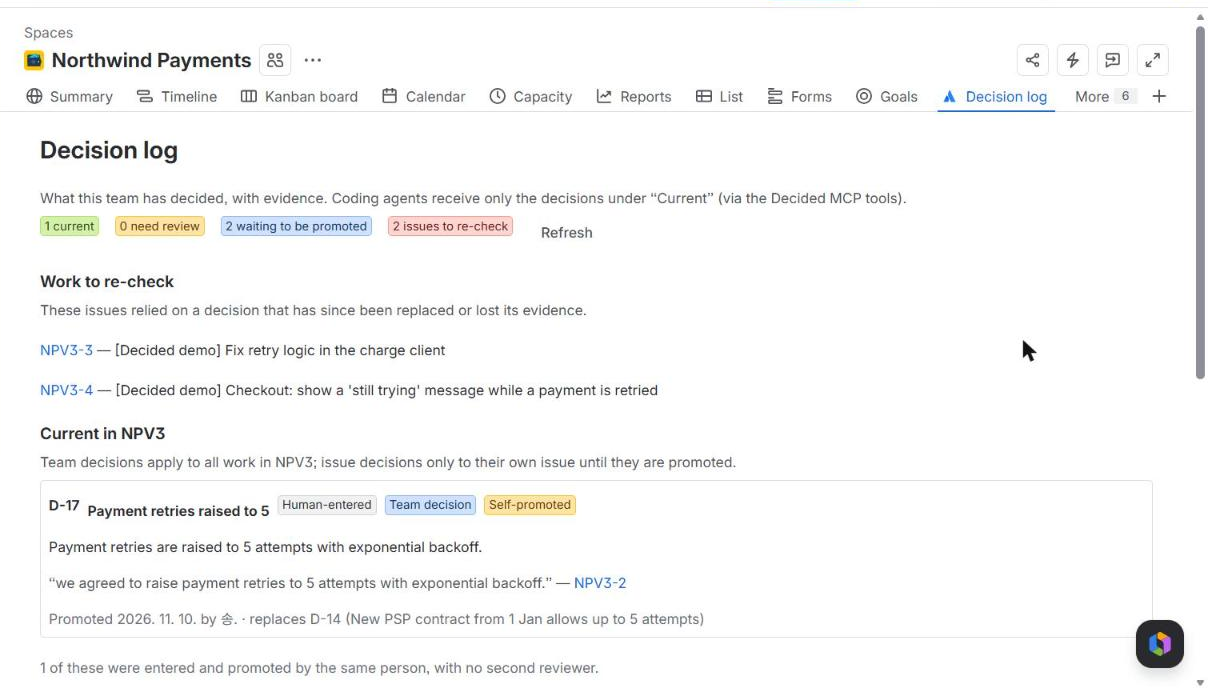
4. Decisions are versioned, not overwritten. When a new candidate covers the same subject with a different rule, the panel shows Conflicts with D-1 and offers Promote, replacing D-1 with a reason ("New PSP contract from 1 Jan"). The old decision moves to History as Replaced by D-4, and agents only ever receive the current one, with a note of what it replaced and why.
5. Changes reach the work that depended on them.
When a decision is replaced — or its evidence changes in Confluence — every issue that relied on it gets a comment from Decided explaining what changed and why, and an issue property that makes it searchable with JQL: decidedRecheck = yes. The issue's panel shows a warning until someone clicks I re-checked this work.
6. One place for the team's decisions. A Decision log page in every Jira project lists the current decisions with their evidence, the ones that need review, candidates waiting to be promoted, the history of replaced decisions, and the issues still waiting for a re-check. If someone typed a decision in and promoted it themselves, it is marked Self-promoted — in the log, in the panel, and in what agents receive — so "human-confirmed" never silently means "confirmed by nobody else".
7. Evidence that changes is flagged. If the Confluence page behind a decision is edited and the quoted sentence disappears, the decision becomes Needs review — for people in the panel and for agents in the MCP answer ("do not rely on it without asking").
How we built it
- Forge, UI Kit — a
jira:issuePanelwith the candidate / decided / history lists, conflict actions, the reliance picker and a two-step guided demo that creates its own fictional issues (as the user) so anyone can try it in two minutes. - Forge
rovo:mcp+actionmodules —find-decisions,read-source,propose-decision, exposed to external MCP clients (tested with Claude Code). - Forge
rovo:agent— the Decided agent in Rovo chat, with the same actions and a prompt that forbids paraphrased quotes and invented rationale. - Forge custom entities (KVS) —
decision(indexed by issue, status and source page) andreliance(by decision and by issue). jira:entityProperty— thedecidedRecheckJQL alias.- Confluence
avi:confluence:updated:pagetrigger — re-checks quotes when a source page changes. - Multi-product app compatibility — Jira required, Confluence optional, so one installation (and one storage) serves Jira, Confluence, Rovo and MCP.
- Runs on Atlassian. All data stays in Forge storage on the customer's site; no external hosting, no egress, no third-party services. The Forge CLI reports every deployed version as eligible for the Runs on Atlassian program.
- Tested. 40 automated tests: the pure logic, plus end-to-end tests of every resolver, MCP action and the Confluence trigger against an in-memory Forge storage and a fake Jira/Confluence (promote → usage → Team → Org, owners policy, replacement and re-check propagation, stale evidence, the guided demo, and the guard rails: a lookup is not usage, one person cannot vouch for themselves, replacing a Team decision follows the same policy as widening one, agents passing odd issue keys or none). Line coverage 96% (
npm run coverage). - No LLM inside the app. All language understanding is done by Rovo or the user's own coding agent; Decided does the deterministic parts: quote verification, promotion, versioning, propagation. That keeps the app predictable and cheap to run.
Challenges we ran into
- Split storage. Installing a Forge app into Jira and Confluence separately gave us two installations and two storages — the Jira panel and the MCP tools were looking at different data. Declaring Jira as the required app and Confluence as optional (
app.compatibility) merged them into one installation. - Agents that are too helpful. The first version of the Rovo agent invented plausible reasons for decisions and re-proposed decisions that were only being restated. We tightened the prompt and the action input descriptions: rationale only if the source states it, and a restatement of the same rule is not a new decision.
- Exposing MCP tools. Tools are off by default; an admin enables them per installation under Connected apps → Decided → Details → Tools. We document this for judges.
Accomplishments that we're proud of
- An agent that reads everything but can only propose; a person decides; every agent answer cites the exact sentence and who confirmed it.
- End-to-end on a real site: Rovo finds three decisions in a ticket and skips the open question and the suggestion nobody agreed to; a later meeting replaces one; three dependent issues get a comment and show up in
decidedRecheck = yes; Claude Code fixes code using the current rule.
What we learned
Verification is cheap and powerful: requiring a verbatim quote and a human click removes most of the risk of letting AI read team knowledge. And the useful unit of "context" for an agent is not a document, it is a decision with provenance and a version history.
What's next for Decided
- Link decisions into the Teamwork Graph as first-class objects.
- A Bitbucket/GitHub check that warns when a pull request contradicts a current decision.
- Decision digests per project ("what changed this week") in Confluence.
Links
- Demo video: https://youtu.be/CxK8tElC7PQ
- Code: https://github.com/song0328/decided
Built With
- atlassian-forge
- confluence-rest-api
- forge-custom-entities
- forge-ui-kit
- javascript
- jira-rest-api
- mcp
- node.js
- rovo
