-
-
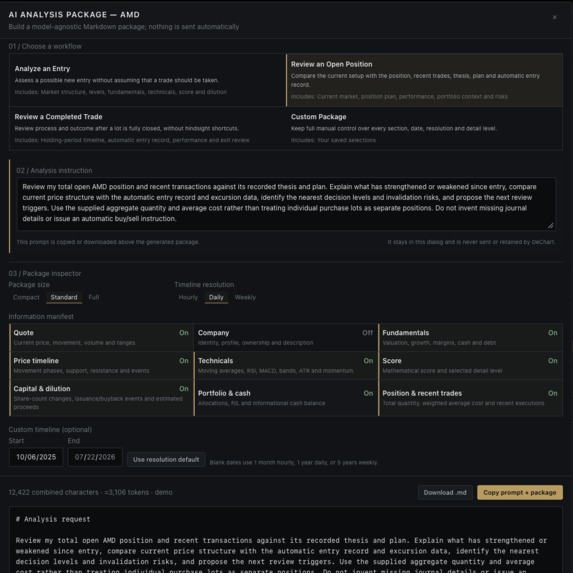
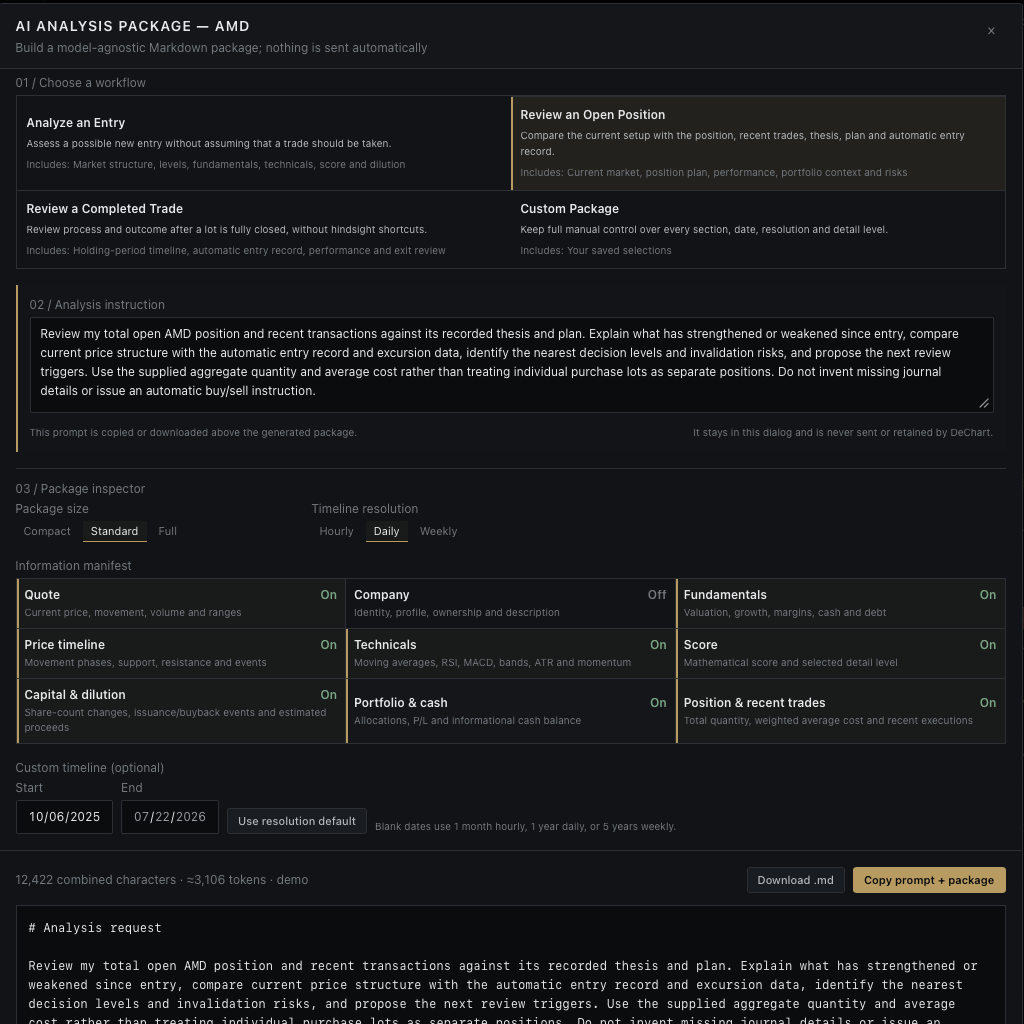
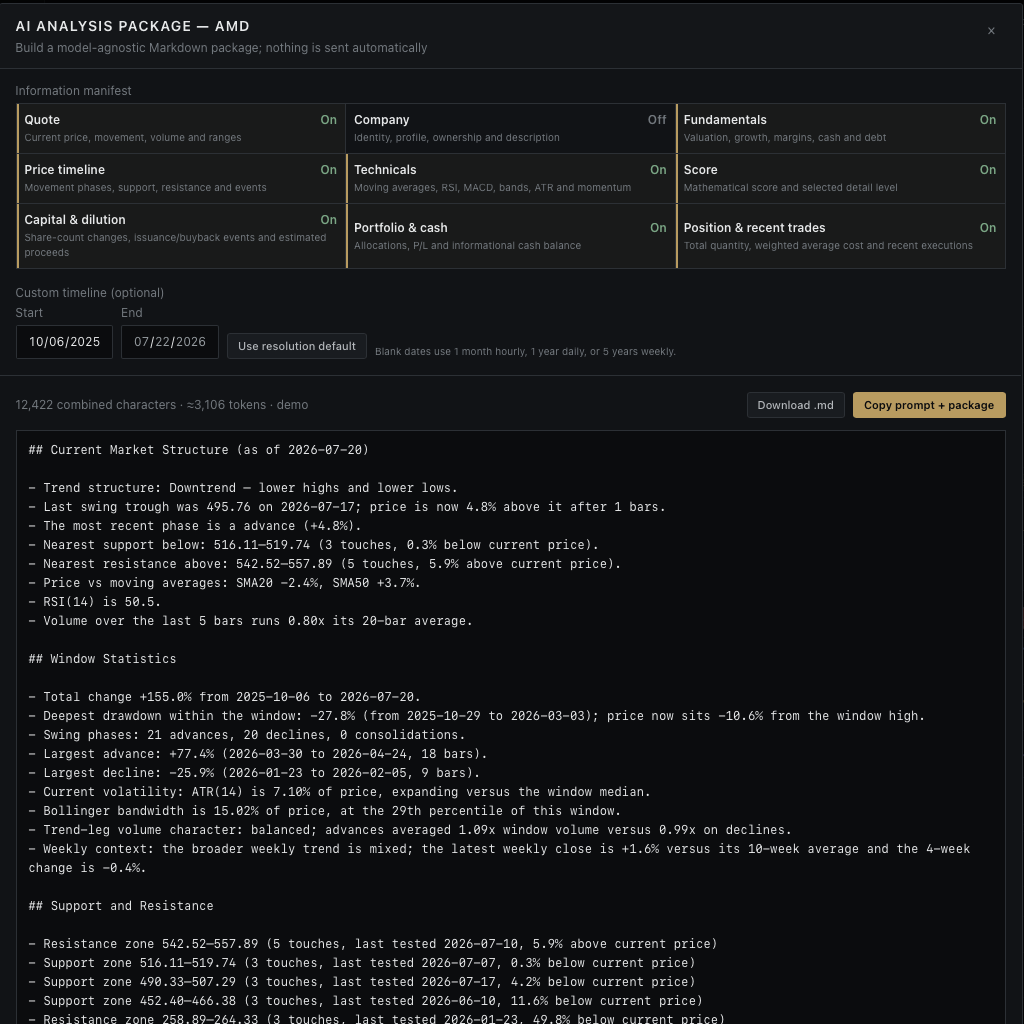
Create an editable Markdown analysis package to review, copy, or download—nothing is sent automatically.
-
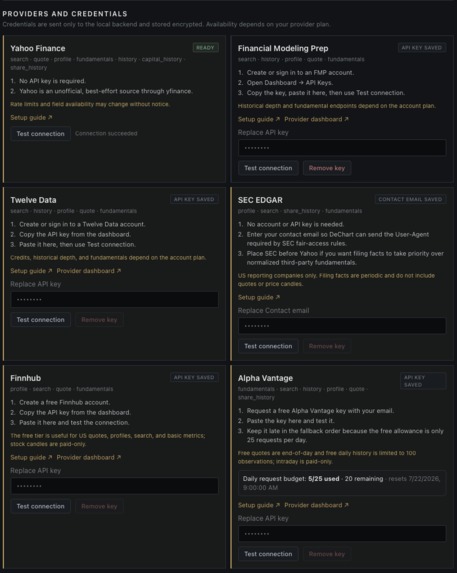
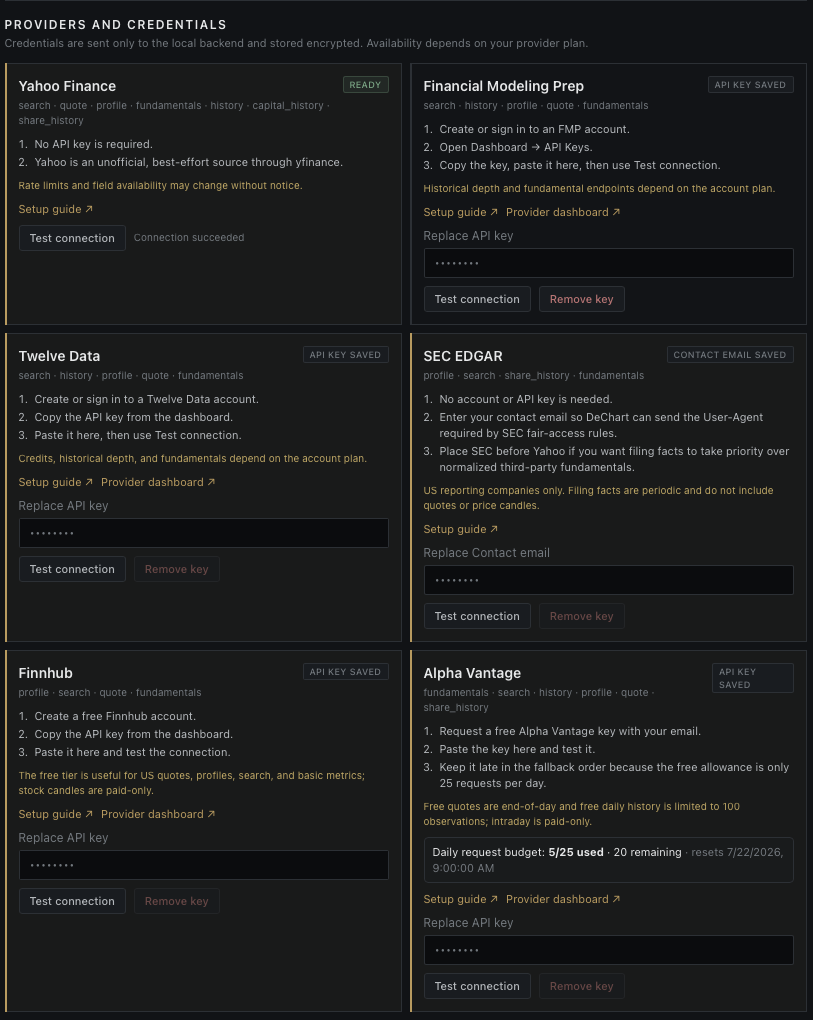
Configure multiple data providers with capability-aware fallback, caching, and visible provenance.
-
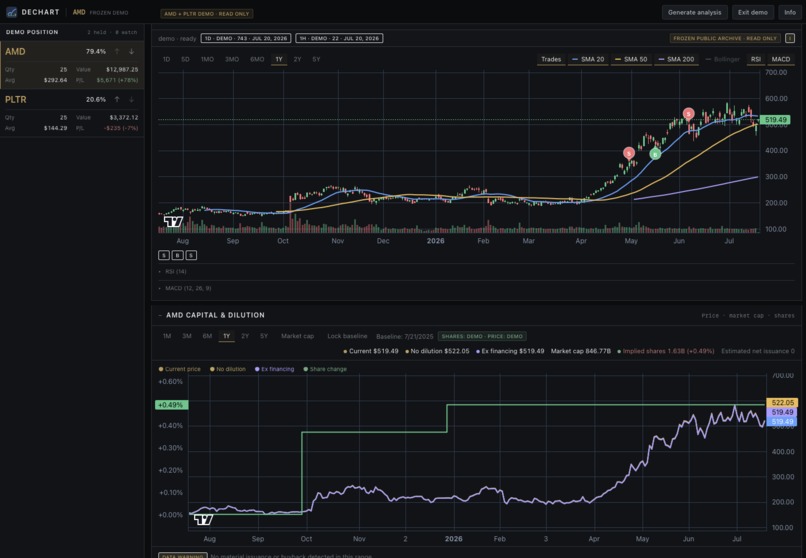
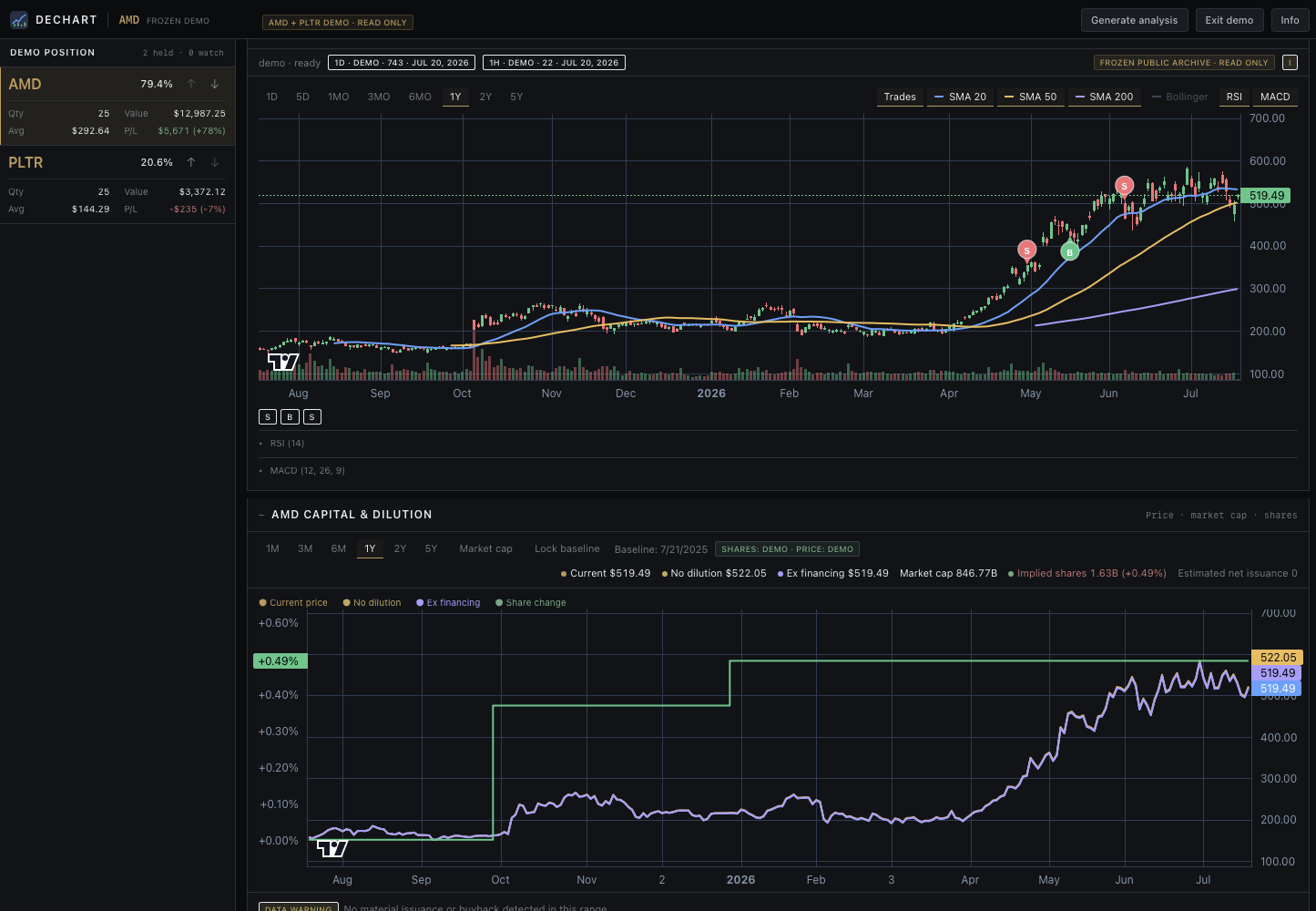
Explore price history, indicators, trade markers, archive coverage, and source provenance.
-
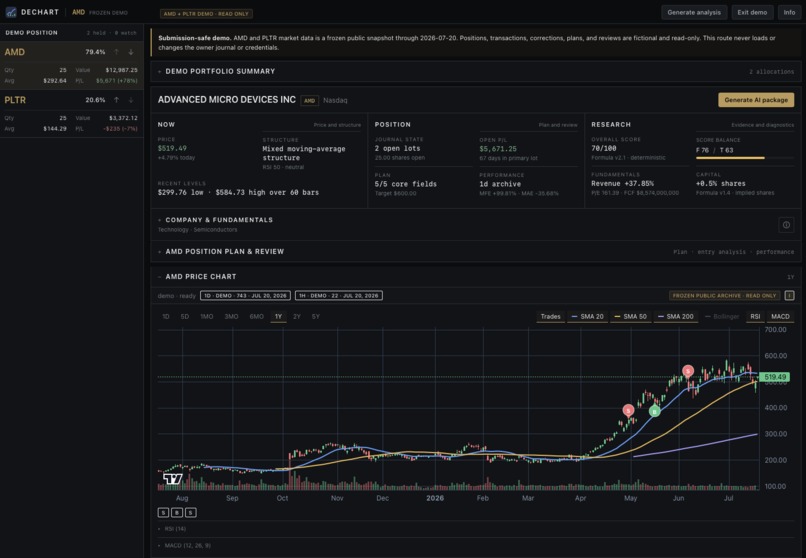
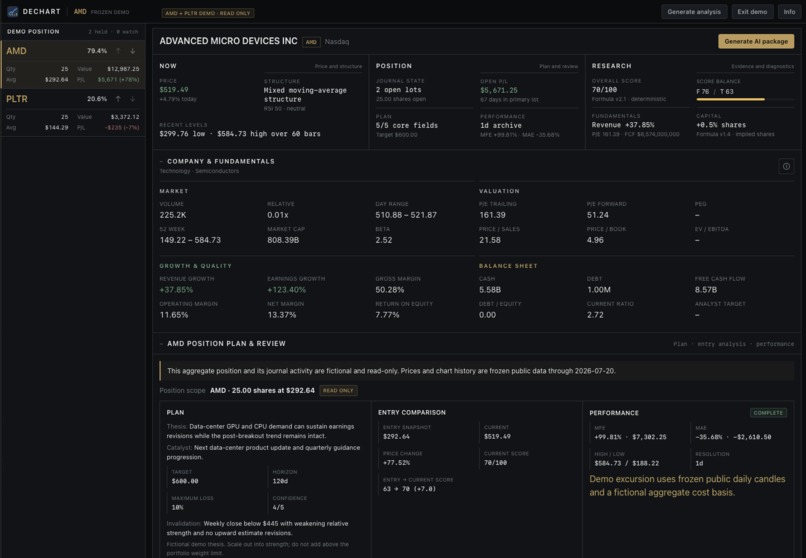
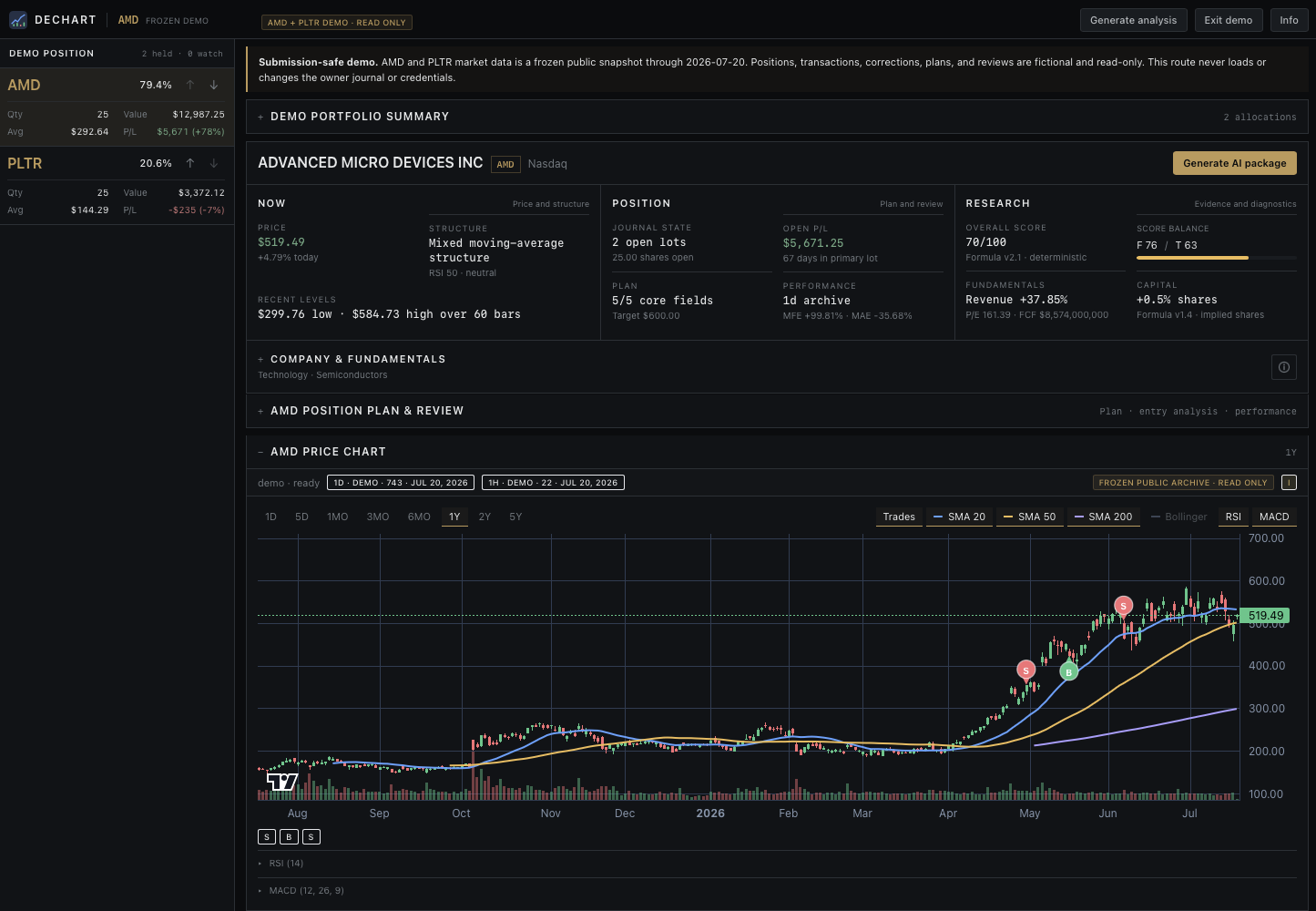
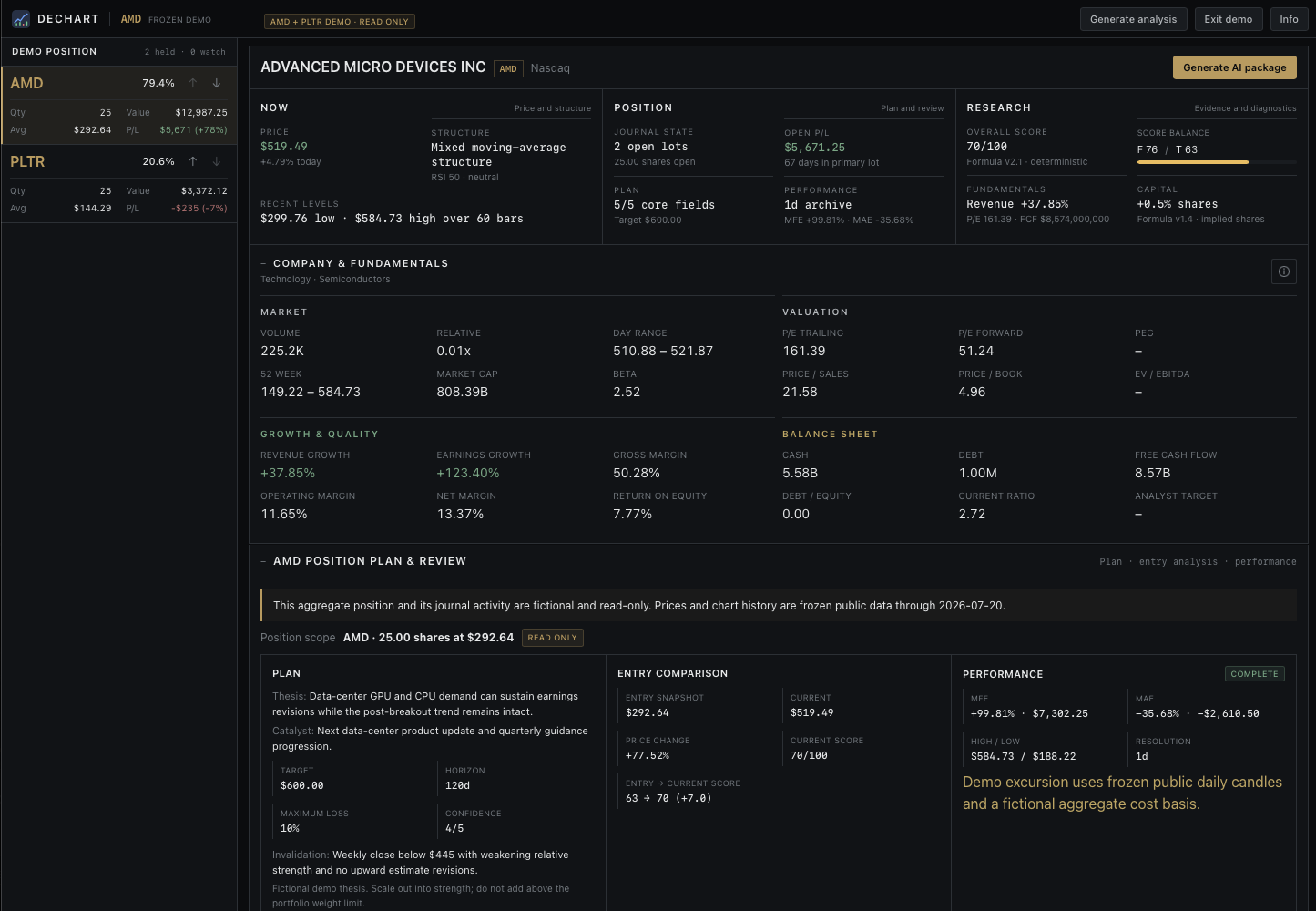
Portfolio, market structure, position context, research, and data quality in one responsive workspace.
-
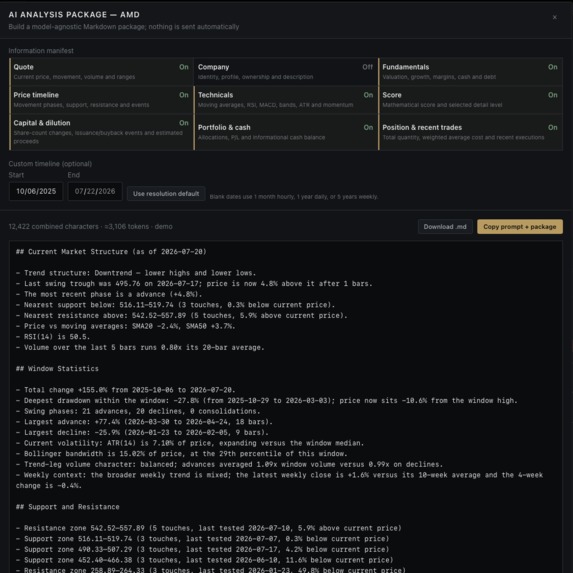
Turn price history into dated trends, corrections, consolidations, momentum, and volume events.
-
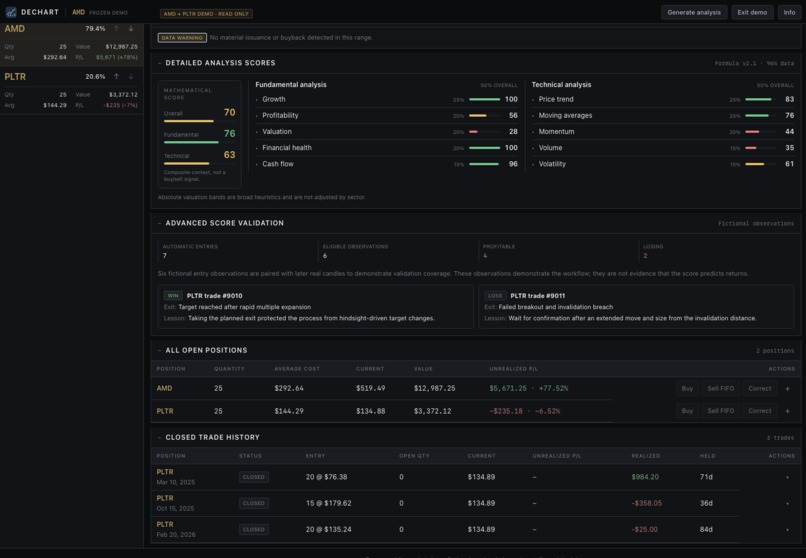
Review the thesis, targets, entry comparison, and MFE/MAE performance in one consistent panel.
-
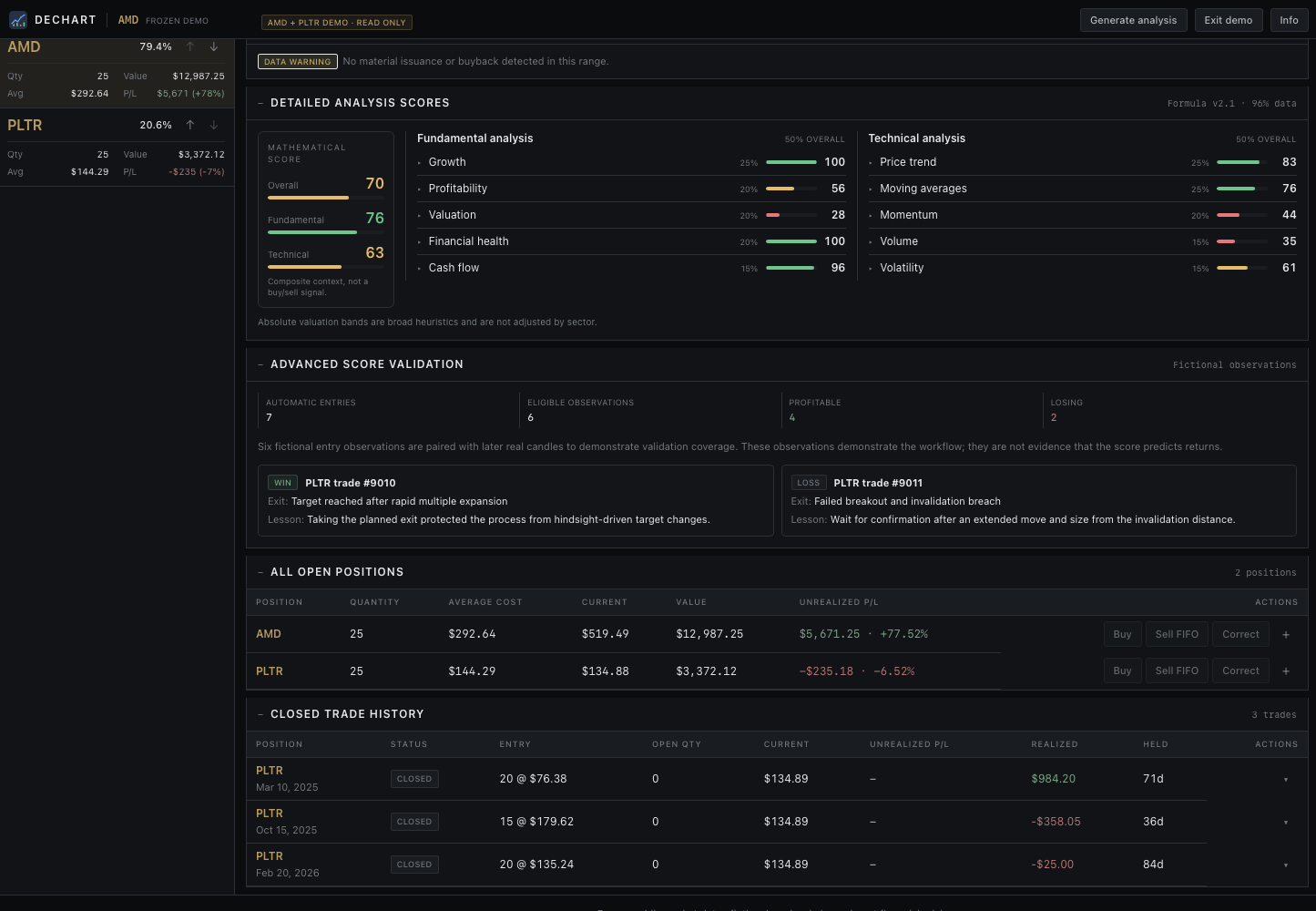
Inspect transparent fundamental and technical scores with coverage, sources, and formula versions.
Inspiration
I actively research and trade stocks, and I often use ChatGPT to discuss price movements, possible entry points, market reactions, and the reasoning behind a trade.
While AI model have a really good analysis skill I am not sure if it has the access to the newest data and how big is their scope. So for it to have more accurate results I built DeChart. The main focus it so convert a price chart and necessary information into readable prompt for AI model to analyze.
I used ChatGPT to plan and review what kind of data it needs to generate more accurate results, and then go to Codex to ask it implements the algorithm for reading the important data in price movement to generate reliable prompt. By only summarize the important movement like the spike and rebound, it eliminate the unnecessary noise and token consumption and can produce more accurate analysis results.
What it does
DeChart is a local-first stock research and trading-journal application.
It brings together:
- Candlestick and volume charts
- Stock fundamentals
- Price-movement summaries
- Position and portfolio context
- Trading notes
- Plan and Review workflows
- AI-ready analysis exports
The main feature is the movement narrative.
DeChart reads market data and summarizes important events such as spikes, drops, rebounds, volume changes, volatility, and turning points. It then combines this with fundamentals, position information, and the user's assumptions.
The result is a structured prompt that can be reviewed before being sent to an AI model.
DeChart does not automatically decide what to buy or sell. It helps provide better and more reliable context for analysis while keeping the final decision with the user.
How we built it
DeChart was built with FastAPI, React, TypeScript, SQLite, Docker Compose, and nginx.
I designed the product flow, decided what information should be prioritized, and defined how the analysis should be structured.
I then used ChatGPT and Codex with GPT-5.6 to help implement most of the application.
I had not worked seriously with modern web development for some time, so instead of manually learning every framework detail first, I focused on the product design, data flow, and expected behavior. I described each module to Codex, reviewed the result, tested it, and refined the implementation step by step.
The development was divided into six planned phases. Each phase had a clear goal, verification steps, and limits on scope.
Codex helped implement the frontend, backend, data processing, Demo mode, tests, documentation, and production setup. My role was to define the workflow, make architectural decisions, review the output, identify problems, and guide the next iteration.
Challenges we ran into
The hardest challenge was finding the right analysis flow.
Stock data contains a large amount of information, but not all of it is equally important. Including too much data creates noise, increases token usage, and can make the AI focus on irrelevant details. Including too little data can produce incomplete or misleading analysis.
I had to decide:
- Which price movements should be summarized
- Which movements were only noise
- How volume and volatility should be represented
- How fundamentals should be prioritized
- How portfolio and position context should be included
- How the final prompt should be structured
Another major challenge was data reliability.
Market data can come from different APIs with different update times, limitations, missing fields, and inconsistent formats. DeChart needed a clear priority system so that more trusted data would be used first, while fallback sources could still keep the application functional.
Managing, normalizing, validating, and prioritizing that data was more important than simply displaying a chart.
The final challenge was coordinating a large amount of AI-generated development work. Without clear planning, AI can produce inconsistent modules, duplicate logic, or features that do not fit the main product goal. Keeping the work divided into small, verifiable phases was essential.
Accomplishments that we're proud of
The biggest accomplishment is that I was able to build a complete working application largely through collaboration with ChatGPT and Codex, even though I had not worked with modern web development for a long time.
I focused on designing the product, defining the analysis flow, choosing the data priorities, and reviewing the behavior. Codex handled much of the implementation across the frontend, backend, database, tests, Docker environment, and documentation.
DeChart now provides a complete workflow:
- Load and organize market data
- Display charts and fundamentals
- Detect and summarize important price movements
- Add portfolio and position context
- Generate a structured AI-ready prompt
- Record and review trading decisions locally
I am also proud that the final application is not only a prototype. It includes a read-only Demo mode, a production Docker setup, documentation, and automated verification.
What we learned
The biggest lesson was that AI development becomes much more productive when the work is properly scheduled and divided into modules.
Asking AI to “build the whole application” is not enough. The result becomes much better when each phase has:
- A clear purpose
- Defined inputs and outputs
- Limited scope
- Verification criteria
- A review step before continuing
This made it easier to detect mistakes early and prevented one bad decision from spreading through the whole application.
I also learned that the developer's role changes when working with AI.
I did not need to manually write every component, but I still needed to understand the product deeply enough to design the architecture, define correct behavior, review the implementation, and decide what should happen next.
The AI accelerated implementation, but planning, prioritization, testing, and judgment remained essential.
What's next for DeChart
The Build Week scope is complete, so the immediate priority is not adding more features.
The next steps are to improve reliability and evaluate DeChart through continued real-world use. I plan to use it during my own stock-research workflow, compare its movement narratives with the underlying charts, and refine areas where the generated context is incomplete or misleading.
I also want to evaluate how different AI models respond to the same DeChart export. Because the input is structured and repeatable, it becomes easier to compare the quality of their reasoning instead of changing both the prompt and the data every time.
Longer term, DeChart could become a more complete personal research environment, but any expansion should preserve its main principles: local ownership of private data, transparent analysis, reviewable AI context, and the user retaining responsibility for every trading decision.
And lastly for the final product I plan to make it into individual app by wrapping it into native app.

Log in or sign up for Devpost to join the conversation.