-
-
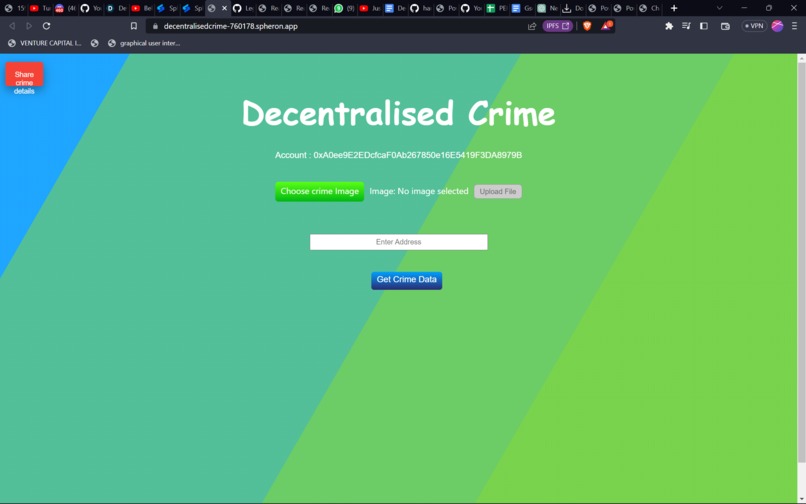
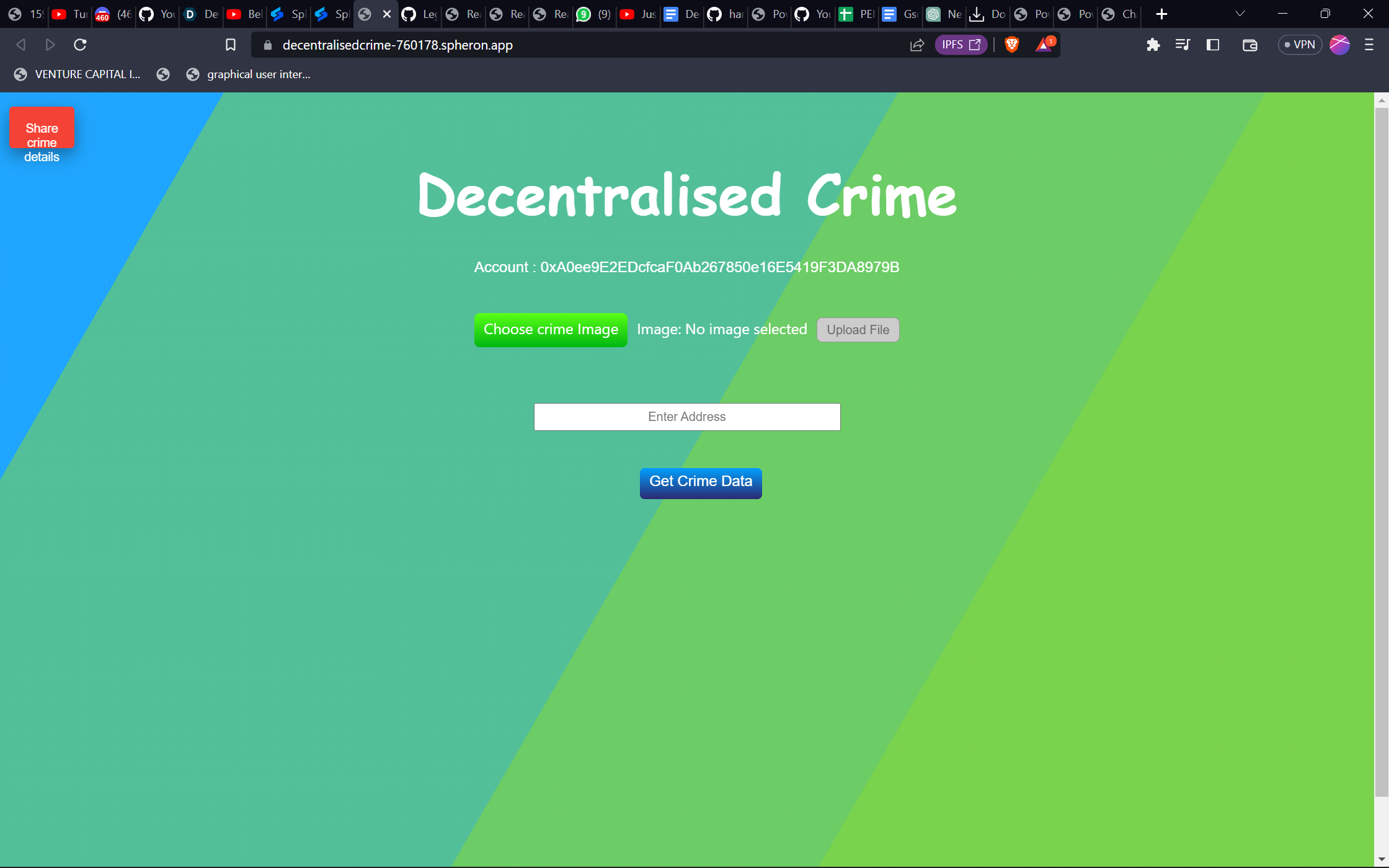
Simplistic UI for registering and submitting crimes and with private key access, the administration views crime details.
The Problem Justice Link solves
In today's society, many crimes go unreported as people often overlook or fail to report them to the police, leading to a lack of comprehensive crime data and delayed or inadequate law enforcement response. This issue results in reduced community safety and hinders effective crime prevention efforts. Also, the lack of a reliable and transparent system for reporting and verifying nearby crimes poses a significant challenge to maintaining public safety. Existing centralized crime reporting methods often suffer from inefficiencies, limited trust, and potential manipulation. Therefore, there is a pressing need for a decentralized crime marking and detection app that harnesses the power of blockchain technology to empower individuals to report crimes and enable the community to collectively validate the information's authenticity.
How will it work?
The decentralized crime marking and detection app can leverage blockchain technology to enable individuals to register crime reports on an immutable and transparent ledger. The app incorporates a voting mechanism, allowing the community to collectively validate the reported crimes. A majority vote of 51% or more would determine the legitimacy of the information, ensuring a fair and democratic decision-making process.
The complete working process: Reporting Crimes: Users of the app can register crime incidents they witness or experience in their vicinity. They can provide details such as the type of crime, location, time, and any other relevant information. This information is then recorded on the blockchain, ensuring its immutability and transparency.
Community Validation: Once a crime report is registered, it is made available to the app's community members for validation. Each member has the opportunity to vote on the authenticity and legitimacy of the reported crime. They can review the provided information and assess its credibility. Voting Mechanism: The app implements a voting system where community members can cast their vote on whether they believe the reported crime is true or false. Each member's vote holds equal weight.
Decision Making: The voting period has a predefined duration to allow enough time for community participation. At the end of the voting period, the app counts the votes received for each crime report. If a reported crime receives a majority vote of 51% or more, it is considered validated by the community.
Marking the Crime: Based on the outcome of the voting process, the app marks the reported crime accordingly. If a crime is validated by the majority, it is labeled as legitimate and remains visible on the app's platform. However, if a crime fails to achieve the majority vote, it is marked as unverified or false, indicating that it may not be accurate.
Public Awareness: The app serves as a public resource, providing real-time information about nearby crimes that have been verified by the community. Users can access the app to stay informed about crime incidents in their area, allowing them to take necessary precautions or report additional information if available.
By leveraging blockchain technology and collective decision-making through community voting, the app aims to provide a transparent, trustworthy, and efficient system for crime reporting and detection. It encourages active community participation, enhances the accuracy of reported crimes, and facilitates timely response and prevention measures by law enforcement agencies.
How we built it?
To develop Justice Link, a combination of technologies and programming languages were used:
Blockchain Technology: The core of the app was built on a blockchain platform, Ethereum. Blockchain provides the necessary decentralization, transparency, and immutability required for recording and validating crime reports.
Smart Contracts: Smart contract, written in Solidity, was used to define the logic and rules governing the crime reporting, validation, and voting processes on the blockchain.
Web Development: The app's user interface and frontend was developed using web technologies such as HTML, CSS, and JavaScript. Framework React was utilized to build a responsive and interactive user interface.
Backend Development: The backend of the app would handle the processing of data, integration with the blockchain network.
Spheron SDK: The Spheron SDK, an SDK developed specifically for interacting with the Ethereum blockchain, would be employed to facilitate seamless integration and communication between the app and the Ethereum network.
Challenges we ran into
Blockchain Complexity: Understanding the complexities of blockchain technology was a significant challenge. However, through thorough research, collaboration with blockchain experts, and continuous learning, we gained a deep understanding of blockchain fundamentals and effectively implemented them in our app.
Scalability: We anticipated the need for scalability and carefully designed our architecture to accommodate a growing user base and increasing transaction volumes. By implementing optimized data structures, efficient algorithms, and exploring scaling solutions, we ensured that our app can handle high user activity without compromising performance.
Data Accuracy and Verification: Ensuring the accuracy and legitimacy of reported crimes was a top priority. We developed sophisticated algorithms and implemented a multi-layered verification process that includes community validation and data cross-referencing to minimize false reporting and maintain data integrity.
Integration with External Systems: Integrating our app with external systems, such as law enforcement databases, required careful coordination and technical expertise. We successfully established secure APIs and data exchange protocols to enable seamless integration, facilitating better collaboration between our app and existing crime reporting platforms.
Accomplishments we’re proud of
Social Impact
Our app Justice Link has the potential to create several significant social impacts, including:
Empowering Communities: The app empowers individuals within communities to actively participate in maintaining safety and security. It encourages community members to take ownership of their surroundings, fostering a sense of responsibility and engagement.
Increased Crime Reporting: By providing a user-friendly platform, the app incentivizes and facilitates the reporting of crimes. It aims to overcome barriers that often prevent people from reporting incidents promptly and accurately.
Improved Law Enforcement Collaboration: The app acts as a bridge between community members and law enforcement agencies, promoting collaboration and information sharing.
Enhanced Community Safety: By facilitating timely reporting and validation of crimes, the app contributes to a safer community. It enables quick awareness of incidents, allowing community members to take necessary precautions and preventive measures, ultimately reducing the likelihood of further crimes.
Transparency and Trust: The app utilizes blockchain technology to ensure transparency and immutability of reported crime data. This fosters trust among community members, as they can have confidence in the accuracy and integrity of the information shared.
Targeted Resource Allocation: By aggregating and analyzing crime data, the app can provide valuable insights into crime patterns and hotspots. This information can be used to allocate law enforcement resources more effectively, focusing on areas with higher crime rates and addressing specific community safety concerns.
**Deterrence Effect: The presence of the app and the active participation of community members in reporting crimes can act as a deterrent to potential offenders. The knowledge that incidents are being reported and investigated by a vigilant community can discourage criminal activities and contribute to a safer environment.
Overall, the app's social impact lies in its ability to empower communities, enhance crime reporting and detection, foster collaboration between community members and law enforcement, and ultimately contribute to a safer and more secure society. It promotes transparency, trust, and active community involvement in addressing crime-related challenges.
What we learned
In the technical aspect, building a decentralized crime marking and detection app can provide valuable insights and learning opportunities in various areas. Some of the technical learnings from our project may include:
Blockchain Development: Developing a decentralized app involves gaining expertise in blockchain development. Learning how to build and deploy smart contracts, interact with the blockchain network, handle transactions, and manage decentralized data storage are essential technical skills that can be acquired during the project.
Consensus Mechanisms: Understanding different consensus mechanisms used in blockchain networks, such as Proof of Work (PoW), Proof of Stake (PoS), or other consensus algorithms, is crucial. Exploring their strengths, weaknesses, and applicability to the crime marking and detection app can be a valuable technical learning outcome.
Smart Contract Development: Smart contracts play a central role in decentralized applications. Learning how to design and develop smart contracts that facilitate the registration, voting, and marking of crime incidents on the blockchain is an important technical skill to gain during the project.
Decentralized Data Storage: Understanding decentralized data storage mechanisms, such as distributed file systems or decentralized database solutions, can be a valuable technical learning outcome. Exploring options for securely storing crime data on the blockchain or other decentralized storage systems can be part of the technical journey.
Blockchain Infrastructure: Gaining knowledge about setting up and managing a blockchain infrastructure is valuable. Learning how to deploy and maintain blockchain nodes, interact with public or private blockchain networks, and ensure the app's resilience and availability.
Built With
- css3
- ethereum
- goerli
- html5
- metamask
- react
- solidity
- spheron
- visual-studio

Log in or sign up for Devpost to join the conversation.