-
-
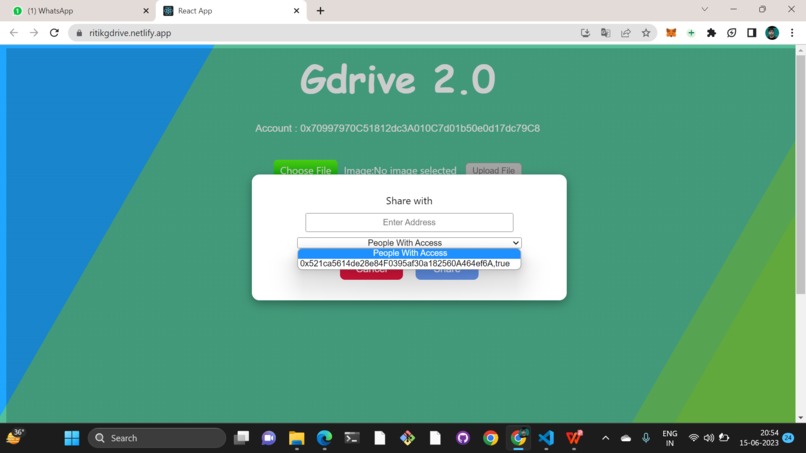
The image could also feature a mock-up or glimpse of the project's user interface, showcasing its ease of use and functionality

Inspiration
The rapid growth of blockchain technology has introduced new possibilities for data storage and management. In this project, we aim to develop a decentralized Google Drive application that tackles the challenges posed by centralized cloud storage services. By leveraging React.js for frontend development, Hardhat for smart contract development, and Ether.js for interacting with the Ethereum blockchain, we can create a solution that prioritizes data control, privacy, security, and efficient file sharing.
What it does
Features and Functionality:
User Registration and Authentication: Users will have the ability to create accounts securely and authenticate themselves. Through blockchain technology, we can ensure transparency and immutability in user registration and authentication processes.
Decentralized Storage: Our application will utilize a decentralized storage system, distributing user files across multiple nodes in the network. By eliminating reliance on a central server, the risk of single points of failure is reduced, ensuring enhanced data availability.
Data Control and Privacy: Users will have complete control over their data. Employing cryptographic techniques, we will guarantee data privacy and security. Smart contracts will govern access control mechanisms, empowering users to define permissions and selectively share files with others.
Data Integrity and Security: Blockchain technology provides a robust mechanism for data integrity and security. Each uploaded file will be accompanied by a cryptographic hash stored on the blockchain, enabling verification of file authenticity and preventing unauthorized tampering.
Efficient File Sharing: Our solution will streamline file sharing, enabling users to share files directly with others without intermediaries. Smart contracts will manage access permissions, facilitating secure and efficient file sharing among authorized users.
Cost-Effectiveness: By harnessing the power of blockchain technology, our application can reduce costs associated with centralized cloud storage services. Users can contribute their unused storage resources to the network, earning incentives or paying only for the storage they utilize.
How we built it
Frontend Development with React.js: We will leverage React.js to develop the frontend of our decentralized Google Drive application. Its extensive component library, coupled with robust development tools, will enable us to create a seamless and intuitive user interface. Users will be able to interact with the application, upload and manage files, and securely share them.
Smart Contract Development with Hardhat: To govern storage and access control logic, we will develop smart contracts using Hardhat. As an Ethereum development environment, Hardhat offers efficient contract deployment, testing, and debugging capabilities. We will define smart contracts for user registration, file storage, access control, and sharing functionalities.
Interacting with Ethereum using Ether.js: Ether.js will serve as our bridge to interact with the Ethereum blockchain. This JavaScript library simplifies communication with the blockchain, allowing us to interact with our smart contracts seamlessly. Through Ether.js, we can perform operations such as uploading files, verifying file integrity, managing access permissions, and facilitating file sharing.
Challenges we ran into
While developing the Decentralised Google Drive project, we encountered several challenges that required careful problem-solving and innovative thinking. One specific bug we faced was related to the integration of the Solidity smart contracts with the front-end application built using React.js.
The bug manifested as inconsistent data retrieval from the Ethereum blockchain. Despite successful transactions and data storage on the blockchain, the front-end was not consistently displaying the correct file information. After extensive debugging, we identified the root cause: the asynchronous nature of the blockchain transactions was causing delays in updating the front-end state.
To overcome this bug, we implemented a comprehensive solution. First, we restructured the code to ensure proper handling of asynchronous operations. We utilized promises and async/await functions to synchronize the data retrieval process and guarantee that the front-end displayed the most up-to-date information.
Additionally, we implemented event listeners using Web3.js to detect and react to changes in the blockchain. By subscribing to specific contract events, we could update the front-end in real-time whenever a file was added, modified, or removed from the decentralized storage.
To ensure the stability and robustness of the system, we conducted rigorous testing, including unit tests and integration tests. This helped us identify and resolve any remaining issues or edge cases that could potentially disrupt the functionality of the application.
Overall, by employing diligent debugging, restructuring code, and leveraging event listeners, we successfully overcame the bug related to data consistency between the front-end and the Solidity smart contracts. This experience taught us valuable lessons about the intricacies of integrating blockchain technology with front-end frameworks and reinforced the importance of thorough testing to ensure a smooth user experience.
Accomplishments that we're proud of
Community Adoption and Support: Successfully gaining traction and building a community around your decentralized Google Drive project shows that it addresses a genuine need and is valuable to users. Growing a supportive user base is a significant accomplishment in the world of decentralized technologies.
Contributions to Open Source Community: If the project is open source, contributing to the open-source community and receiving positive feedback or recognition from other developers or contributors is something to take pride in.
Recognition and Partnerships: If the project has gained recognition from industry experts, received awards, or formed partnerships with other organizations or projects, these accomplishments can validate the project's importance and impact.
Positive User Feedback and Testimonials: When users express satisfaction with your decentralized Google Drive and share positive feedback or testimonials about their experience, it's a clear indicator of a successful implementation.
Contribution to Decentralization and Data Ownership: By offering a decentralized alternative to traditional cloud storage, you contribute to the broader movement of data ownership and control, empowering users to have more control over their own data.
Resilience and Reliability: Demonstrating that your decentralized Google Drive can withstand network disruptions or attacks and still maintain data availability and accessibility is an accomplishment that highlights the project's reliability.
What we learned
Technical Skills: Participants may have learned or enhanced their technical skills related to blockchain, distributed systems, encryption, consensus algorithms, and network infrastructure.
Understanding Decentralization: Working on a decentralized Google Drive project can deepen participants' understanding of decentralization principles, its advantages, and the challenges associated with it.
Collaboration and Teamwork: Collaboration is a key aspect of complex projects. Participants might have improved their teamwork and communication skills while working together to solve challenges.
Adaptability and Problem-Solving: Developing a decentralized system involves facing unique problems and constraints. Participants likely learned to be adaptable and innovative in finding solutions.
User-Centric Design: Participants might have gained insights into the importance of user-centric design and usability in building a successful decentralized Google Drive platform.
Security and Privacy Awareness: Dealing with sensitive user data in a decentralized environment emphasizes the importance of security and privacy considerations. Participants may have learned best practices for securing user information.
What's next for DECENTRALISED GOOGLE DRIVE
Interoperability with Existing Cloud Services: Offering interoperability between a decentralized Google Drive and traditional cloud storage services could make it more accessible to a broader user base. Allowing seamless migration of data between platforms could encourage adoption.
Scalability and Performance Optimization: As the user base grows, ensuring the system can handle increased demands in terms of storage and data transfer speed will be crucial. Optimizing performance and scalability will be an ongoing priority.
Decentralized Identity Management: Integrating decentralized identity solutions can further enhance user privacy and security. Users can have more control over their identities and data access, making the system more user-centric.
Offline Access and Synchronization: Providing offline access to files and robust synchronization capabilities will improve the user experience and usability of the decentralized Google Drive.
Built With
- css
- etherium
- html
- javascript
- pintacloud
- react.js
- soliditiy


Log in or sign up for Devpost to join the conversation.