-
-
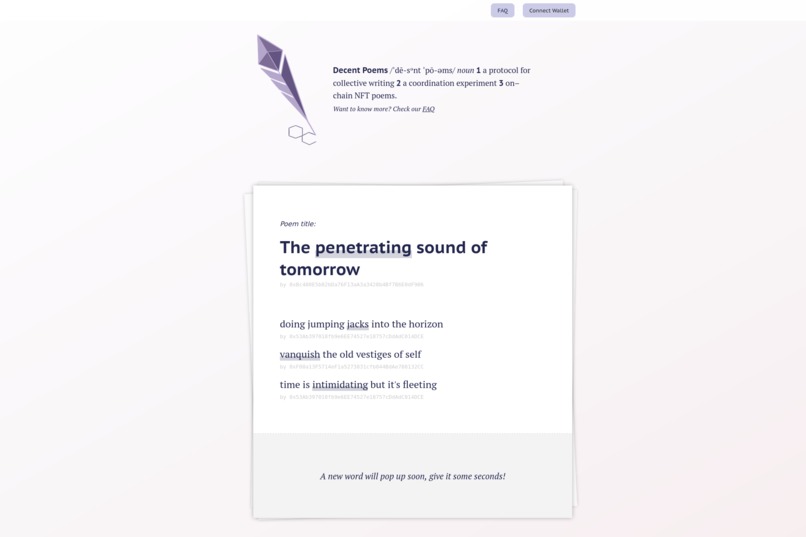
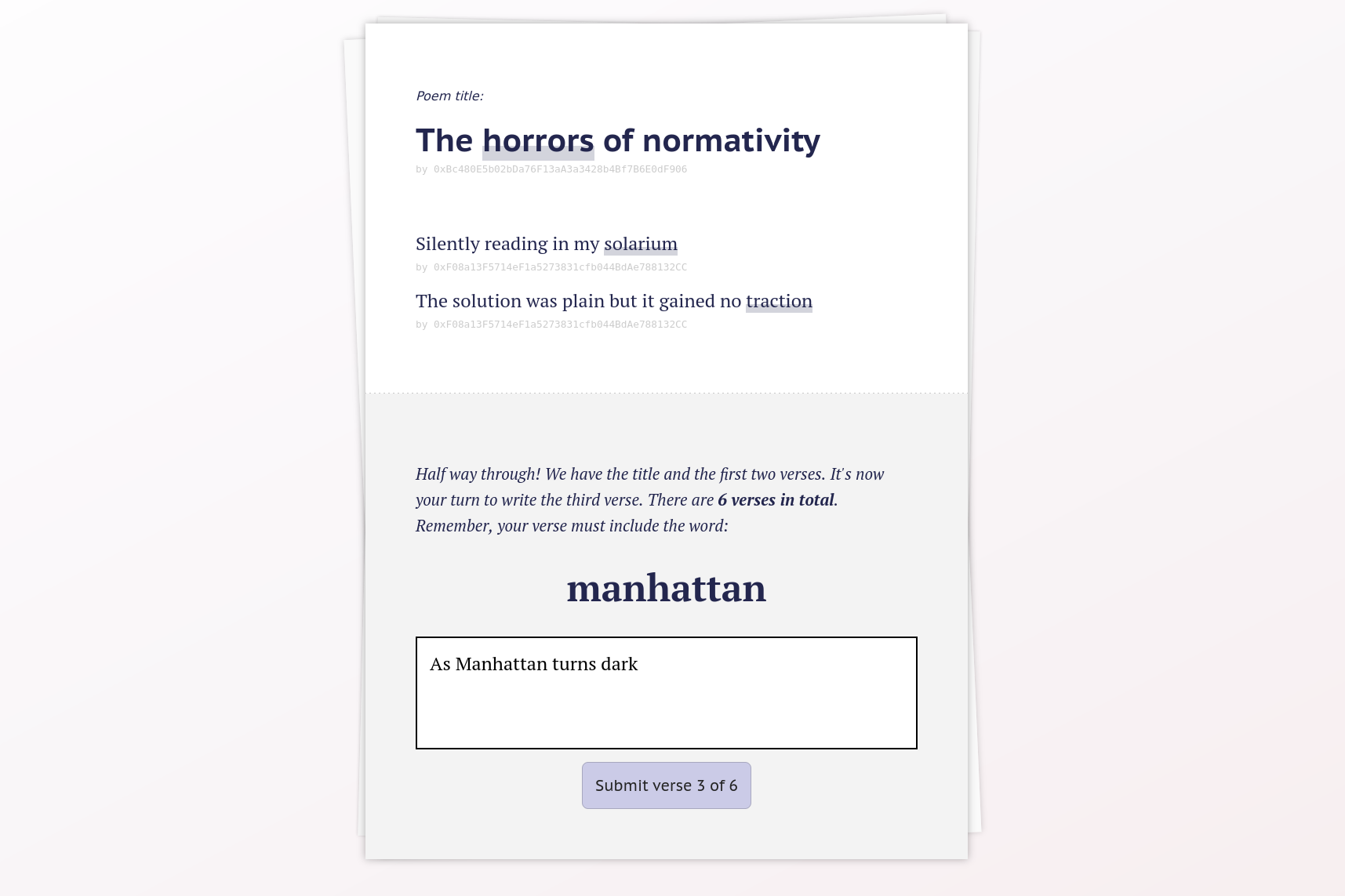
Overview of the dapp, waiting for Chainlink VRF to draw a new word for the next verse.
-
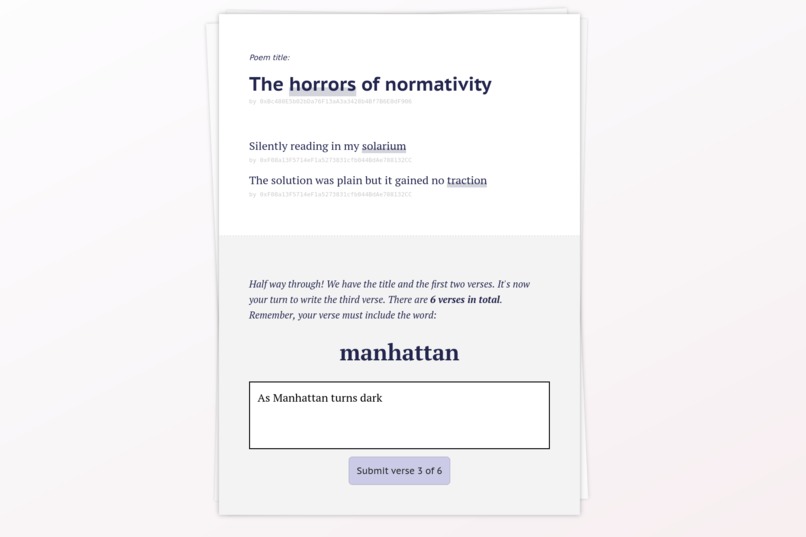
Top half: already written verses. Bottom half: current word, waiting for someone to write a verse with it.
-
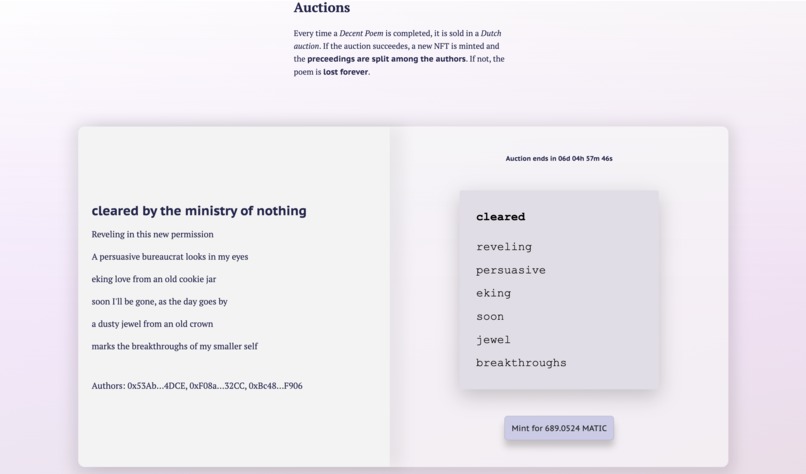
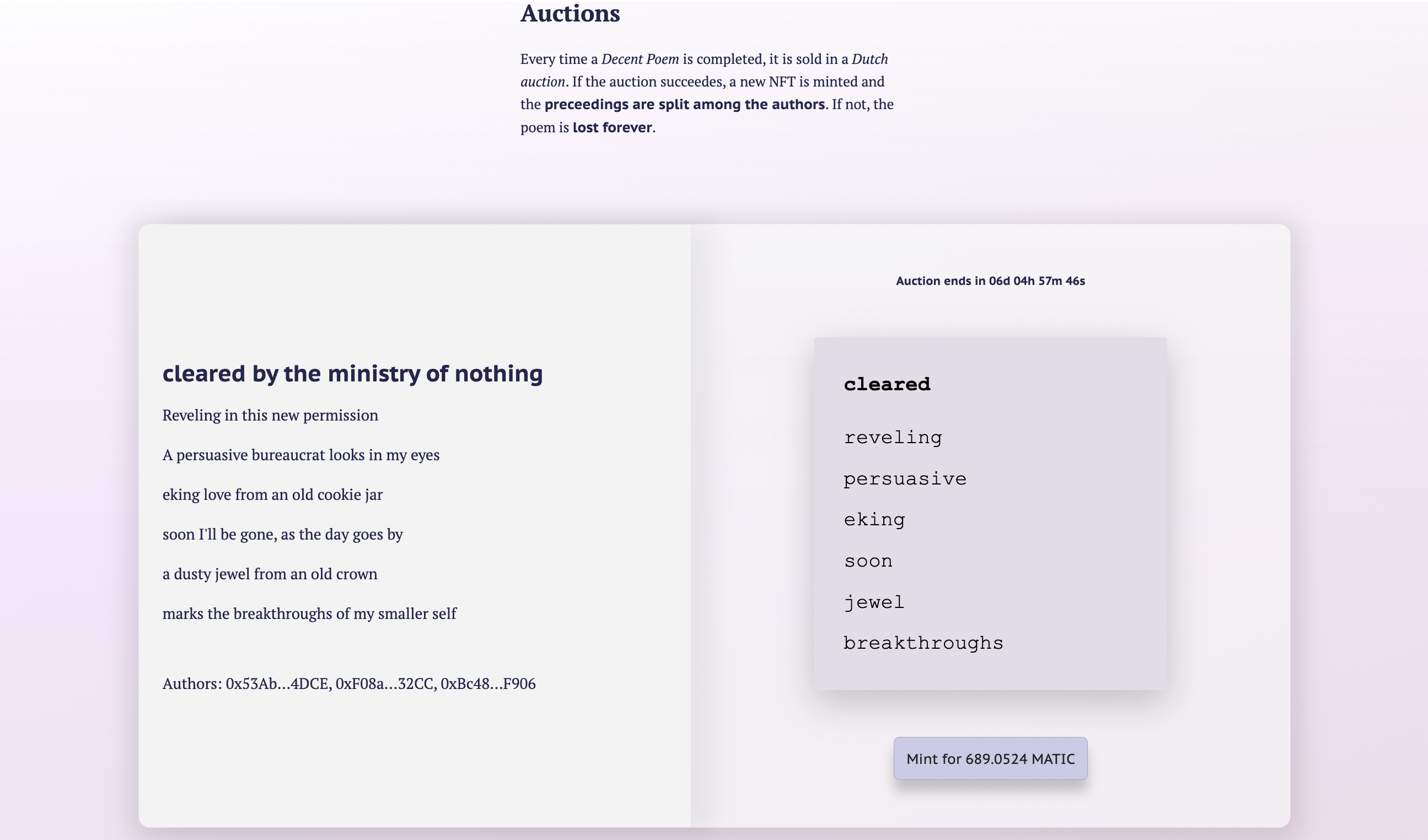
Left side: a finished poem and its authors. Right side: the dutch auction. Goes for 7 days, starts at 777 MATIC, ends at 7.
-
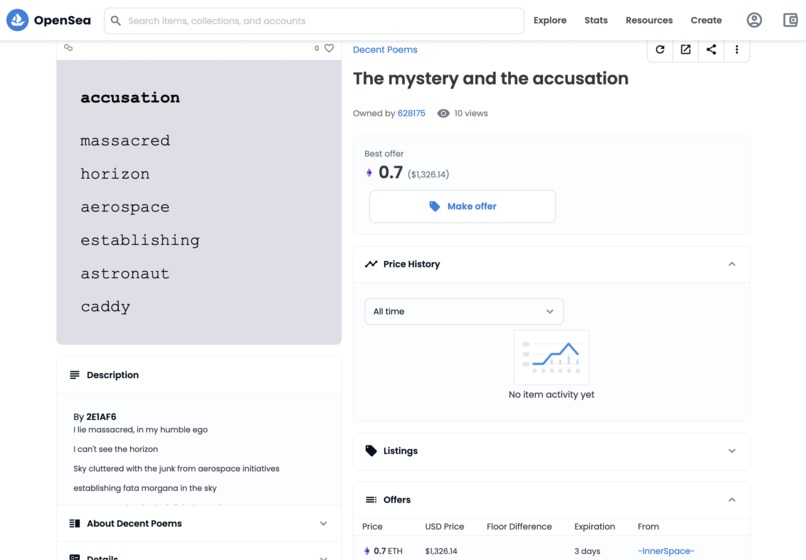
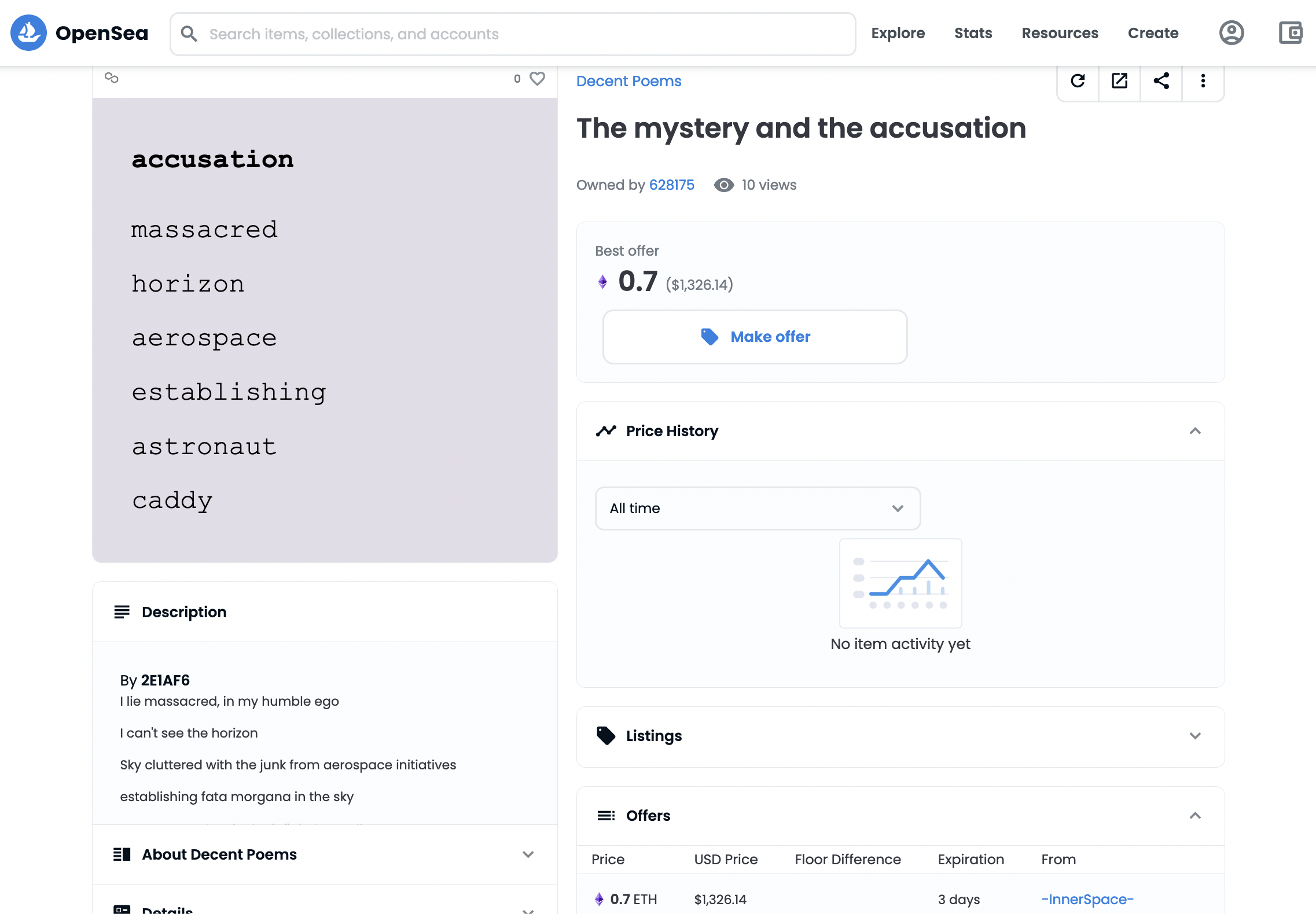
Opensea NFT Detail Page

Inspiration
"Let's put the whole English dictionary on blockchain", said no one ever. Actually, one of us said that, and after some weeks of development during the hottest days of summer, we are happy to announce our project: Decent Poems!
We are deeecent, two freelance blockchain devs in love with games that challenge people to cooperate and (sometimes) compete. We also love art and NFTs. With the chance to build something on a platform like Polygon, we thought it would have been nice to leverage the low fees of the blockchain to create an interactive, collaborative app, with a "web3" flavor. We initially tried to think if we could turn one of the many board or card games into a dapp, but nothing really exciting came to our mind. We thought about the many existing word games (wordle, scrabble, etc.), which are usually very fun and entertaining, but we didn't want to just "migrate" a game into web3.
At the same time, we realized how tiny the world of digital written art is: there are NFTs about music, images, and videos... but very few about words.
So, why not store the whole English dictionary* on-chain and use it to stimulate people's creativity?
Decent Poems /ˈdē-sᵊnt ˈpō-əms/ noun
- a protocol for collective writing
- a coordination experiment
- on–chain NFT poems.
*Not exactly all of it.
What it does
Decent Poems is a dapp that allows people over the internet to write poems. In Decent Poems, a poem has a title and 6 verses. Everyone can participate, but there are a few rules to spice up things a bit:
- Your verse must include what we call current word (randomly drawn).
- The current word is re-drawn every time someone submits a verse.
- If multiple people submit a valid verse, only the first one is stored, and the other ones are discarded.
- After submitting the 6th verse, the poem is finalized and it is sold in a Dutch auction.
- When the poem is sold, it's minted as an NFT, and authors that contributed will receive a part of the proceedings (this is true for secondary sales as well, as long as the marketplace implements the NFT Royalty Standard EIP-2981).
- If the poem is not sold, it is lost forever.
Everything is handled by our Smart Contracts, 100% on-chain, based on Polygon. So the system could live forever.
The website is also available on IPFS via IPNS+DNSLink.
Poetic explanation
The contract draws a word, just a word
Anon sees it, writes a verse that on the ledger is stored
The contract draws a new word, not looking for sense
Someone else takes it from there and writes another verse
5 more times we go on this tone
5 more verses join the poem
Will it be short or long, good or bad?
Only the harmony of the writers can tell
Now a poem has come to life. Where will it go? Who will see it?
A dutch auction is started. Will someone come and buy it?
If a degen presses the button and signs the transaction,
A new NFT is added to the Decent Poems collection
A new piece of creativity flows in the OpenSeas
And all of its authors will enjoy its proceeds
How we built it
Thanks to Polygon, we managed to squeeze all the features on-chain, effectively creating a fully decentralized application (including the SVG and metadata of the NFT-Poems :D).
We could then interact with some pretty cool components that came to the ecosystem:
- We included Chainlink VRF to generate the random words after each submission.
- We added support for the Sequence wallet.
- We deployed the dapp on IPFS as well, using NFT Storage. This makes sure that our content is permanently pinned and available through the Filecoin network.
- The dapp is accessible via IPNS. We set our DNS records according to the DNSLink specifications.
- Last, but not least, we used the great 0xSplit protocol to create the splits for the authors. Every time an NFT is minted, a split is created and the authors will be able (from the 0xSplit dashboard) to distribute the earnings among each other.
In a nutshell: OUR BACKEND IS POLYGON!
Challenges we ran into
- Words. We needed to find a good dictionary of words that were not too specific, to allow the authors to express their creativity with simplicity (thanks https://github.com/dolph/dictionary)
- Words, on-chain. We had to save the whole dictionary on Polygon. We have tried multiple optimization techniques (from storing uint rather than a string to ad-hoc array storing procedures). You know what? On Polygon everything is so cheap that the difference was not noticeable. So we decided to go for clarity rather than for extreme optimization.
- Chainlink VRF: for some reason, we were not receiving randomness from the VRF Coordinator. Everything was fixed after recreating the subscription. We also noticed that VRF fulfillments on Mumbai Testnet are sometimes quite slow (compared to Polygon Mainnet)
- 0xSplit contract interaction: the
createSplitfunction requires unique wallets, sorted by ascending orders, and the sum of the splits to be exactly 100%. This, due to the nature of Solidity, required some coding golf. - Mobile wallet integration: without manually setting a specific RPC endpoint on WalletConnect, mobile transactions would fail due to wrong gas estimates. We have encountered this problem only on Polygon so far and it took us some time to figure out the solution.
- Sequence wallet: we spent quite some time understanding how to enable testnet and we discovered late that the option must be enabled before logging in and not in the wallet settings afterward.
Accomplishments that we're proud of
We asked some friends to play with our dapp. Some of them never used a web3 dapp before, and other than telling them to install a wallet and give them 1 MATIC, they immediately understood the UI and the project itself. They started racing trying to be the first to submit the verse, and they created three beautiful poems! Some of the comments we received:
- I feel the pressure of poetry
- I really like the UI!
- OMG It's like speed chess but poetry
Doing UI/UX for web3 is not trivial, and, although we are not designers, we ended up doing something... decent. (After so many years in the industry we probably learned something). Anyway, our blockchain "newbies" didn't have any trouble playing with decentpoems.art!
We also are very proud of building a system that puts creators first, both in primary and secondary sales. Polygon allows us also to be more inclusive: given the low gas fees, anyone can participate!
What we learned
We learned that the Italian word "dilettante" is also an English one and with the exact same meaning (although we don't know exactly how to pronounce it).
Apart from that, we learned that, by keeping things simple, we can make our concept easier to understand and funnier to use.
Last but not least: this is the first time we deploy something official on Polygon. We learned that
- The block time is way faster than on Ethereum Mainnet and therefore more suited for highly interactive apps.
- The low gas fees enable the storage of very big amounts of data, which opens up the door (for instance) to building an app for poem writing and to storing a dictionary on-chain.
What's next for Decent Poems
In the short run, we will add a few more features to make the UX of the website nicer and provide some additional features, like auction filtering and sorting, a Twitter bot to keep the people informed about the newly created poems/sales, etc.
Talking about the future, Decent Poems is just the first implementation of a concept that goes beyond poems. We want to create protocols that incentivize creative people to express themselves and help them earn thanks to their skills.
Built With
- 0xsplit
- chainlink
- dnslink
- hardhat
- ipfs
- ipns
- sequence
- solidity
- svelte
- svg
- walletconnect


Log in or sign up for Devpost to join the conversation.