Inspiration
1. The Spark
"During my work with TERI (The Energy and Resources Institute), I saw a genuine breakdown. Brilliant teams knew what to do, but spent ₹1-3 Lakhs and 8 weeks on consultants just to structure how to measure it."
2. The Realization
"The problem wasn't a lack of knowledge—it was a tooling gap. We were designing complex logic in static spreadsheets, leading to 'Blank Page Paralysis' and disconnected data."
3. The Solution
"LFA Studio is the tool I wished we had. It turns ShikshaLokam’s 'trapped' spreadsheet data into an active design partner."
- Old Way: 2 months of emails & consulting calls.
- New Way with LFA Studio: 15 minutes of AI-guided collaboration.
4. Strategic Fit
"It closes the loop for Shikshagraha: Moving from just collecting data (ELEVATE) to helping NGOs design the very programs they measure."
What it does
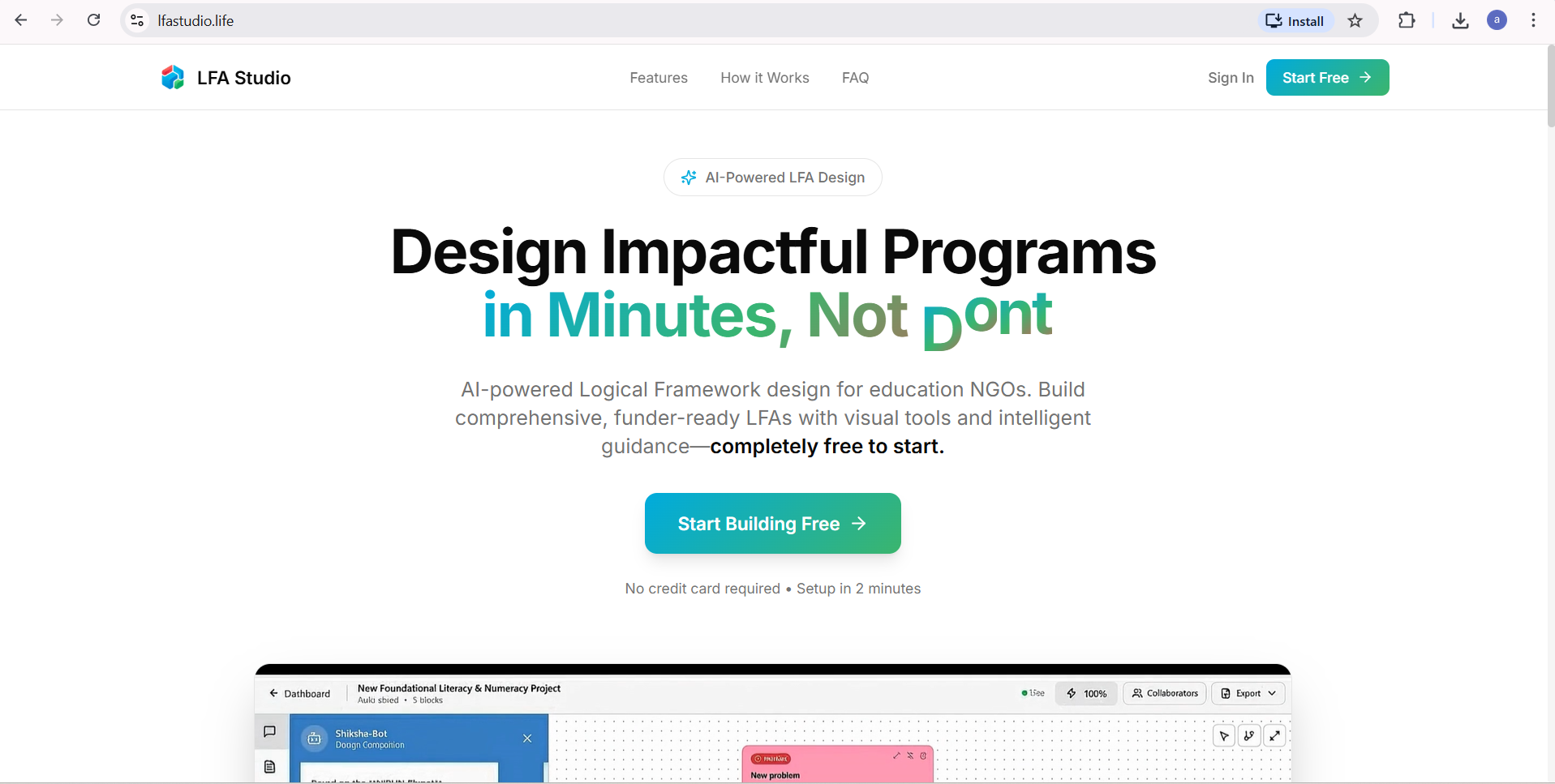
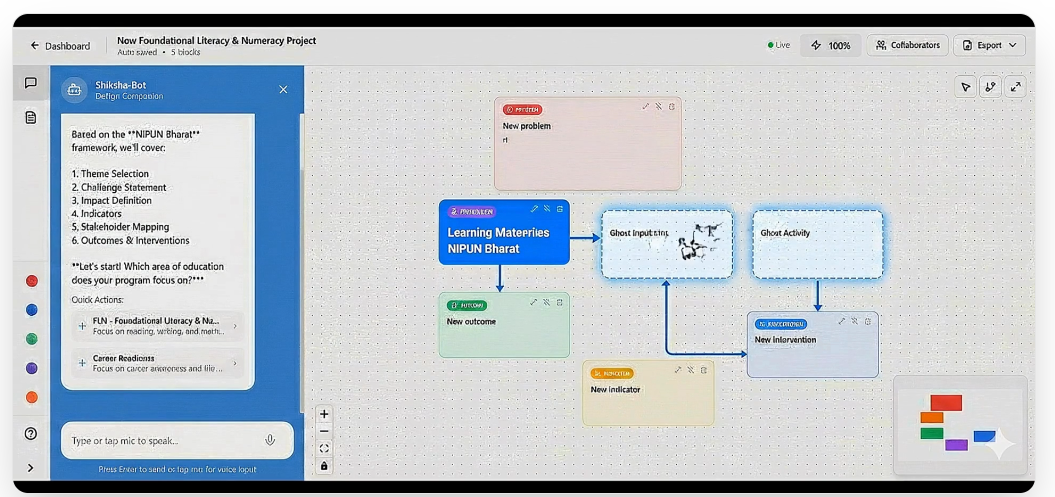
LFA Studio is an AI-powered visual chain design tool that simplifies Logical Framework design for education programs. Users create interconnected Problem-Outcome-Indicator chains on an interactive canvas while AI suggests improvements and auto-generates framework structures based on proven templates like NIPUN Bharat.
A Collaborative "Design Studio" for Development Sector Leaders
1. The Core Innovation
- Real-Time Collaboration: Multiple users edit the same LFA simultaneously (live cursors, comments) — ending the email loop.
- AI Co-Pilot: Users chat naturally to generate structured blocks. No "blank page anxiety".
- Data-Backed: Pre-loaded with NIPUN Bharat & Common LFA library, ensuring standardized inputs.
2. The "Magic" Feature: Ghost Blocks 👻
- Logic Enforcement: If a user connects Problem → Outcome without an intervention, the system visualizes the gap.
- Auto-Correction: A pulsing "Ghost Block" appears: "⚠️ Missing Intervention: How will you achieve this?".
3. Workflow & Scale
- 5-Step Wizard: Theme → Impact → Stakeholders → Outcomes → Export.
- Speed: Reduces design time from 4-8 weeks to 15 minutes.
- Scalability: Built for 4.5M education leaders; supports Hindi regional voice inputs for rural adoption.
How we built it
We built LFA Studio as a real-time AI collaboration system with a modern full-stack architecture.
🖥️ Frontend — Interactive Canvas
- Next.js 14: App framework
- React Flow (@xyflow): Node-based visual canvas
- Tailwind CSS: Rapid UI styling
- Zustand: Client state management
- TanStack Query: Server state syncing
This powers drag-drop blocks, edge linking, and live visual logic mapping.
🔄 Real-Time Collaboration Layer
- FastAPI + WebSockets: Enable sub-100ms sync
- Live cursors & presence indicators
- Block locking during edits
- Multi-user simultaneous editing
🧠 AI & Data Intelligence
- Google Gemini 3 + GPT-4o Mini orchestration
- Context-aware LFA suggestions
- Prompt pipelines trained on NIPUN Bharat frameworks
AI handles:
- Outcome generation
- Indicator suggestions
- Framework structuring
- Logic validation
⚙️ Backend Processing
- FastAPI middleware: Handles orchestration logic
- AI request routing & validation
- Framework generation pipelines
- Export engine generates: PDF, DOCX, PPT
🔐 Auth & State Infrastructure
- Clerk: Authentication & identity
- Zod + Pydantic: Validation & type safety
- Role-based collaboration permissions
⚡ Caching & Performance
- Redis enables:
- Real-time presence tracking
- Cursor position caching
- Ghost block state caching
Ensures low-latency collaboration at scale.
🗄️ Database & Persistence
- Neon PostgreSQL: For structured storage
- Stores:
- Projects
- Framework blocks
- Indicators
- Collaboration metadata
Challenges we ran into
- Designing a node-based UX usable by non-technical NGO leaders
- Maintaining sub-100ms real-time sync performance
- Preventing collaboration conflicts during simultaneous edits
- Structuring AI prompts for policy-aligned indicator generation
- Enforcing LFA logic validation dynamically
- Scaling voice + AI + canvas interactions simultaneously The hardest challenge was building Ghost Block logic detection that works in real time without breaking user flow.
Accomplishments that we're proud of
- Built a fully collaborative LFA design canvas
- Achieved real-time sync with live cursors & locking
- Created the Ghost Blocks 👻 logic enforcement system
- Integrated national frameworks like NIPUN Bharat
- Enabled AI-generated indicators & outcomes
- Reduced design time from weeks to minutes
- Designed infrastructure scalable to 4.5M education leaders
We’re especially proud of turning static spreadsheet planning into an intelligent design experience.
What we learned
- NGOs don’t lack expertise — they lack structured tooling
- Visual systems thinking improves program clarity dramatically
- AI works best as a guided collaborator, not an auto-generator
- Real-time collaboration is essential for sector adoption
- Logic enforcement builds trust in AI outputs We also learned that designing for social impact requires explainability, not just automation.
What's next for LFA Studio
Our roadmap focuses on scaling intelligence, accessibility, and ecosystem integration for the development sector.
📍 Product Roadmap
| Phase | Timeline | Features | Goal |
|---|---|---|---|
| v1.0 | Hackathon | MVP: 5-step wizard + export | Win hackathon |
| v1.1 | Month 1 | Voice assistant, more themes | User testing |
| v1.2 | Month 2 | Template marketplace, mobile web | Wider adoption |
| v1.3 | Month 3 | Offline mode, multi-language | Rural reach |
| v2.0 | Month 4–6 | ELEVATE integration, API access | Ecosystem integration |
| v2.1 | Month 6+ | Live data → LFA refinement | Continuous improvement |
⚠️ Risk Mitigation
| Risk | Likelihood | Impact | Mitigation Strategy |
|---|---|---|---|
| AI hallucinations | Medium | Medium | Use only Common LFA data |
| Real-time scaling | Low | Medium | Redis adapter for production |
| Export formatting | Medium | Low | Test across viewers early |
| User adoption | Low | High | Gamification reduces friction |
📊 Success Metrics
Demo Metrics
| Metric | Target | How Measured |
|---|---|---|
| Time to complete demo LFA | < 10 minutes | Stopwatch during demo |
| Ghost blocks detected | 100% | No unresolved gaps in final output |
| Wow moments in demo | 3+ | Ghost block, live cursor, confetti |
| Export works | 100% | PDF opens in Word/Preview |
| Collaboration shown | Yes | 2 users editing simultaneously |
📈 Post-Launch Metrics (Month 3)
| Category | Metric | Target |
|---|---|---|
| Adoption | Registered organizations | 50+ |
| Adoption | LFAs created | 200+ |
| Engagement | Avg. time to first LFA | < 30 minutes |
| Engagement | Completion rate | > 70% |
| Engagement | Collaboration sessions | > 30% multi-user |
| Quality | Logic gaps at export | 0 (enforced) |
| Quality | User satisfaction (NPS) | > 50 |
| Retention | Weekly active users | > 40% |
| Retention | LFAs per organization | > 2 avg |
🌍 Long-Term Impact Metrics (Year 1)
| Metric | Baseline | Target |
|---|---|---|
| Time to create LFA | 4–8 weeks | < 1 week |
| Consultant cost saved | ₹2–5L per LFA | ₹0 |
| Design quality consistency | Variable | > 80% meet criteria |
| Programs with clear logic | ~40% | > 90% |
| Ecosystem learning | Siloed | Shared across 100+ orgs |
Built With
- clerk
- fastapi
- gemini
- gpt
- neon
- nextjs
- pydantic
- query
- react
- redis
- tailwind
- websockets
- zustand

Log in or sign up for Devpost to join the conversation.