-
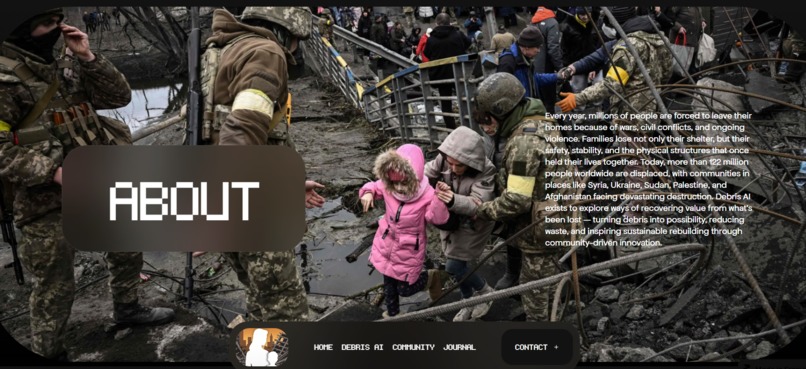
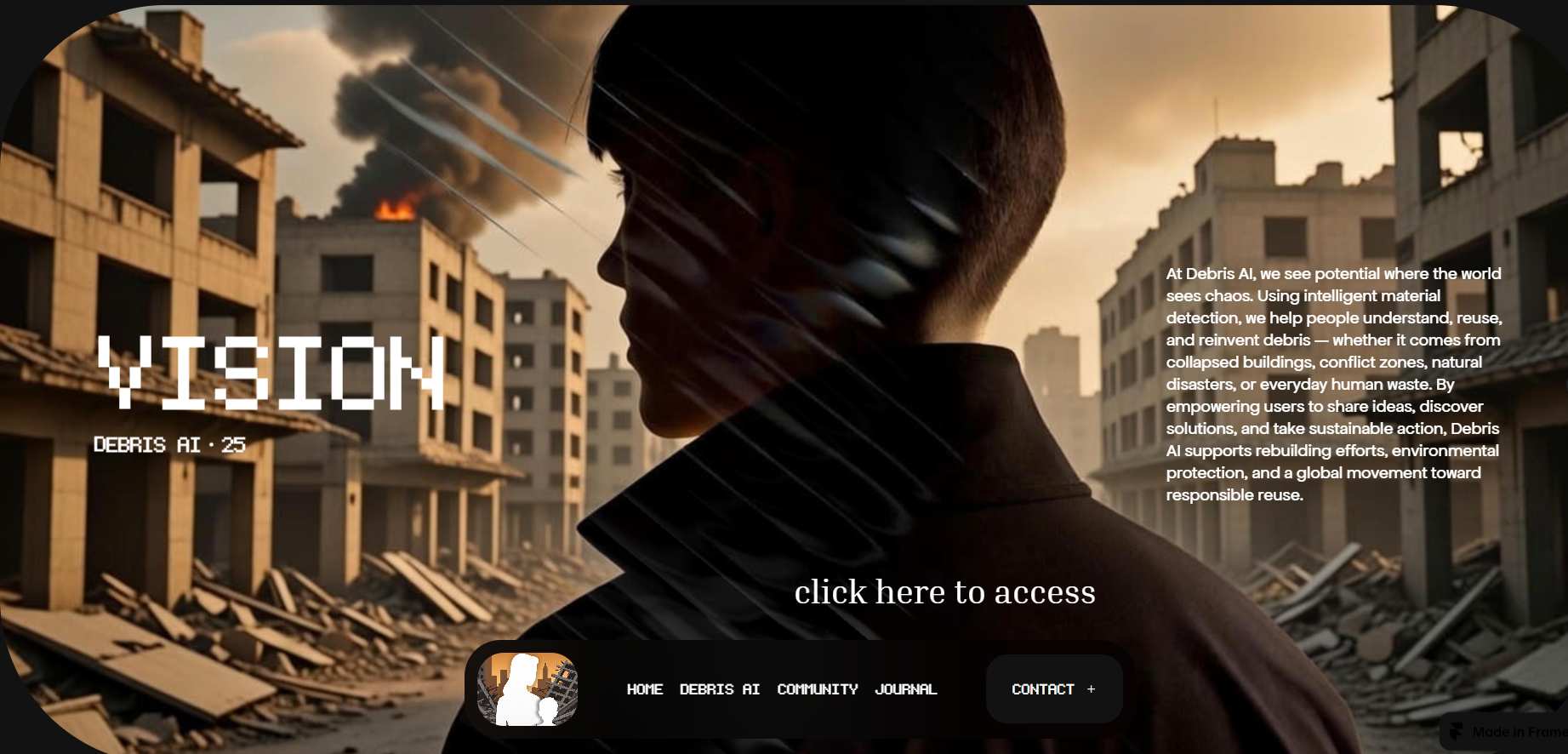
Debris AI analyzes damaged urban environments to identify reusable materials within rubble instead of treating everything as waste.
-

Debris AI helps enable faster, more sustainable recovery by improving decisions around material reuse in resource-constrained environments.
-
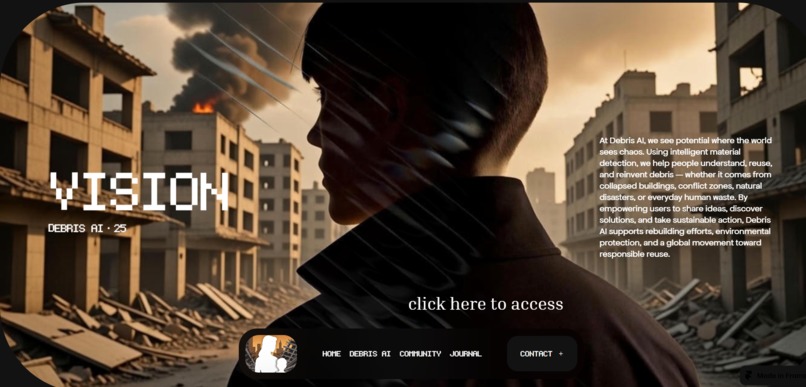
Providing material-level insights in post-conflict zones to reduce uncertainty during rebuilding and recovery.
-
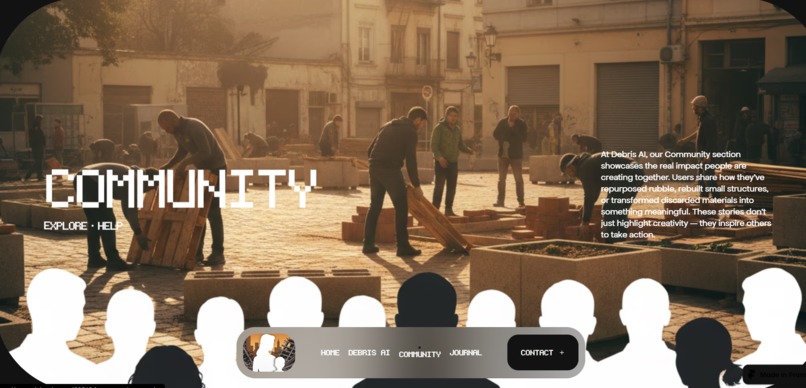
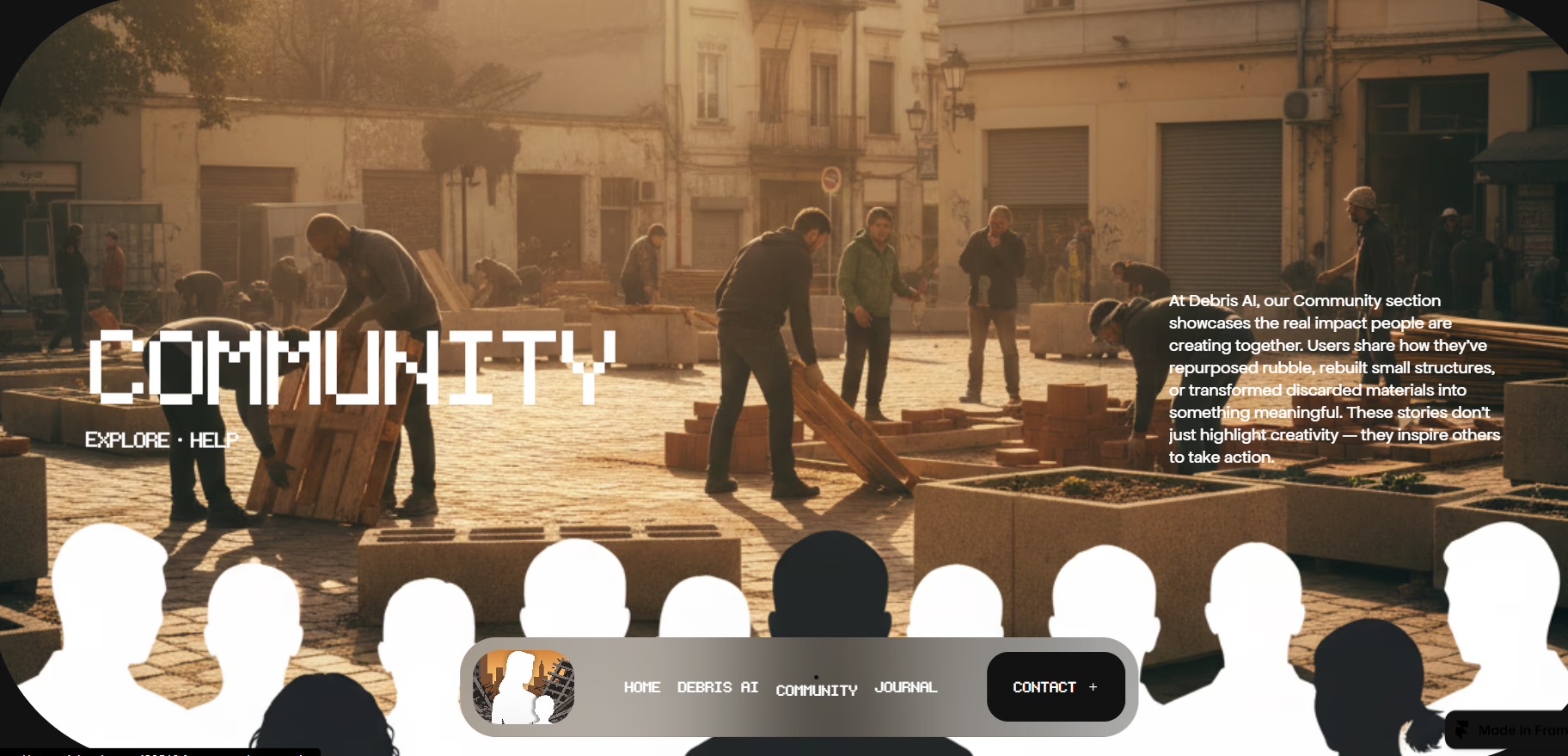
Debris AI supports community-led rebuilding by documenting and sharing practical reuse methods for recovered materials.
-

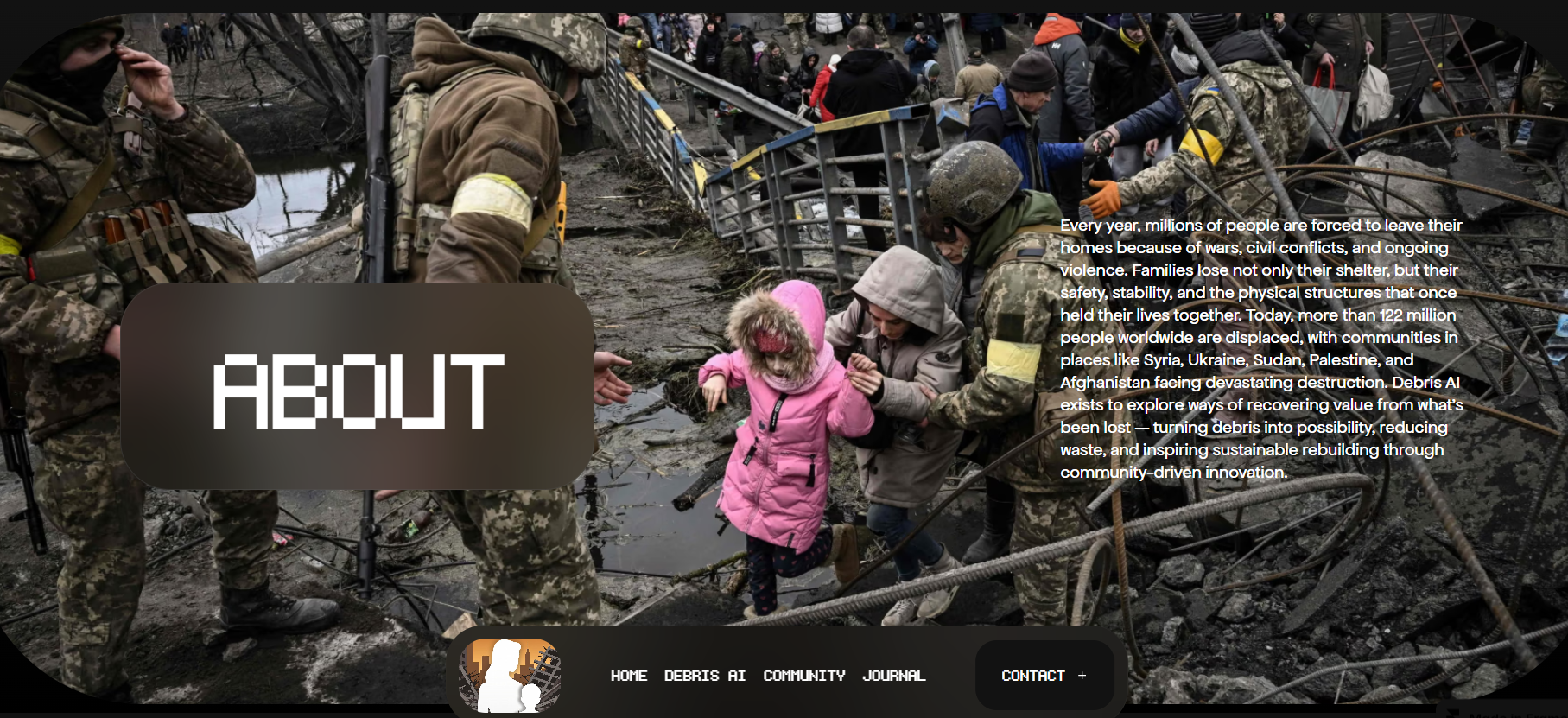
No child deserves to bear a life like this


Inspiration
Debris AI began with a simple but unsettling observation: in moments of destruction—whether caused by disasters, conflict, or rapid urban development—vast amounts of usable material are treated as waste. While studying post-disaster recovery reports and construction waste statistics, I noticed a recurring pattern: rebuilding efforts often depend entirely on new resources, even when rubble and debris on the ground could be partially or fully reused.
What stood out was not just the scale of waste, but the lack of accessible intelligence at the point of decision-making. People on the ground rarely have the tools or expertise to quickly assess whether broken materials can be reused safely or meaningfully. This gap between availability and understanding became the foundation of Debris AI.
What it does
Debris AI is an AI-powered system designed to analyze rubble, debris, and discarded materials to determine reuse and repurposing potential in real-world environments.
It does this by:
- Applying computer vision to identify and classify materials such as brick, concrete, metal, wood, and tile from images
- Evaluating whether fragmented materials can be reassembled or safely repurposed
- Generating practical reuse suggestions based on material properties and geometry
- Enabling a community-driven journaling and exchange system where users share reuse examples and available materials
The result is a system that turns debris from an unknown risk into an informed decision.
How we built it
Debris AI was developed through an iterative research and engineering process:
Problem exploration
We analyzed global construction and demolition waste data, post-disaster recovery workflows, and community-led rebuilding efforts to understand where material intelligence breaks down.
Model prototyping
We designed an image-based pipeline that combines material classification, object segmentation, and heuristic feasibility scoring to assess reuse potential from visual input.
System design
The architecture integrates:
- Image analysis for material detection
- Rule-based and learned reuse feasibility evaluation
- Community knowledge capture through journals and shared listings
Prototype implementation
An early MVP was built to accept real-time image input, return material insights, and allow users to document and share reuse outcomes.
Challenges we ran into
- Visual ambiguity in debris made material classification difficult, especially under poor lighting or heavy damage
- Determining “safe reuse” without overclaiming structural certainty required conservative design decisions
- Translating AI insights into actionable, human-understandable guidance was more complex than raw prediction
- Balancing automation with community knowledge required careful UX and ethical considerations
Accomplishments that we're proud of
- We framed debris not as waste, but as an information problem that AI can help solve
- We built a system that combines material intelligence with human-led reuse knowledge
- We demonstrated that meaningful reuse guidance can be generated without complex or invasive sensing
- We created a foundation for scalable, community-driven recovery intelligence
What we learned
- Most rebuilding inefficiencies stem from uncertainty, not lack of materials
- AI is most impactful when it augments human judgment rather than replacing it
- Conservative, explainable recommendations build more trust than overconfident predictions
- Community-shared knowledge can scale sustainability faster than centralized planning
- Environmental impact reduction begins at the decision level, not the disposal stage
What's next for Debris AI
- Model refinement: Fine-tuning material classification and reuse feasibility scoring
- Expanded datasets: Incorporating more real-world rubble imagery from diverse environments
- Community scaling: Enhancing journaling and exchange features for broader participation
- Deployment readiness: Integrating backend infrastructure for reliable, low-latency inference
- Ethical extension: Aligning future model development with fairness-aware principles inspired by FairVis-SLM
Built With
- framer
- gemini
- vercel

Log in or sign up for Devpost to join the conversation.