Inspiration
The inspiration for the Debian repo builder came from the need to simplify and automate the process of creating, managing, and building Debian repositories and packages. Many developers and organizations struggle with the complexity of maintaining DEB repositories, especially when dealing with frequent updates, multiple packages, and cross-architecture builds. We saw an opportunity to streamline this process using GitHub Actions, making it more accessible to a wider range of projects and allowing developers to focus on their core application logic rather than package management intricacies.
What it does
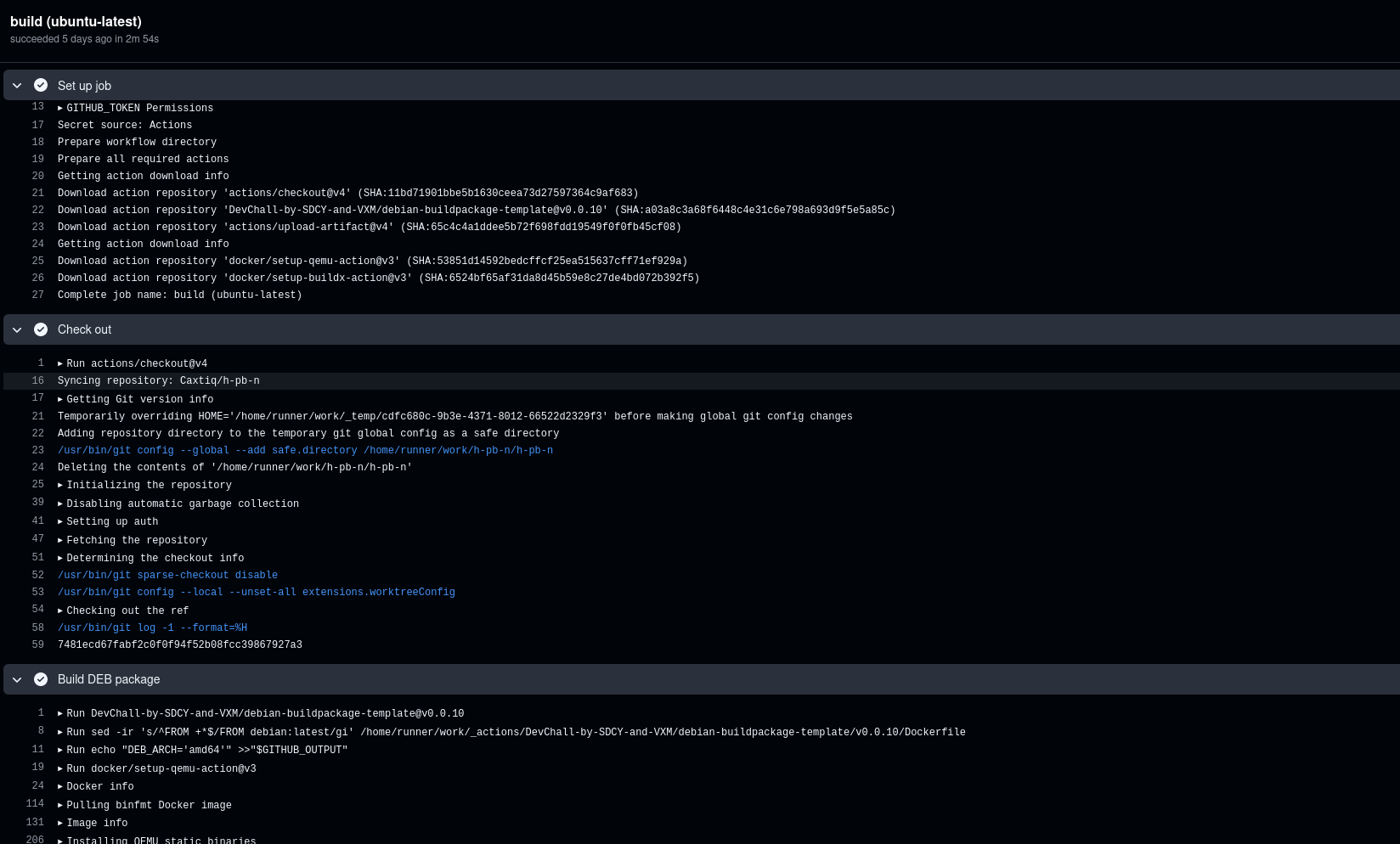
The Debian repo builder is a GitHub Action that automates the creation of DEB repositories and the building of Debian packages. It offers the following key features:
- Generates a customizable repository structure
- Handles package metadata and DEB file downloads
- Supports multiple Debian-based distributions
- Enables cross-architecture builds (e.g., building ARM packages on x86 machines)
- Integrates optional GPG signing for enhanced security
- Creates a ready-to-use Debian repository as a compressed artifact
- Provides flexible configuration options to suit various project needs
- Integrates seamlessly with GitHub Actions workflows
How we built it
We built the Debian repo builder using a combination of technologies and tools:
- Bash scripting for the core functionality and build logic
- GitHub Actions workflow syntax for integration
- Docker to create isolated and reproducible build environments
- QEMU for cross-architecture builds and emulation
- Debian tools like reprepro and dpkg-buildpackage for repository and package management
- GPG for signing capabilities
The action is structured as a composite run steps action, allowing for a modular and maintainable codebase. The development process involved iterative testing with various Debian-based projects to ensure compatibility and reliability across different scenarios.
Challenges we ran into
During the development of the Debian repo builder, we encountered several challenges:
- Ensuring compatibility with various Debian-based systems and package formats
- Implementing secure GPG signing without exposing keys in the GitHub Actions environment
- Optimizing download, build, and repository creation performance, especially for large numbers of packages and cross-architecture builds
- Handling edge cases in package metadata and file structures
- Balancing flexibility and simplicity in configuration options
- Dealing with diverse Debian packaging practices across different projects
Accomplishments that we're proud of
We're particularly proud of several aspects of the Debian repo builder:
- Creating a user-friendly interface for complex repository management and build tasks
- Successfully integrating GPG signing in a secure manner
- Achieving high flexibility in repository configuration while maintaining ease of use
- Simplifying cross-architecture builds without complex setup
- Generating comprehensive metadata about built packages, enhancing traceability and management
- Developing a solution that can significantly reduce manual work in software distribution
- Ensuring broad compatibility with various Debian-based distributions and package types
What we learned
Throughout this project, we gained valuable insights and skills:
- Deep understanding of Debian package management systems and packaging internals
- Best practices for secure key management in CI/CD environments
- Advanced Docker and containerization techniques for build environments
- Intricacies of cross-architecture compilation and emulation
- Techniques for optimizing file operations in GitHub Actions
- The importance of error handling and logging in automated tools
- Balancing automation with user control in developer tools
- Best practices for creating flexible and maintainable GitHub Actions
What's next for Debian repo builder
Looking ahead, we have several ideas to further enhance the Debian repo builder:
- Expanding support for more complex repository structures and Debian-based distributions
- Implementing advanced caching mechanisms to improve performance and speed up repeated builds
- Adding features for repository mirroring, synchronization, and automatic changelog generation
- Developing companion tools for easy repository browsing, management, and local testing of builds
- Exploring integration with other CI/CD platforms beyond GitHub Actions
- Implementing advanced security features like reproducible builds and build attestation
- Creating a web interface for monitoring and managing builds across repositories
- Continuing development based on community feedback and emerging needs in the Debian packaging ecosystem
We're excited about the potential impact of this tool and look forward to its continued evolution and adoption in the Debian packaging community.


Log in or sign up for Devpost to join the conversation.