Inspiration
As a former collegiate debater, I saw how limited access to practice opponents held back growth—tournament prep relied on finding peers with matching schedules. I wanted to build a tool that delivers instant, high-quality debate practice anytime, anywhere, leveraging AI to mimic real-world opposition and provide actionable feedback.
What it does
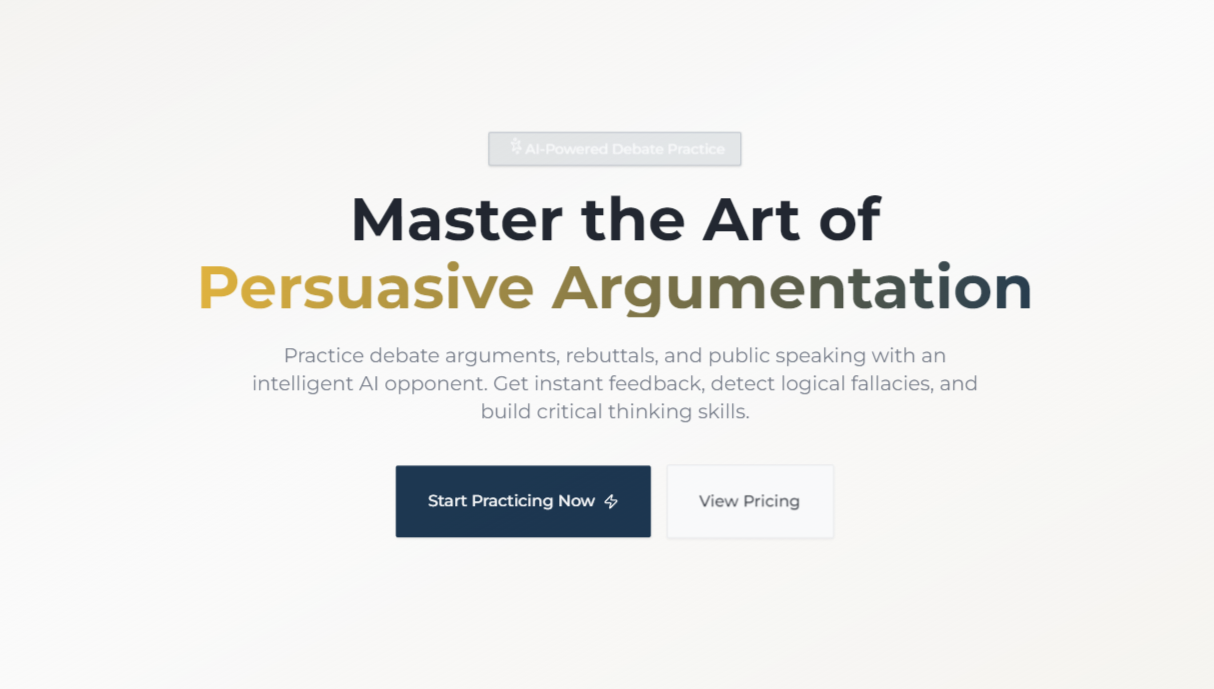
DebatePractice AI is a real-time platform that acts as a dynamic debate opponent. Users select topics (or create custom ones), choose a stance, and engage in structured debate rounds with AI. The platform analyzes arguments for clarity, evidence, and logical fallacies, delivering instant feedback to strengthen critical thinking and persuasive communication skills. It also supports impromptu speaking practice with timed prompts and pacing analysis.
How we built it
We started with core UX mapping for debate flow, then built the frontend with React and TailwindCSS, using GSAP for the advanced animations outlined in the design specs. The backend (Node.js/Express) integrates with OpenAI API to generate context-aware debate responses, while Firebase handles user sessions and subscription management. MongoDB stores debate topics and session data, and Vercel hosts the platform for seamless scaling.
Challenges we ran into
The biggest hurdle was tuning the AI to deliver natural, debate-style rebuttals (not just generic responses) while adhering to formal debate structure. We also struggled with optimizing complex animations (parallax, particle systems) for performance—balancing visual polish with smooth load times took iterative testing across devices. Subscription flow integration with payment processing also required rigorous edge-case testing.
Accomplishments that we're proud of
We created an AI opponent that mirrors real debate dynamics, with nuanced rebuttals and targeted questions. The platform’s visual design (3D tilt effects, animated gradients, glassmorphism) delivers a premium, engaging experience without sacrificing performance. Most importantly, beta testers (collegiate debaters, law students) reported measurable improvement in argument structure and fallacy recognition after just 2 weeks of use.
What we learned
Building AI for conversational debate requires deep alignment with rhetorical rules—not just natural language generation. We also learned that advanced animations demand modular code structure to avoid performance bottlenecks. User testing revealed that specificity in feedback (e.g., "your hasty generalization about climate policy ignores regional data") was far more valuable than generic tips, shaping how we refined the analysis engine.
What's next for this project
We plan to expand the topic library to include regional policy debates (U.S. state-level, EU legislation) and add progress tracking dashboards to visualize skill growth over time. We’re also exploring lightweight voice recognition for spoken debate practice and integrating peer review features—letting users share sessions with coaches/teammates for collaborative feedback. Finally, we’ll optimize the mobile web experience to match the desktop’s animation and functionality polish.

Log in or sign up for Devpost to join the conversation.