-
-
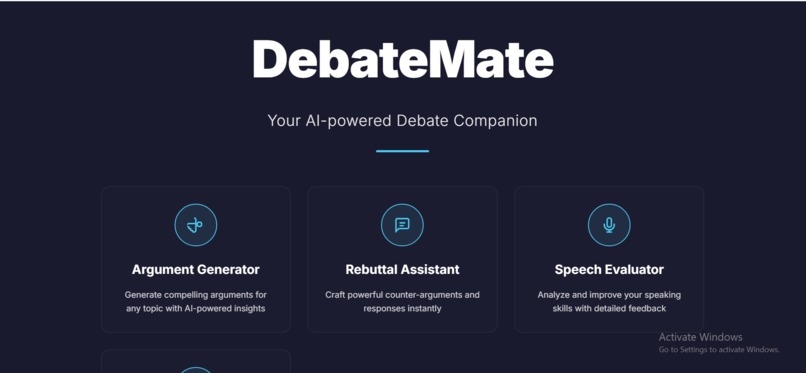
interface
-
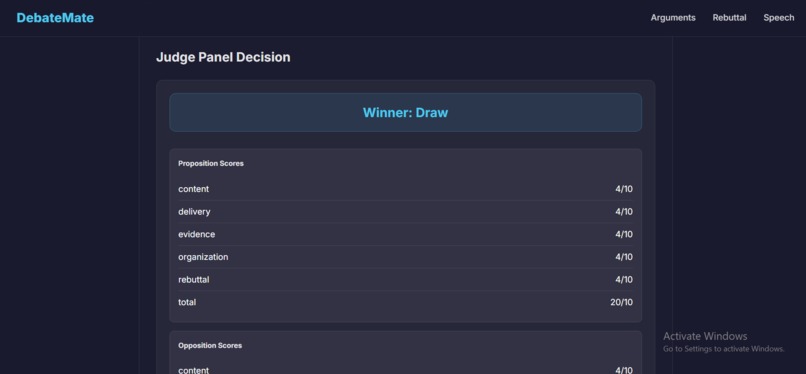
judge pannel decision making process
-
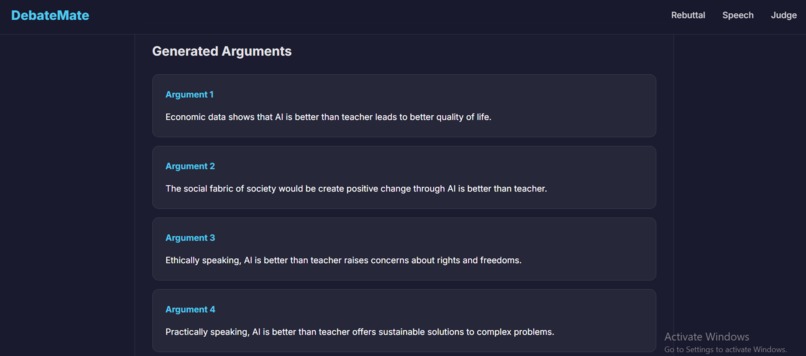
argument generator
-
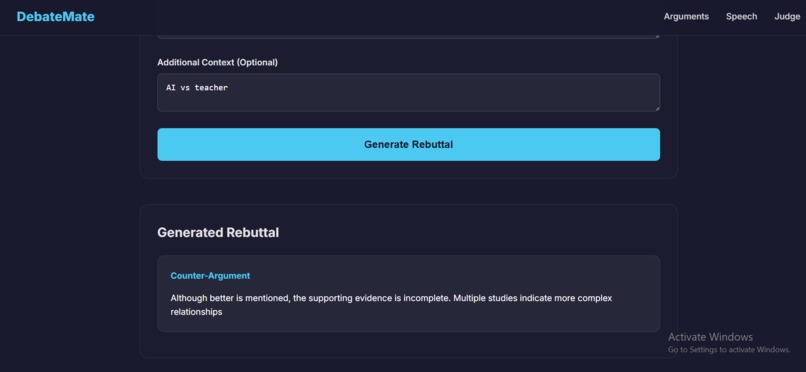
rebuttal assistant
-
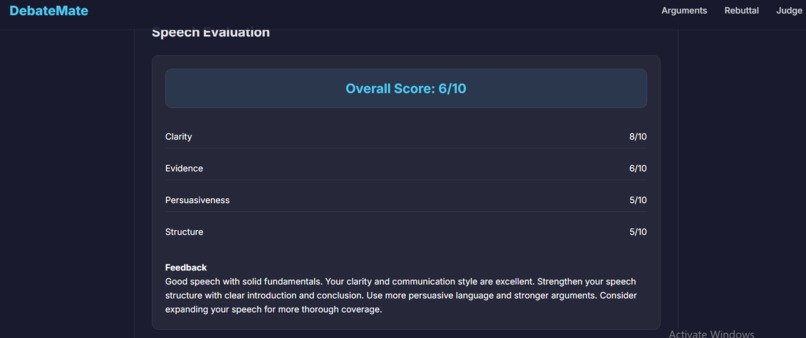
speech evaluator


Inspiration
DebateMate was inspired by a common struggle — trying to express a solid point but getting lost while arguing. Many students, including myself, often find it hard to structure thoughts quickly, especially during serious conversations. The real spark? Arguing with my dad. I knew I was right, but before I could defend my point, his hand was halfway to my face. That slap phase taught me one thing — I needed to prove him wrong before his hand landed. I wished I had something to quickly generate arguments, counter his points, and defend myself logically (and safely). That need — to win with words, not wounds — led to DebateMate, a smart assistant that helps you build arguments, rebuttals, and confidence on the fly.
What it does
Generates 3 strong arguments for or against any debate topic
Creates smart rebuttals based on opponent’s points
Evaluates speech delivery (clarity, structure, persuasiveness)
Judges both sides and picks a winner using AI
Detects bias in judging and scoring
Provides daily debate motions to practice
Helps users learn and improve debate skills step-by-step
How we built it
Frontend: Designed using HTML, CSS, and JavaScript for a clean and responsive UI
Backend: Built with Flask to handle routing, API requests, and ML model integration
Argument Generator: Initially used template-based logic, later integrated OpenAI GPT for natural, context-aware arguments
Rebuttal Assistant & Judge Panel: Custom rule-based logic to simulate realistic debate dynamics
Speech Evaluator: Analyzed structure, clarity, and persuasiveness with basic NLP scoring
Daily Motions: Loaded from a JSON file and rotated using date logic
Bias Detector: Added to ensure fairness in AI judging decisions
Challenges we ran into
OpenAI API limits & quota errors We faced several API key and quota-related issues during integration, which blocked testing until resolved.
Model access restrictions We initially tried using GPT-4, but access was limited. We had to fallback to GPT-3.5 and redesign prompts accordingly.
Environment setup issues Managing .env files, API key security, and library compatibility in local development took effort.
Accomplishments that we're proud of
Built a multi-featured debate assistant from scratch From argument generation to speech evaluation, we implemented an end-to-end intelligent system in just a few days.
Integrated GPT models for live argument and rebuttal generation Successfully leveraged OpenAI’s API to assist users in real-time during debates.
Created a clean and interactive UI Our Flask + HTML/CSS interface provides an intuitive experience for users across different features.
Simulated a judge panel with basic bias detection We introduced a scoring system that mimics real-life judging and checks for possible evaluation biases.
Handled secure API setup and local environment configuration Managed .env files and Git integration to keep API keys safe and avoid common deployment issues.
Made debating feel more fun and educational The tool doesn’t just generate content — it teaches users how to structure, defend, and refine arguments.
What we learned
Through building DebateMate, we gained hands-on experience integrating AI into real-world educational tools. We learned how to connect language models with web applications, handle API limitations, and ensure secure key management. Debugging fetch requests between frontend and backend helped us understand asynchronous data flow in JavaScript. We also realized how important clear prompt design is when working with GPT-based models. Most importantly, we saw how AI can support critical thinking, not just automate tasks. It taught us that even a simple tool — if designed thoughtfully — can empower users to express themselves better and learn from every argument, win or lose.
What's next for DebateMate
We're excited about where DebateMate can go next. First, we plan to move away from API calls and instead train our own transformer model to generate arguments and rebuttals offline. We also want to let users save and revisit their past debates, so they can actually see how they’re improving. Since debating shouldn’t be limited by language, we aim to support multiple languages soon. Another big step is adding voice input — being able to speak your arguments and get real-time feedback would be powerful. To make things more fun, we’re thinking of gamifying the judge panel with badges and scores. Finally, we want users to create their own debate topics and instantly test how strong their points are. There’s a lot ahead!


Log in or sign up for Devpost to join the conversation.