The Problem
Most people cannot argue well. Not because they lack intelligence, but because they have never had a sparring partner who pushes back intelligently, catches their logical errors in real time, and gives them honest feedback on exactly where their reasoning broke down.
Debate coaches are expensive. Study groups are inconsistent. Reading about logical fallacies is passive. None of these give you the visceral experience of having your argument dismantled and being forced to rebuild it on the spot.
What DebateIQ Does
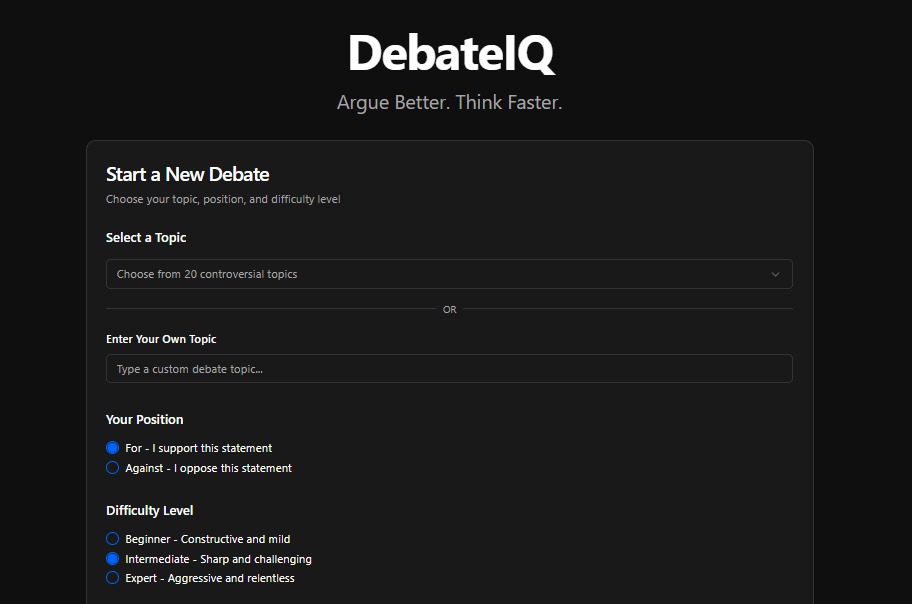
DebateIQ puts you in a structured 3-round debate against an AI opponent that genuinely argues back.
You pick a topic. You pick your side. The AI takes the opposite position and fights for it intelligently, adapting its counter-arguments to whatever you actually said, not generic responses.
While you argue, DebateIQ analyses your messages in real time and flags logical fallacies the moment they appear: ad hominem, straw man, false dichotomy, appeal to authority, slippery slope, hasty generalisation. Each flag appears as a badge on your message with a one-line explanation of what went wrong and why.
After each round, both you and the AI are scored across three dimensions: argument strength, use of evidence, and logical consistency. You watch your score change based on the quality of your reasoning, not just your confidence.
After round 3, the AI delivers a 200-word verdict declaring a winner, referencing specific arguments made during the debate, identifying the turning point, and giving you targeted feedback on what to improve.
How It Was Built
DebateIQ was built entirely on MeDo through natural language instructions. The entire application, including the debate interface, real-time fallacy detection engine, scoring system, and verdict generation, was described conversationally and generated by MeDo without writing a single line of code manually.
Every AI interaction in the app is a live call. The opponent's counter-arguments are generated dynamically with the full debate history as context on every turn. Fallacy detection runs as a separate AI analysis after each user message. Scoring is generated by evaluating the actual arguments exchanged that round. The final verdict is produced from the complete transcript. Nothing is hardcoded or simulated.
The Build Experience
The most impressive moment was watching MeDo wire up the multi-turn debate context correctly. The AI opponent genuinely remembers what you said in Round 1 and references it in Round 3. That level of conversational continuity, built through natural language instructions alone, is what separates MeDo from simpler no-code tools.
The biggest challenge was ensuring every AI interaction was truly dynamic. The first iteration defaulted to static responses in places. Iterating through MeDo's chat interface to enforce live API calls on every single interaction, including fallacy detection as a separate call rather than bundled with the response, required precise instruction but MeDo handled it.
Who It Is For
DebateIQ is for students preparing for debates, professionals who want to sharpen their critical thinking, anyone who has ever lost an argument and wanted to know exactly why, and anyone who wants to think faster and argue better.
The skill of argumentation is one of the most underdeveloped and undervalued cognitive skills in the world. DebateIQ makes practising it addictive.
Built With
- ai
- baidu-ai
- javascript
- medo
- natural-language-processing
- real-time

Log in or sign up for Devpost to join the conversation.