Inspiration
As a former debate team captain, I saw how limited access to practice opponents held back so many talented speakers—especially students without a dedicated coach. I wanted to create a tool that could replicate the rigor of competitive debate, adapt to skill levels, and deliver actionable feedback instantly. The gap between "knowing an argument" and "defending it well" inspired every feature of DebateCoach AI.
What it does
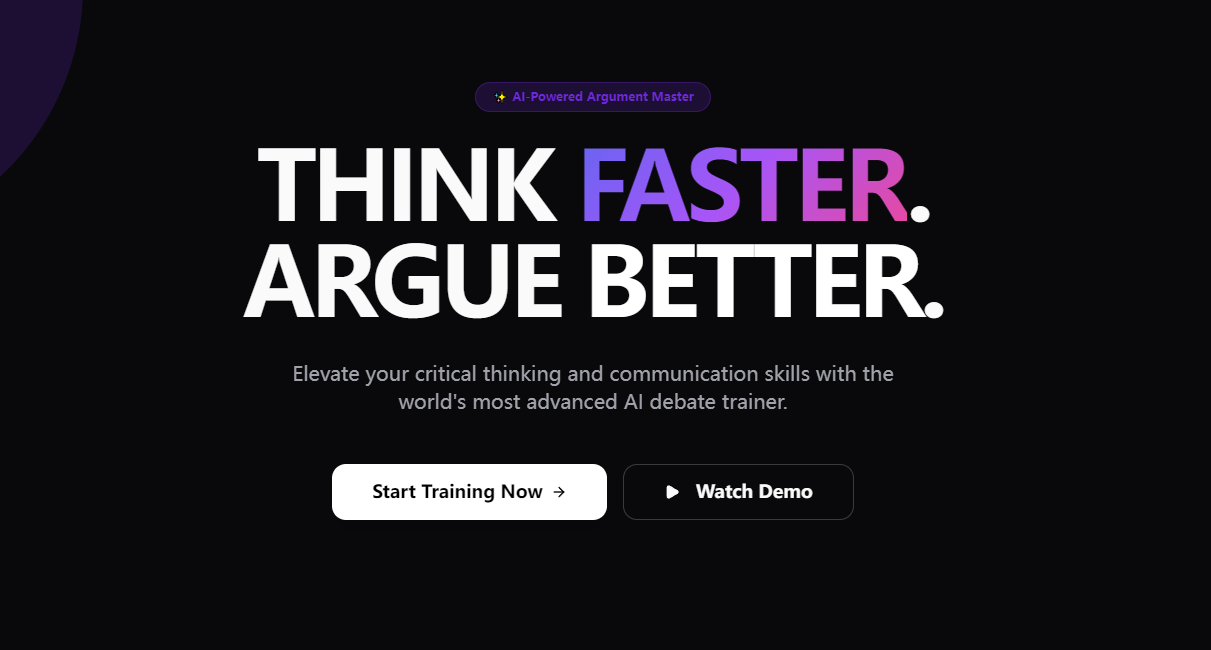
DebateCoach AI is an intelligent debate training platform that acts as a dynamic opponent, challenging users on 500+ topics across politics, science, ethics, and business. It detects logical fallacies in real time, scores argument strength and evidence quality, tracks progress over time, and offers tailored feedback to build critical thinking and public speaking confidence. For educators, it provides a dashboard to monitor student performance and identify skill gaps.
How we built it
We started with core AI logic using Python and TensorFlow to train models for fallacy detection and argument analysis. The frontend was built with React for a seamless, real-time interface, while Node.js powered the backend to handle debate session data and user progress tracking. We leveraged AWS for cloud hosting and PostgreSQL for storing debate transcripts and performance metrics. The OpenAI API was integrated to power adaptive AI opponent responses, with difficulty scaling from Beginner to Oxford Union levels. Chart.js was used to visualize progress analytics, making it easy for users to see their growth.
Challenges we ran into
One of the biggest hurdles was fine-tuning the AI to adapt to different debate styles and skill levels—ensuring beginner-level rebuttals were constructive but not overwhelming, while Oxford Union-level challenges were sophisticated without being unapproachable. We also struggled with real-time fallacy detection accuracy; early models misclassified nuanced arguments, so we iterated with hundreds of debate transcripts to refine the training data. Additionally, balancing speed and depth in feedback was tricky—users needed instant insights without sacrificing detailed analysis.
Accomplishments that we're proud of
We’re proud to have built a platform that delivers 92% accurate logical fallacy detection, with a user interface that feels intuitive even during high-pressure timed debate modes. Seeing beta users improve their win rates by an average of 23% in just one month validated our approach. The educator dashboard has also been well-received, with teachers reporting it saves hours of manual feedback while providing more targeted insights into student performance.
What we learned
We learned that adaptive learning tools succeed when they center user context—debate is as much about confidence as logic, so feedback had to be constructive, not just critical. We also discovered the value of iterative testing with real debate practitioners; their input reshaped everything from topic categorization to the pace of AI responses. Technically, we deepened our expertise in integrating multiple APIs (OpenAI, Chart.js) while maintaining real-time performance, and learned how to scale AI models efficiently for cloud deployment.
What's next for this project
Next, we plan to expand the topic library to include regional issues relevant to US and EU users, and add a voice-based debate mode with speech recognition to simulate in-person speaking. We’re also exploring gamification elements to keep users engaged, like milestone badges for improving specific skills. For educators, we’ll add customizable lesson plans tied to debate curricula, and integrate with popular learning management systems. Finally, we’re researching multilingual support (starting with Spanish and French) to make DebateCoach AI accessible to more users across Europe and the US.

Log in or sign up for Devpost to join the conversation.