Inspiration
I once asked my grandfather what he regretted most. He didn't say a failed business or a missed opportunity. He said "I just didn't realize how fast it would go."
Most productivity tools treat time as infinite. Calendars fill up. To-do lists grow. Nobody stops to ask how many Sundays you actually have left.
DeathClock started from one question: what if the most motivating thing you could show someone wasn't a deadline, but the truth about how much time remains — framed not as a threat, but as a gift with a number attached to it.
What it does
DeathClock is a life remaining dashboard that makes your time visible, specific, and actionable.
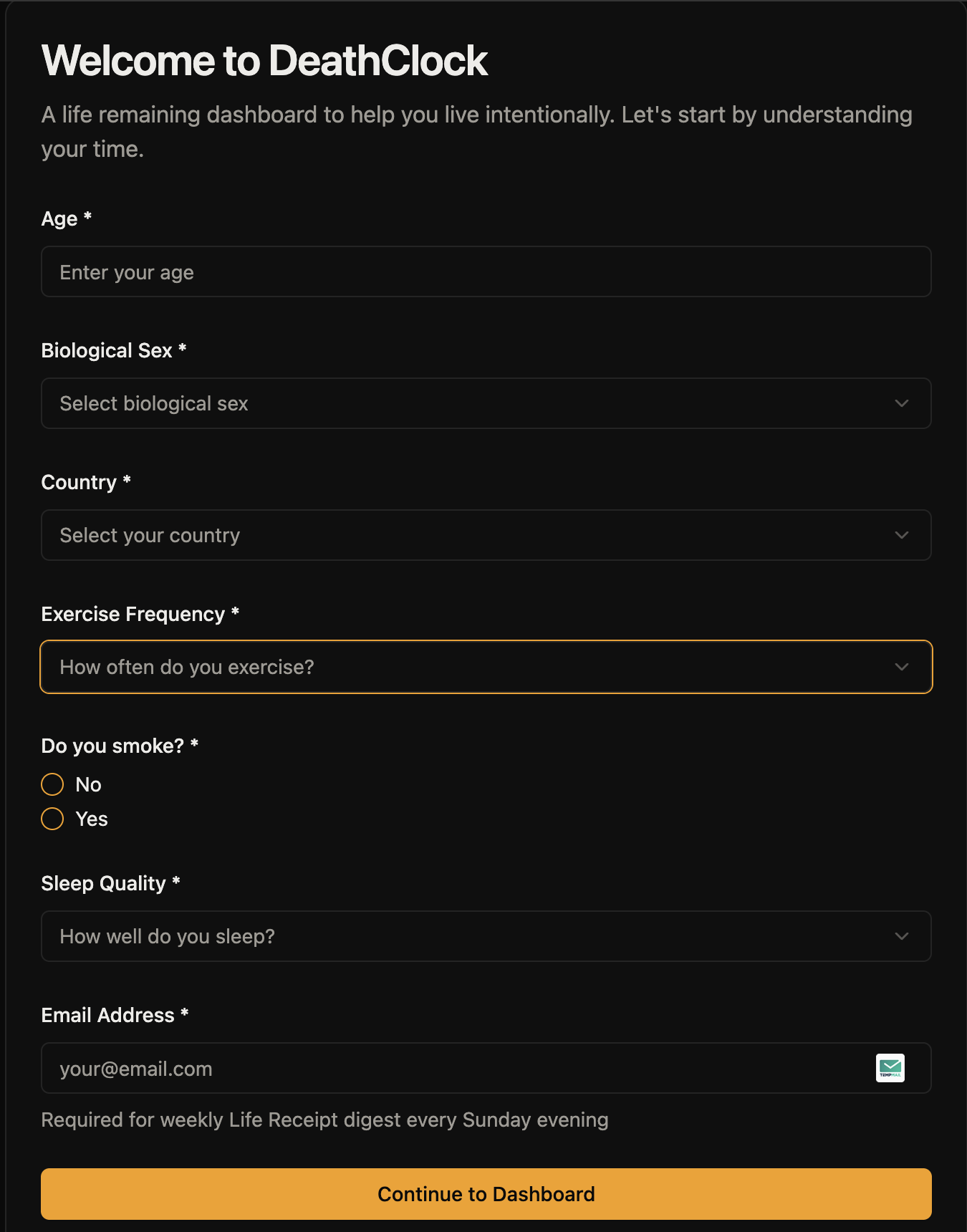
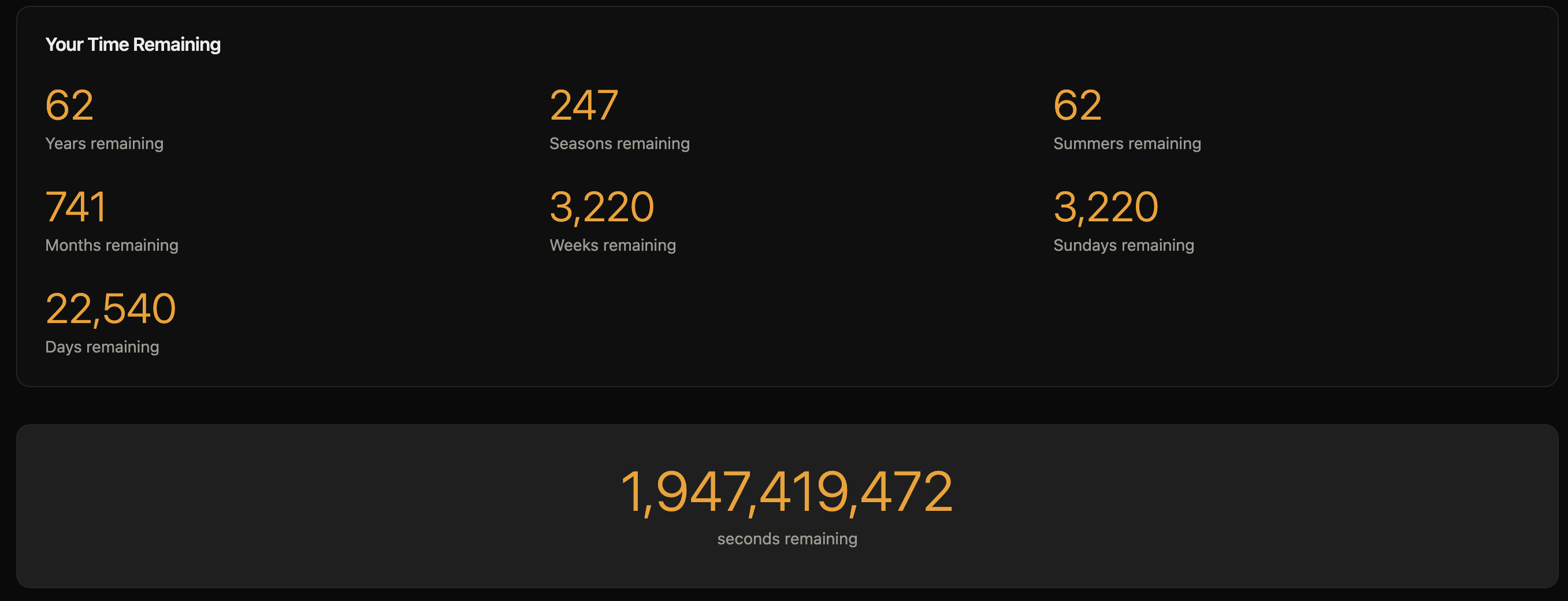
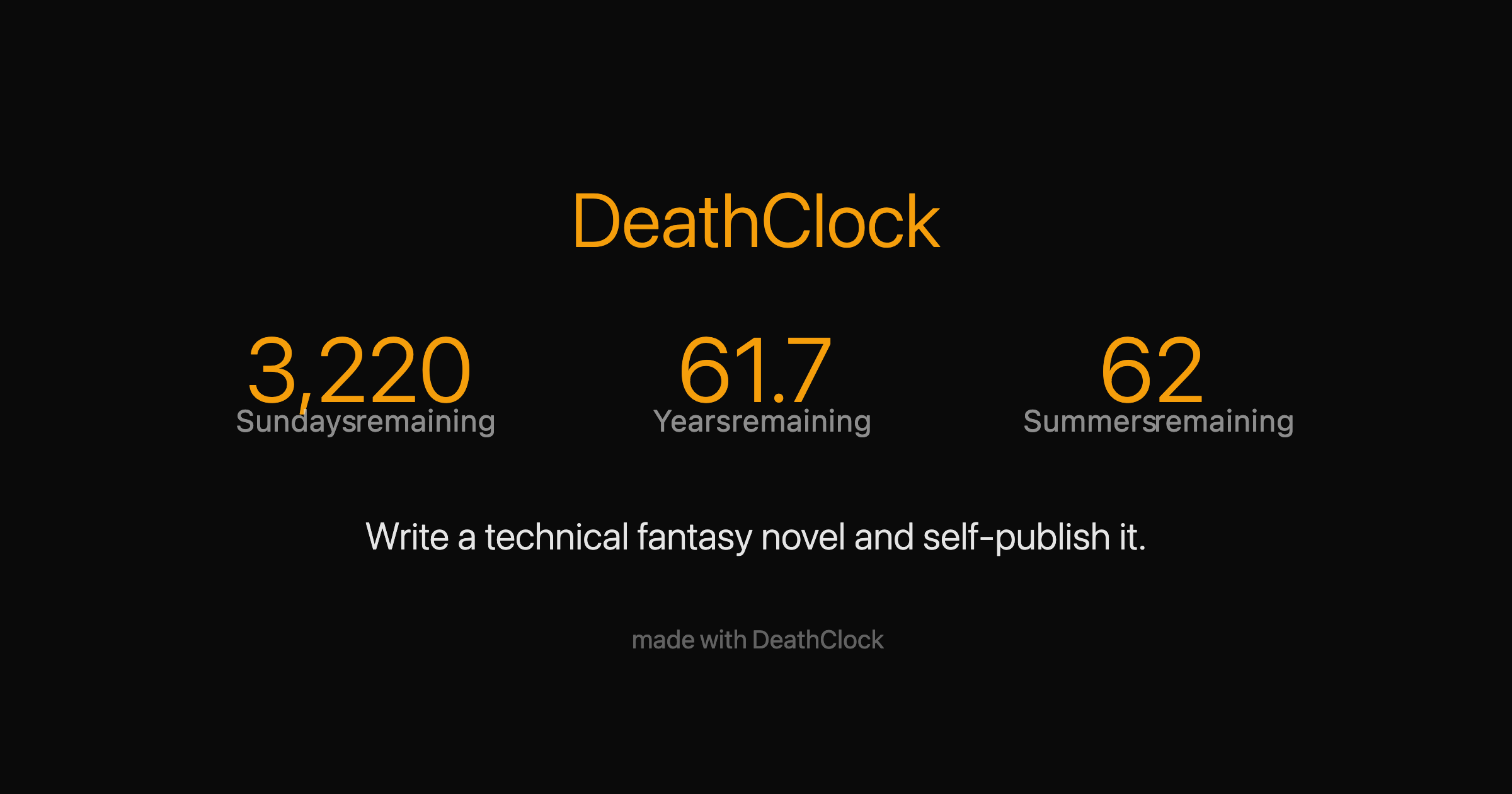
You enter your age, country, and lifestyle habits. The app pulls your life expectancy from the WHO API and calculates how much time you have left — not just in years, but in Sundays, summers, and seasons.
The core calculation:
$$T_{remaining} = (L_{adjusted} - A_{current}) \times 365.25$$
where $L_{adjusted}$ is life expectancy adjusted for lifestyle factors and $A_{current}$ is current age. Lifestyle adjustments follow:
$$L_{adjusted} = L_{base} + \Delta_{exercise} + \Delta_{sleep} + \Delta_{diet} + \Delta_{stress} - P_{smoking}$$
with $P_{smoking} = 10$ years if applicable and individual deltas ranging from $-2$ to $+3$ years.
Beyond the numbers, DeathClock gives you:
- A People Section showing how many times you will see each person you love before one of you is gone
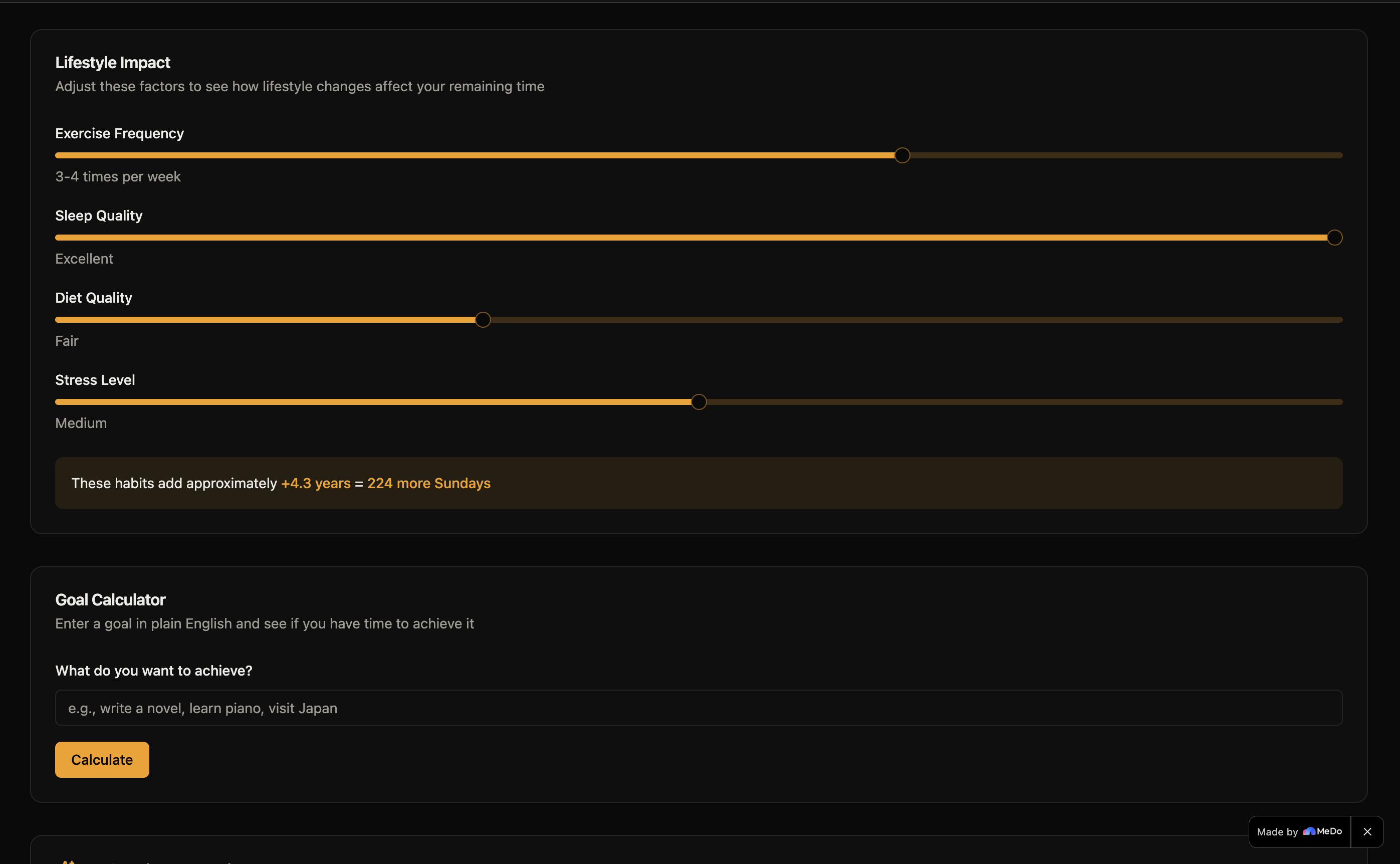
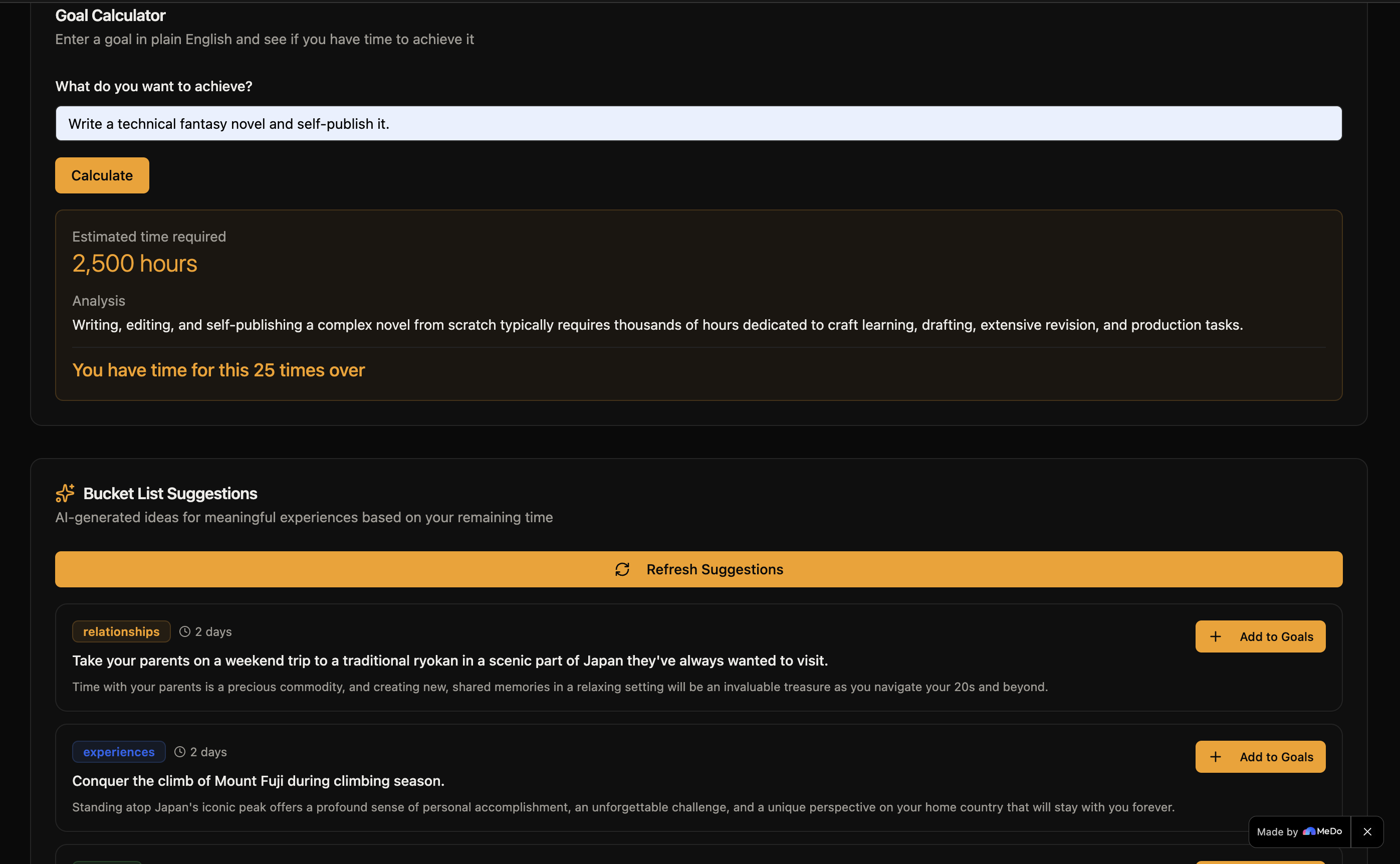
- A Goal Calculator that tells you whether you have time for what you keep putting off
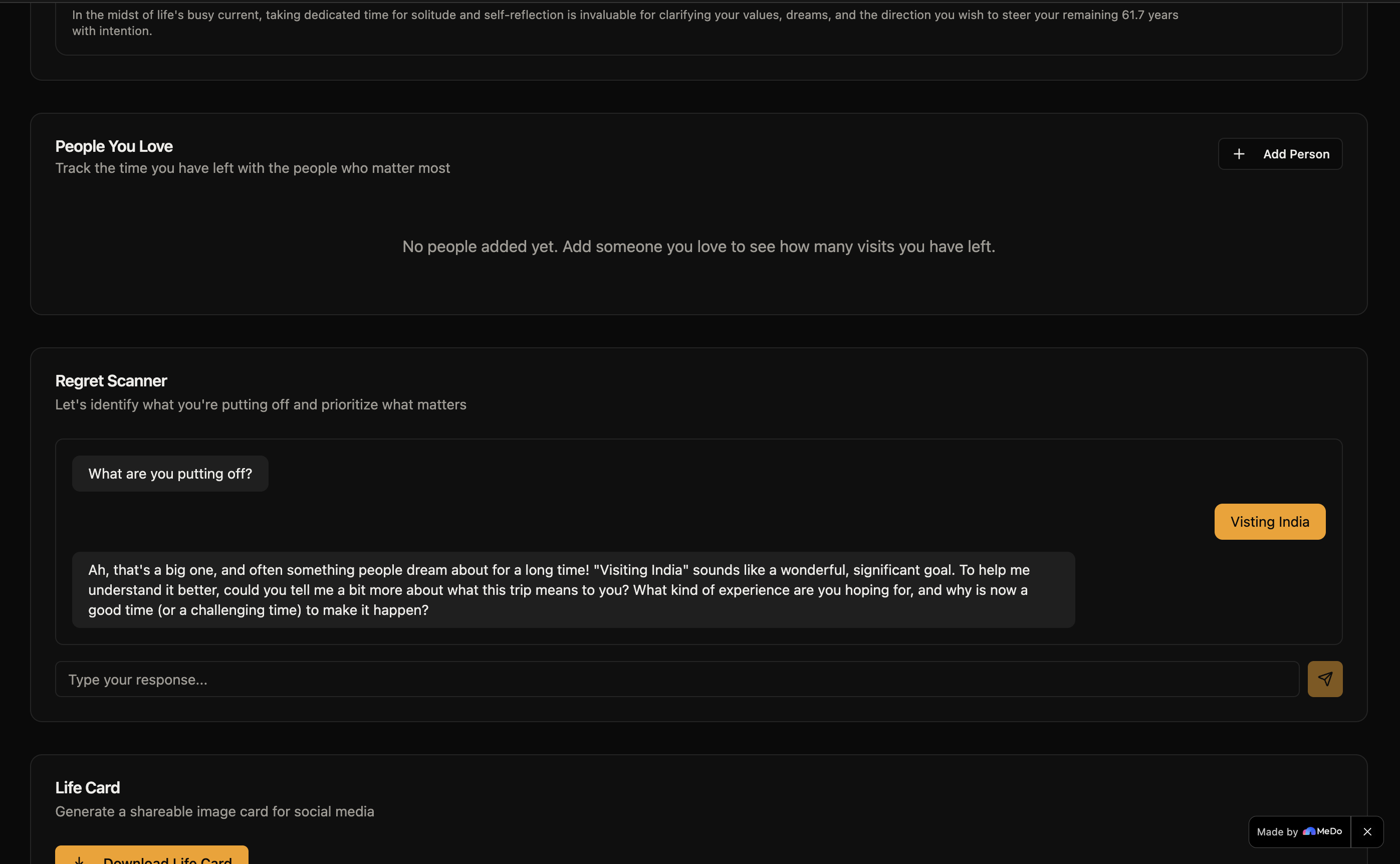
- A Regret Scanner that ranks what you are avoiding by urgency
- A Bucket List Generator that builds personalized suggestions from your actual data
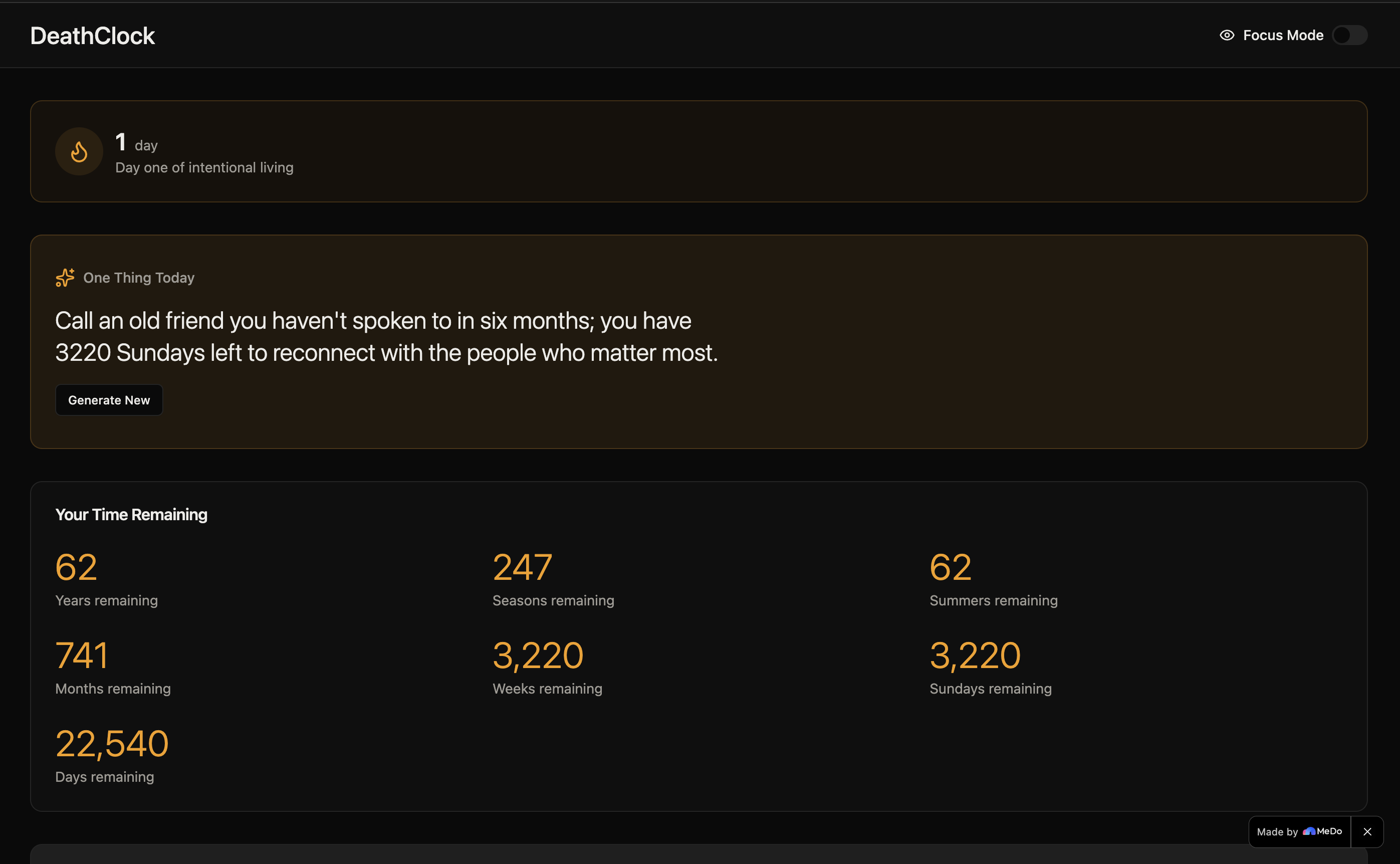
- A One Thing Today prompt that gives you one specific, achievable action each morning
- A Weekly Life Receipt delivered every Sunday evening
How we built it
Built entirely using MeDo through conversational prompting in four turns.
Turn 1 covered the onboarding flow and core calculation engine including the WHO API integration, lifestyle adjustment formulas, and all seven time unit conversions.
Turn 2 built the main dashboard sections: Remaining Time, Live Seconds Counter, Lifestyle Sliders with real-time delta display, People Section with visit calculations, and the Daily Streak system.
Turn 3 added the AI-powered features: Goal Calculator, Regret Scanner multi-turn chat, Bucket List Generator, and One Thing Today daily prompt using MeDo's LLM plugin.
Turn 4 added the Life Card Generator using html2canvas, the Weekly Life Receipt email system via transactional API, and Focus Mode toggle.
Total build time: approximately 3 hours.
Challenges we ran into
Tone was the hardest problem. The difference between motivating and depressing is entirely in the framing. Early versions showed numbers that made testers feel anxious rather than energized. The fix was a single design rule applied everywhere: never show what has passed, only show what remains. "9,847 Sundays remaining" feels like abundance. "You have used 1,300 Sundays" feels like loss.
The People Section required careful edge case handling. When a loved one's age approaches their life expectancy, the visit calculation can return zero or negative. Displaying a number in that case is cruel. The app detects this and shows "Cherish every moment" instead.
WHO API latency affected the onboarding experience. The API occasionally returns slowly. We added a fallback to the global average of 73 years with a user notification, so onboarding never stalls.
One Thing Today needed to be genuinely specific. Generic prompts like "work on your goals today" are useless. The LLM plugin required careful prompting to produce sentences like "Call your dad today — you haven't in 3 weeks and you have 84 visits left." Getting that specificity required including the full user context in every generation call.
Accomplishments that we're proud of
The People Section is the feature we are most proud of. Telling someone they will see their mother approximately 84 more times is the most precise, loving, motivating thing this app does. It converts abstract mortality into a specific, actionable feeling: call them this weekend. Multiple testers opened their phones immediately after seeing their number.
The Urgency Score formula in the Regret Scanner is fully transparent:
$$U = S_t + S_r + S_e$$
where $S_t \in [1,4]$ is time sensitivity, $S_r \in [1,3]$ is time required (inverted, quick wins score higher), and $S_e \in [1,3]$ is emotional investment derived from language analysis. This gives a total $U \in [1,10]$.
What we learned
Scarcity creates clarity. When you show someone that they have 58 summers left, they stop asking what to do with their weekend. The number does the work.
Framing is product design. Every number in DeathClock went through a reframe test: does this feel like a gift or a sentence? That single question changed every label, every copy line, and every edge case message.
The WHO API is underused. Real demographic life expectancy data by country and sex is publicly available and free. Most apps that deal with time never touch it. Using actual data instead of a fixed 80-year assumption makes every calculation feel honest.
What's next for DeathClock
- Health device integration pulling real activity and sleep data from Apple Health or Fitbit to replace manual slider inputs with live measurements
- Relationship check-in tracking so the People Section knows when you last contacted each person and adjusts the One Thing Today prompt accordingly
- Decade view showing your remaining time mapped visually by decade with goals plotted against available seasons
- Partner mode where two people complete separate audits and see their shared remaining time together as a couple or family
Built With
- api
- apis
- css
- deploy
- expectancy
- html
- html2canvas
- javascript
- life
- llm
- localstorage
- medo
- node.js
- plugin
- react
- resend
- rest
- who

Log in or sign up for Devpost to join the conversation.