Inspiration
When someone dies, the grief is just the beginning. Families are suddenly forced to navigate a maze of bank accounts, insurance policies, subscriptions, and debts they never knew existed. Life insurance goes unclaimed because no one knew the policy number. COBRA deadlines pass because no one knew about the employer benefits. Subscriptions keep charging a dead person's card for months. The average family spends weeks, sometimes months, just trying to figure out what financial accounts even exist.
We asked a simple question. What if you could speak your financial life into existence, and when the time comes, your family hears it all back, in your voice, with every detail organized and every urgent action spelled out?
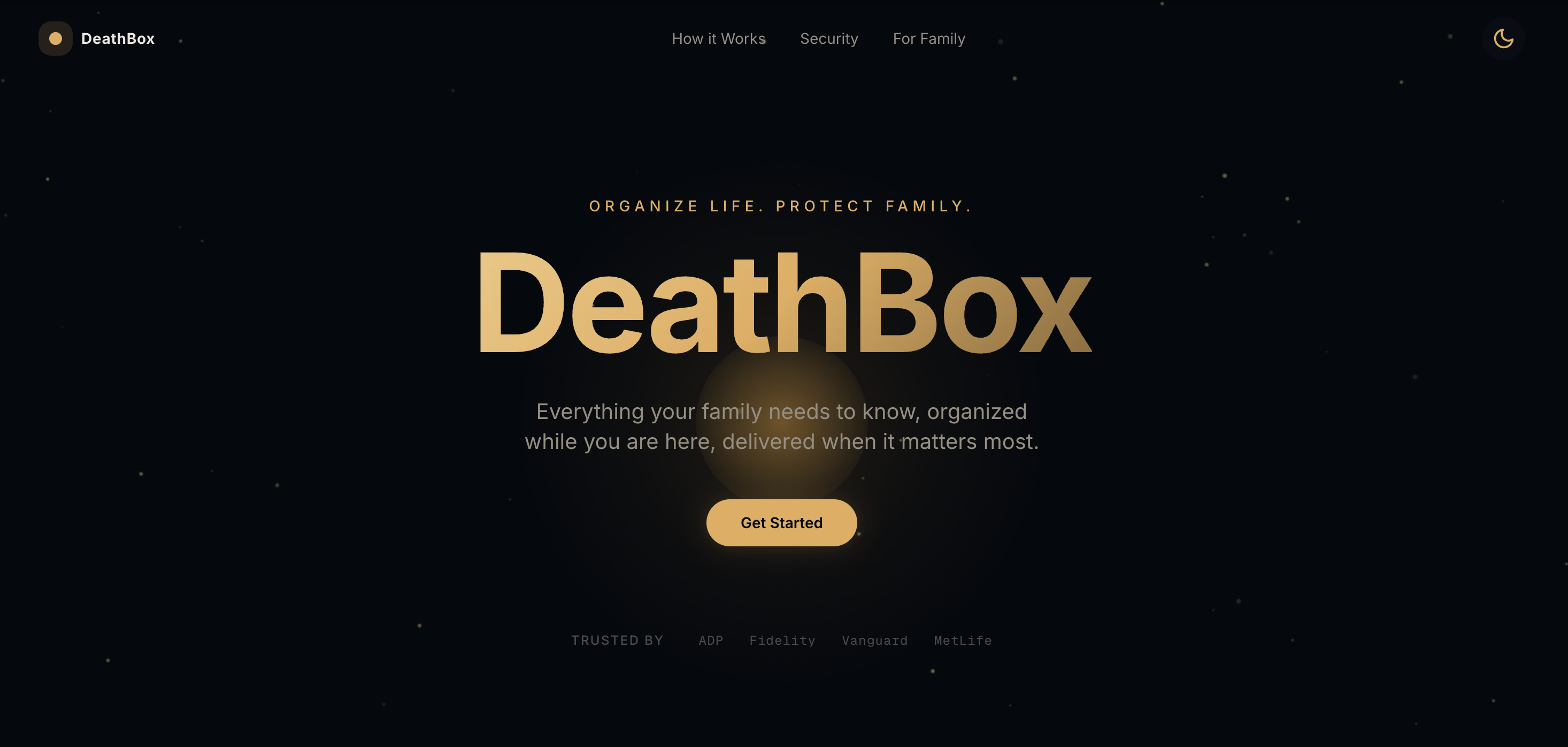
That is DeathBox. Not a spreadsheet. Not a will. A voice-first financial afterlife package that activates only when you are gone.
What It Does
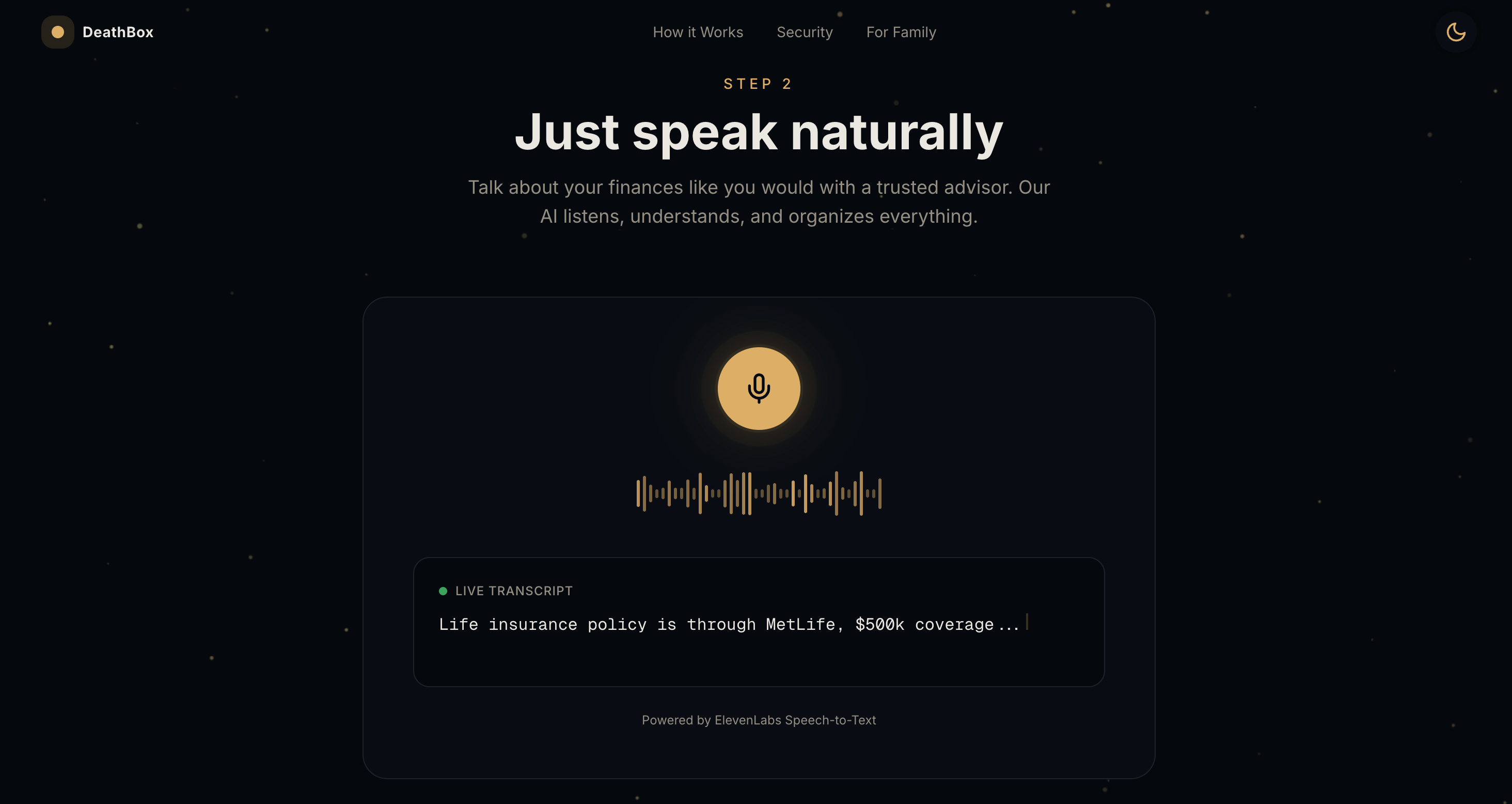
DeathBox lets users record their financial information by simply talking. No forms, no spreadsheets, no legal jargon. You speak naturally about your bank accounts, insurance policies, investments, debts, and subscriptions. AI listens, extracts every detail, and organizes it into a sealed financial package.
The package is locked behind a dead man's switch. As long as you check in periodically, nothing happens. If you stop checking in, the system assumes the worst and automatically delivers your complete financial package to your designated family member.
When your family opens the package, they do not get a wall of numbers. They get an organized breakdown of every account, an urgent action checklist with deadlines, a list of benefits they might not know they are entitled to, and a voice walkthrough that walks them through everything step by step. If you chose to clone your voice, that walkthrough plays in your own voice.
Every package is hashed and verified on the Solana blockchain, so no one can tamper with it after it is sealed After transcation has been recorded.
How We Built It
DeathBox separates capturing financial information from understanding and delivering it.
First, we built a voice recording pipeline. The frontend captures audio and sends it to ElevenLabs Speech-to-Text for transcription. We chose voice because people remember more when they talk than when they type, and financial details come out naturally in conversation.
Next, we built an AI extraction layer using Google Gemini. The model takes raw transcripts full of filler words, mispronunciations, and casual speech, and extracts structured financial data across six categories: bank accounts, investments, insurance, credit cards, loans, and subscriptions. It also flags what is missing, like a beneficiary name or an account number.
Users can also upload photos of financial documents like pay stubs, insurance cards, or bank statements. Gemini Vision reads the document and fills in the gaps automatically.
Once the package is complete, we validate it with a rule-based system that checks every category for mandatory fields and surfaces a clear TODO list before sealing.
When the user seals the package, we generate a SHA-256 hash of all the data and write it to the Solana blockchain using the Memo Program. This creates an immutable proof of what the package contained at the moment it was sealed.
The dead man's switch is timestamp-based. If the user does not check in within their configured period, the package unlocks. When the family accesses it, Gemini generates an empathetic narration script and ElevenLabs converts it to audio. If the user cloned their voice earlier, the narration plays in their voice.
The entire backend runs on FastAPI with SQLite, and the frontend is built with Next.js and Tailwind CSS. The full application is deployed on Vultr for production hosting.
Challenges We Ran Into
Voice transcription of financial information is messy. People say "Chaise" instead of "Chase" and "Fidellity" instead of "Fidelity." We had to build correction logic into the Gemini prompt to normalize company names and account details from casual speech.
Getting Gemini to return consistently structured JSON from unstructured voice transcripts required careful prompt engineering. Early versions would hallucinate account numbers or merge separate accounts into one.
We also struggled with the emotional tone of the narration. The first versions sounded robotic and clinical. We iterated on the Gemini prompt until the walkthrough script felt empathetic and human, guiding a grieving family member through urgent actions without overwhelming them.
Solana integration added complexity. We kept it simple by using the Memo Program on devnet that records transaction whether user is initially setting up the package or it is being transferred to someone else after death.
Accomplishments We Are Proud Of
We built a system where someone can speak for five minutes and walk away with a complete, validated, blockchain-verified financial package ready for their family. We integrated voice recording, AI extraction, document scanning, voice cloning, blockchain verification, and AI narration into a single coherent flow. The dead man's switch works without any external services. The voice cloning feature means a family can hear their loved one's voice explaining what to do next.
What We Learned
People do not want to think about death, but they will talk about their finances if it feels like a conversation, not a form. Voice-first design changes everything about how people interact with sensitive topics. We also learned that AI extraction is only as good as the validation layer on top of it. Without deterministic checks, the model would confidently return incomplete data. One clear action item matters more to a grieving family than a hundred data points.
What Is Next for DeathBox
We want to add automated email delivery when the dead man's switch triggers. We plan to support recurring check-ins via SMS and push notifications. We want to integrate with financial APIs to auto-verify account details. Long term, DeathBox becomes a living financial memory that updates over time, so your family always has the latest picture, no matter when the time comes.
Built With
Google Gemini, ElevenLabs, Solana, Next.js, React, Tailwind CSS, FastAPI, Python, SQLite, Framer Motion, Radix UI, Vultr
Built With
- elevenlabs
- fastapi
- framer-motion
- google-gemini
- javascript
- next.js
- opencv
- python
- radix-ui
- react
- solana
- solathon
- sqlite
- tailwind-css
- typescript
- uvicorn
- vultr

Log in or sign up for Devpost to join the conversation.